zzzzz

3.4K posts

zzzzz

zzzzz

@Adam80494145

yo

United States Katılım Ocak 2023
119 Takip Edilen40 Takipçiler
yeet
yeet@Awk20000·
Sneako counters Asmongold’s comments on the threat of Iran to America "They keep saying this..oh they k*ll Americans..ya when they're deployed as soldiers..not doing it on American soil..why do u think they hate America..u think they are seething abt hot dogs & tailgates..they b*mb a million Iraqis..make a Hollywood movie..Bradley Cooper playing a sniper..obviously they're upset abt the US military" "Embodying the cry as they strike u..do u want to free Iran or n*ke em..the Trump ppl that are still on board..what are u guys even abt now?”
English
138
20
607
85.1K
zzzzz
zzzzz@Adam80494145·
@ncrrangerReal @Awk20000 You can kill anyone with this logic by claiming they are part of a military group that is associated with their religion or ethnicity
English
1
0
0
25
NCR Ranger
NCR Ranger@ncrrangerReal·
@Adam80494145 @Awk20000 He's a Shia from Lebanon at the very least he has family who is in Hezbollah or are sympathizers, like come on bruh.
English
2
0
0
86
Othman
Othman@othmaanX·
@mohammed_hijab @Leafywashere00 We are ASSERTING she was NOT 18. Tons of other hadiths show she could never be 18.. she was young AND WE ARE FINE WITH IT. You are just watering down your religion and bending the knee to modernists .. what a shame, you were better than this.
English
5
0
7
1.4K
Mohammed Hijab
Mohammed Hijab@mohammed_hijab·
In the broader scholarly discourse concerning the historical details of Sayyidah Aisha radiyallahu anha at the time of her marriage and its consummation the narration appearing in the Sahihayn that places these events at the ages of six and nine respectively remains the position affirmed by the vast majority of classical authorities. Yet the present discussion is strictly methodological in nature and does not endorse any alternative chronological proposal such as the figure of eighteen sometimes advanced in modern academic analyses of the sirah and maghazi literature. The sole purpose here is to illustrate through the words of the ulema themselves that the layman Neo Salafi assertion namely that every single narration contained within Sahih al Bukhari and Sahih Muslim must be accepted without the slightest academic reservation is not the nuanced position upheld by the Salaf or by the broader Sunni tradition of hadith scholarship. On matters that are purely historical and biographical rather than constitutive of legal rulings or articles of creed the classical authorities have always permitted a measured degree of critical engagement. The foundational distinction drawn by the early muhaddithun is instructive in this regard. Imam Abd al Rahman ibn Mahdi a towering figure of the second century and teacher of Imam Ahmad ibn Hanbal articulated the principle with characteristic clarity: “When reports reach us from the Prophet peace be upon him concerning the lawful and the prohibited and the legal rulings we are severe with the chains of transmission and we scrutinise the narrators. But when reports concern the virtues of actions their rewards and punishments or permissible exhortations and invocations we show leniency with the chains.” This statement recorded by al Hakim in al Mustadrak and echoed in al Suyuti’s Tadrib al Rawi reflects a consensus among the Salaf that historical and biographical akhbar precisely the category into which the age of Aisha falls allow greater flexibility than those deployed for deriving ahkam. Imam Ahmad ibn Hanbal expressed a similar view when he remarked that extreme strictness is reserved for what pertains to halal and haram while leniency befits reports of virtues stories and narratives. On purely historical questions therefore the acceptance or rejection of a particular report after due academic examination has always been far less consequential than on matters touching usul al din or fiqh.Even within the Sahihayn themselves the classical tradition never treated every narration as immune to scholarly discussion. Consider first the muallaqat those suspended reports in which Imam al Bukhari deliberately omits part or all of the opening chain for the sake of brevity. While the overwhelming majority of these are corroborated elsewhere in the Sahih with complete isnads a significant subset approximately one hundred and sixty unique instances stand alone in suspended form. Al Hafiz Ibn Hajar al Asqalani devoted an entire monograph Taghliq al Taliq to tracing their external supports and evaluating their authenticity according to rigorous criteria. He and other luminaries such as Ibn al Salah and al Dhahabi subjected these reports to independent scrutiny demonstrating that their inclusion in the Sahih did not exempt them from further verification. This labour alone refutes any notion that the mere presence of a narration in al Bukhari rendered further academic inquiry impermissible.A still more pointed illustration emerges from the work of Imam al Daraqutni whose Kitab al Tatabbu systematically examined roughly seventy eight narrations in Sahih al Bukhari one hundred in Sahih Muslim and thirty two common to both. His critique focused on subtle ilal hidden defects in precision of transmission inversion of wording or minor interruptions without ever impugning the overall stature of the two collections. Later authorities such as Imam al Nawawi engaged these points directly sometimes accepting and sometimes rebutting them yet always within the framework of legitimate scholarly discourse. Such exchanges were regarded as the natural outworking of the science of hadith not as an assault upon the Sahihayn. Concrete examples of these ilal include his observation concerning a narration in Sahih al Bukhari on the topic of Heaven and Hell complaining to Allah where one particular chain transmitted by Ubaydallah ibn Sad inverts the order of divine destiny in its wording an issue of narrator precision that later critics such as Abu Hasan al Qabisi also highlighted. Another instance involves reports that al Daraqutni judged were not transmitted in fully mawsul form as presented but only through specific limited routes such as those of Makhramah ibn Bukayr or Abu Burdah thereby introducing a subtle discontinuity in the chain that required separate verification.Nor was this critical spirit confined to earlier centuries. Shaykh Nasir al Din al Albani whose methodology is frequently invoked by those who champion an uncompromising view of the Sahihayn himself acknowledged that his own research led him to conclude that certain narrations within these collections fall short of the sahih or even hasan standard. In a recorded statement he explained: “Allah the Exalted has granted me firmness in the study of Hadith I applied this study to some of the Hadiths that appear in Sahih al Bukhari. Thus I found that there are some Hadiths that are not considered to be on the grade of Hasan much less the level of Sahih in Sahih al Bukhari not to mention Sahih Muslim.” He reiterated that “during my knowledge based research I passed over some Hadiths in Sahih al Bukhari and Sahih Muslim and it was revealed to me that there are some Hadiths that are weak.” He reinforced this position by quoting Imam al Shafi'i who stated “Allah didn't want to complete anything except His Book.” Al Albani’s position was not a wholesale rejection of the Sahihayn but a continuation of the classical practice of evaluating individual reports on their merits even when they appear in the most authoritative compilations as heard in his lecture available at youtube.com/watch?v=9VuoM-… same principle of critical engagement is evident when one examines mawquf reports statements attributed to the Companions rather than directly to the Prophet peace be upon him that are nonetheless included in Sahih al Bukhari. A particularly illuminating example concerns Sayyidah Aisha’s declaration that no one should believe the Messenger of Allah urinated while standing for she had never seen him do so except while sitting. Despite the sound chain supporting this mawquf transmission the scholars of the ummah did not accept her testimony as an absolute and unqualified rule. It stands in direct tension with the explicit report of Hudhayfah ibn al Yaman in the same Sahih al Bukhari who personally witnessed the Prophet urinate while standing during a journey at a place of refuse. Rather than discarding one narration or the other the hadith scholars undertook detailed reconciliation concluding that Aisha spoke of the Prophet’s habitual practice in the domestic setting while Hudhayfah recorded a specific concession made under the necessity of travel. Her sentiment though conveyed through a sound chain was therefore qualified and not taken at face value. This case demonstrates that even a soundly transmitted statement from Aisha within the Sahihayn is subjected to scrutiny cross referencing and qualification rather than uncritical endorsement.This pattern of scholarly engagement extends directly to other reports transmitted by Aisha herself in Sahih al Bukhari including the well known narration concerning her age at the time of marriage and consummation. Just as her mawquf testimony on the Prophet’s manner of urination was weighed against parallel evidence rather than accepted at face value so too are her statements about her own early life placed in conversation with additional historical indicators. In one narration she describes herself as a young girl who had not yet committed much of the Qur’an to memory when Surah al Qamar was revealed placing the event in the context of the early Medinan period after the Hijrah. This is juxtaposed by scholars with the chronological data surrounding her sister Asma bint Abi Bakr who was consistently reported to be ten years her senior. Asma’s own death at the advanced age of one hundred in the year seventy three after the Hijrah supplies an independent timeline that some classical and later analysts have brought to bear on the broader question of Aisha’s birth year and the precise dating of the marriage. In yet another narration Sahih al Bukhari 2297 Aisha states that since she reached the age when she could remember things she has seen her parents worshipping according to the right faith of Islam and she recounts events from the period of early persecution before the Hijrah including Abu Bakr’s attempted emigration to Ethiopia. This recollection of conscious memory from the pre Hijrah era implies that she must have been well beyond the age of one at the time of those events yet under the strict traditional calculation tied to consummation at nine shortly after the Hijrah she would have been no more than an infant during that persecution. The point is not to reject any single report but to illustrate that the ummah’s hadith scholars have routinely subjected even Aisha’s own transmissions soundly chained as they are to this kind of comparative historical analysis exactly as they did with her statement on the Prophet’s urination. The presence of such ikhtilaf within the pages of the Sahihayn themselves shows that academic discussion of these details has always been part of the Sunni tradition.Comparable caution appears in cases involving transmissions that carry Israelite content. A striking instance is the narration found in Sahih Muslim describing the days of creation land on Saturday mountains on Monday and so forth which certain major authorities including Imam al Bukhari and Yahya ibn Ma’in explicitly identified not as a statement of the Prophet but as originating from Ka’b al Ahbar the learned Jewish convert. Despite an apparently sound chain the content itself prompted its reclassification away from the Prophetic corpus. In Sahih al Bukhari itself hadith 7361 Muawiyah radiyallahu anhu remarks of Ka’b that he was among the most truthful of those who transmit from the People of the Book yet sometimes his words turned out to be false. Such examples underscore that even reports supported by strong chains were not immune to rejection or qualification when historical and biographical scrutiny revealed Israelite influence or internal inconsistencies.It is also important to recognise why many of the classical scholars of the past did not delve more deeply into this particular historical question. In their time there was simply little impetus or external pressure to do so the age of Aisha was not a major point of polemical attack against the Prophet peace be upon him or Islam as it has become in certain modern contexts. Had a scholar of the calibre of al Hafiz Ibn Hajar al Asqalani been aware that this matter would one day constitute one of the primary lines of attack upon the character of the Holy Prophet peace be upon him it is entirely conceivable that he and others would have approached the issue with even greater scrutiny and produced a more exhaustive analysis.In sum the tradition of the Salaf and the classical Sunni muhaddithun has consistently maintained that rigorous academic discussion of individual narrations even those appearing in the Sahihayn remains both permissible and necessary particularly when the material in question belongs to the domain of history and biography. Such discussion in no way undermines the overarching reliability of these collections nor does it constitute rejection of the Sunnah as a whole. Applied to the historical question of Sayyidah Aisha’s age any conclusion reached through sincere evidence based inquiry whatever that conclusion may be carries no implication whatsoever for a Muslim’s aqeedah. It remains a matter of ikhtilaf in the realm of akhbar not a challenge to the foundations of iman. This is not a moral issue the Prophet’s marriage to Aisha fourteen hundred years ago is very much fully defensible within its historical cultural and revelatory context. Rather the discussion serves to show those who disbelieve in Islam that even if they hold a strong view on the perceived immorality of this practice it does not undermine the religion itself. The ummah’s scholars have always distinguished between what touches the core of religion and what pertains to the details of sirah on the latter scholarly difference has been tolerated without the slightest accusation of deviation. May Allah grant us all the guidance to pursue knowledge with integrity and to preserve the unity of the community.
YouTube video
YouTube
English
56
21
252
98.1K
NCR Ranger
NCR Ranger@ncrrangerReal·
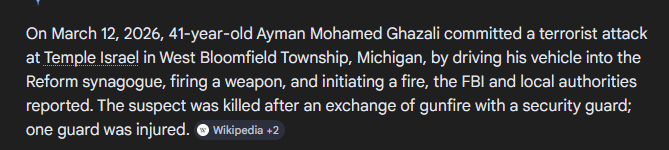
@Awk20000 'They only kill soldiers', sure pal that's why a hezbollah operative on American soil did this
NCR Ranger tweet media
English
2
0
8
1.3K
Muhammad Ammar
Muhammad Ammar@_Muxlim·
@Hassan_alQadri Exalted are the Ahlul Bayt (A.S) far above what you attribute to them. Infallibility is something even they never claimed for themselves. This is your innovation and not from their teachings.
English
3
0
2
111
Tall T
Tall T@whatevaUsaylol·
It’s so funny seeing Muslims and non believers use words like “anti- Christ” lmaoo basically acknowledging Christianity I would never acknowledge Islam or Judaism as real religions bc they’re not
SNEAKO@sneako

“Leftist Muslims” like Mehdi Hassan and Hassan Piker worship the democrat party above Allah. They attack Professor Jiang and Dr. Marandi for trivial nonsense because leftism is destroyed by analysis of eschatology. They fight to forever blame fascism instead of the Anti-Christ.

English
1
0
0
99
El Errante
El Errante@elerrantenomad·
Didn’t know Bangladesh had this many Shias. As for Pakistan based on Twitter algos, it feels like it’s 80% Shia
English
167
30
600
57.1K
Muhammed Ali
Muhammed Ali@Chainless_Slave·
The war with Iran has distracted many of us from what’s happening in Palestine Al-Aqsa Mosque has been closed for weeks, and God knows what the Israelis are doing there The new death penalty for Palestinian prisoners has already been forgotten Don’t take your eyes off the ball
English
117
1.4K
6.2K
93.3K
AutisticClips
AutisticClips@AutisticClip·
John Kiriakou shares a prison story where he tried to show Nation of Islam members how to pray. “They dont really know if they are Sunni or Shia… they just keep repeating “Allahu Akbar”.. that’s not the prayer.”
English
63
186
5.2K
383.3K
zzzzz
zzzzz@Adam80494145·
@dsonoiki Thats not true because Adam Silver is a jew and the Bulls owner is jewish
English
0
0
3
397
Gene Parmesan
Gene Parmesan@dsonoiki·
if Jaden Ivey had said “Death to America” and praised the Ayatollah, they would have made him MVP backwards league
English
40
263
7.4K
72.7K
Nurko Bal
Nurko Bal@BalNurko·
@HALALK0 Sneako CAN'T CALL " Syrian Holocaust " as " blah blah" ! 1 000 000 muslims were killed by Iran and shia militia...
English
1
0
1
352
DAILY
DAILY@HALALK0·
SNEAKO officially launched his clothing brand 'NICOLAS' 👀
English
34
10
229
17.4K
Syrus
Syrus@MomeniSyrus·
@HALALK0 I was Christian, then Sunni and since 1991 Shia Muslim here in Tampa! Loving it !
English
3
0
12
488
DAILY
DAILY@HALALK0·
SNEAKO responds to people calling him Shia 👀 "I'm not Shia, I'll never gonna become Shia, I'm just a Muslim."
English
67
72
1.7K
49.1K
Rafa
Rafa@StreamPlusRafa·
@Goatedko Sneako is a radicalised sympathiser goy for shi'i terrorism
English
6
0
7
1.5K
GOATKO
GOATKO@Goatedko·
Sneako sends an emotional message to Muslims criticising him for supporting Iran and advocating his ban from Makkah 🇮🇷😳🇸🇦 “How can you criticize me when you see our people are being attacked in Palestine? We have to wonder where does your allegiance really lie?”
English
229
564
6.4K
279.7K
sadia
sadia@Ana_SadiaAbbas·
@Adam80494145 @khawatbat @AltSNEAKO @sneako Shia historians and scholars attribute the killing of Malik ibn Nuwayrah to the harshness and misunderstanding of Khalid ibn Walid during his early days. When scholars declaring it as mistake, then no public views matters.
English
1
0
0
62
SNEAKO ALT
SNEAKO ALT@AltSNEAKO·
Khalid Ibn-Walid
Filipino
178
550
4.9K
128.9K