Sabitlenmiş Tweet
Adam Lovett
175 posts

Adam Lovett
@AdamLovett91
Philosophy lecturer. I do mainly politics with some normative ethics thrown in. I wrote a book titled Democratic Failures and the Ethics of Democracy. Buy it!
London Katılım Eylül 2022
192 Takip Edilen263 Takipçiler

@AdamLovett91 @bswud elite cues also play a role here, nobody is making the effort to explain why building is the solution and all parties are opportunistically nimby when it suits them partly due to the incentives of the electoral system and the structure of local govt
English

This is correct. But opinions don’t come like manna from heaven. The size of the growth coalition is driven primarily by how many have a stake in growth. Our institutions are uniquely bad at sharing the proceeds of growth. One reason is enervated local government.
Matthew Yglesias@mattyglesias
Sometimes you need to blame the voters — the UK has an acute housing shortage and the authentic preference of the population seems to be to not solve it. slowboring.com/p/its-not-bad-…
English

@wrwveit I was a little puzzled by this. "Intrinsic value" is something of a term-of-art. I would think the natural Humean idea would be to say the intrinsically valuable things in Eric's sense are things we have a distinctive kind of attitude towards, e.g valuing them for their own sake.
English

I wrote a new essay responding to Eric Schwitzgebel: Is Diversity Intrinsically Valuable? If you can provide me with better arguments for the existence of intrinsic values I'd be happy to be convinced.
walterveit.substack.com/p/is-diversity…

English
Adam Lovett retweetledi

Robbie Kubala, @AdamLovett91 and I have a new paper forthcoming in the Journal of Philosophy. It’s called “On the value of irreplaceable objects” – Here’s a thread! 1/n
philpapers.org/rec/KUBOTV
English

@rbnmckenna86 My sense is that it never got *that much* uptake among political scientists. It was kind of cloistered in psychological journals and popular publications. Good, I think, for our assessment of political science...
English

@hanno_sauer Or a less realistic case: I know arguing for more frequent trash collect throws Terry into a murderous rage, weirdly. I argue for it anyway. Terry predictably murders someone. Terry is obviously responsible. But I think I am too. I'm blameworthy for making an argument here.
English

@hanno_sauer That doesn't seem right to me. Suppose I'm, say, the US president. I know publicly defending some foreign dissidents will get them imprisoned. I do it anyway. Aren't I responsible for this? It seems that i've done something wrong for which I'm blameworthy.
English

@BrandonWarmke @resistancemoney I'd be pretty surprised if the egalitarians you have in mind were against public health interventions.
English

@xphilosopher I suspect many US students did History and English because they did them at school. As college got more expensive, these students chose more career-focused majors. Philosophy had fewer such weakly attached students—it had much lower enrollments—and so didn't have them to lose.
English

@danwilliamsphil I think it's kind of the opposite. Some people think that "X was arrived at democratically" tells decisively in favor of X. But, sometimes, X is something they really don't like! So instead of revising their normative commitments, they revise the claim that X is democratic.
English

I suspect many within the expert class simply dislike democracy but can't admit this (even to themselves), so they develop this whole technocratic language - "misinformation", "disinformation", etc. - to frame undesirable outcomes of democracy as threats to it.
Nate Silver@NateSilver538
"Democracy is threatened unless we're allowed to control the flow of information on social media" is among the worst ideas in the discourse from being naive about how persuasion works to kind of lowkey authoritarian.

English

@rbnmckenna86 Debatably, the BJP. The relevant left wing economic issues involve massively expanding a system of direct welfare payments for poor Indians.
English

@deeesharp In Mondragon and I think La Lega a council is elected then the council appoints the managers, either from within country members or from outside. So here the workers only have indirect power to fire a manager. If a worker gets fired from this role I think they retain their stake.
English

@deeesharp It depends. In the plywood cooperatives in the US the manager was a hired hand from outside. They stayed on average for about two years. by then, the workers would likely have fired them and they’d have to go elsewhere. It was (by self-report) a pretty unsatisfying job.
English

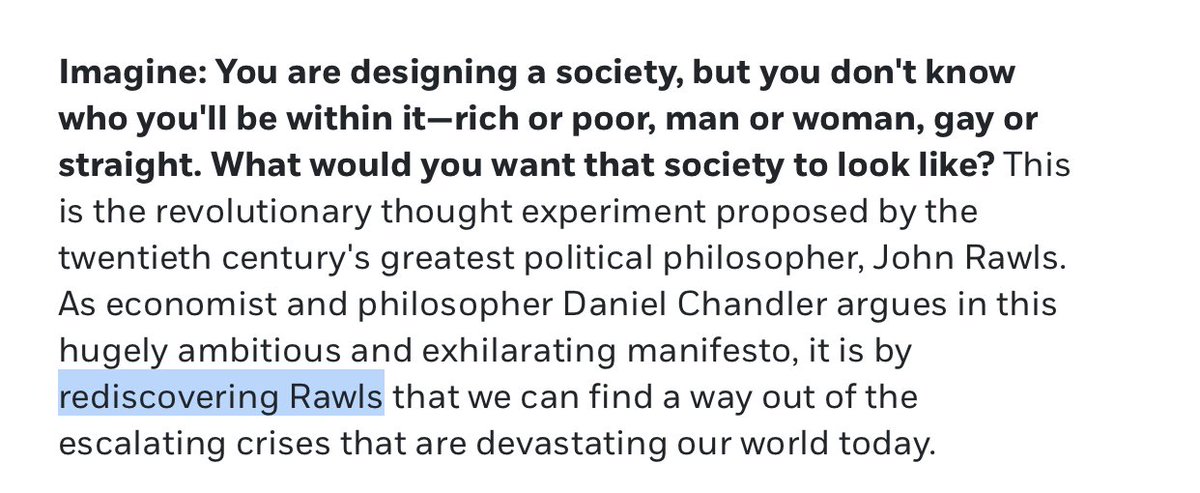
@BrandonWarmke Truth be told I think that’s also a good criticism of Chandler’s book. Still, the project of applying abstract political theories to concrete issues seems like a pretty good one to me.
English

@BrandonWarmke Perhaps you’re a little optimistic about the speed at which academic work makes it into party platforms.
English

@AdamLovett91 That’s been done and it was the 1972 Democratic Party platform.
English

@WallfacerAG Yeah, I just think sortition is undemocratic. Mainly that’s because I think democracy requires that citizens rule themselves—that there is an actual causal connection between what citizens want and what the government does. And sortition blocks such a connection.
English

@AdamLovett91 I agree that elections are not necessarily undemocratic! There is a stronger claim made by some—that elections are uniquely democratic—which I think is false.
I'm mostly surprised when I see people claim that sortition is undemocratic, or haven't heard of it, etc.
English