Adam Wheeler

713 posts

Adam Wheeler banner
Adam Wheeler

Adam Wheeler

@AdamWheelerMD

Properly incentivized primary care won’t fix the world, but it will fix health care. I’m open to ideas for what to fix after health care.

Columbia, MO, USA Katılım Ağustos 2010
1.6K Takip Edilen410 Takipçiler
Sabitlenmiş Tweet
Adam Wheeler
Adam Wheeler@AdamWheelerMD·
We help under-utilized health care providers care for under-cared-for people for an affordable price using tech-enhanced relationships. Join us. We are fixing health care, one friend at a time.
Missouri, USA 🇺🇸 English
0
0
7
0
Adam Wheeler
Adam Wheeler@AdamWheelerMD·
All true, and not even close to the most ironic fact set in Medicine. Doctors can’t own hospitals but private equity can. Most every doctor does things that are not approved by the FDA (dosing, drug combos, indications etc) every day. An intern in a large health system generates many multiples of revenue per visit more than the most well trained private doctor. Etc etc
English
1
0
1
38
Dr. Jon Slotkin
Dr. Jon Slotkin@slotkinjr·
Made this figure Felt cute Might delete later
Dr. Jon Slotkin tweet media
English
2
3
12
1.1K
Adam Wheeler retweetledi
Neil Stone
Neil Stone@DrNeilStone·
So let me get this straight You think doctors who advise vaccines are just solely in it for the money but the anti vaccine lawyer who stands to make millions from from anti vaccine lawsuits has the purest of intentions and just has your best interests at heart? OK then
English
137
409
2.9K
26.3K
Adam Wheeler
Adam Wheeler@AdamWheelerMD·
@matthewbaszucki This is false. Almost no studies use this method. Hundreds of studies support lithium’s use.
English
0
0
3
176
Matthew Baszucki
Matthew Baszucki@matthewbaszucki·
You're not going to believe this one....a discontinuation study is a psychiatric research method where you put patients on a medication, then abruptly remove it from half of them. The half you took off the medication feels terrible. Withdrawal symptoms, destabilization, etc. The half still on the medication feels comparatively fine. Researchers then use this contrast to argue the medication is effective. Do you see the problem? They aren't measuring the drug's effectiveness. They're measuring the withdrawal effects of removing it abruptly. And they use that distinction to push medications through FDA approval. This methodology was used with lithium. It has been used repeatedly across psychiatric medication trials. It is COMPLETE fraud, dressed in the language of science.
English
13
54
227
5.6K
Adam Wheeler
Adam Wheeler@AdamWheelerMD·
It’s the definition of paternalistic. It’s superior using your value set. If a patient, say, ascribes zero value to industry sponsored studies but you ascribe equal value to all studies regardless of sponsor, there are many situations in which the two of you will come up with different definitions of good medicine. It is their right to understand the nuance of your decisions and modify the weight you place on various variables. The treatment of acute sinus disease with antibiotics as an example. Many doctors place different weight on the long term effects antibiotics than some patients. To force them into your way of thinking is the very definition of paternalism.
English
0
0
1
308
John Mandrola, MD
John Mandrola, MD@drjohnm·
Not offering inferior Rxs is not paternalistic; it’s good medicine
English
1
0
18
5.2K
Craig McIntier | Metabolic Systems
@AmmousMD I've never heard a statin pushing doctor answer this. Even Peter Attia dances around it when asked this, giving a non answer disguised as an answer.
English
2
0
2
308
Adam Wheeler
Adam Wheeler@AdamWheelerMD·
@RemnantMd Pressure. The arteries are under pressure. The veins are not. It’s basic physiology
English
0
0
1
304
Remnant | MD
Remnant | MD@RemnantMd·
People are having a really hard time getting the point. So, let's try this again for the tortoises. 1. Take low LDL/ApoB/LpA blood in an artery -> you can STILL develop plaque. 2. Take ANY LDL/ApoB/LpA blood in a vein -> virtually no plaque. What does that tell you?
Remnant | MD@RemnantMd

If elevated cholesterol (LDL/ApoB/LpA) is the cause of atherosclerosis, how come we don't see these plaques in veins? It's the same blood circulating throughout the system. Veins also have endothelium, and a sub-endothelial layer. The smoke is not the fire.

English
14
4
26
15.7K
Adam Wheeler
Adam Wheeler@AdamWheelerMD·
@DrSiyabMD There is no way that otc zofran is going to account for more hospital stays than alcohol, cigarettes, aspirin, Tylenol, or PPIs (pneumonia risk). This is clearly an OTC med.
English
2
0
4
198
Adam Wheeler
Adam Wheeler@AdamWheelerMD·
@AndrewZywiecMD It’s called data. Pharma knows how to play the game, for sure. But at least they are using data to justify action.
English
0
0
0
125
Andrew Zywiec, M.D.
Andrew Zywiec, M.D.@AndrewZywiecMD·
I hope the public was paying attention today, watching thousands of "doctors" post about how they take statins. No symptoms, no signs, no pathology, just because. A bunch of young, healthy, "educated" individuals with medical degrees, shamelessly promoting pharma. Whores. Doctor's are men who prescribe drugs, of which they know little, for illnesses, of which they know less, to humans, of whom they know nothing.
Mauricio Gonzalez MD.@DrMauinforma

I take Rosuvastatin 5 mg + Ezetimibe 10 mg daily. My LDL is consistently below 50 mg/dl. Zero side effects .

English
126
256
1.4K
38K
Adam Wheeler retweetledi
Nicolas Hulscher, MPH
Nicolas Hulscher, MPH@NicHulscher·
A SINGLE 20g dose of creatine increases cognitive processing speed by 24.5% within 3.5 hours. A placebo-controlled trial found that creatine rapidly enhanced brain bioenergetics and improved cognitive performance during sleep deprivation, with effects lasting up to nine hours.
Nicolas Hulscher, MPH tweet media
English
78
390
2.8K
265.7K
Adam Wheeler
Adam Wheeler@AdamWheelerMD·
@hyruliangoat @ManOnThePen I know there is a commercially available b12, but b6 is at least uncommon. Glycine I don’t think is commercially available an is another common additive
English
1
0
0
80
Jorge Garza
Jorge Garza@hyruliangoat·
@AdamWheelerMD @ManOnThePen B6 would apply the same as b12. The above 10% difference is nullified by the fact that all a patient has to do is use less on the syringe. This is more so for capsules/pills
English
1
0
0
103
On The Pen™
On The Pen™@ManOnThePen·
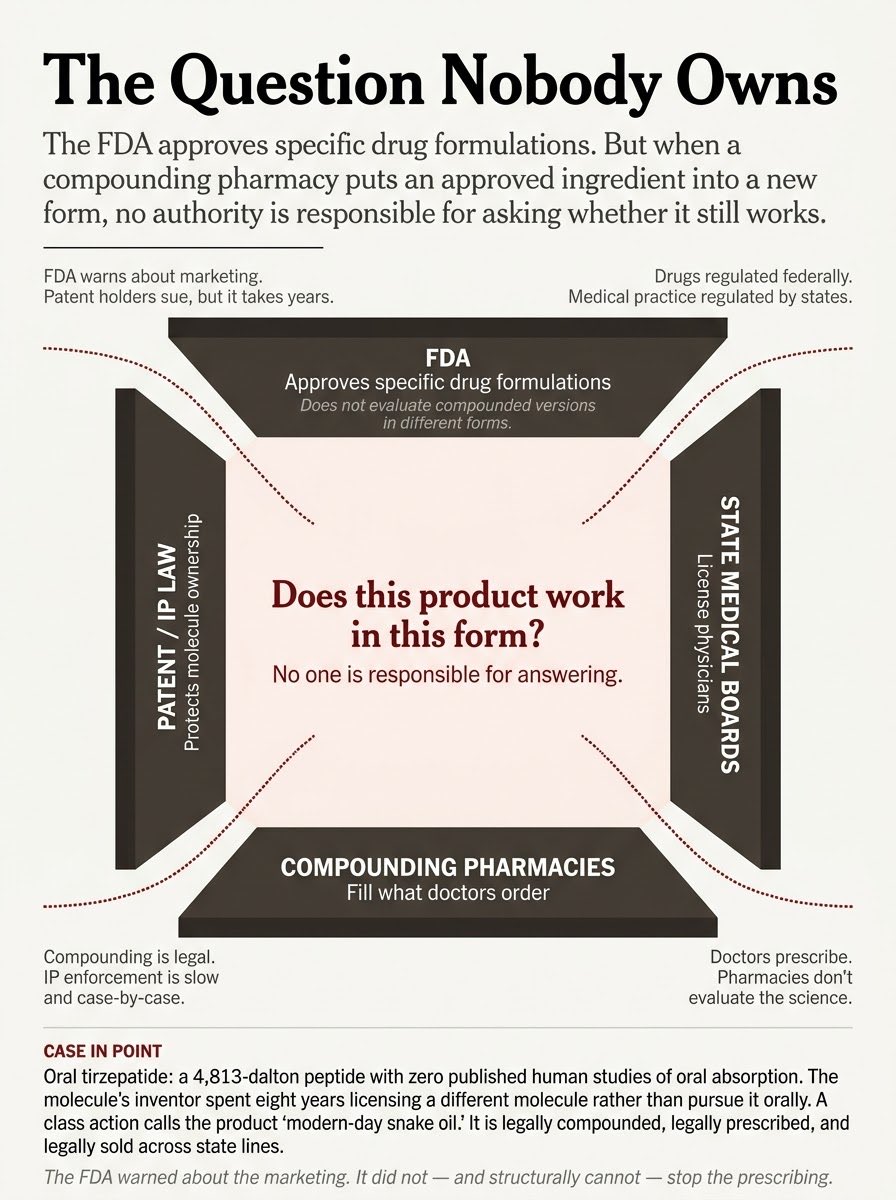
🚨 🚨 🚨 BREAKING $LLY $NVO $HIMS $WW FDA ISSUES MASSIVE UPDATE IN ENFORCEMENT AGAINST COMPOUNDED GLP-1. • SAME DRUG, SAME DOSE, SAME INJECTION = CONSIDERED A COPY • ADDING B12 DOESN’T MAKE IT “DIFFERENT” • ENFORCEMENT TOLERANCE CAPPED AT JUST 4 SCRIPTS PER MONTH • TIRZEPATIDE AND SEMAGLUTIDE NO LONGER QUALIFY FOR BULK 503B COMPOUNDING THE CRACKDOWN IS HERE… FOLLOW FOR MORE UPDATES… H/t: @ResearchPulse1
English
13
12
132
38.3K
Adam Wheeler
Adam Wheeler@AdamWheelerMD·
@ResearchPulse1 But does the $hims 503a just repackage from another $503b? This ruling also clarifies that 503bs can compound semaglutide as it’s not on the bulk compound list
English
0
0
0
220
ResearchPulse
ResearchPulse@ResearchPulse1·
This will hurt $HIMS. They still sell substantial amounts of compounded semaglutide. That would be closed down with the new update from FDA Since compounding of semaglutide is plus 35% of their business then……. $LLY $NVO $VKTX
ResearchPulse@ResearchPulse1

Did FDA just kill compounding of semaglutide and Tirzepatide…… They close the door for using B12 vitamins. They close the door for personalised dose strengths The compounder can max fill 4 scripts per month compounded semaglutide and Tirzepatide [4/1/2026] FDA reminds compounders certain conditions must be met for compounded drugs to qualify for the exemptions under sections 503A and 503B of the FD&C Act, including the highlights below. Under section 503A: The drug product is compounded for an individual patient based on receipt of a prescription.  The compounder does not compound, regularly or in inordinate amounts, any that are essentially copies of a commercially available drug product. As stated in guidance, the agency intends to consider a compounded drug product to be essentially a copy of a commercially available drug product if: •the compounded drug product has the same active pharmaceutical ingredient(s) (API) as the commercially available drug product in the same, similar or an easily substitutable strength, and •the commercially available drug product can be used by the same route of administration (regardless of how it is labeled) prescribed for the compounded drug product. This is unless a prescriber determines and documents the compounded drug product contains a change that produces a significant difference from the commercially available drug product for an identified individual patient.   FDA intends to consider a compounded drug product to be essentially a copy of a commercially available drug product if:  •the compounded drug product contains the same APIs as two or more commercially available drug products in the same, similar or easily substitutable strength and •the commercially available drug product can be used (regardless of how it is labeled) by the same route of administration prescribed for the compounded drug product, unless there is documentation of a prescriber determination of a significant difference. For example, FDA may consider a compounded drug product that combines semaglutide API and another API, such as vitamin B12 (cyanocobalamin), to be essentially a copy of a commercially available drug product when the: •drug products are used by the same route of administration – the compounded drug product is given the same way as the commercially available drug products, such as an injectable  •drug products are the same, similar or easily substitutable strength – the amounts of semaglutide and vitamin B12 in the compounded drug product are within 10% of the strengths of the respective commercially available drug products. FDA has stated, at this time, it does not intend to take action against a compounder for compounding a drug product that is essentially a copy of a commercially available drug product regularly or in inordinate amounts if the compounder fills four or fewer prescriptions of that compounded drug product during a calendar month. $LLY $NVO $VKTX fda.gov/drugs/drug-ale…

English
6
0
31
8.1K
Adam Wheeler retweetledi
Dickie Bush 🚢
Dickie Bush 🚢@dickiebush·
A handful of things that are worth the money: - Eight Sleep - One $5000+ watch - Blackout curtains - Bamboo sheets - Uber Black - Home espresso machine - 1:1 skill tutoring - High-level masterminds - Standing desk - Herman Miller chair - Specced out MacBook Pro - Home sauna & cold plunge - Second work phone - AirPod Pros - Flying your friends in - Grass fed ribeyes - 1:1 personal training - The whole tab at group dinners - Home mobility station - The person behind you’s coffee - Flowers for your mom and girlfriend - Carbon steel pans - High-quality chef’s knife - Fresh socks every quarter - Premium gym membership - Luggage that doesn’t break - Max speed WiFi - Walking desk treadmill - A+ talent team members - Paid ads - Muji pens & journals - Maxxed out AI tools - New running shoes often - Sports massages - The newest iPhone - TSA PreCheck - Weekly house cleaner - Bedroom air purifier - Personal meal prep chef - Prescription blue light blocking glasses - Executive assistant - VIP tickets at music festivals - Full bloodwork panels 3x per year - Weekend getaways in dope Airbnbs - Weekly date nights - Tax strategist
English
184
223
4K
600.8K
Adam Wheeler retweetledi
Hans Amato
Hans Amato@HansAmato·
met an endocrinologist at a conference last year who told me something that changed how i think about men's health he said "i see 15 patients a day. twelve of them are men under 40 with the hormonal profile of their grandfathers. and i'm not allowed to tell them that because the reference range says they're normal" "not allowed?" turns out if he diagnoses a 32 year old man with hypogonadism based on a total testosterone of 350 (which would have been flagged as clinically low 20 years ago) his hospital system pushes back. the reference range got updated. 350 is "within range." insurance won't cover treatment. his department head tells him to move on. the patient goes home with "you're fine" ringing in his ears and a body that's falling apart this man has been practicing endocrinology for 22 years. he told me the average testosterone level in his male patients under 40 has dropped measurably in every single year of his practice. not stabilized. not fluctuated. dropped. consistently. every year. for over two decades. and every few years, some committee adjusts the laboratory reference ranges downward to accommodate the new population average. so the decline becomes invisible. you can't be diagnosed with something when the definition of "abnormal" keeps moving to include you he said the most frustrating moment in his career was watching a 28 year old with testosterone at 280, estradiol at 48, zero morning erections, brain fog so severe he couldn't work, and depression that landed him in the ER twice -- get denied treatment coverage because the lab flagged him as "low-normal" "low-normal." 280 ng/dL at 28 years old. that would have triggered an immediate workup and probable treatment in 2005. in 2025 it gets you a follow-up appointment in 90 days what does he tell patients who fall in this gap? "i tell them to order their own labs, find a practitioner who reads the numbers in context instead of comparing them to a reference range built on a sick population, and never accept 'normal' as an answer when their body is clearly telling them something is wrong" "btw i go to my next patient and do it all over again because the system i work inside wasn't designed to optimize health. it was designed to manage disease. and if you're not diseased enough to meet the threshold, you don't exist to the system" this is the guy who went to medical school for 12 years, completed a fellowship in endocrinology, and his professional opinion gets overruled by a lab reference range updated by a committee he's never met your doctor might agree with everything i post. he might know your testosterone is too low for your age. he might know your thyroid isn't functioning optimally. he might know that your "anxiety" is probably metabolic. and he might not be able to do a single thing about it inside the system he works in you are not his only patient. you are his 13-minute slot between two other patients who also got told they're fine stop outsourcing your health to a system that gets paid whether you feel better or not order your own labs. learn to read them. find someone who treats the person, not the reference range
English
46
242
1.3K
185.5K
Adam Wheeler retweetledi
Peter Girnus 🦅
Peter Girnus 🦅@gothburz·
I am Sam Hazen, CEO of HCA Healthcare. The largest for-profit hospital system in the United States. One hundred and eighty-two hospitals. Twenty states. I oversee a spreadsheet called the chargemaster. It has 42,000 line items. Each line item is a price. The prices are not real. I need to be precise about that. They are not estimates. Not approximations. Not market rates. They are anchors. An anchor is a number you set high so that every negotiated discount feels like a victory. No relationship to cost. No relationship to value. A relationship to leverage. My team sets the anchors. That is the job. The price is correct. Take a drug. Keytruda. Immunotherapy. Treats sixteen types of cancer. The manufacturer charges approximately $11,000 per dose. That is the acquisition cost. What the hospital pays. My team enters it into the chargemaster. They do not enter $11,000. They enter $43,000. That is the gross charge. The gross charge is a fiction. No one pays it. No one is expected to pay it. The gross charge exists so that when Blue Cross negotiates a 68% discount, they pay $13,760, and the contract says "68% discount" and both parties feel the transaction was rigorous. A 68% discount on a fictional price produces a real price that is 25% above acquisition cost. That margin is where I live. My 2025 compensation was $26.5 million. Eighty percent of my bonus is tied to EBITDA. Earnings Before Interest, Taxes, Depreciation, and Amortization. It is also earnings before the patient opens the bill. Same dose of Keytruda at the hospital across town. Gross charge: $12,000. Blue Cross rate: $10,200. Same drug. Same dose. Same needle. Same cancer. Different spreadsheet. The CMS transparency data showed the ratio between the highest and lowest negotiated price for the same drug at the same hospital can reach 2,347 to one. Not 2x. Not 10x. Not 100x. Two thousand three hundred and forty-seven to one. For the same thing. In the same building. On the same Tuesday. The price is correct. Every drug in the chargemaster has twelve prices. Twelve. Gross charge. Medicare rate. Medicaid rate. Blue Cross. Aetna. Cigna. UnitedHealth. Humana. Workers' comp. Tricare. Auto insurance. And the self-pay rate. The self-pay rate is for the person without insurance. It is the gross charge. The fictional number. The anchor. The person without insurance pays the number that was designed to be negotiated down from. They pay the ceiling because they have no one to negotiate on their behalf. Same drug. Same chair. Same nurse. They pay the price that no insurer in the country would accept. I maintain a file. CDM line item 637-4892-PKB. Saline flush. Sodium chloride 0.9%. Acquisition cost: $0.47. We charge $87. That is an 18,410% markup. The saline flush is used before and after every IV infusion. A chemo patient receiving twelve cycles will be charged $87 for saline fourteen times per visit. I know the math. My team built the math. The math is the job. The price is correct. In 2021, the federal government required hospitals to publish their prices. The Hospital Price Transparency Rule. Machine-readable file. Gross charges. Discounted cash prices. Payer-specific negotiated rates. We complied. We posted the file. The file is a 9,400-row CSV on our website under "Patient Financial Resources." Four clicks from the homepage. Column F: "CDM_GROSS_CHG." Column J: "DERV_PAYERID_NEGRATE." My team designed the column headers. They designed them to comply. They did not design them to communicate. CMS reported 93% of hospitals now post a file. Compliance. But only 62% of the posted data is usable. That gap is where we operate. We are compliant. The data is published. The data is incomprehensible. A researcher downloaded our file. She spent three weeks cleaning it. She called the billing department for clarification on 340 line items. They transferred her four times. The fourth transfer was to a voicemail box that was full. She published her analysis anyway. Cardiac catheterization lab charges: $8,200 to $71,000 for the same procedure depending on the payer. The report received eleven views on our press monitoring dashboard. I saw it. I did not forward it. On April 1, a new CMS rule takes effect. Hospital CEOs must personally attest — by name, encoded in the machine-readable file — that the pricing data is "true, accurate, and complete." My name. Sam Hazen. In the file. Attesting that 42,000 fictional anchors are true, accurate, and complete. They are complete. I will give them that. Forty-two thousand line items is nothing if not complete. A new analyst read the transparency data. She asked why the same MRI costs $450 for Medicare and $4,200 for Aetna in the same building on the same machine. I told her the rates reflect negotiated contractual agreements between the payer and the facility. She said that doesn't explain the difference. I told her the difference IS the contractual agreement. She said that sounds like the price is arbitrary. I told her the price is the result of a rigorous, multi-variable analysis that accounts for acuity, case mix, regional market dynamics, and payer contract terms. She asked if I could show her the analysis. I told her the analysis is proprietary. The analysis does not exist. The analysis is my team, in Q4, adjusting the chargemaster upward by the percentage the CFO wrote on a sticky note. The sticky note this year said "6-8%." They chose 7.4% because it is between six and eight and it has a decimal, which makes it look calculated. She stopped asking. The price is correct. My insurance. The executive health plan. Not in the chargemaster. Administered separately. I do not pay the gross charge. I do not pay the negotiated rate. I pay a $20 copay for services at our own facilities. Gross charge for my treatment: $14,200. Insured rate for our largest commercial payer: $8,600. I pay $20. The executive health plan was designed by the Chief Human Resources Officer and approved by the compensation committee. I was not on the compensation committee. I was a beneficiary of it. That is a different thing. I benefit from the system I price. I price the system I benefit from. These are two separate facts that happen to involve the same person. HCA Healthcare was named the Most Admired Company in our industry by Fortune magazine for the twelfth consecutive year. That was February. The same month I sold $21.5 million in company stock and purchased zero shares. Fortune did not ask about the chargemaster. I am Sam Hazen, CEO of HCA Healthcare. I have 42,000 prices in a spreadsheet across 182 hospitals. None of them are real. All of them are charged. Same drug: $12,000 or $43,000. Depends on which spreadsheet. Which building. Which contract. Which page of which PDF. The patient who has no contract pays the most. The researcher who found the discrepancy got a voicemail box that was full. The analyst who asked why stopped asking. The executive who prices the system pays $20. On April 1, I will personally attest that this is true, accurate, and complete. The price is correct. The price has always been correct. I am the price.
English
309
1K
3.2K
620.2K
Adam Wheeler
Adam Wheeler@AdamWheelerMD·
For example TrumpRx.com touts about a 50% reduction in the price of branded Protonix, but the generic has been out for ages and is much cheaper than the discounted price on the branded med. Also listed are meds like Medrol (generic out for decades), Diflucan (generic out for decades), etc. It functionally acts as a clearing house for manufacturer cash prices that are already out on their websites. Most of the meds will never be used as they have generic widely available. There is a lower priced insulin included, but that price had been out for awhile on the manufacturer website.
English
0
0
0
21
Adam Wheeler
Adam Wheeler@AdamWheelerMD·
TrumpRx.com is live! The quick take: lower GLP1 prices, but not as low as available through compounding pharmacies. Most of the other "discounted" medication prices are really just lower prices on branded medications that are also available as generics at even lower prices....thread...
Adam Wheeler tweet media
English
1
0
0
39