Adil Salim

220 posts

Adil Salim

Adil Salim

@AdilSlm

Research in math, AI and other candies. Telecom Paris / KAUST / UC Berkeley / Microsoft Research

Redmond Katılım Şubat 2019
319 Takip Edilen852 Takipçiler
Sabitlenmiş Tweet
Adil Salim
Adil Salim@AdilSlm·
100% agree on the productivity boost. One just needs patience to correct mistakes, which are more subtle than before imo. I had a nice interaction with GPT-5-pro while proving a convex analysis lemma: arxiv.org/abs/2510.26647 The model didn’t write the full proof, but the interaction was interesting enough for me to write a short report about it. The report illustrates both the productivity gain and the need for careful proof-checking. The model’s contributions are in blue, and the full chat is in the Appendix. You will see my prompts and how I think, so, no judgement please :) The problem itself has an history in optimal transport (see intro) and comes from a question I was discussing with some UCLA math professors last summer. Simpler than @ErnestRyu's recent result imo, but still very useful in optimal transport!
Adil Salim tweet media
Sanjeev Arora@prfsanjeevarora

Totally agree with @ErnestRyu that AI helpers will become very useful for research. But in the near future the biggest help will be with *informal* math, the kind we work out with our collaborators/grad students on a whiteboard. I already use frontier models to help write/debug lemmas for my papers and lectures. AI is fast, but can also misunderstand. So have to still carefully check the lemma statements and proofs. But already a big productivity boost. (Lean provers will automate the proof checking, but the human will still need to check that the lean formalization accurately captures their intent, which humans will be doing for a while.)

English

6
20
158
46.1K
Adil Salim retweetledi
Peter Richtarik
Peter Richtarik@peter_richtarik·
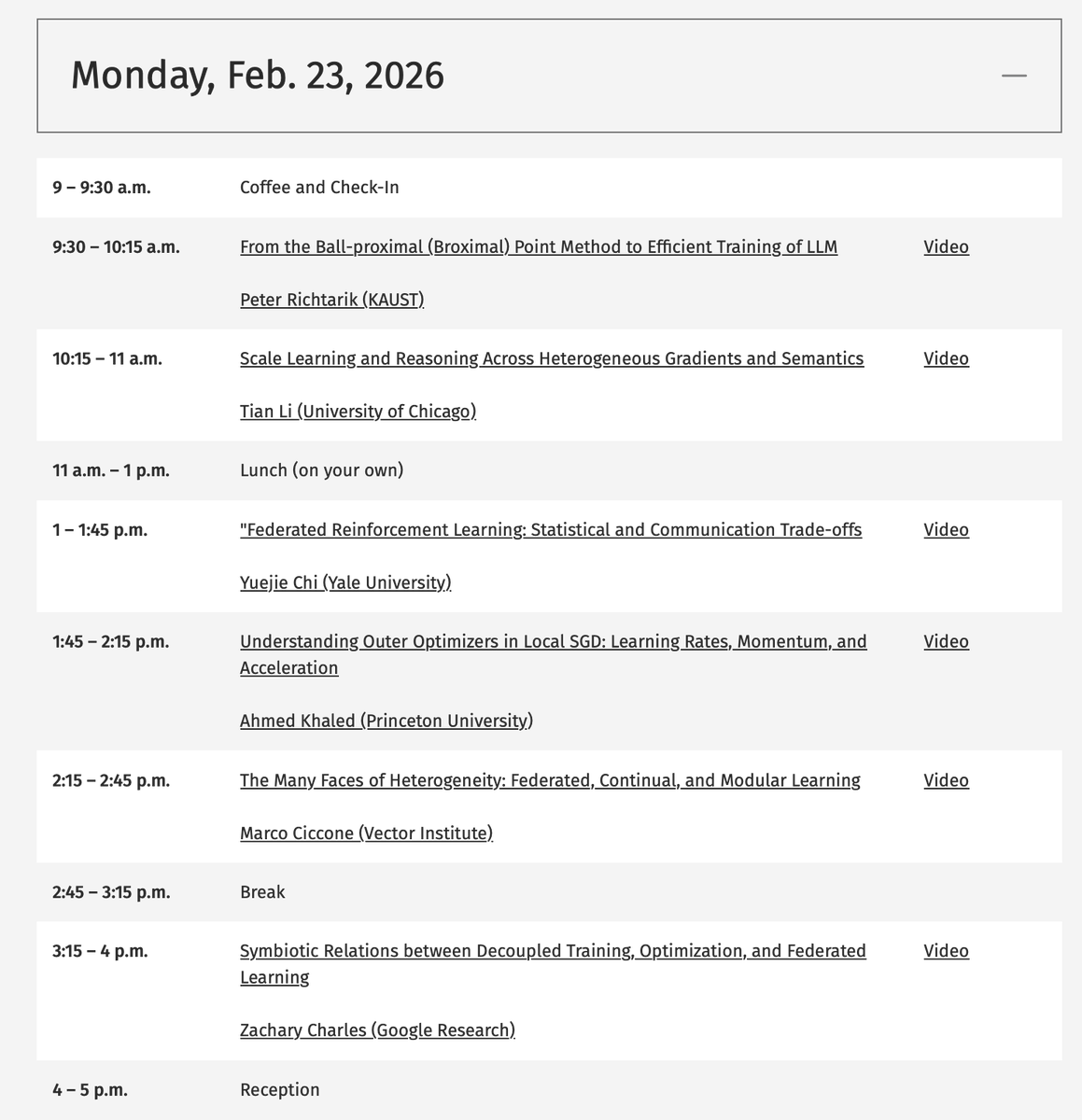
Following my visit last month, I've just arrived to Berkeley again! At 9:30am PT today, I am giving the opening keynote talk at the Simons Institute workshop "Learning from Heterogeneous Sources". #simons-tabs#simons-tabs" target="_blank" rel="nofollow noopener">simons.berkeley.edu/workshops/lear… Title of my talk: "From the Ball-proximal (Broximal) Point Method to Efficient Training of LLM". Abstract: simons.berkeley.edu/talks/peter-ri… During my February visit, I gave a tutorial on "Federated Optimization" at the "Federated and Collaborative Learning Boot Camp". Recordings of my lectures are available on the Simons Institute YouTube channel: Part 1: youtube.com/live/WcHUu08CL… Part 2: simons.berkeley.edu/talks/peter-ri… Part 3: youtube.com/live/oT02lHX6s…
YouTube video
YouTube
YouTube video
YouTube
Peter Richtarik tweet mediaPeter Richtarik tweet media
English
0
3
28
1.8K
Adil Salim
Adil Salim@AdilSlm·
Kudos to Khashayar Gatmiry who led this project (that was part of his 2024 internship at MSR) and to @sitanch
English
1
0
8
868
Adil Salim
Adil Salim@AdilSlm·
📢New paper out! We propose an inference algorithm for diffusion models that does not explicitly depend on the ambient dimension and converges exponentially fast. That’s because, unlike most of the competition, we solve the reverse ODE via Picard and not via Euler discretization
Adil Salim tweet media
English
9
23
209
14.9K
Adil Salim retweetledi
Ernest Ryu
Ernest Ryu@ErnestRyu·
I’ll work to make ChatGPT a better tool for accelerating scientific and mathematical discoveries. If you come across failure cases to improve upon (or exciting success stories) please send them my way!
Sebastien Bubeck@SebastienBubeck

I'm thrilled to welcome @ErnestRyu to our team in @OpenAI !! If you're excited about the progress we've made in making ChatGPT a useful tool for scientists, just wait for what we'll cook for you next year with @ErnestRyu and the rest of the team!

English
46
32
515
146.4K
Adil Salim
Adil Salim@AdilSlm·
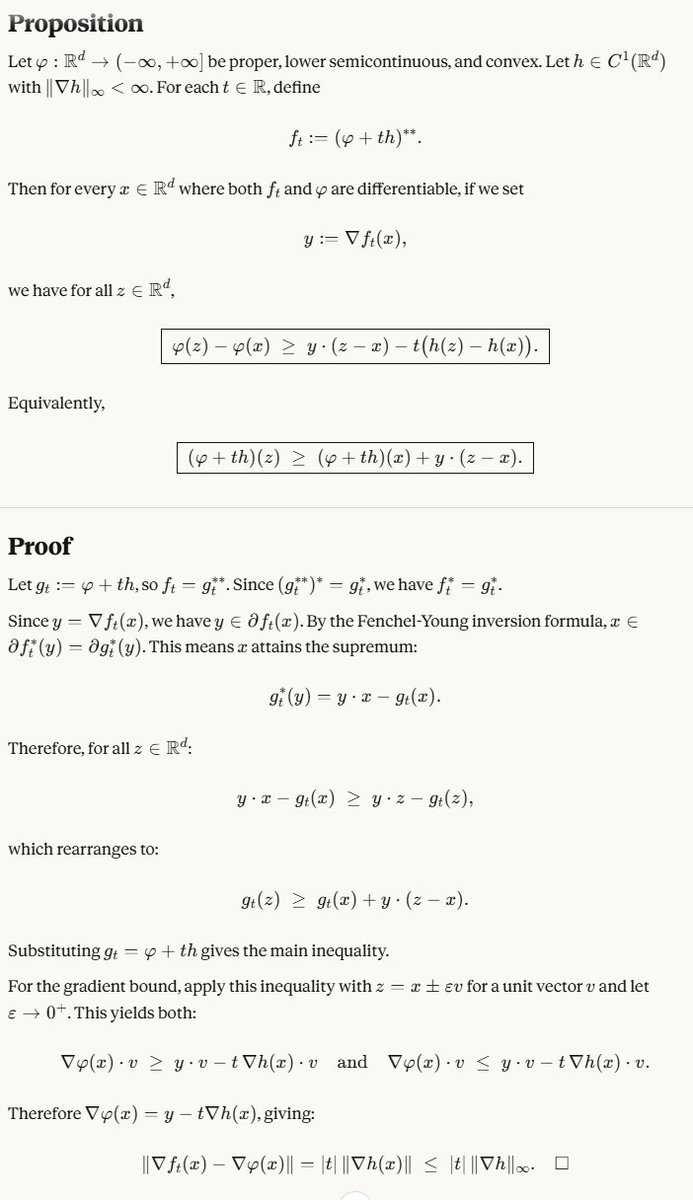
When I say mistakes are more subtle than before. You see the bug?
Adil Salim tweet media
English
1
1
28
5.8K
Adil Salim
Adil Salim@AdilSlm·
@vladtenev @HarmonicMath Okay I had a quick look. How does Lean stay up to date with mathematical literature? That’s probably not a big deal for IMO problems, that's a big deal for math research. All the theorems in my proof are 50+ years old — yet Lean doesn’t know them.
English
1
0
1
307
Adil Salim
Adil Salim@AdilSlm·
100% agree on the productivity boost. One just needs patience to correct mistakes, which are more subtle than before imo. I had a nice interaction with GPT-5-pro while proving a convex analysis lemma: arxiv.org/abs/2510.26647 The model didn’t write the full proof, but the interaction was interesting enough for me to write a short report about it. The report illustrates both the productivity gain and the need for careful proof-checking. The model’s contributions are in blue, and the full chat is in the Appendix. You will see my prompts and how I think, so, no judgement please :) The problem itself has an history in optimal transport (see intro) and comes from a question I was discussing with some UCLA math professors last summer. Simpler than @ErnestRyu's recent result imo, but still very useful in optimal transport!
Adil Salim tweet media
Sanjeev Arora@prfsanjeevarora

Totally agree with @ErnestRyu that AI helpers will become very useful for research. But in the near future the biggest help will be with *informal* math, the kind we work out with our collaborators/grad students on a whiteboard. I already use frontier models to help write/debug lemmas for my papers and lectures. AI is fast, but can also misunderstand. So have to still carefully check the lemma statements and proofs. But already a big productivity boost. (Lean provers will automate the proof checking, but the human will still need to check that the lean formalization accurately captures their intent, which humans will be doing for a while.)

English
6
20
158
46.1K
Adil Salim retweetledi
Ernest Ryu
Ernest Ryu@ErnestRyu·
I firmly believe we are at a watershed moment in the history of mathematics. In the coming years, using LLMs for math research will become mainstream, and so will Lean formalization, made easier by LLMs. (1/4)
English
47
189
1.3K
474K
Adil Salim retweetledi
Timothy Gowers @wtgowers
Timothy Gowers @wtgowers@wtgowers·
I crossed an interesting threshold yesterday, which I think many other mathematicians have been crossing recently as well. In the middle of trying to prove a result, I identified a statement that looked true and that would, if true, be useful to me. 1/3
English
62
305
2.5K
891.5K
Adil Salim
Adil Salim@AdilSlm·
@PiusSprenger @ErnestRyu I think it’s just that many researchers work in both AI and convex optimization, because these are neighboring fields. For example, @ErnestRyu and I have both published in convex optimization journals and AI conferences.
English
1
0
1
111
Pius the Banker
Pius the Banker@PiusSprenger·
Is it coincidence—or something structural—that LLMs are particularly effective on problems where convexity plays a key role? @AdilSlm @ErnestRyu
Adil Salim@AdilSlm

100% agree on the productivity boost. One just needs patience to correct mistakes, which are more subtle than before imo. I had a nice interaction with GPT-5-pro while proving a convex analysis lemma: arxiv.org/abs/2510.26647 The model didn’t write the full proof, but the interaction was interesting enough for me to write a short report about it. The report illustrates both the productivity gain and the need for careful proof-checking. The model’s contributions are in blue, and the full chat is in the Appendix. You will see my prompts and how I think, so, no judgement please :) The problem itself has an history in optimal transport (see intro) and comes from a question I was discussing with some UCLA math professors last summer. Simpler than @ErnestRyu's recent result imo, but still very useful in optimal transport!

English
1
0
7
2.4K
Adil Salim
Adil Salim@AdilSlm·
@hayou_soufiane No I haven't. My original goal was to prove the result, not to evaluate GPT-5. Also, I don't know if I can behave with the other LLM as I behaved with GPT-5, since now I know the proof.
English
0
0
1
515
Soufiane Hayou
Soufiane Hayou@hayou_soufiane·
@AdilSlm Nice. I'm wondering if you tried other LLMs for the same problem and what was your experience.
English
1
0
1
643
Adil Salim
Adil Salim@AdilSlm·
@juxiliu789 @ErnestRyu Well, it’s already too late. Dimitri Shlyakhtenko, who is part of the broader research project, is busy trying to save the IPAM from defunding.
English
0
0
0
41
Ernest Ryu
Ernest Ryu@ErnestRyu·
Another AI-assisted proof. This time in optimal transport / convex analysis by @AdilSlm This report details the interactions with the LLM and is a very informative case study on how to work together with ChatGPT.
Adil Salim@AdilSlm

100% agree on the productivity boost. One just needs patience to correct mistakes, which are more subtle than before imo. I had a nice interaction with GPT-5-pro while proving a convex analysis lemma: arxiv.org/abs/2510.26647 The model didn’t write the full proof, but the interaction was interesting enough for me to write a short report about it. The report illustrates both the productivity gain and the need for careful proof-checking. The model’s contributions are in blue, and the full chat is in the Appendix. You will see my prompts and how I think, so, no judgement please :) The problem itself has an history in optimal transport (see intro) and comes from a question I was discussing with some UCLA math professors last summer. Simpler than @ErnestRyu's recent result imo, but still very useful in optimal transport!

English
5
27
155
18K
Adil Salim
Adil Salim@AdilSlm·
@ErnestRyu This is also a message to those saying ODE representation is useless. Most of the time I reply with Su-Boyd-Candes, but now I can reply with your paper
English
0
0
2
603
Ernest Ryu
Ernest Ryu@ErnestRyu·
The proof, cleaned up and typed up by me, resolves the 42-year-old open problem: 5/N
Ernest Ryu tweet mediaErnest Ryu tweet mediaErnest Ryu tweet media
English
3
6
84
45.8K