Dr. Maki Motapanyane

1.3K posts

Dr. Maki Motapanyane banner
Dr. Maki Motapanyane

Dr. Maki Motapanyane

@Afro_Balkan

Educator, researcher-motherhood, African feminist epistemology, cultural studies. Fortis fortuna adiuvat. Views my own. Retweets ≠ endorsement.

Nova Scotia Katılım Temmuz 2013
483 Takip Edilen416 Takipçiler
Dr. Maki Motapanyane retweetledi
BBC News (World)
BBC News (World)@BBCWorld·
Giant of African literature Ngũgĩ wa Thiong'o dies aged 87 bbc.in/4kgVU3C
Suomi
288
4.4K
12.7K
748.3K
Dr. Maki Motapanyane retweetledi
Al Jazeera English
Al Jazeera English@AJEnglish·
Nigeria's Senate has suspended a female senator, Natasha Akpoti-Uduaghan, after she accused its presiding officer of sexual harassment aje.io/84m0b9
Al Jazeera English tweet media
English
1.3K
9.9K
15.3K
3.3M
Dr. Maki Motapanyane
Dr. Maki Motapanyane@Afro_Balkan·
Veronica, Collagen Scientist@celestialbe1ng

The idea that “women have always stayed home with the babies while men single-handedly funded everything” is pure brain-rot mythology. For most of history, women worked just as hard as men to sustain their families. The image of the 1950s housewife the wannabe trad Twitter obsesses over was an anomaly, mostly limited to a certain period and a specific class. If we look at history, the idea of women being strictly stay at home mothers is a relatively modern and class dependent phenomenon. So maybe let’s break it down by era and class structure: Pre- industrial societies (ancient times - 1700s) • In agrarian and hunter-gatherer societies, women worked alongside men to sustain the family. • Women farmed, ploughed fields, harvested crops, tended livestock, and participated in trade. • In hunter-gatherer societies, women gathered and often hunted small game—providing a substantial portion of the diet. • Domestic work (childcare, food preparation, textile production) was labour-intensive and essential for survival. Industrial revolution (1700s - 1800s) • The shift to industrial economies saw many working-class women and children forced into factory jobs, mines, and textile mills. • Middle- and upper-class women were more likely to stay at home, but even they often contributed through home-based industries (like sewing, managing family businesses). • In rural areas, women still worked the fields while managing household duties. 19th century - early 20th century (1800s - 1920s) • Working-class women continued to work, often as domestic servants, in textile factories, or in farming. • The Victorian “ideal” of the stay at home wife applied mostly to upper-class and emerging middle-class women. • In many societies, widows and poor women had no choice but to work, often in gruelling conditions. 1930s - 1950s: the “Tradwife” • The Great Depression forced many women into the workforce, as families needed dual incomes to survive. • After World War II, with men returning from war, there was a cultural push (especially in the West) to return women to the home. • The nuclear family ideal, a working dad, a stay at home mum, and children, was heavily promoted in media, but it was largely a middle-class phenomenon. 1960s - present: • Second-wave feminism pushed women in education and employment. • Economic conditions / necessities meant dual-income households became increasingly common. • Today, many women work full-time while still shouldering the majority of domestic labour; essentially doing both. Soooooo…… Belittling women for working while raising children isn't just ignorant-it's historically illiterate. The idea that women have always been delicate little house pets, shielded from labour while men toiled away, is a delusional fantasy cooked up by grifters. For most of human existence, women worked just as hard as men-ploughing fields, running businesses, handling trade, and keeping families alive through sheer force of will. The whole "tradwife" aesthetic doesn’t seem to be about tradition at all; it's a rebranded aristocratic fantasy, where they imagine themselves swanning around in linen dresses on sunlit estates. These wannabe tradwives are literally historically wrong, but that’s cute and okay, as long as you’re not insulting generations of women who had no choice but to work to keep their families alive. So don’t erase the labour of farmers' wives who worked the fields, factory women who kept industries running, and market women who ensured their children had food on the table. You sneer at working mothers today as if raising children while holding down a job is some kind of moral failing rather than the impossible balancing act it has always been. You’re rewriting history to suit your own delusions.

QHT
0
0
0
332
Dr. Maki Motapanyane retweetledi
onjali rauf
onjali rauf@OnjaliRauf·
They were: Electricians Firefighters Bakers Nurses Tilers Restaurateurs Shop workers Gardeners Plumbers Office temps Builders Prison guards Lorry drivers Carpenters Technicians Soldiers... NEVER again can #women be told our fear of male violence is "irrational". #GiselePelicot
Making Herstory@MakeHerstory1

Today, she did it. Despite the burden of global infamy, she did it. Despite the insulting sentences meted out to the 51 rapists today, she did it. She exposed the "normal", "family man" facades and the ridiculous lies too many rapists hide behind. She won. #MerciGisèle

English
51
4.4K
13K
522.7K
Dr. Maki Motapanyane
Dr. Maki Motapanyane@Afro_Balkan·
So thrilled to celebrate academic achievement yesterday with M. Wallace who graduated with First-Class Honours in a double major & received the Women’s Studies Book Prize awarded to our top graduating student. Congrats to all graduates! 🎓
Dr. Maki Motapanyane tweet media
English
0
0
5
155
Dr. Maki Motapanyane retweetledi
IAMAS
IAMAS@iamafeministmom·
CALL FOR PAPERS! Join the 2025 IAMAS Conference, Theme: (Re-)producing Motherhood, Motherwork, and Mothering. At Boston University + online in June 17-20. Visit iamas.com for more info + to submit your abstract. Last year had over 300 attendees, don't miss out!
English
1
2
4
186
Dr. Maki Motapanyane retweetledi
StatusofWomenNS
StatusofWomenNS@StatusofWomenNS·
In honour of #IDG2024, the Status of Women Office, @dbdli , and @SenatorWanda , are excited to highlight a series of incredible African Nova Scotian women who are making a difference in their communities.
English
1
1
2
112
Dr. Maki Motapanyane retweetledi
CBC Nova Scotia
CBC Nova Scotia@CBCNS·
Panel discussion celebrates Black women in Nova Scotia electoral politics ift.tt/2B95EeC
Català
0
1
4
2.7K
Dr. Maki Motapanyane
Dr. Maki Motapanyane@Afro_Balkan·
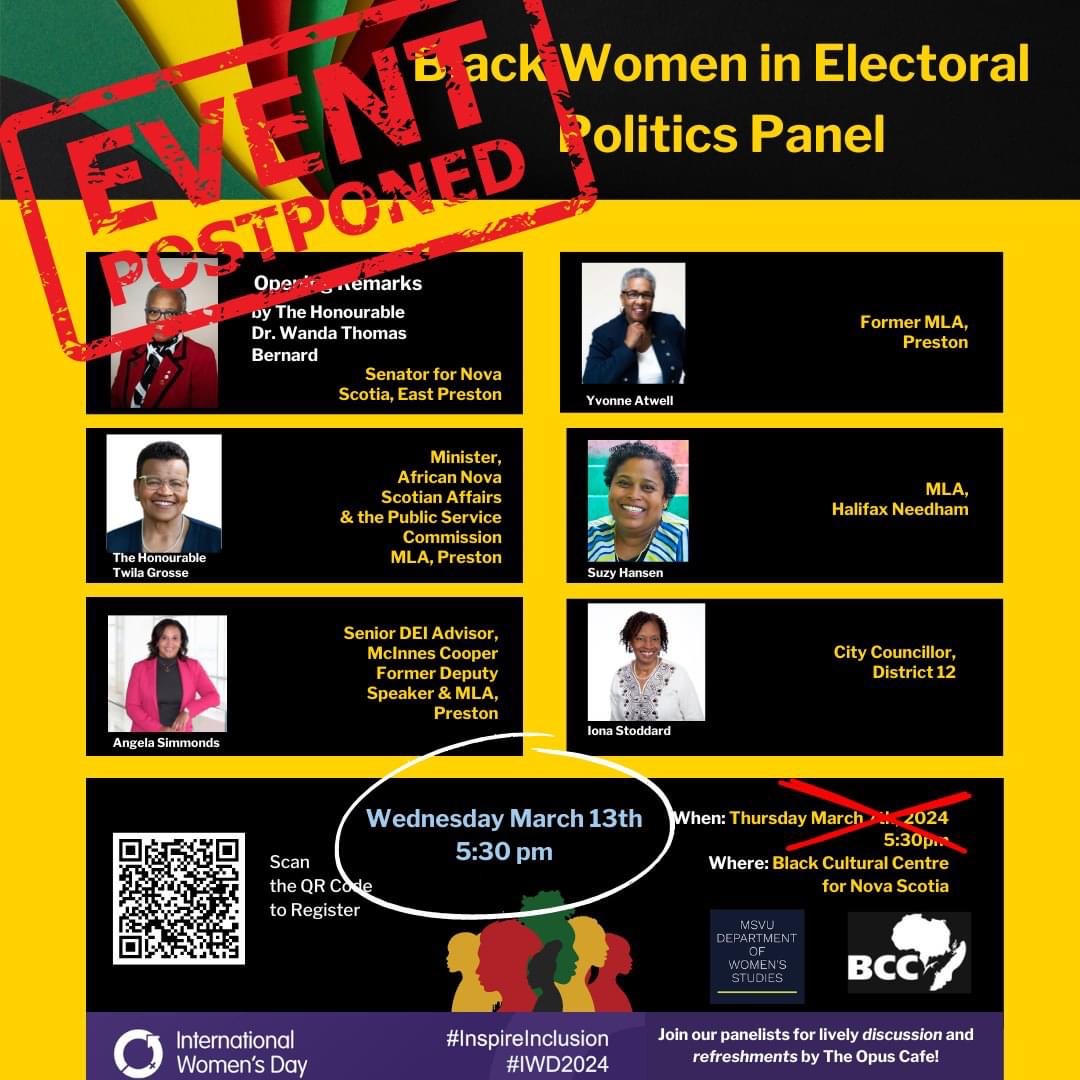
**REMINDER**: We are still on! Join us this WEDNESDAY, MARCH 13th, 5:30 p.m. at the Black Cultural Centre for Nova Scotia @BCC_NS for the powerful Black Women in Electoral Politics Panel!
Dr. Maki Motapanyane tweet media
English
0
2
3
188
Dr. Maki Motapanyane
Dr. Maki Motapanyane@Afro_Balkan·
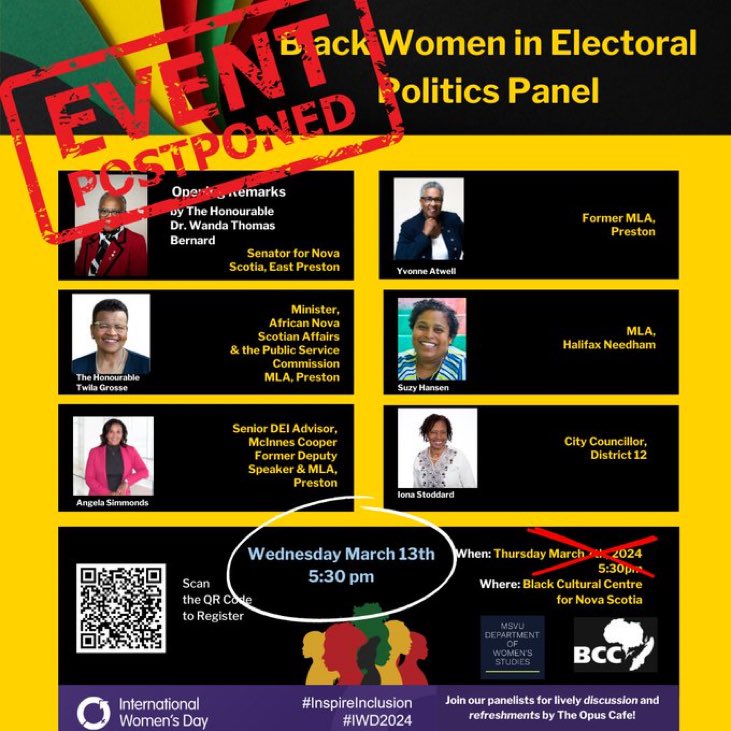
@SH_BordenColley Thank you for sharing! Due to the weather forecast this week, the panel has been postponed to Wednesday, March 13th, 5:30 pm. 🙂
Dr. Maki Motapanyane tweet media
English
0
2
2
145
Dr. Maki Motapanyane
Dr. Maki Motapanyane@Afro_Balkan·
Due to the weather forecast this week, we have postponed the Black Women in Electoral Politics Panel to Wednesday, March 13, 5:30 pm. Join us then for the same fantastic panel at @BCC_NS the Black Cultural Centre for Nova Scotia. Catering by Opus Cafe. ☀️
Dr. Maki Motapanyane tweet media
English
0
0
4
240
Dr. Maki Motapanyane retweetledi
MSVU Women's Studies
MSVU Women's Studies@MSVU_WomensStu·
Due to impending weather, we've needed to change the date for our Black Women in Electoral Politics event. The new date will be Wednesday, March 13, 2024 at 5:30pm. Same venue :)
MSVU Women's Studies tweet media
English
0
1
1
110