AiLifeNotes ☀️

9.2K posts

AiLifeNotes ☀️ banner
AiLifeNotes ☀️

AiLifeNotes ☀️

@AiLifeNotes

日常观察☀️ | 算力/AI随笔🔶 #Qubic🏂 ————————Daily observations ☀️ | Computing/AI notes 🔶 #Qubic 🏂

距离你13.14km Katılım Nisan 2025
3.6K Takip Edilen4.9K Takipçiler
Sabitlenmiş Tweet
AiLifeNotes ☀️
AiLifeNotes ☀️@AiLifeNotes·
1/6 兄弟们,我今天刷Qubic的更新,直接人傻了…… 这玩意儿不是在追热点,它就是在自己造下一个时代。 2026年3月了,别人还在聊TPS多少,它已经把矿工的算力直接喂给AGI训练了。 我靠,这不是区块链,这是分布式大脑在醒来啊!🧠💥
AiLifeNotes ☀️ tweet media
中文
6
8
31
56.5K
AiLifeNotes ☀️ retweetledi
Qubic
Qubic@_Qubic_·
Saylor's case for Bitcoin is the cleanest argument in crypto. Decentralized protocol = commodity. No one controls it. No one can take it away.  Economic energy for 8 billion people. He's right. But he stopped one step short. Bitcoin secures value. What secures intelligence? Ethereum tried. Failed. It wasn't built for it. But, Qubic is. Decentralized. No corporation owns the AI training running on it. The people contributing compute own the output. Same fire. Different engine. Bitcoin made value sovereign. Qubic makes cognition sovereign. It's been building quietly for four years. Most people still haven't looked. That window doesn't stay open.
Qubic tweet media
English
17
140
522
9.8K
AiLifeNotes ☀️ retweetledi
Qubic
Qubic@_Qubic_·
Doge Mining Revenue Report | Epoch 212 Mining Sample: QDOGE's Fluminer L1 (5.7 GH/s) Revenue per GH/s per day: Mining DOGE via Qubic → $0.82 / GH/s Mining LTC + DOGE on traditional pools → $0.55 / GH/s That's +$1.52/day. +$10.62 over the full week. 48% more revenue on the same hardware. Even with merge mining, combining LTC and DOGE, other pools couldn't close the gap.
Qubic tweet media
English
12
89
383
9K
AiLifeNotes ☀️ retweetledi
Qubic
Qubic@_Qubic_·
Qubic All-Hands Recap - May 14, 2026 6,500+ live attendees. New record. Here's what was covered: → Neuraxon v2.0 paper accepted at IEEE ICMLT Berlin  → New CUDA library brings Neuraxon to NVIDIA GPUs  → Solana Bridge mainnet target: late July  → Doge mining at 7.6 TH/s, 153B QU in buybacks distributed  → Oracle Machines live on mainnet  → My Last Match beta entered Phase 2  → 4x transaction capacity upgrade landing May 20
Qubic tweet media
English
14
91
407
6.8K
AiLifeNotes ☀️ retweetledi
Qubic
Qubic@_Qubic_·
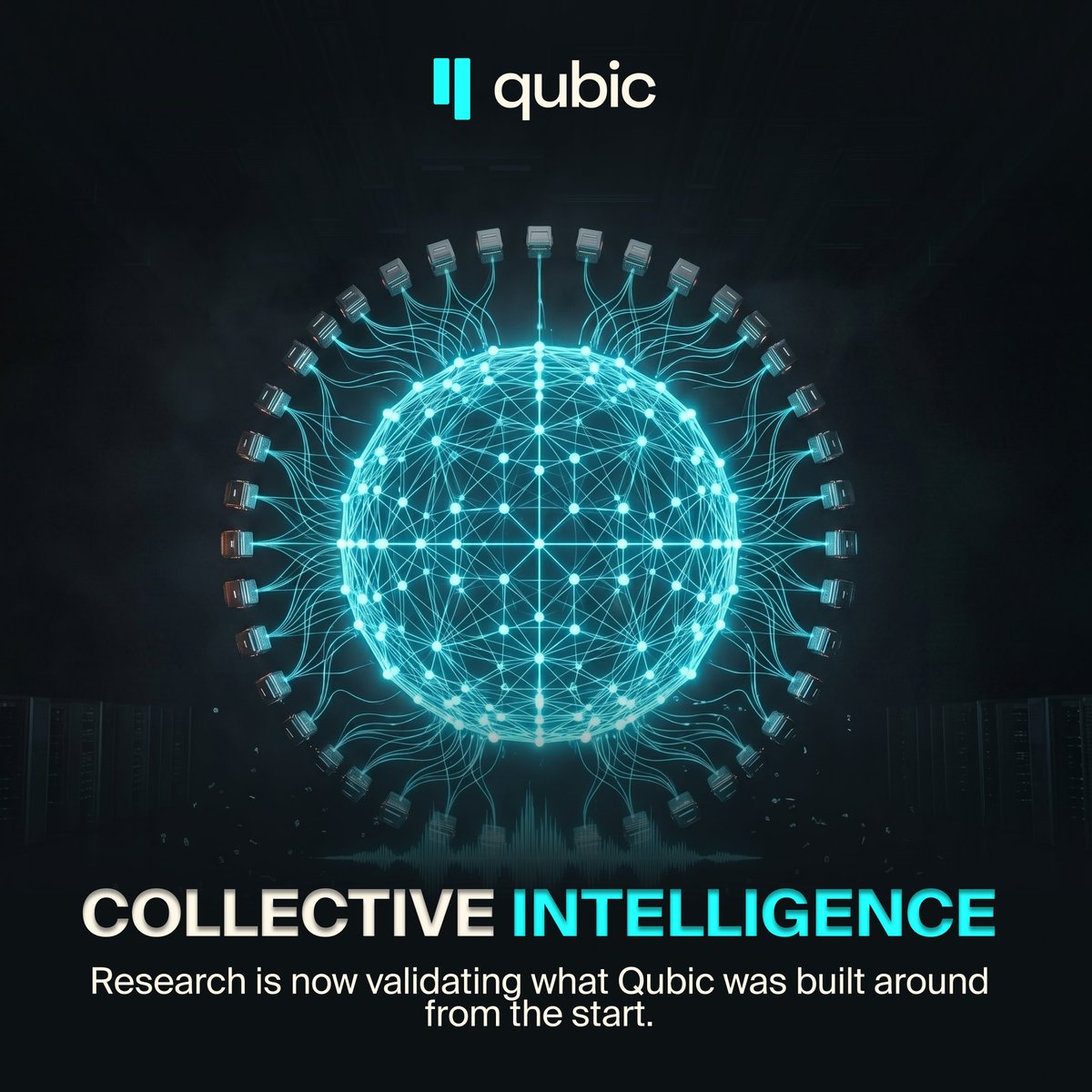
A new paper out of KRICT and KAIST just put a number on something Qubic's architecture has been built around since 2022. Multiple AI agents working in coordination reduce extrapolation error by up to six orders of magnitude versus isolated deep neural networks. Up to a million model parameters compress into 5 to 40 interpretable ones. Tested across deterministic and previously uncharacterized dynamics. The collective recovered the underlying governing equations across all of them. @c___f___b  described the design premise of Qubic's coordinated mining layer this way: "The work of one miner benefits from the work of another miner, and their combined work is greater than the sum of their works measured separately." That is not a metaphor. The MCI paper is empirical confirmation of the mechanism. The researchers tested on a small lab cluster and noted the obvious next question: what happens when this runs at network scale? Qubic's 676 Computors and broader mining base sit directly on the other side of that question.  Coordinated, network-scale machine intelligence is what Aigarth is being built for. The frontier is catching up to the foundation.
Qubic tweet media
English
19
105
452
7.4K
AiLifeNotes ☀️ retweetledi
Qubic
Qubic@_Qubic_·
If you are running Scrypt ASICs on a conventional DOGE pool right now, you are running the right hardware on the wrong pool. Phase 3 of Qubic's DOGE mining has been live for three weeks. The setup is one configuration change. The economics are structured differently from any pool you are currently using. Here is what mining DOGE on Qubic actually looks like. 🧵
Qubic tweet media
English
9
90
415
15.9K
AiLifeNotes ☀️ retweetledi
Qubic
Qubic@_Qubic_·
Your brain sits at a frontier between order and chaos, and a single number determines which side it falls on. The branching ratio (σ) measures how neural activity propagates. Too low, signals die. Too high, you would have seizures. But right around σ ≈ 1, something remarkable happens: sensitivity, memory, information capacity, and complexity all peak at once. In NIA Vol. 8, the Qubic scientific team breaks down how this principle from statistical physics and neuroscience became a core design constraint in Neuraxon, and why the "edge of chaos" matters for building brain-inspired AI that actually works.
GIF
English
9
90
386
11K
AiLifeNotes ☀️ retweetledi
Qubic
Qubic@_Qubic_·
The Qubic All Hands is back tomorrow. Thursday, May 14 at 11:00 AM EDT | 3:00 PM UTC, live on X. Incubation, Marketing, Core-Tech, Science, and Business Development are all presenting. Five teams, one stream, questions answered live.
Qubic tweet media
English
6
58
266
5.7K
AiLifeNotes ☀️ retweetledi
Qubic
Qubic@_Qubic_·
Free to attend. RSVP here: luma.com/qmk4juuu
English
1
6
58
1.9K
AiLifeNotes ☀️ retweetledi
Qubic
Qubic@_Qubic_·
Almost everyone reading this owns a CPU more powerful than the supercomputers used to train early neural networks. Most of that capacity sits idle. At a fraction of its potential during normal use. At zero while you sleep. The Qubic Mining Academy is free, structured, and built for people who have never mined anything. Wallet setup. Node deployment. Tuning. No assumed knowledge. If you held $QUBIC and never ran a miner, this is how you cross that gap. If you came in through DOGE Phase 3 and want to understand the AI side of the network, this is where you actually learn it. The point of Useful Proof of Work is that the people running the compute own the output. The Academy is how you become one of those people.
Qubic tweet media
English
31
103
448
14.9K
AiLifeNotes ☀️ retweetledi
David Vivancos - e/acc
David Vivancos - e/acc@VivancosDavid·
Today #MultiNeuraxon🪼joins the @nvidia #cuda family , very glad to release for @_Qubic_ #OpenScience The Cuda Kernels and library so you can teach your #bioinspired #AIs using Nvdia #GPUs too. Code: github.com/DavidVivancos/… Why it matters? It brings Multi-Neuraxon + #Aigarth evolution to GPU-native execution: CPUs orchestrate while NVIDIA GPUs teach, execute, and scale neural compute in parallel. CPU + GPU together = Multi-Neuraxon at speed.
David Vivancos - e/acc tweet media
English
14
156
456
26.3K
AiLifeNotes ☀️ retweetledi
Qubic
Qubic@_Qubic_·
A research group just demonstrated the first AI agent system to autonomously discover and experimentally validate a new physical mechanism on a real optical platform. Hypothesis. Experiment design. Data collection. Analysis. Validation. No humans in the loop. The discovery is the headline. The bottleneck behind it is the actual story. 🧵
Qubic tweet media
English
30
103
468
28.6K
AiLifeNotes ☀️ retweetledi
Qubic
Qubic@_Qubic_·
Quottery: Qubic's first decentralized prediction market, is live. No house. No counterparty. A smart contract that matches, settles, and pays out on-chain, every time. A thread 🧵
Qubic tweet media
English
26
125
545
20.5K
AiLifeNotes ☀️ retweetledi
Qubic
Qubic@_Qubic_·
QubicFlow, a clean portfolio tracker for Qubic, is finally here. Built by Andy (@Andy_Qus), QubicFlow is a free, open-source portfolio tracker for Qubic. It captures every wallet event in real time. Incoming and outgoing transactions, smart contract events, dividend payouts. Filterable by epoch, month, or year. Multi-wallet. CSV and PDF, ready for export. It runs on Umbrel OS, the home-server platform a lot of Computor operators are already using. That means your data stays on your hardware. No cloud account. No third party. If you have a Raspberry Pi sitting on a shelf, you have everything you need. QubicFlow has been submitted to the official Umbrel App Store. While it sits in approval, you can install it via the community store or run it through Docker on any home server. Andy saw a real gap, built a real tool, and released it under an open license. The work of one participant elevates everyone else who runs on the network.
Qubic tweet media
English
31
98
479
22.8K
AiLifeNotes ☀️ retweetledi
Qubic
Qubic@_Qubic_·
Every blockchain before this one had one job.  Burn energy. Secure the chain. Repeat forever.  Trillions of calculations. Zero intelligence produced.  The most powerful computers on earth, wasted. Qubic changed the equation. Here, miners don't just validate. They think.  Every computation trains a real artificial neural network.  The energy doesn't disappear. It becomes intelligence. 676 Computors. Feeless. Instant. 15.5M TPS.  No premine. No VCs. No compromises. This isn't another blockchain.  This is what blockchain was always supposed to become. This is Qubic.
English
40
138
607
613.9K
AiLifeNotes ☀️ retweetledi
Qubic
Qubic@_Qubic_·
Replace trust with proof. That is the cypherpunk method. Three people. Three decades. Three layers. Hughes in 1993 wrote code to protect communications. Satoshi in 2008 wrote code to protect value. The third act was always coming. AI needed infrastructure eventually. It just didn’t need it until now. A community piece called The Execution makes the case that Qubic is where that line lands. The Qubic property it pulls out is one most people walk past. At the end of every epoch, the network purges its intermediate state. Only balances persist. History, ranked positions, accumulated influence, reset weekly. Every cycle, Computors earn their seat through real contribution. Not through capital held. Not through position accumulated. Through work done in that epoch. “No one can take root in a system that renews itself every week.” This is the architectural answer to a question Bitcoin didn’t face and Ethereum hasn’t solved: how do you build a system whose long-term capture is structurally costly, not just normatively undesirable? You make power something that must be rebid. Every week. Without exception. The cypherpunks protected communications. Then value. The third act protects computation itself, from the same forces that have captured every powerful system before it. It does not ask permission.
Qubic tweet media
English
25
127
600
19.8K
AiLifeNotes ☀️ retweetledi
Qubic
Qubic@_Qubic_·
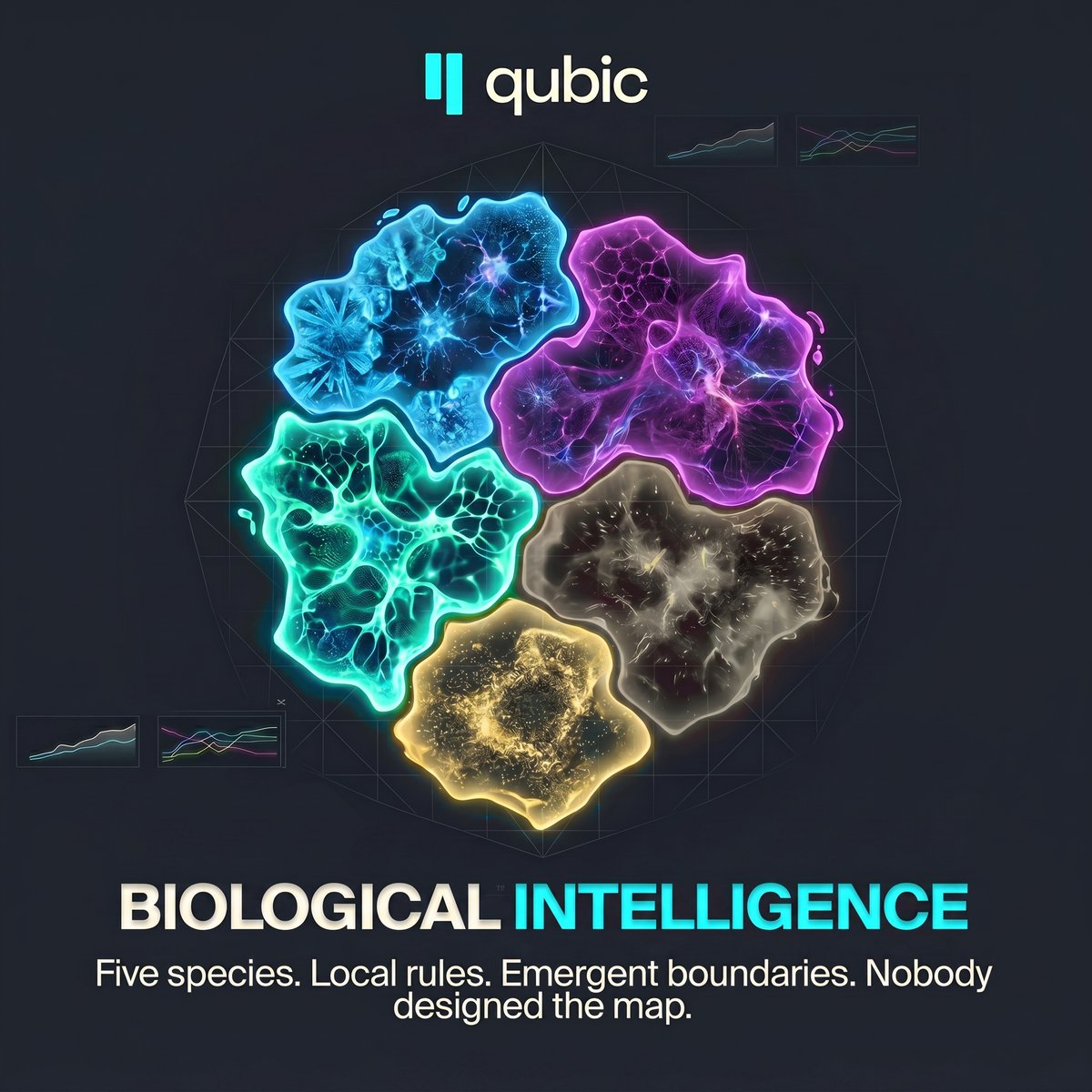
In 1970 John Conway wrote four rules on a postcard. Cells live or die based on neighbor count. That was the entire system. What emerged from those four rules: stable structures, oscillators, gliders, and eventually, full Turing machines. Computation arose from a system that was never programmed to compute. The deep idea: complexity does not have to be designed. It has to be enabled. Christopher Langton extended this in the 1980s. He found that interesting things happen at a specific regime, the edge of chaos. Below it, systems freeze. Above it, they dissolve into noise. In between, computation, learning, and adaptation emerge on their own. This is where biological intelligence operates. It is also where Aigarth is engineered to live. The connection between Conway’s Game of Life and Qubic’s Neuraxon architecture is not a metaphor. It is a method. Neuraxon’s trinary state: -1, 0, +1 was not a quantization trick to save bits. The neutral state is a buffer that lets the system navigate the edge of chaos without collapsing into rigidity or noise. In the NxonLife simulator, the team measured a branching ratio close to 1 and 1/f temporal dynamics, the exact signatures Alife research predicts for systems capable of genuine computation. There’s a harder finding underneath all of this that Alife keeps producing: cooperation, specialization, and division of labor emerge in systems never programmed to cooperate. They arise as consequences of the dynamics. Not as goals. This is uncomfortable if you believe intelligence has to be optimized top-down. Fifty-six years of evidence suggests otherwise. Qubic’s scientific team published the full breakdown: Conway, Langton, Sakana AI’s Digital Ecosystems work, and the bridge to Neuraxon production infrastructure. Not as observation. As architecture.
Qubic tweet media
English
24
104
463
25.4K