Aïda Elamrani retweetledi

📢 AI-Phi Session 32 — Seminar Series — AI: Are We Losing Control? — with @CRSegerie from CeSIA 📢
📅 12/02
🕖7PM
📍 @SonyCSLParis
🔗 Details & Registration: ai-phi.github.io/posts/session-…
English
Aïda Elamrani
374 posts


@AidaElam
Philosophy of A.I. - Artificial Consciousness & Ethics of AI @aidaelamrani.bsky.social @[email protected]
The live is online : youtube.com/live/m7PmW4WUY… #ai #Consciousness #philosophy


The editors at @Nature must be living in an alternate universe to think this is going to help the credibility of science in any way. Just say no.

Delighted to announce the last AI-Phi of this academic year. We will be hosting Prof. Kathinka Evers (Uppsala U) for a talk on Artificial Consciousness. 🗓️ Date: Thursday, 26 of June ⏲️ Time: 11:00AM CEST ➡️ Details & Registration: ai-phi.github.io/posts/session-…
She is life. Our future. Our responsibility. She is our ocean. 🌊 And though she faces growing threats, we still have the power to protect her. But we must #ActNow. Our voices and choices matter. Sunday is UN World Oceans Day. unworldoceansday.org #SaveOurOcean
1/ As @joannejang notes, people increasingly perceive AI systems as conscious. This is confirmed not only by recent studies but also by the volume of email that many of us receive from concerned citizens! However, OpenAI's response is incomplete in one key respect. Short 🧵👇
Anthropic researchers: humans could end up being "meat robots" controlled by AI Trenton Bricken: "The really scary future is one in which AIs can do everything except for the physical robotic tasks ... In which case, you’ll have humans with AirPods, and glasses and there’ll be some robot overlord controlling the human through cameras by just telling it what to do."
(on IIT-related controversies.) in the weeks after the "25 years of consciousness" event, some controversy about issues discussed in the event developed, especially tied to the role of integrated information theory (IIT) in the cogitate collaboration. a couple of media articles about the event declared "winners" (typically IIT) and "losers" (typically GWT) of the adversarial collaboration. many theorists think that IIT has very little empirical support (as came out in subsequent discussions of IIT as "pseudoscience"), and were dismayed by IIT's being portrayed as the winner in an empirical contest. because of the controversy, the conference organizers (ned block and me) were asked to hold off on posting the video, initially by the ASSC board (which wanted to avoid the appearance of endorsing the claims made in and around the event) and then later by the cogitate group (which wanted to avoid social media further complicating a lengthy and difficult review process). now that the cogitate article has been published in nature (almost two years later), there are no more obstacles to publishing the video, so here it is. for what it's worth, the video shows that no winners and losers of the collaboration were declared on the night. stan dehaene does note that his theory receives more "red" for falsified predictions, but the bottom line was that both theories were seriously challenged. furthermore, ned block makes clear at the very start of the event that any successful predictions made by IIT (mainly concerning the relative role of sensory areas and prefrontal areas) are shared by many other theories of consciousness, and so those predictions aren't specific to IIT. many of the media articles managed to avoid winner/loser talk. but the coverage brought out that one needs to be not just clear but ultra-clear about these delicate issues in public presentations. i think the recent nature article (nature.com/articles/s4158…, where again i'm a minor co-author) does a nice job clarifying these issues at the start (see excerpt attached). as the article says, the collaboration isn't really testing the core mathematical or computational claims of IIT or GWT, but rather is testing associated claims about proposed neurobiological implementations of the theories (in posterior and prefrontal areas respectively). many of those claims are shared with other theories, and any predictive successes and failures are shared with those theories. the results leave many questions open, but they help to clarify the neurobiological lay of the land.
the long-awaited video for the "25 years of consciousness" event at the 2023 ASSC conference has now been posted at youtube.com/watch?v=M6DHCQ…. this event was framed as a resolution of a 1998 bet between christof koch and me about whether we'd know the neural correlate of consciousness by 2023 (spoiler: i won). but the real excitement was the first public presentation of results of the @ArcCogitate adversarial collaboration, testing predictions of the global workspace and integrated information theories of consciousness (spoiler: predictions of both theories were seriously challenged.) it was a memorable evening in front of 800 people in the NYU skirball theater, with a spirit of celebration in the air. the whole thing is captured beautifully by @vanroyko and marie-philippe gilbert of @eyesteelfilm, who are making a definitive film about the science of consciousness. the audience shots are great -- e.g. look out for danny kahneman (sadly no longer with us, but a big supporter of the adversarial collaboration) and barbara tversky in the second row. there are even consciousness-related musical interludes by @theamgydaloid and @babaBrinkman, and @heatherberlin does an excellent job as host. the event gives a reasonable sense both of how far we've come in the science of consciousness and of how far we have to go. 25 years ago we couldn't dream of systematic experiments on the scale of the cogitate experiment. huge credit goes to co-leaders lucia melloni, @liadmudrik, and mike pitts, and to an army of extremely talented investigators and trainees, for all their work in pulling the experiment off. (full disclosure: i was a very minor co-author.) the results were deservedly published in a major article in nature in march this year. at the same time, we've found that the search for the neural correlates of consciousness is far from easy. it may not require solving the hard problem of consciousness, but there are still many difficult philosophical and empirical issues that need to be sorted out before we can be confident in a claim about the NCC. all that comes out in seeing the very different interpretations that the adversarial theorists make in interpreting the results, including issues as basic as whether the key features of stimuli really are consciously perceived or not. more results are coming soon, including a second experiment by the cogitate team, and results from four other adversarial collaborations sponsored by the templeton world charity foundation. @BiyuHe (NYU neuroscience), @De_dicto (ned block), and i are co-directing one of these collaborations (as ned mentions near the start of the video), along with jan brascamp, rachel denison, and megan peters as the other PIs. this collaboration is testing first-order theories of consciousness (theory leader: @VictorLamme) and higher-order theories of consciousness (theory leaders: @onemorebrown and @hakwanlau) using experiments on subjective inflation and on change blindness. of course this experiment is unlikely to fully resolve the debate between these theories any more than the cogitate experiment did, but hopefully it will lead to some significant results that help the science and the philosophy of consciousness make progress. after settling the bet, christof and i renewed our bet for another 25 years, to be settled in 2048 (when we'll be 92 and 82 respectively, if still around). i may still have the better side of the bet, but there's room for a lot of advances between now and then, especially if AI gets good enough to help out. it's entirely likely that current theories will look quite primitive from the perspective of 2048. here's to the next 25 years!
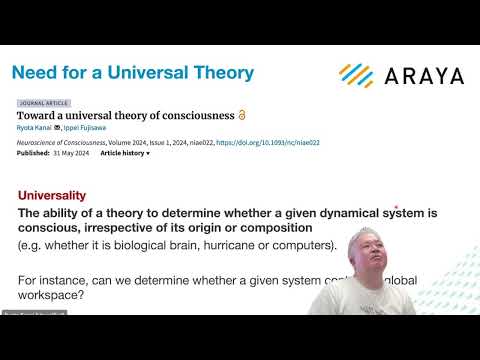
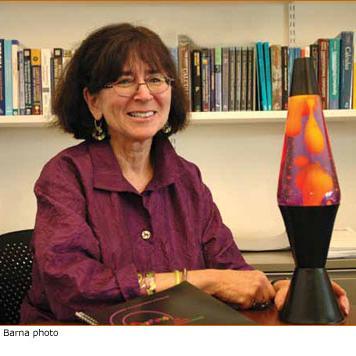
Delighted to announce the next AI-Phi Seminar Series. We will be hosting @kanair for a talk on Qualia and Symmetry. 🗓️ Date: Wednesday, May 14, 2025 🕖 Time: 7:00 PM CEST 📍 Location: Sony CSL, 6 rue Amyot, 75005 Paris 🔗 Details & Registration: ai-phi.github.io/posts/session-…