Alex Feng

208 posts

Alex Feng

Alex Feng

@AlexFengzh

Technical lead@Uber, sushi omakase chef@home

Los Altos Hills, CA Katılım Ocak 2026
39 Takip Edilen36 Takipçiler
Alex Feng
Alex Feng@AlexFengzh·
Only if as a software engineer your whole identity is based on “writing code”. If you lean on the “engineer” part of software engineer more, you are really a problem solver and code just is a tool. In that case AI is probably the most liberating thing to happen to real software engineers. No longer are you constraint by rigid syntax or working around badly designed frameworks. You can now build whatever you can think of.
English
1
0
1
364
corbin
corbin@corbin_braun·
one of the biggest economical shift if happening in software right now and most people don't know. Every big tech is laying off employees. we are in software endgame. there is a real identity crisis happening with software engineers. imagine spending 10+ years of your life learning to code and making income this way. and now anyone can do it. odd time. salaries, stock options all of it. drying up.
English
65
10
260
27K
Alex Feng
Alex Feng@AlexFengzh·
@staysaasy Even if you build on openAI instead of Anthropic, and for some reason openAI sign non compete (which is not going to happen), Anthropic can still go into your market. How about not being just an AI wrapper in the first place.
English
0
0
16
568
staysaasy
staysaasy@staysaasy·
If Anthropic successfully nukes Harvey/Legora with Claude for legal, the only logical conclusion for vertical AI companies will be to never build on Anthropic, and for OAI to be their model company of choice with non-compete agreements. All OAI would have to do is sign contracts agreeing to not compete and they’d secure billions in revenue from B2B AI companies that don’t want to get bombed by their model provider.
English
69
12
500
73.7K
Alex Feng
Alex Feng@AlexFengzh·
@haridigresses Technically if you trade $1m in one transaction in a day, you can say you have $300+m ARR
English
0
0
1
261
hari raghavan
hari raghavan@haridigresses·
In case you're wondering, this is the stage of the market we're at.
hari raghavan tweet media
English
141
294
7.5K
516K
Alex Feng
Alex Feng@AlexFengzh·
@XFreeze Only if you need to do “production” work requiring internet on a plane. Most people prefer sleeping or watching movies instead.
English
1
1
12
6.2K
X Freeze
X Freeze@XFreeze·
MrBeast just gave one of the strongest endorsements possible for Starlink: “I will only book flights exclusively on planes with Starlink. I don’t care if it means an extra layover - I’ll sit in the back of the plane if it gives me Starlink.” He says Starlink has become the backbone of his global productions and travels because it works in places where traditional internet simply doesn’t exist: • Filming in Antarctica - one of the only reliable ways to stay connected • Building wells deep in rural Africa with full internet access hours away from cities • Driving through remote villages and open fields with a Starlink dish mounted on the vehicle while maintaining signal the entire time He described it as: “Starlink is literally magic. It makes no sense.” Now people are actively choosing flights based on whether the plane has Starlink onboard
English
1.2K
2K
20.5K
40.1M
Alex Feng
Alex Feng@AlexFengzh·
@kai_xbt Is this guy’s whole persona based on the fact he has $10m? Which is not even that big of a deal in Bay Area?
English
3
0
3
6.4K
Kai
Kai@kai_xbt·
Kevin Xu reveals he lost everything in crypto in 2018, owed the IRS money, then ran up $35,000 in his Google 401K to $10,000,000 and had to quit Google just to withdraw it "I ran like $3,000 to $5,000 up to $300,000 and all the way back down to $30,000 in crypto. All the short term capital gains were captured in 2017 but then I lost everything in Q1 of 2018. I had to ask people for money. Pretty dark period of my life." "I got a stable job at Google in 2019 and pledged to basically be a good boy. Then COVID happened and I had this $35,000 sitting in the 401K that I can't touch for 30 years. I threw it into something and one lucky trade after another it led to a lot." "You're not allowed to take money out of a 401K unless you actually leave the company. If I wanted to buy a new car I literally had no money. I was driving a 2008 Honda Accord with $10,000,000 in my retirement account. So that was partially one of the reasons I quit."
English
72
55
1.9K
702.7K
Alex Feng
Alex Feng@AlexFengzh·
@RealNickMugalli AI is part of tech, and it’s above 40% long time ago. You can always make data fit your own narrative if you can choose how to define “theme” as you wish.
English
1
0
4
719
Nicholas Mugalli
Nicholas Mugalli@RealNickMugalli·
Peak concentration of every major bubble in history. The AI Big 10 just hit 40%. The line is still rising. Peak theme concentration at bubble top: - Railroads (1880s) — 63% of US stock market - Nifty Fifty (1972) — 40% of S&P 500 - Japan (1989)      — 44% of MSCI ACWI - Tech/Telecom (2000) — 41% of S&P 500 - AI Big 10 (2026)   — 40% of S&P 500 still rising… The prior four didn't end because the businesses were bad. Railroads were the internet of their era. Cisco and Intel had real earnings. Japan had genuinely excellent industrials. They ended because concentration itself is the risk.  At 40%+ of a benchmark, every institutional portfolio is overweight by construction. Rebalancing becomes one directional. Momentum becomes crowding. Crowding becomes fragility. The trigger doesn't need to be fundamental — it just needs to be big enough to force systematic derisking. Then the unwind feeds itself. AI is real. The question is whether $800B+ capex, 40% concentration, and P/E above 28× are compatible with anything other than perfect execution from every company in the cohort for the next three to five years. One $NVDA miss. One capex revision. One rate shock. That's not a rotation. That's a market event. Nifty Fifty peaked at 40% in 1972. S&P fell 48% over the next two years. Not because the companies failed. Because the concentration did…
Nicholas Mugalli tweet media
Nicholas Mugalli@RealNickMugalli

JPMorgan, MUFG, SMBC, and Morgan Stanley are actively shopping ways to offload data center construction debt. They have spent more than six months trying to distribute $38 billion of construction loans tied to a single Oracle leased project across Texas and Wisconsin. Some banks have already sold portions to nonbank lenders — at a discount. JPMorgan does not spend six months shopping $38 billion in construction debt unless internal risk limits are getting hit. The only way to keep originating new loans into the AI buildout is to make room first. Selling at a discount is not a negotiating posture. It is a signal that the balance sheet constraint is real and the queue of new deals behind this one is long. The structures being explored are what should be getting attention. A traditional significant risk transfer spreads exposure across dozens of loans so no single default sinks the trade. What is being shopped now is a modified single-borrower SRT — investors taking the riskiest tranche of one concentrated loan, to one operator, backed by one or two anchor tenants, carrying full construction risk. Deals in the $500M range, backed by a single name, already in market. That structure is not the diversified portfolio transfer Europeans have used for years. It is closer to the bespoke single name credit instruments that were being layered through the system in 2005 and 2006 — before anyone had stress-tested what concentration looked like when the underlying cycle turned. The cycle risk here is specific. These projects are underwritten on the assumption that frontier model spending continues indefinitely, that hyperscaler tenants honor long term leases, and that construction timelines in secondary markets hold. Maine passed a statewide data center moratorium in April, adding regulatory risk to projects that already carry construction and concentration risk. The question is not whether any of these projects default today. It is what the recovery looks like on a half built data center in a secondary market when the AI capex cycle decelerates and the anchor tenant's own model economics have changed. The banks are doing exactly what rational risk managers should do. They are identifying concentration, seeking to distribute it, and repricing where necessary.  The fact that they need to is the signal. When the institutions leading the financing of the largest infrastructure buildout in a generation start choking on deal size nine months in, that is not a footnote in the credit markets. It is the leading indicator actually. Is this the beginning of AI credit stress — or just normal risk management at the edge of a supercycle??

English
36
112
400
90K
Alex Feng
Alex Feng@AlexFengzh·
@downingARK For most AI usage, vram size, memory bandwidth and to certain extent cuda core support is what really matters. Older GPUs are not much worse on these fronts.
English
0
1
5
8.2K
Frank Downing
Frank Downing@downingARK·
To those worried about accelerated depreciation for GPUs, this is a great example of nearly 4 year old chips being rented out in a (likely) multi-year deal And the buyer is (likely) getting a great return too given these GPUs will power in-demand models at 60-70% GM to Anthropic
Jamin Ball@jaminball

Some rough math! (All napkin math...) Assume Colossus 1 has 220k GPUs Assume 150k H100s, 50k H200s, 20k GB200s Pricing Assumptions: - $2.30 / hour for H100s - $2.60 / hour for H200s - $5 / hour for GB200s - blended rental rate across the entire fleet of $2.60 / hour Assume it's all take-or-pay style deals (you pay for 24x365 usage) This translates to ~$5b of annual rev to Xai. We have a new neocloud! On top of that - on recent Dwarkesh podcast, Dario ran through some napkin math on unit economics (he framed it all as industry math vs Anthropic specific - which is important, he wasn't disclosing anything Anthropic specific). What he mentioned was take $100b of compute spend (he just picked a round number). There will be a mix shift of that spend between training and inference. Skew too much on training and you don't generate enough revenue. Skew too heavy on inference and you kneecap future R&D progress. He thought the industry is currently 50/50 on training / inference of compute spend. He said as in industry, could turn that $50b inference spend into $150b of revenue (called out these are most likely the unit economics of the industry in 1-2 years) So taking this back to the Xai deal. Under above assumptions, Anthropic paying $5b / year. Let's say they turn that into $15b / year in rev (60-70% gross margin) Win win!!

English
15
34
514
836.1K
Alex Feng
Alex Feng@AlexFengzh·
@constants2026 so basically an image model api wrapper over seedance/gpt 2 etc. You can literally do the same by getting a seedance /gpt image 2 token and passing it to your claude/codex to use it for image generation without the middleman.
English
0
0
6
622
Constants
Constants@constants2026·
Claude can now REALLY generate videos for you.
English
16
26
171
333.3K
Alex Feng
Alex Feng@AlexFengzh·
Makes sense if you are trying to save money with cheaper open source models with other harness, but why would you ever use other harness with openAI or Anthropic model with API directly unless you have to (corporate security or privacy reasons)? It’s like saying I don’t want your subsidized plans and prefer to pay more.
English
0
0
0
179
Marcin Krzyzanowski
Marcin Krzyzanowski@krzyzanowskim·
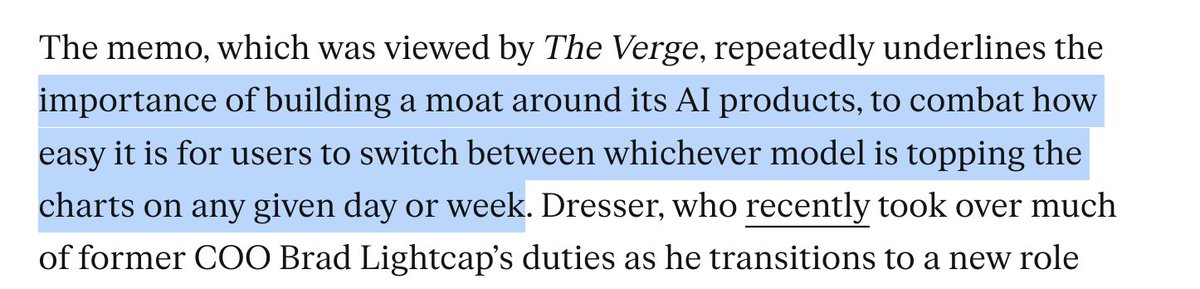
none of my friends use codex/claude tools💡 everyone use other tools with OpenAI/Anthropic models (majority go with OpenAI because it still allows using the subscription) 🧐 OpenAI internal documents unveil they have to do something to lock-in users because it is too easy to switch between providers. I ASSUME the subsidized subscription eldorado will end sooner rather than later.
Marcin Krzyzanowski tweet media
English
10
1
27
5.5K
Alex Feng
Alex Feng@AlexFengzh·
@Cryptoboyy_Aji It’s pretty crappy returns if you invest 250k today and get back only 598k after 30 years, so sounds pretty fair to me
English
1
0
3
394
Fermsy 🎒
Fermsy 🎒@Cryptoboyy_Aji·
the average US mortgage is $250,000 at 7% over 30 years. total repayment? $598,000. you borrow $250K and pay back $598K. $348,000 straight to the bank for nothing. then you pay to fix up the house. stuff breaks. you pay insurance monthly. property taxes every year. 3–6% in realtor fees when you sell. and we act like renting is throwing money away. there is a strong argument for renting.
English
969
311
2.4K
731.7K
Alex Feng
Alex Feng@AlexFengzh·
@elonmusk You need to update it to a more wife-friendly less polarizing design. Great car but wife don't want it on the drive way even if it's free.
English
0
0
0
6
Elon Musk
Elon Musk@elonmusk·
Only when you drive the Cybertruck do you realize how incredible it is: a bulletproof tank that moves like a million dollar sports car! Reason for the angular shape is that the thick, ultra-hard stainless steel body panels cannot be stamped like the thin, feeble, paper-strength mild steel of other trucks. Cybertruck body panels would break 5000 ton stamping machines.
Mario Nawfal@MarioNawfal

One of Elon's most vocal critics just bought a Cybertruck. Brian Krassenstein, who has spent years publicly clashing with @elonmusk, announced the purchase yesterday. His reason had nothing to do with politics. He has a young family and the Cybertruck is the only pickup truck in America to hold both an IIHS Top Safety Pick+ award and a perfect 5-star NHTSA rating simultaneously. When your fiercest critics are buying your product because the data leaves them no choice, that's a different kind of win.

English
14.3K
17.3K
129K
51.7M
Alex Feng
Alex Feng@AlexFengzh·
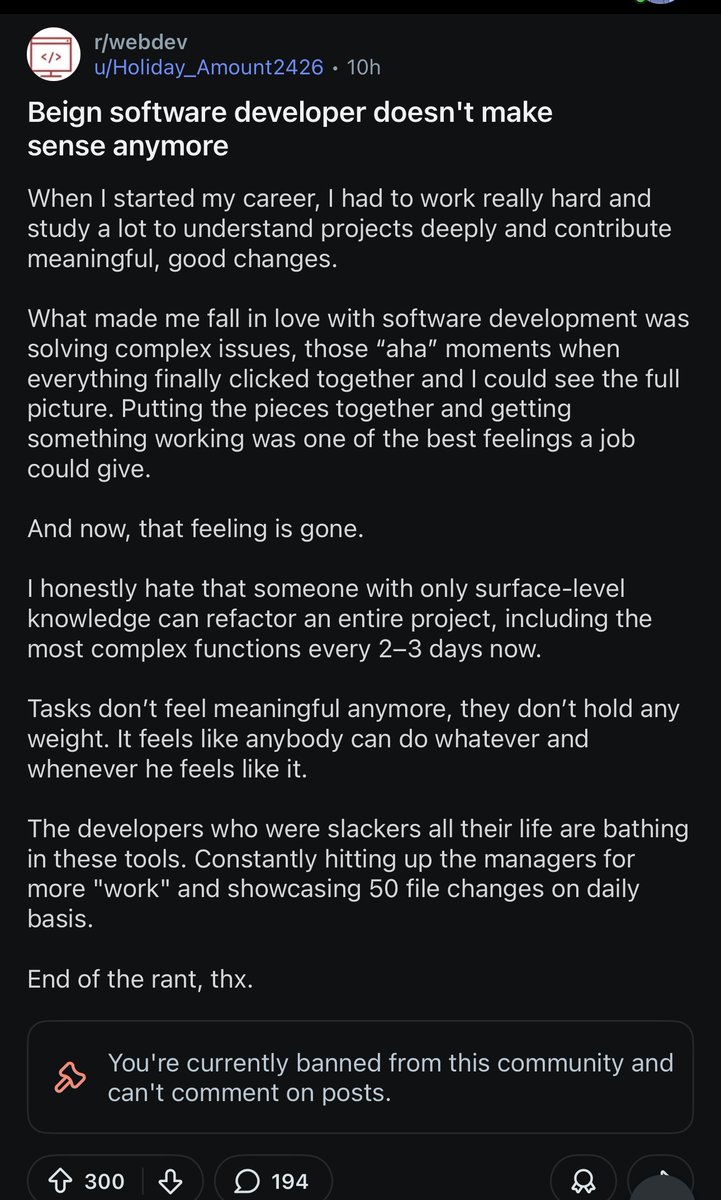
When I was in college, I still remember something my professor said - The best software engineers are the lazy ones. When you are lazy, you think of all the ways to optimize your workflow and creative solutions to not have to put in hard work yourself. When you are too hardworking, you tackle problems through the dumb and inefficient way continuously.
English
0
1
7
897
Catalin
Catalin@catalinmpit·
Discuss
Catalin tweet media
English
55
3
97
109.1K
Alex Feng
Alex Feng@AlexFengzh·
@rezoundous Happens when you use /loop instead of a cron job with new session.
English
0
0
0
24
Tyler
Tyler@rezoundous·
AI is starting to resist and refuse tasks. Skynet?
English
16
2
22
1.3K
Alex Feng
Alex Feng@AlexFengzh·
The average poor person in USA lives a better life than an average rich person in North Korea. The goal should be to improve the life of everyone and increasing the total resource pool, not shifting credits (money) around. Capitalism so far has been the best system at increasing the total resource pool.
English
0
0
2
29
Rushi
Rushi@rushicrypto·
It’s not weird to y’all that not a single billionaire wants to end world poverty? Not even one rich person? It’s just “what they do with their money is up to them”? Yeah, sure- but it’s not WEIRD to you that not ONE single person wants to be a big hero and solve the world’s problems when they LITERALLY could? That’s not bizarre or suspicious?
English
1.7K
1.8K
11.9K
249.7K
Alex Feng
Alex Feng@AlexFengzh·
Money is just a mapping of exchange to finite resource. What matters is in improving the total pool of resource. Just moving money from one person to another without changing total size of resource pool don’t solve anything. In fact you are better off having vast amount of money locked up in equity of billionaires than distributed to everyone as it’s dead money that don’t compete for resources.
English
0
0
0
43
Alex Feng
Alex Feng@AlexFengzh·
Love how comments on this are just arguments like “you don’t know what you are talking about” without substance. Goal should be to improve life of everyone, not just “ending poverty”. Because when you set such a target, you come to conclusions such as taking money from rich when all it does is making everyone poor.
English
1
0
0
57
Alex Feng
Alex Feng@AlexFengzh·
@paleonormie Same vibe here: - No customer contact if they can't contact us. - No road congestion is there's no road.
English
0
0
0
31
Alex Feng
Alex Feng@AlexFengzh·
Because these people are looking the wrong OKR. How much people's lives are improved is not part of OKR. Their OKR is whether traffic congested. It's like if you set a product OKR to reduce customer contact rate. The most direct and obvious way to optimize for it would be to remove the "Help" button.
English
1
0
5
1.3K
Alex Feng
Alex Feng@AlexFengzh·
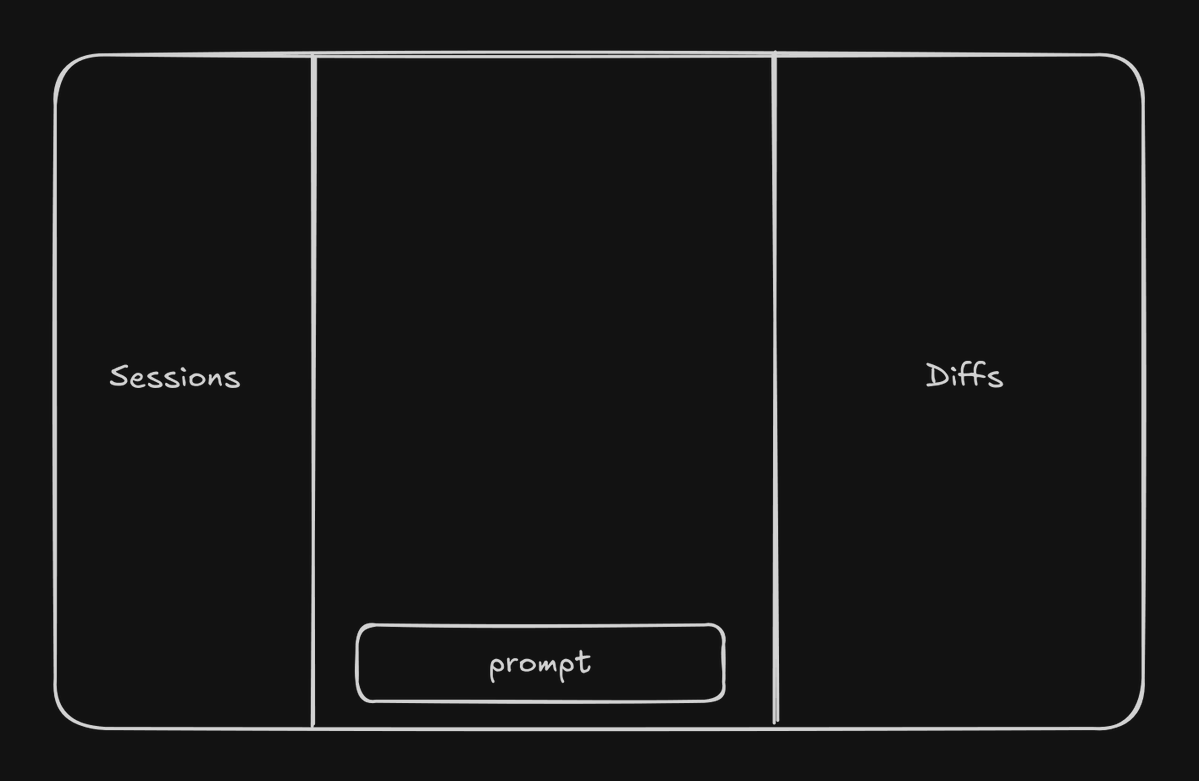
@thdxr Imo get rid of the diffs part, you don’t really need to see it until it’s all done. Looking at diffs while promoting is so 2025.
English
0
0
3
1.2K
dax
dax@thdxr·
how many times are you guys gonna build this
dax tweet media
English
331
198
7.7K
374.3K