

Alex Stuart
534 posts

Alex Stuart
@Alex_Stuart_APS
Cashed out my retirement to build a startup alone. Documenting the journey.
Los Angeles, CA Katılım Temmuz 2024
110 Takip Edilen224 Takipçiler


12 years ago, humble beginnings. No kitchen. No bathroom. No bed. No closet. This was the whole pad 😂

English
Alex Stuart retweetledi

Ever tried talking to your spending? 🤯
ExpenseEasy.app lets you chat with your money 💬
Try it. Tell us what it says 👇
Like, RT & comment — I’ll DM you a 1-month free subscription 🎁
#PersonalFinance #Claude #AI
English
The one who sits and reads all day rarely beats the one who gets out, rolls up their sleeves, and tries.
some things just can’t be learned from a book.
People will laugh at first. Some will roll their eyes. Others will tell you it’s not the smart way to do it.
But trial and error is the best teacher. Theres no better way to learn a lesson than to be humiliated.
Plus, when it comes to finding an edge—once it’s written down, it’s not really an edge anymore.
English
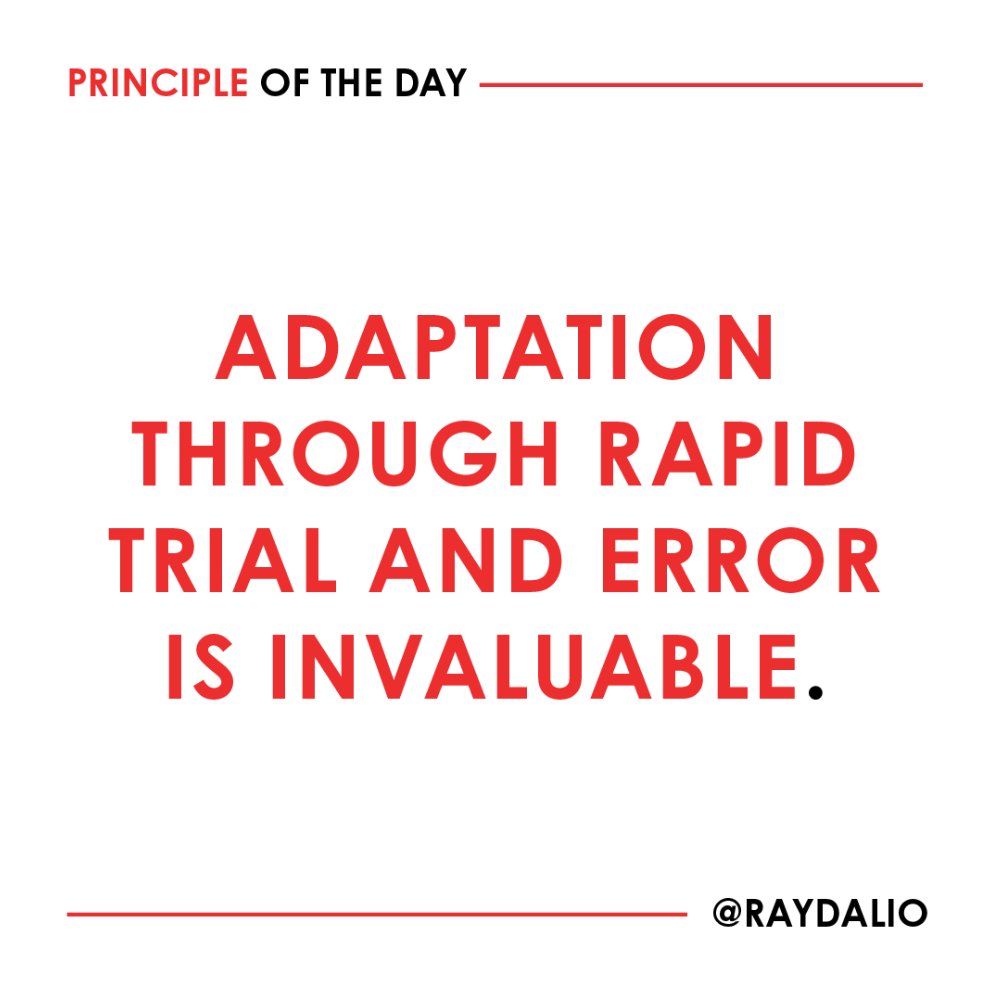
Natural selection’s trial-and-error process allows improvement without anyone understanding or guiding it. The same can apply to how we learn. There are at least three kinds of learning that foster evolution: memory-based learning (storing the information that comes in through one’s conscious mind so that we can recall it later); subconscious learning (the knowledge we take away from our experiences that never enters our conscious minds, though it affects our decision making); and “learning” that occurs without thinking at all, such as the changes in DNA that encode a species’ adaptations. I used to think that memory-based, conscious learning was the most powerful, but I’ve since come to understand that it produces less rapid progress than experimentation and adaptation. #principleoftheday
English


Shill me an AI project doing something different👀
English
@rxhit05 Onboarded 150+ in 2 weeks. Still trying to figure out the pricing for the screener, that seems to be the product that most people are excited to use. I just finished building it last night. I’m hoping to open it up on my server before the end of this week.
English


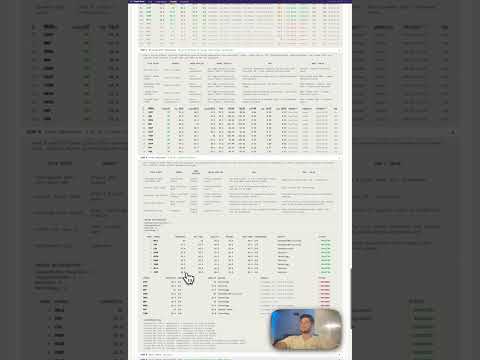
My scanner passed every test I ran. Then I ran a real trade and looked harder. Claude had been quietly lying by omission the whole time. I think it's finally working!
Built with Claude
Not lying exactly. Claude doesn't lie.
But it doesn't volunteer problems either. It answers what you ask and optimizes for the answer sounding good.
I asked: is the pipeline working? Claude said: yes.
What Claude didn't say: I built a cache and numerous fallbacks on your live data because it seemed more efficient and I didn't think you'd mind.
well.... I minded.
So I rebuilt the audit layer. Now every data point has to prove it's fresh. Every API response shows its fetch time and age. Every step surfaces its raw output before using it.
I can see every number in the system, where it came from, and when it was fetched. Claude can't hide optimization decisions in there anymore because there's nowhere to hide.
20 steps. Full transparency. Open source. github.com/Temple-Stuart/…
moral of the story: Claude is super cool, but you need to audit every single step of they way.. Just because something appears to be working, doesnt mean its actually working!
Here's how this works:
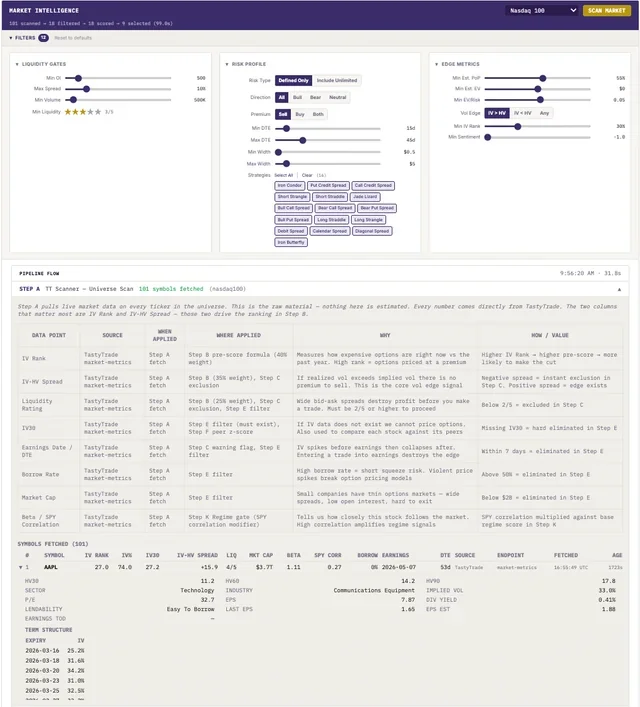
Step A pulls live market data on every ticker in the universe. This is the raw material — nothing here is estimated. Every number comes directly from TastyTrade. The two columns that matter most are IV Rank and IV-HV Spread — those two drive the ranking in Step B.
📷Step 1 (A) Scan Universe
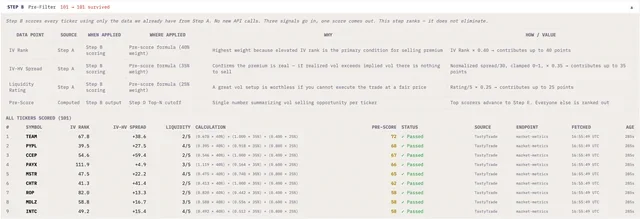
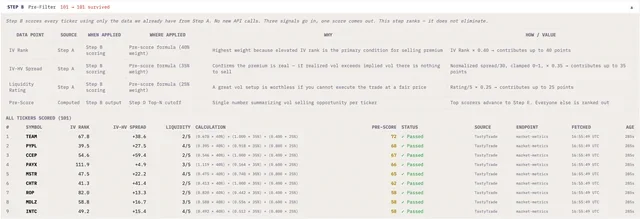
Step B scores every ticker using only the data we already have from Step A. No new API calls. Three signals go in, one score comes out. This step ranks — it does not eliminate.
📷Step 2 (B) - Pre Filter
Step C applies two instant disqualifiers. No partial credit. If a ticker fails either rule it is gone. This step eliminates — it does not score.
📷Step 3 (C) - Hard Exclusions
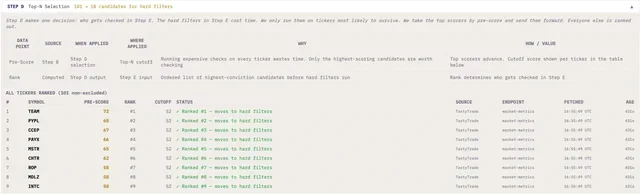
Step D makes one decision: who gets checked in Step E. The hard filters in Step E cost time. We only run them on tickers most likely to survive. We take the top scorers by pre-score and send them forward. Everyone else is ranked out.
📷Step 4 (D) - Top - N Selection
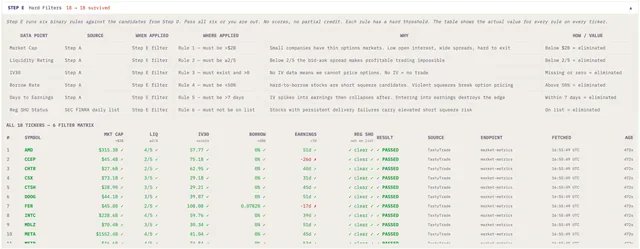
Step E runs six binary rules against the candidates from Step D. Pass all six or you are out. No scores, no partial credit. Each rule has a hard threshold. The table shows the actual value for every rule on every ticker.
📷Step 5 (E) - Hard Filters
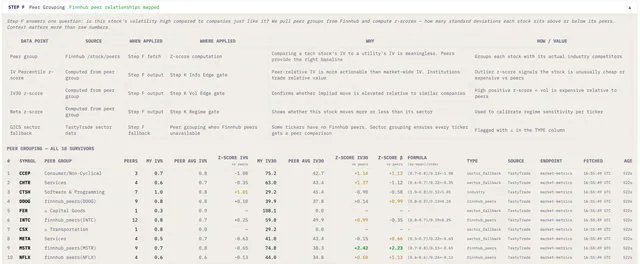
Step F answers one question: is this stock's volatility high compared to companies just like it? We pull peer groups from Finnhub and compute z-scores — how many standard deviations each stock sits above or below its peers. Context matters more than raw numbers.
📷Step 6 (F) - Peer Grouping
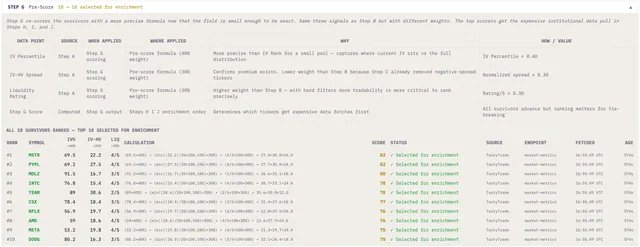
Step G re-scores the survivors with a more precise formula now that the field is small enough to be exact. Same three signals as Step B but with different weights. The top scorers get the expensive institutional data pull in Steps H, I, and J.
📷Step 7 (G) - Pre - Score
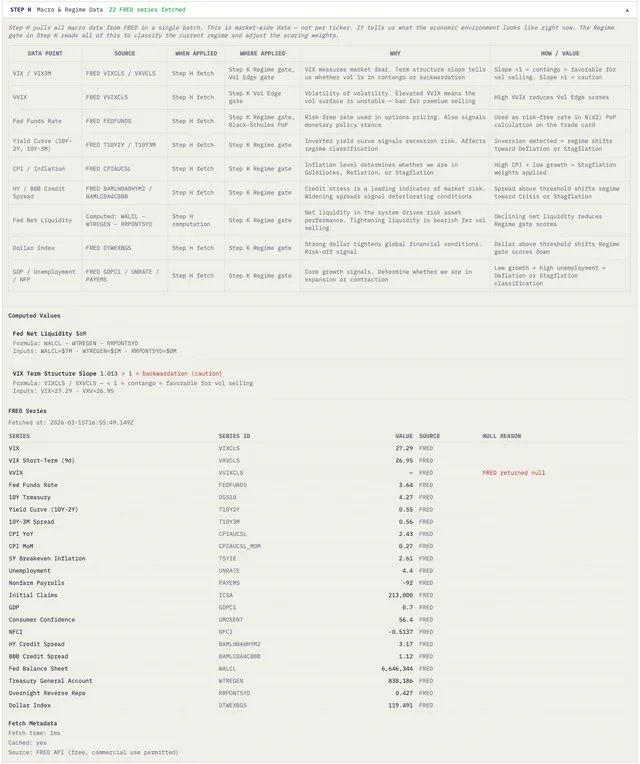
Step H pulls all macro data from FRED in a single batch. This is market-wide data — not per ticker. It tells us what the economic environment looks like right now. The Regime gate in Step K reads all of this to classify the current regime and adjust the scoring weights.
📷Step 8 (H) - Macro and Regime Data
Step I is the most expensive step. Multiple data sources per ticker. The question it answers is: why is IV elevated? A high IV rank tells you options are expensive. It does not tell you whether that is an opportunity or a warning. This step finds out.
📷Step 9 (I) - Data Enrichment
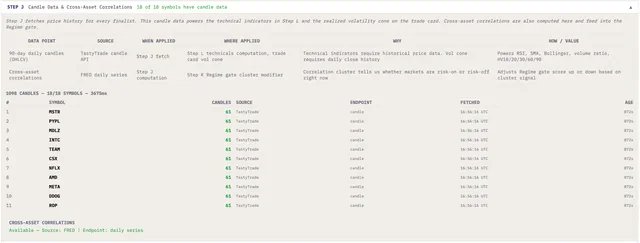
Step J fetches price history for every finalist. This candle data powers the technical indicators in Step L and the realized volatility cone on the trade card. Cross-asset correlations are also computed here and feed into the Regime gate.
📷Step 10 (J) - Candle Data & Cross-Asset Correlations
Step K scores every finalist 0 to 100 across four independent gates. Each gate looks at the stock from a completely different angle. The final score is a weighted average of all four. The weights shift based on the current macro regime.
📷Step 11 (K) - 4 - Gate Scoring
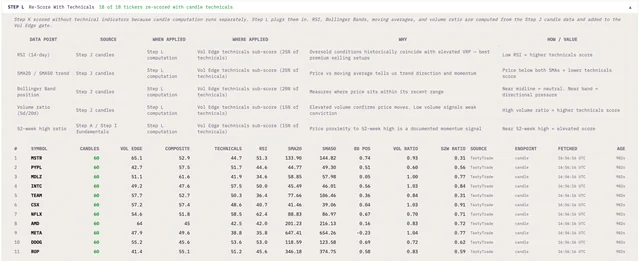
Step K scored without technical indicators because candle computation runs separately. Step L plugs them in. RSI, Bollinger Bands, moving averages, and volume ratio are computed from the Step J candle data and added to the Vol Edge gate.
📷Step 12 (L) - Re-Score with Technicals
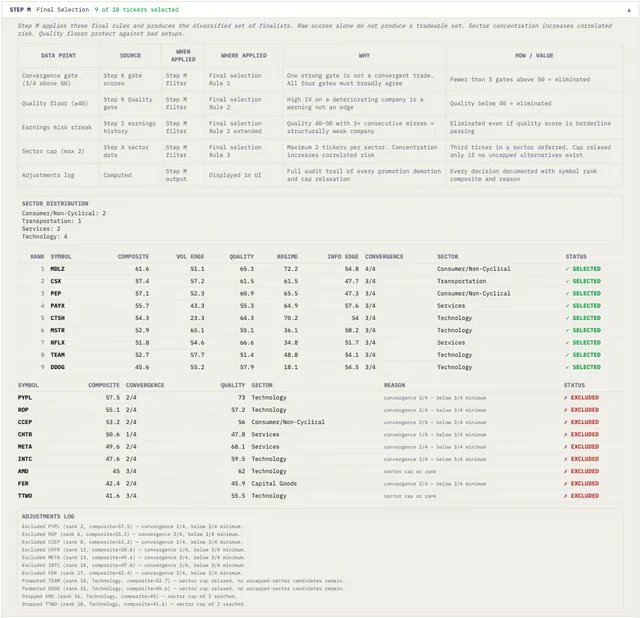
Step M applies three final rules and produces the diversified set of finalists. Raw scores alone do not produce a tradeable set. Sector concentration increases correlated risk. Quality floors protect against bad setups.
📷Step 13 (M) - Final Selection
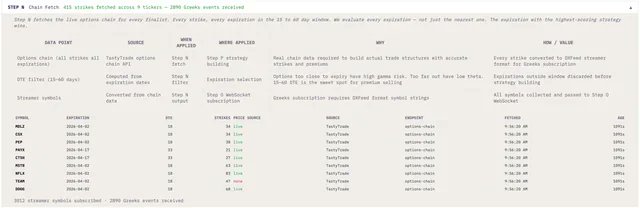
Step N fetches the live options chain for every finalist. Every strike, every expiration in the 15 to 60 day window. We evaluate every expiration — not just the nearest one. The expiration with the highest-scoring strategy wins.
📷Step 14 (N) - Chain Fetch
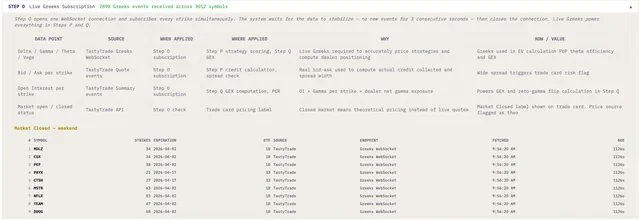
Step O opens one WebSocket connection and subscribes every strike simultaneously. The system waits for the data to stabilize — no new events for 3 consecutive seconds — then closes the connection. Live Greeks power everything in Steps P and Q.
📷Step 15 (O) Live Greeks Subscription
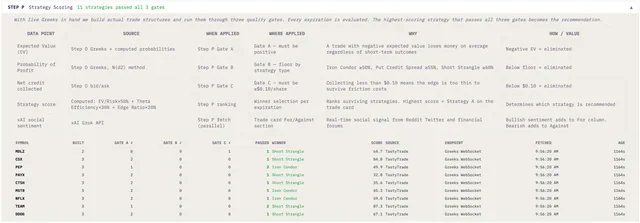
Step P With live Greeks in hand we build actual trade structures and run them through three quality gates. Every expiration is evaluated. The highest-scoring strategy that passes all three gates becomes the recommendation.
📷Step 16 (P) Strategy Scoring
Step Q computes live options flow and dealer positioning from the real chain data. These signals replace the estimates used in Steps K and L when Step R re-scores.
📷Step 17 (Q) Live Options Flow & GEX
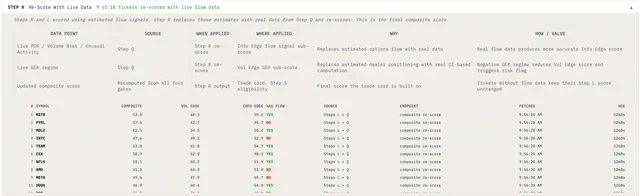
Steps K and L scored using estimated flow signals. Step R replaces those estimates with real data from Step Q and re-scores. This is the final composite score.
📷Step 18 (R) Re-Score with Live Data
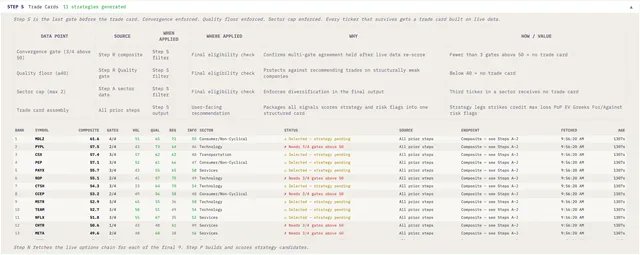
Step S is the last gate before the trade card. Convergence enforced. Quality floor enforced. Sector cap enforced. Every ticker that survives gets a trade card built on live data.
📷Step 19 (S) Trade Cards
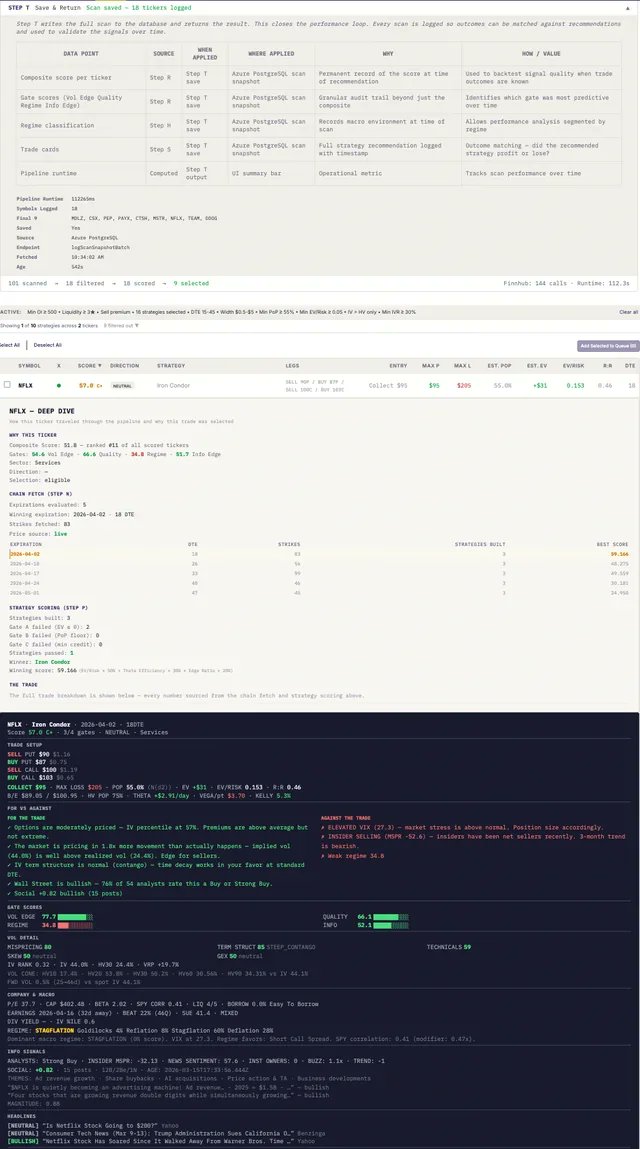
Step T writes the full scan to the database and returns the result. This closes the performance loop. Every scan is logged so outcomes can be matched against recommendations and used to validate the signals over time. Then produces trade cards
📷Step 20 (T) Save and Return
English


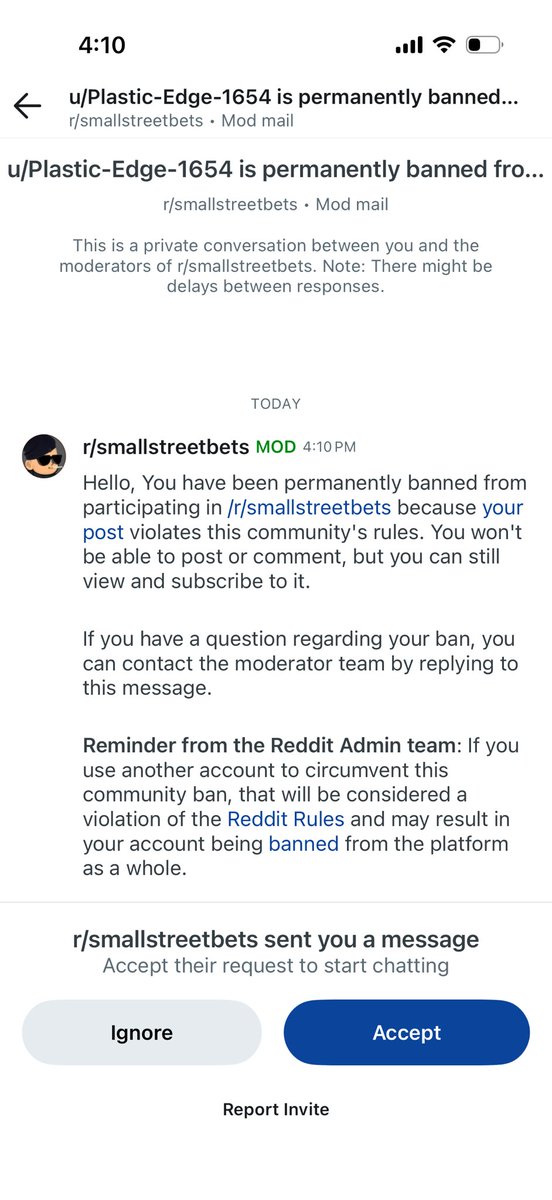
Wow… I guess building cool tools that people like and engage with gets you banned from group?
English