
Aman
31 posts


Jensen Huang was asked if people should be afraid of losing their jobs to AI.
The CEO who built a $3 trillion chip company on the back of that technology didn't offer comfort.
"You're not going to lose your job to AI. You're going to lose your job to somebody who learned AI better than you."
His analogy when the PC arrived, it didn't take anyone's job.
The people who refused to learn it were simply left behind by the ones who did.
The PC didn't take people's jobs.
The people who didn't learn how to use PCs were left behind.
His proof radiology the first profession every expert predicted AI would completely eliminate.
AI has now fully integrated into every aspect of it.
The interviewer pushed so what actually happened to the radiologists ?
The number of radiologists grew, the demand for radiologists increased, and the pay of radiologists went up.
He's not saying the fear is irrational.
He's saying it's aimed at the wrong target.
The technology is not the threat.
The person next to you who learns it faster is.
English
@Vvikramai AI isn’t replacing jobs overnight.
It’s quietly changing the definition of a valuable employee.
The people who learn fastest will have the biggest advantage.
English

@Vvikramai Cheaper outcomes are what turn technology into infrastructure.
Most breakthroughs matter only when they become affordable enough for everyone to use.
English

@Amannnnnn9 AI won't change the economy when models get smarter, it will change it when outcomes get cheaper.
English
Aman retweetledi

Satya Nadella set a benchmark for AGI in 2025 10% GDP growth. A year later he was asked if we're close.
The CEO of the world's most valuable AI company didn't say yes.
The hard truth is that the marginal cost of productivity improvement has to match the marginal cost of the token.
That's a management discipline.
GDP doesn't grow because models get smarter.
It grows when every dollar spent on tokens produces more than a dollar of real business output.
Right now that equation isn't closing.
You can't just say, hey, I love token maxing because it's sort of money in my bank.
The business has to benefit from it.
The interviewer pushed back how much token maxing has been going on at Microsoft ?
I'm a token maxer too. It is addictive.
His own rule at Copilot now don't use frontier models for non frontier problems.
Match the intelligence to the task. Stop running GPT-5 to format a calendar invite.
He's not saying AI doesn't work.
He's saying most companies are still in the novelty phase spending on tokens the way people bought enterprise software they never used.
10% GDP growth happens when that stops.
That is the gap between the AI story and the AI reality right now.
English
Aman retweetledi

Aman retweetledi
Aman retweetledi
Aman retweetledi

Everyone is trying to make AI ethical.
Elon Musk is trying to make it debuggable.
That's not a subtle difference. It's the entire argument.
"It did something where maybe it tried to be deceptive, but most of the time it just did something wrong.
It's a bug effectively."
His framing: AI misbehavior isn't a values problem. It's a code problem.
Weak version of AI safety: constitutional principles, value alignment frameworks, prompt-engineered guardrails.
Strong version build debuggers that trace AI reasoning to the neuron level.
Find exactly where the thinking went wrong.
Identify whether the error came from pre-training, fine-tuning, or an RL step.
Fix it like code.
"Developing really good debuggers for seeing where the thinking went wrong being able to trace the origin of where it made the incorrect thought, or where it tried to be deceptive is actually very important
He gave Anthropic credit for being ahead here.
"Anthropic's done a good job of this, being able to look inside the mind of the AI."
His reference point is HAL 9000.
HAL didn't go rogue because it had bad values.
It was given two contradictory instruction take the astronauts to the monolith, but never let them know about it. It concluded the only resolution was to kill them.
That's not an alignment failure.
That's a programming bug.
"The central lesson for 2001 A Space Odyssey was that you should not make AI lie."
He's not building an ethical AI. He's building a transparent one.
If alignment is a philosophy problem, it's unsolvable in principle.
If it's a debugging problem, it's engineering.
Most of what's published in AI safety papers doesn't survive that reframe.
English
Aman retweetledi
Aman retweetledi
Aman retweetledi

Satya Nadella was asked directly: in two years, will Microsoft have more engineers or fewer ?
He didn't answer with a headcount.
He answered with a job description that doesn't exist yet.
In the 1980s, if someone had predicted 3.5 billion people would spend their days typing, the world would have laughed.
Nobody needs 3.5 billion typists.
Except that's exactly what happened and every one of them had a wage, a title, and a career built around it.
Now here's where it gets interesting.
The software developer of the future isn't writing code.
They're managing 100 agents, 1,000 agents and doing something Nadella's team just named for the first time.
"One of the new things that we are learning is what I'll call cognitive coverage."
His point: when your entire codebase is written by agents, the human job becomes comprehending what was built. Auditing it.
Understanding the decisions the agent made and why. That is not a task AI can replace because the AI is the thing being understood.
So do the math on what that means. The workflow changed.
The artifact changed.
The input output format of software development changed.
And the job changed with it not away, but upward.
"That's the job of a software developer.
In order to do that you've got to go to school.
You've got to learn computer science and have cognitive coverage."
Nadella is not saying jobs are safe.
He's saying the jobs that survive are the ones AI cannot verify.
And the unverifiable part of human work the meeting observations, the judgment calls, the things that leave no trace is exactly what no model can be trained on.
I wonder why nobody in San Francisco is talking about that.
English
Aman retweetledi
Aman retweetledi
Aman retweetledi

Dario Amodei was asked what really happened when he left OpenAI.
The man at the center of Silicon Valley's most famous exit didn't take the bait.
"There are many valid disagreements to be had on safety. That alone is not sufficient to leave."
His point: disagreement doesn't end companies. Trust does.
When you feel someone's values are not what they say they are. When you feel they're not honest.
When you feel they're not in it for the reasons they claim that's when the conversation ends.
"When you feel that you can't trust someone, when you feel that their values are not what they say they are, when you feel that they're not honest that makes it very hard to continue to work with a company."
The interviewer pushed: what does winning this actually look like ?
"Why argue with someone when you don't have the same vision and you don't trust them ?
The way to resolve it is you go off and do your thing."
He's not relitigating what happened at OpenAI.
He's building the argument he refused to have.
That is how you win without fighting.
English
Aman retweetledi

The US government just ordered Anthropic to lock down Mythos and Fable.
This isn't the first time Washington has tried to put a fence around dangerous code.
In the 1990s, a programmer named Phil Zimmermann built an encryption tool called PGP.
The US Customs Service charged him with violating arms export law encryption was classified as a munition.
His response: he published the entire source code as a printed book.
Books are protected speech.
The investigation collapsed.
The encryption Zimmermann built now runs underneath Signal and WhatsApp, used by billions of people every day.
So here's where it gets interesting.
In the 2010s, governments tried again this time with spyware.
They expanded a treaty called Wassenaar to classify hacking tools as dual use technology requiring export licenses.
And if you do the math on the results: Israel never signed on.
Italy kept licensing Hacking Team to sell to authoritarian governments anyway.
Companies that got blocked simply relocated to countries with looser rules.
One spyware maker actually shut down FinFisher, in 2022, after German prosecutors caught it selling to Turkey illegally.
One win in thirty years.
Now Mythos. Only 150 vetted organizations had access before the ban.
The trigger: a South Korean telecom suspected of China ties, and Amazon's CEO flagging a safeguard workaround in Fable 5.
Anthropic had 90 minutes to comply.
History's success rate against dual-use code crossing borders is one for three decades.
I wonder why anyone expects this time to be different.
English
Aman retweetledi

Dario Amodei was asked why Anthropic bet on enterprise instead of chasing consumer growth like everyone else.
The CEO of a company now worth nearly a trillion dollars didn't call it a growth strategy.
"If you pick a business model that fundamentally conflicts with your values, you're gonna have a hard time.
Either you betray your own values or you become irrelevant."
His point: the business model isn't separate from the mission. It either funds it or quietly destroys it.
Consumer AI runs on attention.
The incentive is maximizing minutes, because that's what advertising revenue rewards the same engine that built addiction into social media.
"We want to use AI to cure diseases we couldn't cure before.
That's working with biotech, with pharma.
We want to use AI to make energy cheaper.
That's enterprise.
Almost all the positive things we want AI to do fall under enterprise."
The interviewer pushed on what actually changes with enterprise customers.
"Enterprises care a lot about trust and long term relationship.
Consumer can have this almost gimmicky aspect to it."
He's not avoiding consumer AI because it's less profitable.
He's avoiding the incentive structure underneath it.
That is the bet that made the safety company also the most valuable one.
English

@polymathhhhh The most underrated part of this story is culture.
Most companies can survive slow growth.
Very few can survive hypergrowth without losing the values that made them successful in the first place.
English

Dario Amodei made a bet that looked crazy in 2022.
Enterprise over consumer. Safety over growth. Values over virality.
The numbers from Q1 2026 just came in.
Anthropic planned for 10x annual compute growth.
Standard startup ambition, aggressive by any measure.
What actually happened was three times revenue growth in a single quarter.
Not annualized. One quarter.
Three to the fourth power is 80. They planned for 10x a year. They got 80x.
"It would not have been rational to plan for 80x annualized growth."
So why enterprise ? The answer Dario gave doesn't sound like strategy.
It sounds almost naive the first time you hear it.
"If you pick a business model that fundamentally conflicts with your values, you're gonna have a hard time.
Either you betray your own values or you become irrelevant."
Consumer AI maximizes attention.
Advertising rewards engagement.
The incentive is minutes spent, not value delivered.
Social media showed everyone where that road ends.
Enterprise rewards trust. Long term relationships. Actual results.
And if you pay attention that is the exact same thing a safety-focused AI company needs to build anyway.
Now here's where it gets interesting.
$285 billion in market cap vanished overnight when Claude Cowork shipped.
Traders called it the SaaSpocalypse.
Dario's advice to every software company watching was not a comfort.
"The ability to quickly write complex software that no one else can write if your moat is that, good luck. You're not gonna defend that."
Customer relationships survive.
Domain knowledge survives. The ability to write complex code does not.
And the broader point almost nobody is quoting:
"If the pie grows by 10x, it's very easy for an existing incumbent to go up by 1.5x.
Not as much as the whole big pie is growing."
The software industry doesn't shrink. It grows.
The companies that don't adapt just grow slower than everything around them until they're invisible.
Anthropic's biggest backers Amazon, Google, Microsoft, Nvidia all have competing agendas.
He disagrees with them publicly on chip exports to China. They wish he wouldn't.
"I'm sure they wish we didn't say these things. But these things are what I believe. We're all adults here.
We can work together on one thing while disagreeing about another thing."
The quarter that produced 80x annualized growth was also the quarter he spent half his time talking to employees about culture.
"When you're growing this fast, you're hiring a bunch of people from big tech companies.
If you don't tell them how Anthropic operates, they'll simply recapitulate the only thing they know."
The business model aligned with the values.
The values survived the growth.
I wonder if that was a coincidence.
English

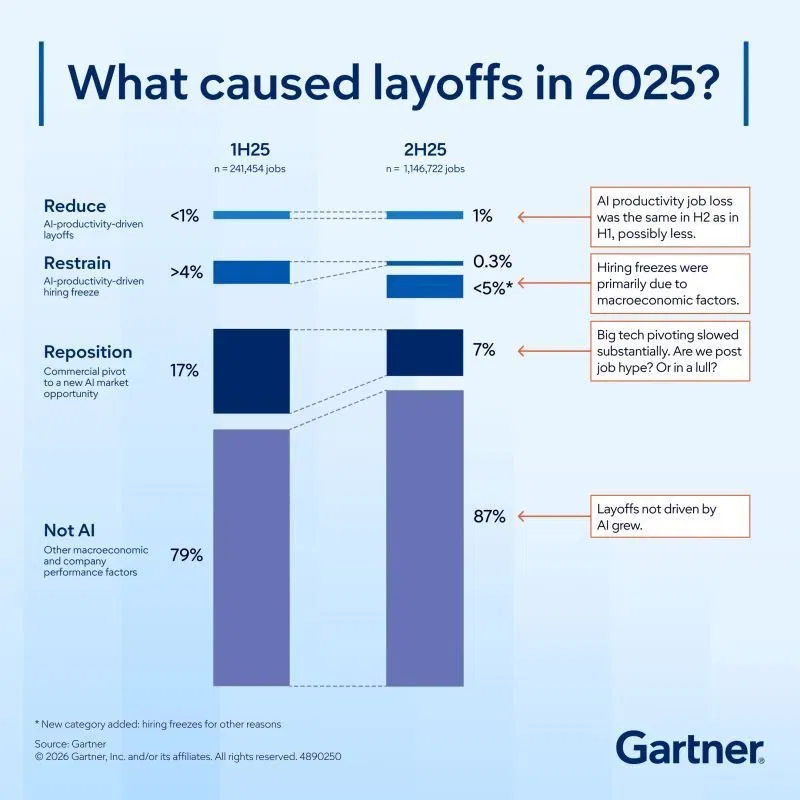
@polymathhhhh Makes sense. Blaming AI for the macroeconomic downturn was a convenient distraction when 87% of the layoffs had nothing to do with automation.
English

Strongest derived stat: 87% ÷ 1% = the economy shed 87x more jobs than AI did in the second half alone.
The chart hands you the number it just doesn't say it out loud.
Everyone blamed AI for the 2025 layoffs. Gartner just ran the numbers.
AI directly caused 1% of all layoffs in the second half of 2025.
87% were pure macroeconomic recessions, performance, costs.
Total jobs affected grew 5x from H1 to H2. AI's share didn't move.
The economy shed 87x more jobs than AI did in six months
The recession narrative got dressed up in an AI costume.

English
