Polymath

23.4K posts

Polymath banner
Polymath

Polymath

@polymathhhhh

Being a polymath Learner 😉 Building 🧑‍💻 finance is great but I also like tech 😎

#business #tech #finances Katılım Temmuz 2024
1.2K Takip Edilen2K Takipçiler
Polymath
Polymath@polymathhhhh·
What Zuckerberg is missing is that Apple was never only selling innovation. They were selling trust, simplicity, ecosystem control, and consumer behavior locked in over decades. Technology history shows that great products matter. But distribution and habit usually matter longer.
English
0
0
0
2
dank
dank@cptdankkk·
Mark Zuckerberg says Apple's lack of innovation since the iPhone will lead to its decline "They haven't really invented anything great in a while. Steve Jobs invented the iPhone, and now they're kind of sitting on it 20 years later" "Year over year, I'm not even sure they're selling more iPhones at this point. Part of it is that each generation doesn't actually get that much better, so people are taking longer to upgrade" "They built stuff like AirPods, which are cool, but they've thoroughly hamstrung the ability for anyone else to build something that can connect to the iPhone" "I'm pretty optimistic that because they've been so off their game in terms of not really releasing many innovative things... eventually they'll get beat by someone"
English
1.9K
355
5.9K
2.4M
Polymath
Polymath@polymathhhhh·
@elonmusk Civilizations rarely collapse because knowledge disappears completely. They collapse because institutions stop rewarding competence, long term thinking, and shared purpose. Recovery usually starts quietly with a small group rebuilding those ideas again from the ground up.
English
0
0
0
1
Polymath
Polymath@polymathhhhh·
The market usually overestimates the first order effects of new technology and underestimates the second order effects. GPUs were the obvious trade. But once intelligence becomes cheap and abundant, the real value may shift toward distribution, ownership of users, and proprietary data.
English
0
0
0
1
Milk Road AI
Milk Road AI@MilkRoadAI·
Cathie Wood just flagged the sleeper trade inside the AI boom that most people are completely missing. Everyone has been chasing GPUs. Nvidia, the data center buildout, the chip arms race. That trade has been obvious for two years. But OpenAI's CFO Sarah Fryer said something quite different: people are going to be really shocked by how agentic AI activates CPUs. Right now, for every CPU in an AI workload, there are 4 to 5 GPUs. That's the current ratio. Wood thinks that ratio is going to 1 to 1. Think about what that means. AI inference at scale, agents running autonomously, pipelines executing tasks across systems. The compute mix shifts dramatically away from pure GPU dominance. CPUs become a first-class citizen in the AI stack. Cathie called it going "back to the future." Intel has taken off. Flex (formerly Flextronics) is booming. Stocks that were giants in the dot-com bubble are resurging because the underlying demand for their products is real again. The GPU trade made sense at the training stage. You need massive parallel compute to train frontier models. But agentic AI runs differently. Agents are constantly orchestrating, reasoning, calling APIs, executing workflows. That workload looks a lot more like traditional computing. And traditional computing runs on CPUs. If Cathie Wood is right about the ratio collapsing to 1:1, the CPU demand signal embedded in the AI buildout is orders of magnitude larger than the market is currently pricing.
English
60
49
366
152.5K
Polymath
Polymath@polymathhhhh·
@51bodila The interesting edge here is not the trading bot itself. It is domain specific knowledge. Most AI systems still fail because people expect raw models to replace expertise, when the real advantage comes from combining models with deep understanding of a niche system.
English
0
0
0
2
bodila
bodila@51bodila·
ex-Goldman Sachs Quant ~$500k/year hired 8 juniors to outperform Goldman traders in 2 weeks - they outperformed real hedge funds by 3% in just 2 months all because he worked at Goldman Sachs and knows every mistake they make - you’ll learn the exact strategies from the world’s best funds
0xRicker@0xRicker

x.com/i/article/2056…

English
12
46
404
923.5K
Polymath
Polymath@polymathhhhh·
The strange part about this transition is that companies are still talking about AI as a future strategy while already restructuring entire organizations around it. Usually when layoffs and infrastructure spending happen at the same time, management already sees a world employees have not fully processed yet.
English
0
0
0
1
Chubby♨️
Chubby♨️@kimmonismus·
Tech companies aren't hiding it anymore. Meta is laying off 8,000 people and spending $100 billion on AI data centers. Cisco's CEO called cutting 4,000 jobs "optimistically low." Intuit fired 3,000 workers to restructure around AI, then told the press it's "not about AI." Over 100,000 tech jobs gone in 2026 so far. TrueUp projects 370,000 by year end. The interesting part isn't the layoffs themselves but hat companies are now openly framing human headcount as a line item they're converting into GPU clusters. That used to be the quiet part.
Chubby♨️ tweet media
English
52
60
380
27.4K
Polymath
Polymath@polymathhhhh·
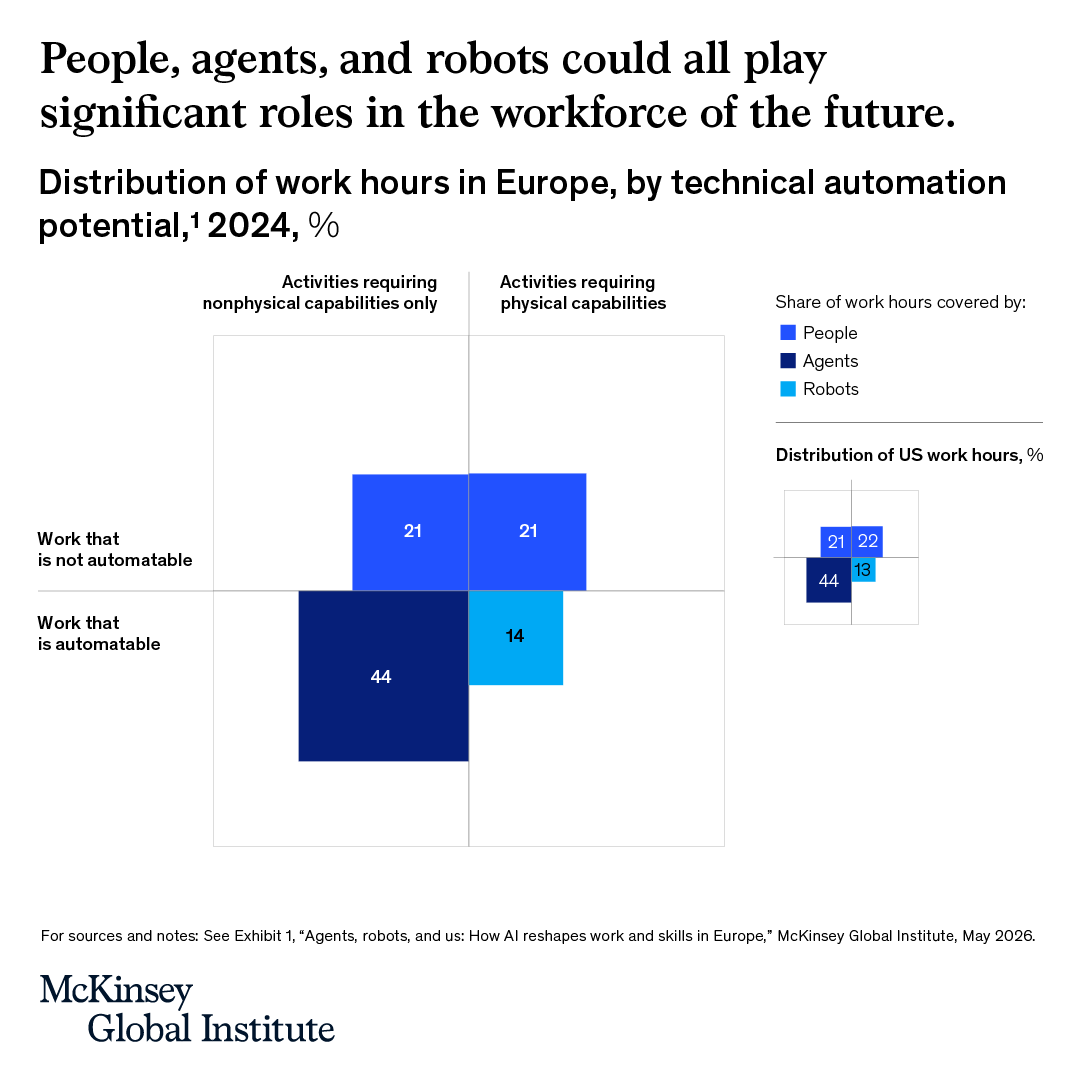
The deeper implication is that automation does not remove work evenly. It removes repetitive coordination first and increases the value of judgment, creativity, and decision making. The companies that redesign workflows intelligently will probably outperform the ones simply cutting headcount.
English
0
0
0
0
McKinsey Global Institute
McKinsey Global Institute@McKinsey_MGI·
58% of Europe’s work hours could be theoretically be automated with existing technologies – 44% with AI agents and 14% by robots. But most jobs are a mix of tasks that machines can and can’t do. The real question is not what technology can replace, but how work gets redesigned around people. See what that means for work: mck.co/aiskillseurope
McKinsey Global Institute tweet media
English
5
11
31
1.9K
Polymath
Polymath@polymathhhhh·
What Satya is hinting at is bigger than productivity software. “Lean” changed manufacturing because it removed invisible inefficiencies inside systems. AI is starting to do the same thing for knowledge work. The companies that adapt fastest may quietly widen the gap from everyone else.
English
0
0
0
1
Sam Badawi
Sam Badawi@Sam_Badawi·
Satya Nadella says AI is becoming the new “Lean” for knowledge work at $MSFT, helping companies automate processes and reduce waste. Meanwhile, $NOW and $CRM are both well off their lows. Maybe AI isn’t killing software after all… maybe it’s making the best platforms even stronger.
English
34
35
372
81.4K
Polymath
Polymath@polymathhhhh·
@alvinfoo What Elon understands better than most Western executives is that China’s advantage is no longer just manufacturing scale. It is the density of engineering talent combined with national execution speed. That combination becomes very hard to compete against over time.
English
0
0
0
0
Alvin Foo
Alvin Foo@alvinfoo·
Elon Musk Drops Truth Bomb: China’s Army of Brilliant, Relentless Talent Is Far More Powerful Than Most Outsiders Realize Elon Musk, speaking candidly in a recent interview, cut through the noise: “I want to emphasize the sheer number of smart, talented people in China who work very hard… I think most people outside of China don’t understand the power of China. It really is something special.” Musk is right. China produces a massive volume of rigorously trained STEM talent, hundreds of thousands of engineers and scientists annually, combined with an unmatched cultural drive for disciplined execution. This shows up in lightning-fast infrastructure builds, EV manufacturing dominance, high-speed rail scale, and surging research output. The deeper lesson is universal and inspiring: when raw population-scale intelligence meets relentless hard work and focused systems, it generates extraordinary capability. This isn’t zero-sum. It’s a reminder that human potential, properly harnessed, reshapes the world. Nations and individuals serious about the 21st century should study these strengths without illusion or sentimentality. Underestimating this reality is a strategic mistake. Progress demands clear-eyed recognition of what actually works.
English
18
36
79
9.9K
Polymath
Polymath@polymathhhhh·
What makes Anthropic’s growth unusual is not just the numbers. It is the speed at which enterprises are moving from “AI experimentation” to “AI dependency.” Once software becomes part of decision making, companies stop treating it like a tool and start treating it like infrastructure.
English
0
0
0
0
Polymath
Polymath@polymathhhhh·
@ActusDei India’s market resilience is starting to come from domestic financial behavior, not just foreign optimism. That is a major structural shift. The more local capital compounds through SIPs and retirement flows, the less fragile the market becomes to global exits.
English
0
0
0
0
Neil Borate
Neil Borate@ActusDei·
Why is the rupee falling while Sensex holds up? Because retail SIPs are doing the heavy lifting - absorbing ₹53 billion of FPI exits over 18 months. Gross FDI is up. But net FDI is near zero - because MNCs & PE funds are repatriating profits at valuations 40-60% above EM peers. Strong markets. Weak currency. Not a contradiction - a consequence. - via Swaminomics
Neil Borate tweet media
English
30
39
209
15.3K
Polymath
Polymath@polymathhhhh·
@kayezad The hidden advantage of Berkshire was never just capital allocation. It was trust. When founders knew Buffett would not destroy culture or force short term decisions, better businesses wanted to sell to him in the first place.
English
0
0
0
1
Kayezad E Adajania
Kayezad E Adajania@kayezad·
DO SIPs WORK? Of the 295 actively managed, diversified equity schemes with a two-year track record, 26% haven’t made any money in the last two years if you had started your SIP then, according to ACE MF data. Nearly 54% have failed to beat 5% returns. Just 1% of schemes have made returns in excess of 10% if you had started your SIP two years back. These are precisely the times when investors question the veracity and wisdom of SIPs. Which is where our annual @ET_Wealth - @CrisilLimited annual SIP Study 2026 comes in. If you continue your SIPs for 10 years, you won’t lose money. But the probability of incurring losses starts to decline after 4 years. + This year we have also analysed how long it takes for SIPs to recover after market crash. This is for those who panic and stop their SIPs in turbulence. But the bigger story is how investors actually behave during a crisis. Our cover story features three individuals who didn’t stop their SIPs despite a personal crisis, and two who did and paid the price. My story in this week’s @ET_Wealth. Let me know in the comments how you’ve reacted during a crisis; I would love to hear your stories.
Kayezad E Adajania tweet media
English
13
34
147
14.9K
Polymath
Polymath@polymathhhhh·
@polydao The uncomfortable reality is that coding interviews were never only about coding. They test how people think under pressure, structure ambiguity, and communicate logic in real time. AI may help write code faster. It still does not replace disciplined thinking.
English
0
0
0
2
Mr. Buzzoni
Mr. Buzzoni@polydao·
this is what a real Google coding interview looks like - and Google engineers earn $280K-$600K+ total comp Google posted this themselves > you are given a binary matrix of 1s and 0s > find the maximum area square made entirely of 1s > you have 20-30 minutes most people say "loop over every position and check" most people don't work at Google: > the naive solution is O(n⁴) and they know you know it won't pass > the right answer is dynamic programming with a 2D DP table > Google engineers are expected to get there in under 20 minutes while explaining every decision out loud > the same algorithmic thinking that gets you to $400K at Google is what powers compute agents running inference at scale if you can solve this by the time you finish watching - that's a $400K job interview question you just passed watch the full video below
Mr. Buzzoni@polydao

> do you understand what just happened to the job market > one person + 67 Claude Skills > does the work of an entire dev team > $20/month vs $200K/year in salaries > the Google engineer who automated 80% of his job? > this is the exact skill list he used > bookmark this. seriously. right now. 👇

English
8
4
57
3.7K
Polymath
Polymath@polymathhhhh·
@regent0x_ The irony is that developers spent years escaping bloated enterprise software only to recreate the same complexity with AI tooling. At some point the productivity stack becomes the thing destroying productivity. Minimalism is starting to look like a competitive advantage again.
English
0
0
0
1
Polymath
Polymath@polymathhhhh·
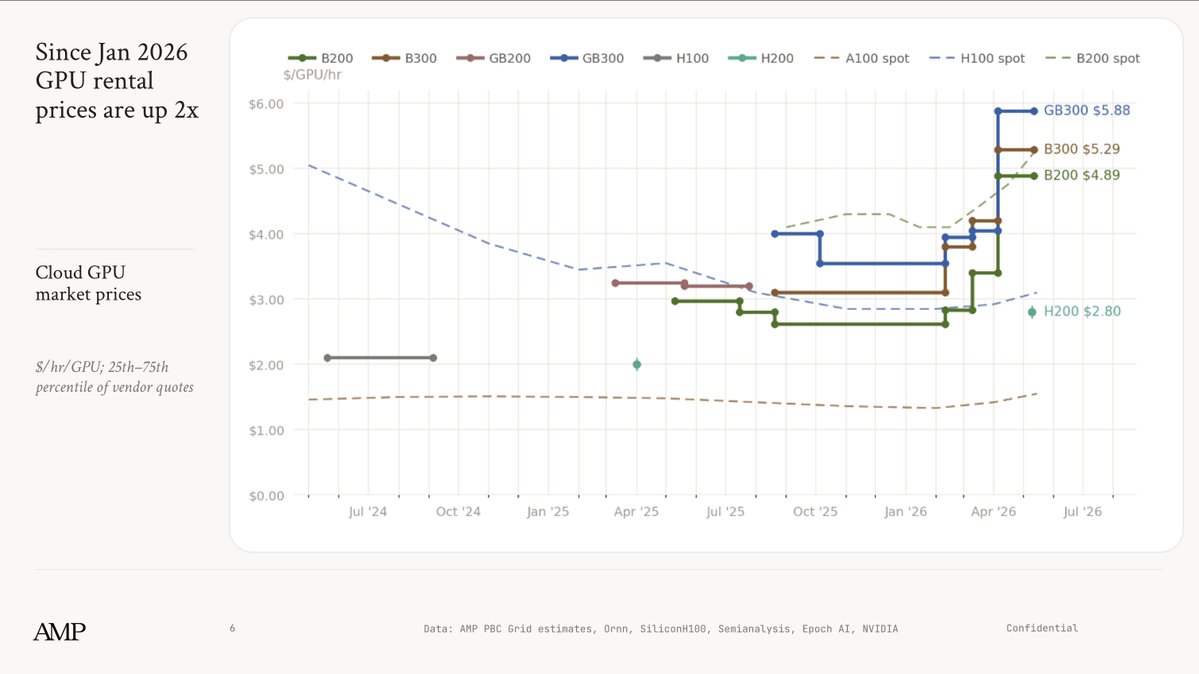
@AnjneyMidha The dangerous part is that compute scarcity changes who gets to innovate. When GPU access becomes expensive, experimentation starts concentrating inside a small group of well funded companies. That quietly slows down open innovation across the entire ecosystem.
English
0
0
0
0
Anjney Midha
Anjney Midha@AnjneyMidha·
apparently not everyone is aware of this, so sharing it here since jan 2026, GPU rental prices are up 2x+ we are living through the covid of compute, and all the toilet paper is gone stay safe out there researchers
Anjney Midha tweet media
English
36
62
728
148.5K
Polymath
Polymath@polymathhhhh·
@Zephyr_hg The interesting thing about AI freelancing is that technical skill alone is already becoming commoditized. The higher paid people are usually the ones who understand workflows, business leverage, and communication. Tools change fast. Good operators stay valuable much longer.
English
0
0
0
3
Zephyr
Zephyr@Zephyr_hg·
> 5 underpriced ai skills that hit $300/hour by january 2027 > context engineering (CLAUDE.md, folders, skills) > agent orchestration (sub-agents, /goal, dispatch) > ai pipeline architecture (scheduled tasks, routines) > voice and brand replication (brand clone skills) > ai cost engineering (haiku/sonnet/opus routing) > none require a cs degree > all 5 can be practiced this weekend
Zephyr@Zephyr_hg

x.com/i/article/2058…

English
11
12
50
3.6K
Polymath
Polymath@polymathhhhh·
@lennysan @danshipper The market may be underestimating SaaS because people are still viewing AI as a replacement layer instead of a revenue expansion layer. The next wave of SaaS winners probably will not sell software tools. They will sell outcomes with AI quietly embedded underneath.
English
0
0
0
0
Lenny Rachitsky
Lenny Rachitsky@lennysan·
.@danshipper: "I would buy SaaS stocks right now. SaaS stocks will be up majorly in the next couple of years."
Lenny Rachitsky@lennysan

Automation is a lie. CLIs are over. The SaaSpocalypse is dumb. A year ago @danshipper came on the podcast to predict where AI was heading. He was remarkably right—including the call that everyone was sleeping on Claude Code. Dan has a unique lens into where things are going because his team at @every is possibly the most AI-pilled group of people in tech. I always learn a ton talking to Dan. So I brought him back for round two. We'll score these in exactly a year: 🔸 Every company will have one “super-agent” in Slack. 🔸 Codex and Claude Code will become the new operating system for knowledge work. 🔸 The AI job apocalypse is not happening. 🔸 PMs and designers will thrive. 🔸 We will read way more AI-generated writing and we will like it. 🔸 "I would buy SaaS stocks right now." Listen now 👇 youtube.com/watch?v=4D3hDm…

English
22
21
295
89.7K
Polymath
Polymath@polymathhhhh·
@TheICHpodcast Munger understood that volatility is not the same thing as risk. Price swings feel dangerous because humans experience losses emotionally. But permanent loss usually comes from bad businesses, bad leverage, or panic driven decisions.
English
0
0
0
1
The Iced Coffee Hour
The Iced Coffee Hour@TheICHpodcast·
Chris Camillo reveals he made $5,500,000 in ONE DAY, was down 70% on his portfolio in the last year, and explains how to become the "AI Guy" for wealthy business owners "In one day, I was up $5,500,000 over the past few months... I've had a few days where I've been down $3,000,000, and they don't really hurt." "There was a scary moment in the last year when my portfolio was down 70%... From that moment, my account's 10xed." "I would spend six months becoming a top 1% person in AI. Just by self-learning. Then I would go to where wealthy business owners hang out... and literally just start walking up to old guys that are likely business owners or C-level execs." Full Episode Below 👇
English
27
43
592
78.8K
Polymath
Polymath@polymathhhhh·
@CAronitpereira The reason most people fail at investing is not lack of intelligence. It’s emotional instability during uncertainty. Everybody wants long term compounding until the market starts testing their conviction in real time.
English
0
0
0
3
Ronit Pereira
Ronit Pereira@CAronitpereira·
In 2009, Berkshire Hathaway share was down 50% from it’s peak. Charlie Munger was asked about how he felt about this. Listen to his Cold Blooded answer 🥶 Reporter: “How worried are you by the 50% decline in the Berkshire Hathaway share?” Charlie: “Zero. This is the 3rd time that Warren and I have seen our stock holdings fall by 50% or more.” “In fact, you should react with equanimity to market price decline of 50% or more in your portfolio at-least 2-3 times a century.” “If you don’t, you’re not fit to be a common shareholder and you deserve the mediocre results you’re going to get. 🔥
English
32
131
2.3K
442.7K
Polymath
Polymath@polymathhhhh·
@L1vsun What most retail traders call “market randomness” is often just information asymmetry. The bigger players are not emotional. They are operating on faster signals, deeper data, and better probability models. Retail usually reacts after the move already started.
English
0
0
0
2
Livsun
Livsun@L1vsun·
hedge funds aren't trading the market. they're TRADING YOU they built LSTM models on 8 years of order flow. output isn't price - it's what retail is about to do, 40 minutes before you do it inputs aren't proprietary: > options flow 20-40 min before open > dark pool prints vs lit market ratio > sentiment velocity, not sentiment score > bid-ask spread anomalies on liquid names all public, all free - they just built the model solo dev with python, yfinance, free GPU can replicate 60% of this stack over a weekend backtesting 2022-2024 shows this signal leads retail entries by 19-23 minutes on average 19 minutes is forever when you're the one on the wrong side they charged 2-and-20 for decades on data you could've pulled yourself Just bookmark it to make no mistakes next time they just bet you'd never look
Roan@RohOnChain

x.com/i/article/2048…

English
7
14
93
10.7K
Polymath
Polymath@polymathhhhh·
@daniel_mac8 The uncomfortable truth is that AGI may not arrive like a product launch. It may look more like electricity or the internet. Slow at first. Then suddenly embedded into everything around us before most people fully notice the shift.
English
0
0
0
1
Dan McAteer
Dan McAteer@daniel_mac8·
AGI is here. Marc Andreessen is right. Most people didn’t notice because AGI was never going to arrive in a discrete moment. It wasn't go to be televised like the Super Bowl. There is no discrete moment when a child becomes an adult either. We create legal thresholds because society needs them to function, but nature does not move that way. A 17-year-old and an 18-year-old are not different species. AGI is like that, because AGI is a product of nature. People always talked about it as if one day a machine would cross a bright line and everyone would agree: "there it is!" In hindsight, it's obvious that was never going to happen. If you've been working with these systems since 2015, like me, the continuum is obvious. They did not go from useless to magical overnight. They kept getting better and better. It was a slow progression. There were step changes, but the overall progress was smooth. And now they are even superhuman in some areas. > They can build complex software. > They can find software vulnerabilities humans missed for decade. > They can disprove mathematical conjectures that got human attention for 80 years. You can argue about the definition. It's fun. But that argument is becoming disconnected from reality. AGI is here. There, I said it. That's the hill I'll die on. I’m not sure the world is ready. But reality doesn't care if you're ready or not. I have two kids. I never felt ready to become a father. Then it happened, and I adjusted because that is what intelligent creatures do. AGI will require the same kind of adjustment, except the thing arriving is even MORE alien than a baby. And let me tell you man, babies are PRETTY ALIEN!
English
23
21
113
4.9K