
Amit Sharma

1.7K posts

Amit Sharma banner
Amit Sharma

Amit Sharma

@Amit_Cellbio

Postdoc fellow Lunenfeld Tanenbaum Research Institute

Toronto, Ontario Katılım Aralık 2014
585 Takip Edilen294 Takipçiler
Amit Sharma retweetledi
Lori Mills
Lori Mills@LoriMills4CA42·
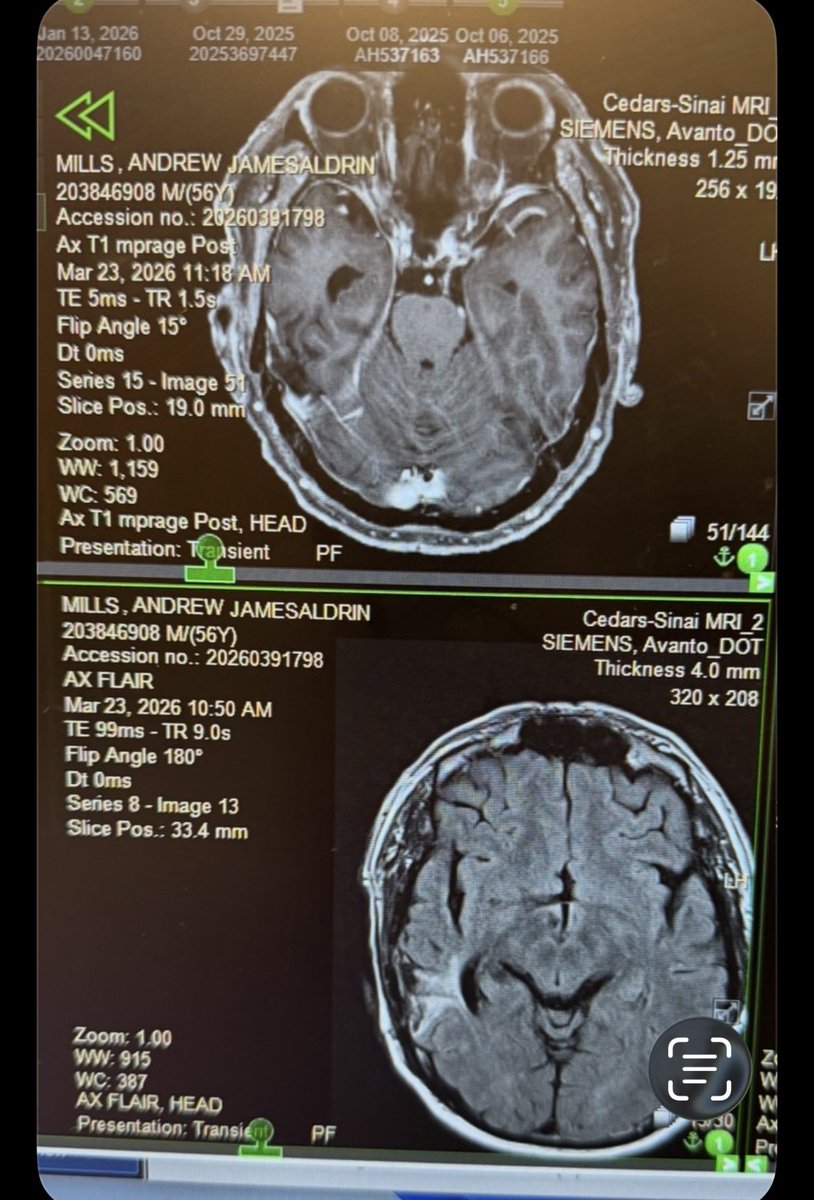
Fact- my husband was given 12 months to live 6 months ago. He has been on ANKTIVA and PDL-1 NK therapy and we are grateful for hope. He has now had 2 normal brain scans. The first scan is before, the second after. Sounds like big Pharma is threatened and if true, shame on the @US_FDA I can’t say what tomorrow holds but my family is one of the fortunate ones. So many want therapy. We have hope.
Lori Mills tweet mediaLori Mills tweet media
Jason R. Williams, MD, DABR@jasonwilliamsmd

The FDA issued a warning letter to ImmunityBio over claims that Anktiva can "cure cancer" and "treat all cancers." There's a lot to unpack here. Today at 3:10 PM PST, @drgoodyear and I are going live to talk about what Anktiva actually is, how we use it at WCI, and why no single drug is the answer. Join us.

English
57
288
1.5K
82.2K
Amit Sharma retweetledi
Tiger Jian
Tiger Jian@tigerhzjian·
(1/6): How can we better test therapeutics without using animals or risking lives? Lab-grown human mini-organs, called “organoids”, provide an answer! Despite their progress, organoids and related methods lack realistic flow through blood vessels, the “plumbing” of our bodies.
English
5
50
260
26.6K
Amit Sharma retweetledi
Pelletier Lab
Pelletier Lab@PelletierLab·
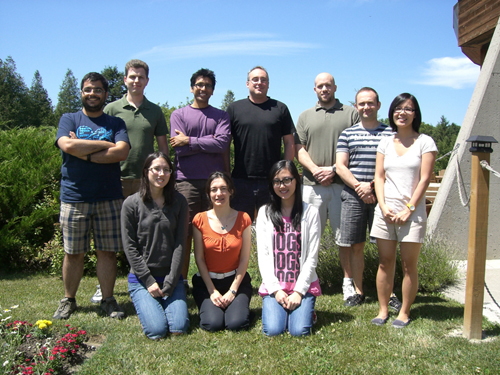
(1/7): New preprint from the lab! We generate physiological vascular flow in vitro to vascularize organoids, interrogate the effects of hemodynamic forces on vascular architecture, and model the disease Hereditary Hemorrhagic Telangiectasia.
Pelletier Lab tweet media
English
2
31
131
8.5K
Amit Sharma retweetledi
JJ
JJ@JosephJacks_·
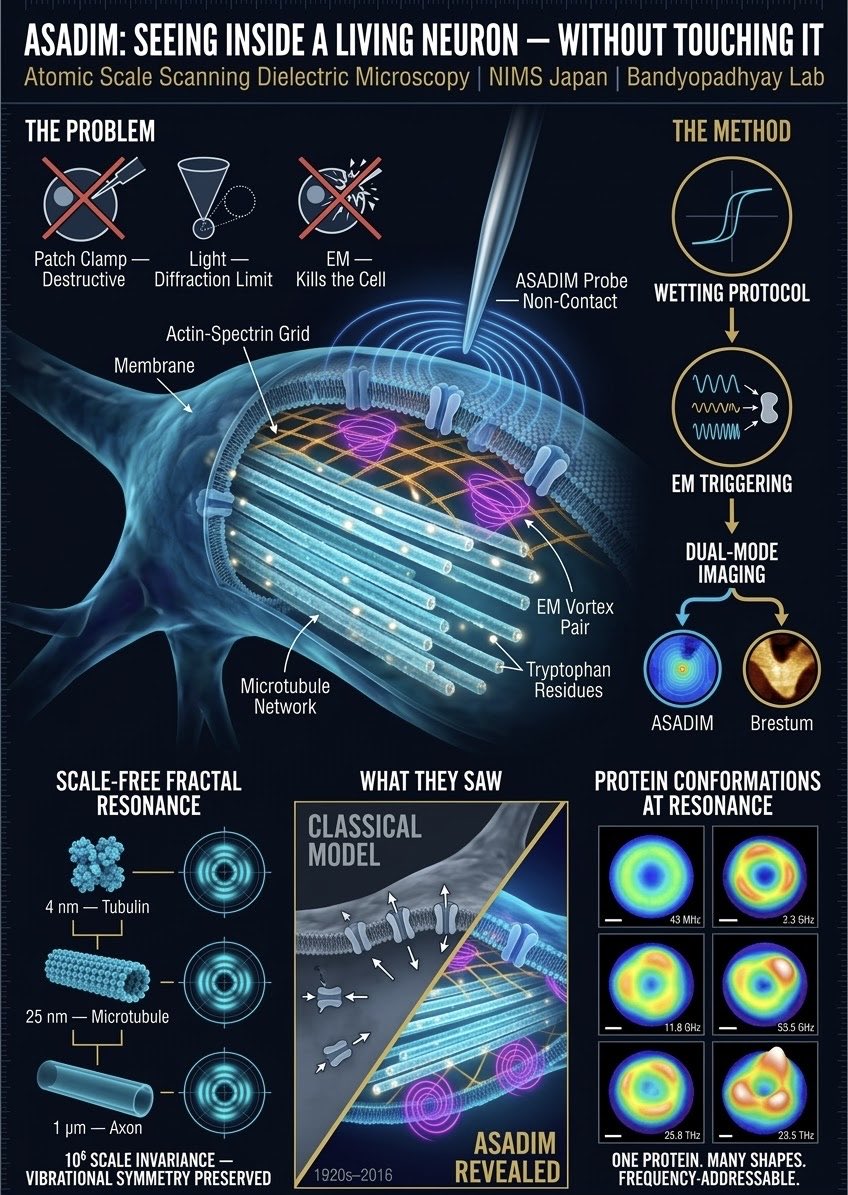
This image represents one of the most important and least known inventions in the history of neuroscience. In 2016, @anirbanbandyo and his team at the National Institute for Materials Science (NIMS) in Tsukuba, Japan published a paper announcing two new instruments they had built from scratch: ASADIM (Atomic Scale Scanning Dielectric Microscopy) and Brestum (Resonant Scanning Tunneling Microscopy of Biomaterials), both housed inside a single homebuilt bio-STM. To understand why this matters, you need the backstory. Since Hodgkin and Huxley’s Nobel Prize-winning work in 1952, the entire field of neuroscience has operated under a single foundational assumption: the cell membrane and its ion channels are the sole mechanism of neural signaling. The membrane fires. Everything inside the cell — microtubules, actin filaments, the entire cytoskeleton — is just passive structural scaffolding, like rebar in concrete. For 70 years no one could challenge this because no one could see inside a living neuron at the molecular scale without destroying it. Every existing tool had a fatal limitation: patch clamps puncture the membrane, optical microscopy can’t resolve single proteins, electron microscopy requires dead fixed tissue. Bandyopadhyay solved all three problems simultaneously. Using nonlinear dielectric response imaging — measuring the spatial distribution of conductance, capacitance, and phase without ionic or electronic screening — he made the neuronal membrane effectively transparent. He could see inside a living, firing neuron at atomic resolution, in real time, without touching it. What he saw overturns a century of neuroscience. First: a single protein molecule adopts a completely different three-dimensional shape at each resonance frequency — proteins are not static structures but frequency-addressable conformational machines. No one in biology knew this. Second: the microtubule network inside the neuron is not passive scaffolding. It actively communicates before the membrane fires, deciding whether a spike is necessary and regulating its timing through electromagnetic vortex pairs generated by the actin-spectrin grid it instructs. The membrane does not act alone. The cytoskeleton is the brain’s pre-processing layer. Third: the resonance frequency patterns are self-similar across a million-fold scale difference — from a 4nm tubulin protein to a 25nm microtubule to a 1μm axon segment — preserving vibrational symmetry in a fractal architecture that suggests information integration in the brain is scale-free from single molecule to cognition. This is not incremental science. This is a new instrument revealing a new picture of how the brain actually works at the most fundamental level. The history of Nobel Prizes in neuroscience runs through exactly this kind of inflection: Cajal saw neurons for the first time, Hodgkin-Huxley decoded the membrane, Bhatt decoded the ion channel structure. Bandyopadhyay has built the tool that sees what none of them could — the living interior of a neuron in operation — and what it reveals is that the computational architecture of the brain is far deeper, more structured, and more sophisticated than anything the membrane-only model ever imagined. Paper: worldscientific.com/doi/abs/10.114…
JJ tweet media
English
6
63
237
10.5K
Amit Sharma retweetledi
Ravi Sharma
Ravi Sharma@ravishar313·
I am Open-Sourcing PyMolAI! Meet PyMolAI, an AI agent that can talk to your protein structures. Built on top of PyMOL, PyMolAI lets you interact with your structures in plain language. Whether you're: - Analyzing protein structures - Aligning complexes - Creating publication-ready figures - Or running design workflows PyMolAI interprets your request, executes the necessary PyMOL commands, and manages the workflow for you. It integrates with @OpenBioAI APIs, giving you access to tools like Boltz, ProteinMPNN, and BoltzGen — directly from your PyMOL session. It has local chat history with session syncing, so you can pick up exactly where you left off.
English
51
197
867
80.5K
Amit Sharma retweetledi
Bo Wang
Bo Wang@BoWang87·
A San Diego startup just made whole genome sequencing cost $100. It used to cost $1 billion + The Human Genome Project took 13 years (1990-2003), billions of dollars, and an international consortium of 20+ institutions to sequence one genome. My PhD advisor, @s_batzoglou, was one of the first MIT PHDs who worked on it. He helped build the computational foundations that made it possible. His career spans the entire arc — from assembling the first human reference genome to making sequencing routine. The 10,000,000x cost drop isn't just a number. It's the difference between a moonshot national project and a routine lab test. Previous generation proved it was possible. This generation proved it could be cheap. The question now: what happens when everyone's genome is a $100 blood test? The implications for medicine, privacy, insurance, human identity? We're not ready. Link: sandiegouniontribune.com/2026/02/19/scr…
English
88
407
2.1K
733.1K
Amit Sharma retweetledi
Bo Wang
Bo Wang@BoWang87·
After leading AI & Health at @UHN — Canada’s largest hospital network — for the past few years, this is the first time it genuinely feels different. A cardiologist just placed 3rd out of 13,000 at Anthropic’s hackathon. He built it between hospital shifts. In a week. An AI agent that follows patients home — reverse scribe, full history, devices, evidence — all in one place. A few years ago this would’ve taken a full team and months. Now? One doctor. That’s the shift.
English
16
56
339
48.6K
Amit Sharma retweetledi
Ravi Tiwari🇮🇳
Ravi Tiwari🇮🇳@Ravitiwariii_·
An Indian Startup just did something that no company in the world has ever done..!🔥🇮🇳
English
56
1.2K
5.6K
179K
Amit Sharma retweetledi
Science girl
Science girl@sciencegirl·
Finland's underground data centers heat entire city blocks using server waste heat In Finland, several data-centres now feed their waste heat into municipal district-heating networks instead of simply dumping it into the air. For example, waste heat generated by data-centre cooling is captured and transferred into the district-heating grid, providing carbon-neutral heat to thousands of homes and public buildings. This reuse of thermal energy helps reduce reliance on fossil-fuel heating, cuts emissions, and turns the by-product heat from digital infrastructure into a genuine resource rather than waste.
English
127
1.2K
3.7K
107.9K
Amit Sharma retweetledi
Quanta Magazine
Quanta Magazine@QuantaMagazine·
Expansion microscopy is possible for any lab with a basic microscope. It’s allowing biologists to observe cellular processes like never before. quantamagazine.org/expansion-micr…
Quanta Magazine tweet media
English
4
47
210
10.8K
Amit Sharma retweetledi
Massimo
Massimo@Rainmaker1973·
HiP-CT is a new technique that can hierarchically image whole human organs, beginning with the resolution of a human hair (25μm/voxel) down to a resolution where we can see single cells (1.5μm/voxel) [📹 Paul Tafforeau]
English
30
244
1.6K
99.4K
Amit Sharma retweetledi
IISc Bangalore
IISc Bangalore@iiscbangalore·
Researchers at IISc have uncovered a surprising mechanism involving actin, a cytoskeletal protein, in mediating the contact between T cells and antigen-presenting cells, an important step in adaptive immunity. Read: iisc.ac.in/events/how-act…
IISc Bangalore tweet media
English
1
15
120
4.2K
🥀🌹N𝖆𝖓d𝖚 H𝔦𝔫d𝔲🌹🥀
The 3000-year-old Anantha Padmanabhaswamy statue, made of 7800 kg of pure gold, 780,000 diamonds and 780 carats of diamonds, is said to be over 3000 years old. It is said that its current value is several thousand lakh crores and that the Sadhapatis and modern experts said that its price could not be estimated. It is known that the team of experts invited from France were amazed and returned with incalculable amounts. It must have been a great privilege to see this with our own eyes.
English
116
708
3.8K
205.6K
Amit Sharma retweetledi
anand mahindra
anand mahindra@anandmahindra·
These are exactly the kind of initiatives we need to do to show that India is not just the world’s back office, but can also be its think tank… More such projects, please, for creating knowledge at the frontiers of technology & exploration. 👏🏽👏🏽👏🏽
English
172
1.3K
8.6K
222.8K
Amit Sharma retweetledi
PiatkevichLab
PiatkevichLab@PiatkevichL·
Next-generation orange-to-far-red photoconvertible fluorescent protein for single-molecule microscopy and protein dynamic tracking nature.com/articles/s4159…
English
0
25
120
7.4K