Anglican Aesthetics

6.8K posts

Anglican Aesthetics banner
Anglican Aesthetics

Anglican Aesthetics

@AngAesthetics

Katılım Ağustos 2022
122 Takip Edilen3.3K Takipçiler
Sabitlenmiş Tweet
Anglican Aesthetics
Anglican Aesthetics@AngAesthetics·
Love (II) By George Herbert Immortal Heat, O let Thy greater flame Attract the lesser to it; let those fires Which shall consume the world first make it tame, And kindle in our hearts such true desires. As may consume our lusts, and make Thee way: Then shall our hearts pant Thee, then shall our brain All her invention on Thine altar lay, And there in hymns send back Thy fire again. Our eyes shall see Thee, which before saw dust, Dust blown by wit, till that they both were blind: Thou shalt recover all Thy goods in kind, Who wert disseized by usurping lust: All knees shall bow to Thee; all wits shall rise, And praise Him Who did make and mend our eyes.
English
0
1
26
8.6K
Anglican Aesthetics
Anglican Aesthetics@AngAesthetics·
Where does Augustine say it is "the Word of God and *not* inspiration"? You're assuming a juxtaposition that just isn't there; it is eisegesis. Interpreting a text through its reception in the Church is not eisegesis. Once again, you're assuming a scholastic definition of inspiration that I don't accept anyway to draw the distinction.
English
0
0
0
6
Kevin Fernandez
Kevin Fernandez@sincead33·
Yes, even something being the command of the Lord isn’t synonymous with being delivered as inspired. The fact you have to try to fit that there is telling how little Biblical evidence you have there. It is not the invention of the schoolmen. Literally Ambrosiaster and St. Augustine (from the little I have looked into this) interprets the “Word of God” delivered by the apostles’ oral preaching to mean divine revelation and mysteries, not inspiration. No one doubts the apostles delivered the Word of God. You are simply equivocating on that meaning inspiration.
English
1
0
0
15
Anglican Aesthetics
Anglican Aesthetics@AngAesthetics·
I will argue that we have Biblical reason to think that the Apparition that told children that God was pleased with these "sacrifices" and that they could offer them for the reparation of the sins of the world is not from God: "Another day we were playing, picking little plants off the walls and pressing them in our hands to hear them crack. While Jacinta was plucking these plants, she happened to catch hold of some nettles and stung herself. She no sooner felt the pain than she squeezed them more tightly in her hands, and said to us: “Look! Look! Here is something else with which we can mortify ourselves!” From that time on, we used to hit our legs occasionally with nettles, so as to offer to God yet another sacrifice."
Capturing Christianity@CapturingChrist

This Friday, Ethan Muse (@emuse1955) will debate Sean Luke (@AngAesthetics) on whether Catholic miracles like Fatima are a demonic deception. Who do you think will win?

English
11
6
89
11.2K
Anglican Aesthetics
Anglican Aesthetics@AngAesthetics·
And the text literally says that *whatever* St. Paul writes is such. That this was understood by the fathers as "the teaching of the apostles is the Word of God" is clear. What remains then is whether the notion of "delivering the Word of God without being inspired" is apostolic or patristic, or a sheer invention of the schoolmen.
English
1
0
0
23
Anglican Aesthetics
Anglican Aesthetics@AngAesthetics·
My claim isn't that they were "always and everywhere" such, but that *whenever they taughr" they were. And clearly Whitaker literally is talking about what they are saying as apostles or as prophets. What im saying isn't unique to me at all. Literally no one accused me of saying anything novel in my published article in the Journal of Ecumenical Studies on Sola Apostolica (which was reviewed by several theologians). That notion that im saying something new literally only ever comes from here. The only "new" thing is tje term "Sola Apostolica".
English
0
0
0
18
Anglican Aesthetics
Anglican Aesthetics@AngAesthetics·
That wasn't my claim. I agree infallibility and inspiration aren't the same thing. I never said they aren't separable. My claim is simply that the apostles were always inspired in what they taught as apostles, and are therefore infallible--i never said infallibility and inspiration aren't distinguishable.
English
0
0
0
13
Taylor Patrick O'Neill
Taylor Patrick O'Neill@thomaesplendor·
Trump is just now fielding questions outside of the White House, and he doubled down on his comments regarding Pope Leo. He said Bishop Barron is wrong in stating that he owes Pope Leo an apology.
English
3
5
57
2.5K
Anglican Aesthetics
Anglican Aesthetics@AngAesthetics·
I agree that infallibility and authenticity were necessary. I don't think inspiration of their speech at all times was *necessary*, but is just in fact how God did it. The evidence is taken from St. Paul saying that *whatever* he writes is a command of the Lord, how this was understood in the Church (there is no distinction made between inspired and non-inspired "Word of God" that the fathers think the Church must distinguish between in apostolic speech), and there is no need to posit what Roman Catholics posit. But on the contrary, this framing has the advantage of theological simplicity. We can account for Divine Revelation and its promulgation without positing an operation of the Church unknown to the fathers (e.g., that the Church had to distinguish between inspired and non-inspired speech from the Apostles).
English
2
0
0
36
Jason Snow
Jason Snow@JasonSnow42914·
@unodostracey @AngAesthetics you realize that non infallible statements from the pope also require submission of the will and intellect right?
English
1
0
4
37
Anglican Aesthetics
Anglican Aesthetics@AngAesthetics·
If your father commands you to beat up your sister, you do not owe absolute obedience. And when the Pope commands you to kill Hussites and Wycliffite women and children, you owe him condemnation. The heart of the debate is over whether the Pope is a failed papa.
Patrick Neve@catholicpat

Papal infallibility is easy to understand if you see the Pope as a Father. When your father gives you advice, you owe him deference. When he gives you a command, you owe him absolute obedience.

English
7
9
146
7.9K
Anglican Aesthetics
Anglican Aesthetics@AngAesthetics·
You do realize the same King killed Protestants, and the papist Queen Mary did so too, right? The difference is that we can consistently repudiate their actions as consistent with the Word or as truly owed obedience. RCs must maintain that the Pope commanding the slaughter of Hussites for the forgiveness of sins was owed religious submission of mind and will such that the lay faithful were obligated to believe killing Hussites in the prescribed manner would win remission of sins because the Pope said so.
English
1
0
1
13
Holt Dad
Holt Dad@backdoc47·
@AngAesthetics When the King of England commands you to kill and persecute Catholics and steal their property you owe him condemnation. Yet here you are virtue signaling from your Ivory tower of Satan. The heart of the debate is authority. #thomasmore #johnfisher
English
1
0
0
17
Anglican Aesthetics
Anglican Aesthetics@AngAesthetics·
Not sure I understand. He is both inspired and infallible because his speech simply is God speaking in the mode of a creaturely personality. It doesn't matter if what he is saying is new or not. What matters is that God promises to be with the Apostle such that when the Apostle teaches, God is teaching. Their words are the form in which God utters in creation, whereas every other exposition of the Word only exposits that which God uttered in and as apostolic speech.
English
1
0
0
43
Anglican Aesthetics
Anglican Aesthetics@AngAesthetics·
You know what's kind of funny? I'll critique the Papacy all day for its errors. But I'll defend Pope Leo over and against a pagan like Trump any day. I suppose it's one of those "I will criticize a family member but you certainly can't" things.
English
0
2
12
382
Anglican Aesthetics
Anglican Aesthetics@AngAesthetics·
They can say that (I'm assuming you're speaking about Anglicans), but at this point I've documented the contrary now from Hooker, Bilson, Field, Whitaker, and have countless other quotes from folks like Tillotson, Chillingworth, Hammond, Gibson, Simon Patrick, Thomas Ken, and actually many more. So they can say that, but I'll keep quoting our sources. I'm not sure what some councils being infallible (which I also agree is possible) has to do with this. Divine Speech being delivered in and as human speech is not at stake in the infallibility of a council. Councils are infallible not because they immediately received Divine Revelation from God and then communicate it by the Spirit, but because the Spirit guides them into a true interpretation of Divine-Speech-as-Apostolic-Speech. Hence, if the words of the Apostles are true by which they communicate Divine Revelation, then this is just identical to their sense (since truth is a matter of sense corresponding to reality) being the sense provided and intended by God.
English
1
0
1
55
Kevin Fernandez
Kevin Fernandez@sincead33·
Ironically I’ve spoken to high church Protestants well read in their tradition who don’t think the apostles were inspired or even infallible in their oral preaching. Anyway, I think you’re overly sophisticating it. Obviously a message can be given in one’s own words while being true and in words or at least the sense given by God. This is especially obvious in that Anglican divines admit some councils can be infallible but not inspired.
English
1
0
0
41
Anglican Aesthetics
Anglican Aesthetics@AngAesthetics·
The distinction between Divine Revelation being communicated "in the Apostle's own words or with the sense provided by God" is a distinction I don't think even works philosophically. Communication itself is an act of sense-making, minimally at the level of sentences. If the Apostles are communicating Divine Revelation in their own sentences truly, then their own sentences just is the sense God provides of Divine Revelation. The distinction presupposes a clean distinction between words and sense--and worse, between sentences and meaning--that doesn't actually obtain in reality. Communicating Divine Revelation is just an act of communicating Divine Sense in human sense--or Divine Meaning in human meaning.
English
2
0
1
50
Kevin Fernandez
Kevin Fernandez@sincead33·
@the_thin_place @AngAesthetics @ChrisRojas4081 I don't reject this distinction since the distinction is pretty obvious i.e. obviously revelation can be said in one's own words or with the sense provided by God. Now, I don't know if you're saying you reject the distinction in principle or in fact.
English
2
0
0
53
Anglican Aesthetics
Anglican Aesthetics@AngAesthetics·
@iam_shwa 10/10 post. I love how Roman Catholic architects think through architecture theologically to facilitate a sense of the majesty of God.
English
0
0
9
101
Pop Cultured🇻🇦
Catholics! Say one NICE thing about Protestantism Protestants! Say one NICE thing about Catholicism
English
1K
36
609
142.9K
Anglican Aesthetics
Anglican Aesthetics@AngAesthetics·
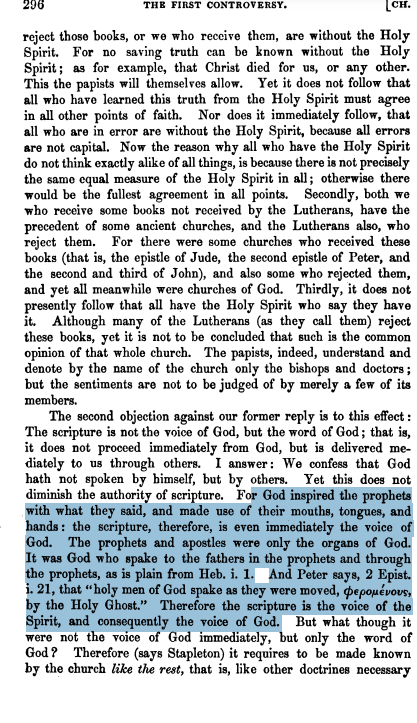
It seems clear to me, but regardless--I think we can see he teaches this by the "therefore" consequent. "They were inspired with what they said or wrote, therefore Scripture is immediately the voice of God" assumes that "that which is inspired with what they said or wrote is immediately the voice of God", and it is for that reason that Scripture--which belongs to what they wrote--is inspired.
English
0
0
2
17
Anglican Aesthetics
Anglican Aesthetics@AngAesthetics·
@sincead33 @the_thin_place @ChrisRojas4081 Always inspired wrt to whatever they taught. See the highlighted. It is clear that he says that because the prophets and the apostles were inspired with both what they said and what they wrote, the Scripture is the speech of God ("thus God spake") and the voice of God.
Anglican Aesthetics tweet media
English
1
0
0
36