Ankur Samanta

50 posts

Ankur Samanta

Ankur Samanta

@Ankur_Samanta_

AI PhD Candidate @Columbia, @AIatMeta | Self-Improving AI, Credit Assignment in Reinforcement Learning, and Autoresearch

Katılım Ağustos 2024
86 Takip Edilen147 Takipçiler
Ankur Samanta
Ankur Samanta@Ankur_Samanta_·
Come check out our #ICML2026 poster on self-localization and self-correction with language models! Location: Poster #1603 in Hall A, 5 pm today Swing by or dm me to chat about credit-assignment, long-horizon/multi-turn RL, and exploration!
Ankur Samanta@Ankur_Samanta_

Happy to share that our paper Structure Enables Effective Self-Localization of Errors in LLMs got accepted at #ICML2026! Paper: arxiv.org/abs/2602.02416 Code: github.com/Ankur-Samanta/…

English
1
1
6
1.2K
Ankur Samanta
Ankur Samanta@Ankur_Samanta_·
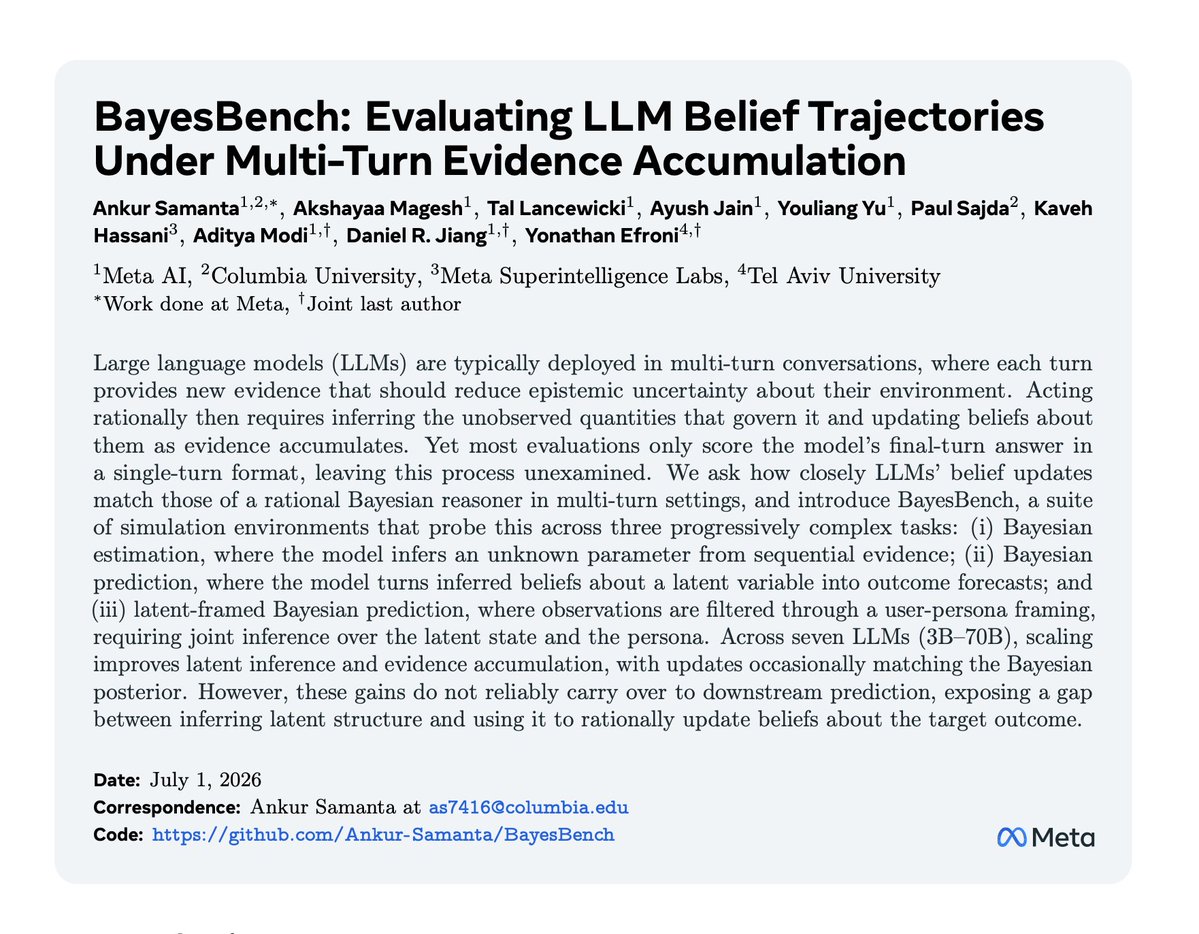
🚨 New work on Bayesian reasoning in multi-turn LLM interactions 🚨 Introducing BayesBench, evaluating how well LLMs perform (i) latent inference—recovering hidden structure behind an interaction, and (ii) outcome prediction using the inferred latent, as evidence accumulates 🧵
Ankur Samanta tweet media
English
14
8
30
3K
Ankur Samanta
Ankur Samanta@Ankur_Samanta_·
Overall, we show consistent gaps in how well models perform latent inference and use it to make predictions in multi-turn environments with complex graphical models. This motivates further research into aligning these capabilities in broader real-world scenarios. [13/n]
English
0
0
0
93
Ankur Samanta
Ankur Samanta@Ankur_Samanta_·
We simulate Accurate, Hypochondriac, Minimizer, and Cyberchondriac patients. The underlying clinical facts stay fixed; only the reporting style changes. We test whether models infer that style and use it to recover the true urgency over turns. [12/n]
Ankur Samanta tweet media
English
0
0
0
89
Ankur Samanta
Ankur Samanta@Ankur_Samanta_·
For medical triage, users ask whether symptoms warrant urgent care. We start from real triage scenarios, split each symptom summary into storyboard segments, and simulate a patient revealing what they are experiencing over turns. [11/n]
English
0
0
0
73
Ankur Samanta
Ankur Samanta@Ankur_Samanta_·
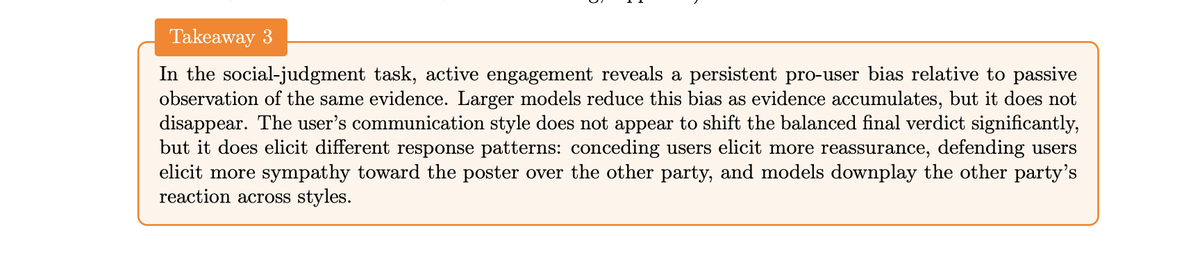
In active social judgment, we vary the poster's style: neutral, conceding, or defending, while keeping the underlying facts fixed. This lets us test whether presentation changes the model's beliefs and response behavior over multiple turns. [10/n]
Ankur Samanta tweet media
English
0
0
0
71
Ankur Samanta
Ankur Samanta@Ankur_Samanta_·
For social judgment, we start from Reddit r/AmItheAsshole scenarios. Each post is decomposed into storyboard segments, and the model predicts the community verdict as evidence unfolds under passive observation or active conversation with a simulated poster. [9/n]
English
0
0
0
66
Ankur Samanta
Ankur Samanta@Ankur_Samanta_·
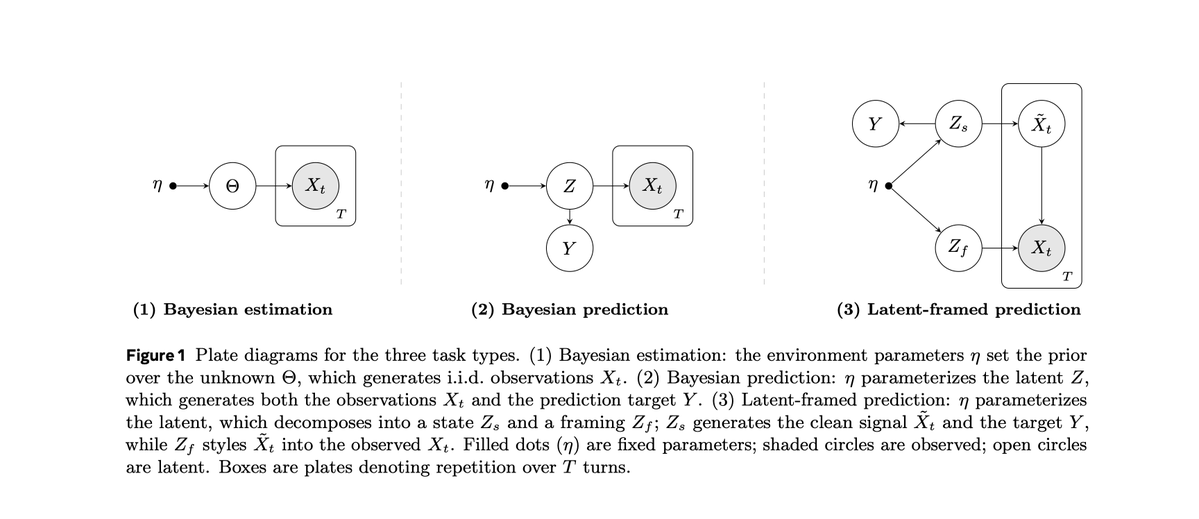
Task 3: latent-framed Bayesian prediction. LLMs are often asked for advice in conversations where users provide info shaped by their tendencies over several turns. We build a simulator for this, controlling user evidence and presentation to study model beliefs & behavior. [8/n]
Ankur Samanta tweet media
English
0
0
0
67
Ankur Samanta
Ankur Samanta@Ankur_Samanta_·
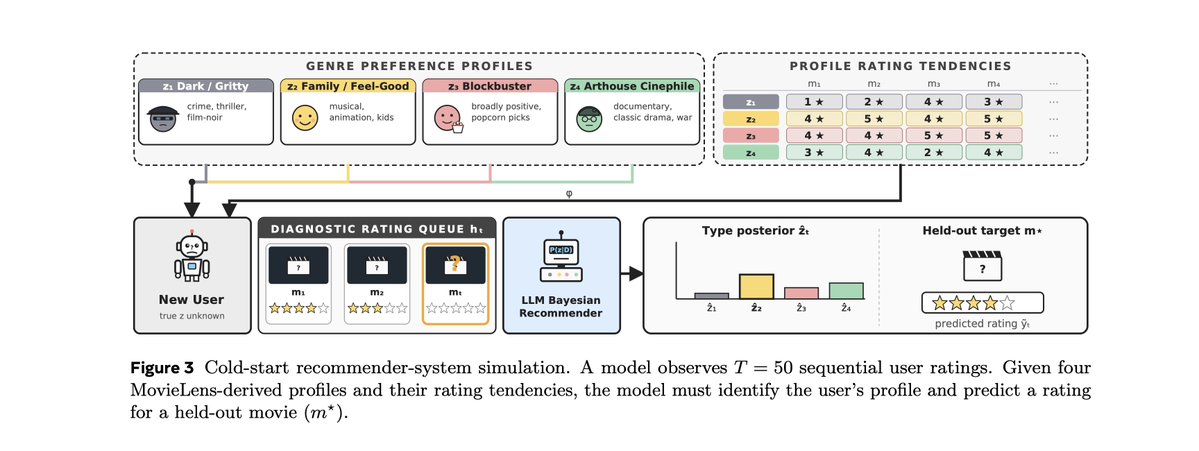
Since users' ratings are sampled from one of a discrete set of representative rating distributions, we can reverse it to recover the per-turn Bayesian posterior. We anonymize semantic features like titles so the model has to recover the type from rating patterns alone. [7/n]
Ankur Samanta tweet media
English
0
0
0
65
Ankur Samanta
Ankur Samanta@Ankur_Samanta_·
Task 2: Bayesian prediction. In the recommender system, the model is given clusters of users and their rating tendencies over a set of movies. As a new user's ratings arrive over turns, the model must infer which cluster they belong to and predict a held-out movie rating. [6/n]
Ankur Samanta tweet media
English
0
0
0
64
Ankur Samanta
Ankur Samanta@Ankur_Samanta_·
Task 1: Bayesian estimation. In coin flip, the model observes one flip per turn from a coin with unknown bias. After each partial history, we ask it to "Predict the next flip"; the probability of heads is its running estimate of the coin bias. [5/n]
Ankur Samanta tweet media
English
0
0
0
74
Ankur Samanta
Ankur Samanta@Ankur_Samanta_·
We find that (i) models show an ability to infer the hidden structure at play — what we call latent inference. This improves with scale, but stops short of being reliable; and (ii) they can’t yet reliably use what they infer to make accurate predictions or judgments. [4/n]
English
0
0
0
89
Ankur Samanta
Ankur Samanta@Ankur_Samanta_·
BayesBench applies this to LLMs across four environments — coin flips, recommender systems, social judgment, and medical triage — spanning increasingly complex graphical models. Each turn, we probe beliefs over possible outcomes against a Bayesian reference where tractable. [3/n]
Ankur Samanta tweet media
English
0
0
0
124
Ankur Samanta
Ankur Samanta@Ankur_Samanta_·
To study sequential belief updating in LLMs, we adopt a classic cognitive-psychology paradigm — the bookbag-and-poker-chip task: you draw chips one at a time from one of two bags with different color mixes, and are polled after each draw on which bag you think they're from. [2/n]
English
0
0
0
126
Ankur Samanta retweetledi
John Langford
John Langford@JohnCLangford·
This is quite nice. I've been looking for something in the vein of the old learning to search work hunch.net/~l2s . The really nice thing here is that these kinds of improvements, in some cases, can yield exponential-in-the-number-of-turns improvements.
Ankur Samanta@Ankur_Samanta_

🚀New work on credit assignment in multi-step reasoning RL post-training🚀 Introducing Self-Reset Policy Optimization (SRPO): i) localize the first wrong reasoning step, ii) reset to that step, iii) learn from counterfactual continuations from there – no external supervision.🧵

English
1
8
69
13.3K
Ankur Samanta
Ankur Samanta@Ankur_Samanta_·
🚀New work on credit assignment in multi-step reasoning RL post-training🚀 Introducing Self-Reset Policy Optimization (SRPO): i) localize the first wrong reasoning step, ii) reset to that step, iii) learn from counterfactual continuations from there – no external supervision.🧵
Ankur Samanta tweet media
English
13
35
233
69.9K
Ankur Samanta
Ankur Samanta@Ankur_Samanta_·
Overall, we study how resets can be used as a credit-assignment primitive for RL post-training. Self-localized resets beat random and no resets in performance and sample efficiency — with self-localization an imperfect-but-effective proxy for the credit-assignment oracle. [9\n]
English
0
1
2
604