Daniel Jiang

227 posts

Daniel Jiang banner
Daniel Jiang

Daniel Jiang

@danielrjiang

Research Scientist @Meta. PhD @Princeton. Interested in RL.

New York, NY Katılım Mart 2009
1.8K Takip Edilen921 Takipçiler
Sabitlenmiş Tweet
Daniel Jiang
Daniel Jiang@danielrjiang·
In RL, the ability to *reset* to an arbitrary state is powerful (see, e.g., Go-Explore), but often unrealistic. For LLMs though, states are tokens, so resets are natural! In work led by @Ankur_Samanta_ , we propose a GRPO variant where the model "self-resets then resamples."
Daniel Jiang tweet media
Ankur Samanta@Ankur_Samanta_

🚀New work on credit assignment in multi-step reasoning RL post-training🚀 Introducing Self-Reset Policy Optimization (SRPO): i) localize the first wrong reasoning step, ii) reset to that step, iii) learn from counterfactual continuations from there – no external supervision.🧵

English
1
18
166
21.5K
Daniel Jiang retweetledi
Ankur Samanta
Ankur Samanta@Ankur_Samanta_·
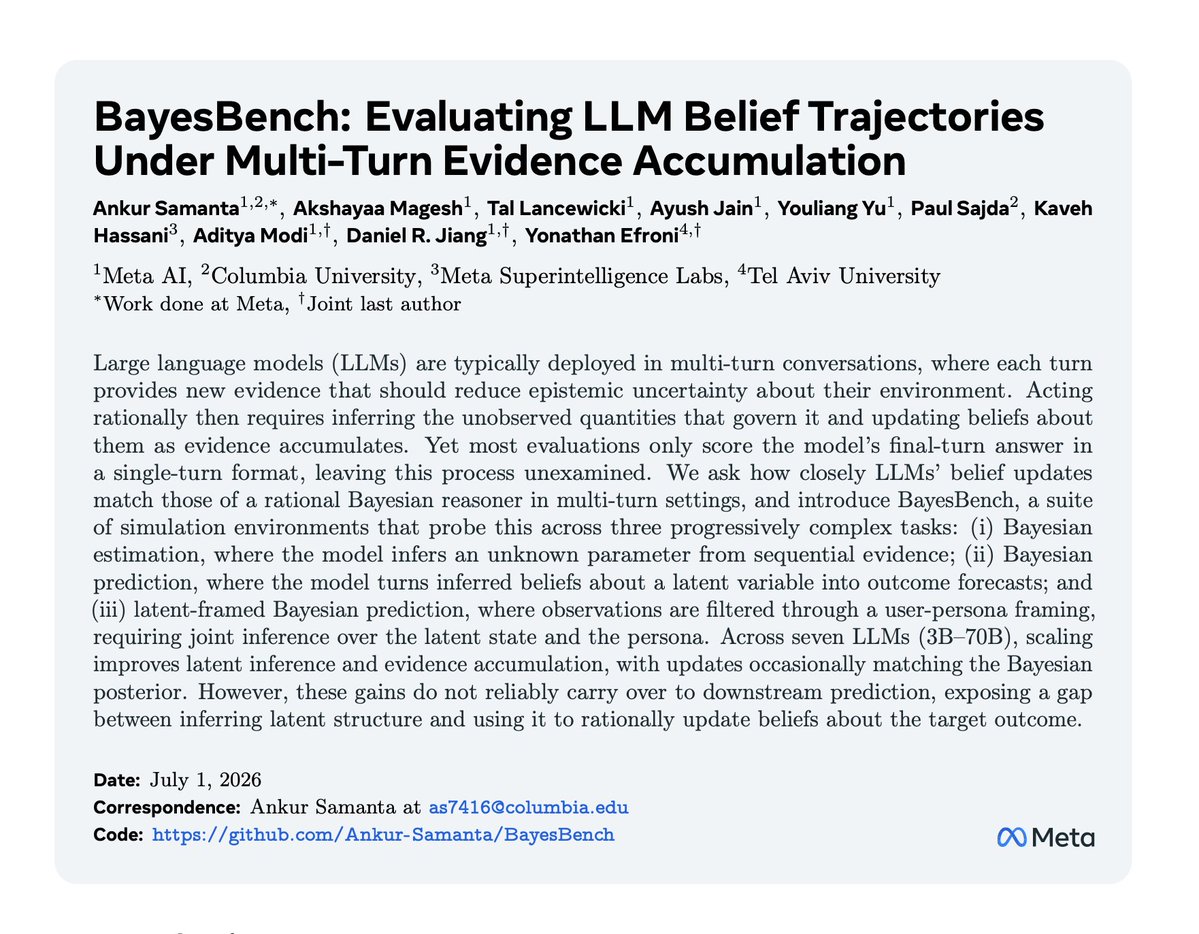
🚨 New work on Bayesian reasoning in multi-turn LLM interactions 🚨 Introducing BayesBench, evaluating how well LLMs perform (i) latent inference—recovering hidden structure behind an interaction, and (ii) outcome prediction using the inferred latent, as evidence accumulates 🧵
Ankur Samanta tweet media
English
14
8
30
3K
Daniel Jiang retweetledi
John Langford
John Langford@JohnCLangford·
This is quite nice. I've been looking for something in the vein of the old learning to search work hunch.net/~l2s . The really nice thing here is that these kinds of improvements, in some cases, can yield exponential-in-the-number-of-turns improvements.
Ankur Samanta@Ankur_Samanta_

🚀New work on credit assignment in multi-step reasoning RL post-training🚀 Introducing Self-Reset Policy Optimization (SRPO): i) localize the first wrong reasoning step, ii) reset to that step, iii) learn from counterfactual continuations from there – no external supervision.🧵

English
1
8
69
13.3K
Daniel Jiang retweetledi
Ben Recht
Ben Recht@beenwrekt·
My teacher and friend Dimitri Bertsekas passed away earlier this month. I wrote about his broad contributions to the field of numerical optimization and his deep impact on my writing and research. argmin.net/p/a-tribute-to…
English
1
35
156
15.4K
Daniel Jiang retweetledi
Yonathan Efroni
Yonathan Efroni@EfroniYonathan·
Proper credit assignment has potential to dramatically improve performance of RL post-training. This is especially true as agents increasingly gather longer trajectories. In this work we explore the idea of using *resets* and *self-localization of errors* as means to do that.
Ankur Samanta@Ankur_Samanta_

🚀New work on credit assignment in multi-step reasoning RL post-training🚀 Introducing Self-Reset Policy Optimization (SRPO): i) localize the first wrong reasoning step, ii) reset to that step, iii) learn from counterfactual continuations from there – no external supervision.🧵

English

1
3
23
3.3K
Daniel Jiang retweetledi
Binfeng Xu
Binfeng Xu@billxbf·
“We therefore move from group-wise optimization to a critic-based PPO formulation that learns from individual rollouts, relying on a critic to estimate token-level advantages rather than group-relative comparisons. This single-rollout formulation fits compaction naturally, as it places no constraint on how many traces a prompt produces or on their relative lengths” It is so true that PPO fits better in multi-trace credit assignment for agenti RL. Still surprised how @Zai_org speeds on carrying this through at scale! 🚀 🐐
Z.ai@Zai_org

Introducing GLM-5.2: Frontier Intelligence, Open Weights - Significant improvements in coding and agentic tasks - Strong long-horizon capabilities with a 1M context window - Two levels of reasoning effort: GLM-5.2 (max) pushes the limits, while GLM-5.2 (high) strikes a strong balance between performance and token efficiency - MIT-licensed open weights - Same API pricing as GLM-5.1 Tech Blog: z.ai/blog/glm-5.2 Weights: huggingface.co/zai-org/GLM-5.2 API: docs.z.ai/guides/llm/glm… Coding Plan: z.ai/subscribe Chat: chat.z.ai

English
1
6
105
11.6K
Daniel Jiang retweetledi
Luke Heeney
Luke Heeney@heeney_luke·
We've lost an absolute giant today. RIP Dimitri Bertsekas. His probability and optimization books got me through my masters. Massive loss for the MIT community and the field.
English
17
116
1K
94.8K
Daniel Jiang retweetledi
Ankur Samanta
Ankur Samanta@Ankur_Samanta_·
Self-correction for LLMs is usually done by critiquing an answer and regenerating the entire reasoning trace. We show targeted backtrack-and-resample works better: self-localize the first erroneous step, then sample a counterfactual. Repeat. [1\n]
English
8
3
5
4.2K
Daniel Jiang retweetledi
Csaba Szepesvari
Csaba Szepesvari@CsabaSzepesvari·
@yoavgo Oh, to me it is the opposite. LLM RL is when you say supervised fine-tuning (SFT) instead of behavior cloning, RLVF instead of batch policy optimization, base policy instead of behavior policy, trace instead of trajectory, verifiable reward instead of reward, .. LOL
English
2
4
38
3K
Daniel Jiang retweetledi
Zhuoran Yang
Zhuoran Yang@zhuoran_yang·
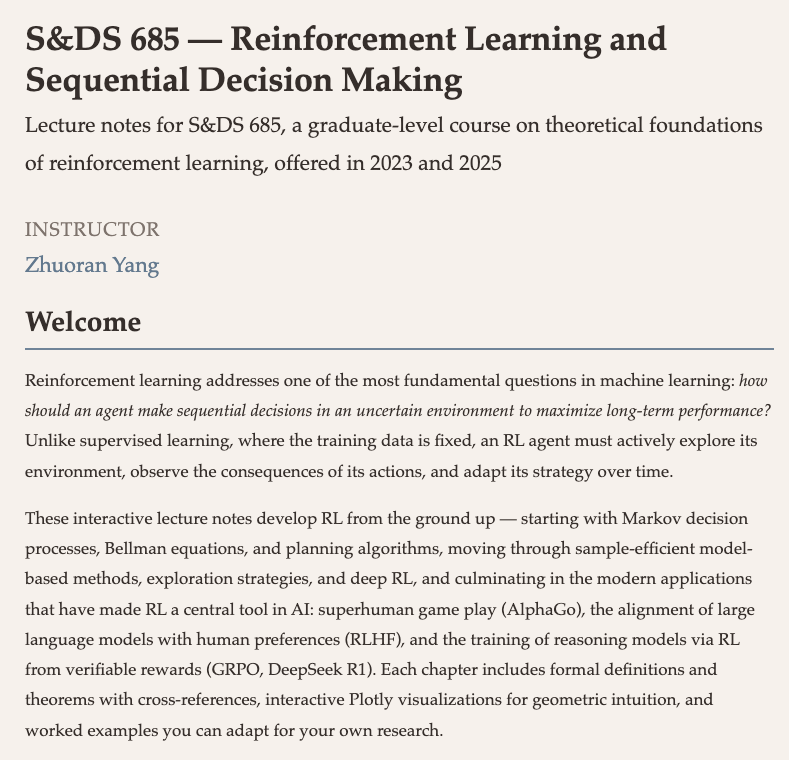
When I teach, I prepare my lecture notes by writing on Goodnotes, then export them as PDFs and share to the class. Recently I asked claude code to read these PDF files and convert them into markdown. This is a test I constantly gave to new LLMs and now claude is good enough to pass it. I converted my RL theory graduate-level course into markdowns and post the lecture notes here: zhuoranyang.github.io/sds685-notes/ When preparing the course, I learned a lot from the wonderful courses offered by @CsabaSzepesvari @chijinML @WenSun1 @nanjiang_cs and borrowed some good stuffs from their notes. Also I discussed what to teach in a RL course heavily with @zhaoran_wang and stole many of his insights.
Zhuoran Yang tweet media
English
6
59
485
77.5K
Daniel Jiang retweetledi
Mina Lee
Mina Lee@MinaLee__·
What if we boost LLM output diversity by fusing base and aligned models? Excited to share this work led by @YichenZW, whose passion for understanding LLM diversity really shows here. More insights and fun ideas on LLM creativity coming soon as well!💡
Yichen (Zach) Wang @ICML@YichenZW

Lack of diversity in your LLM generation? (also noted by Artificial Hivemind, best paper @NeurIPSConf) Time to bring your base model back! An inference-time, token-level collaboration between a base and an aligned model can optimize and control diversity and quality!

English
0
2
24
5.5K
Daniel Jiang retweetledi
Aditya Oberai
Aditya Oberai@aditya_oberai·
TD Learning can suffer on long tasks: ↑ deep bellman recursions → ↓ poor scalability (despite big data) We introduce a new method (TRL) with a "divide-and-conquer" value update, which scales well with long horizons!
GIF
English
2
31
235
63.1K
Daniel Jiang retweetledi
Ethan Mollick
Ethan Mollick@emollick·
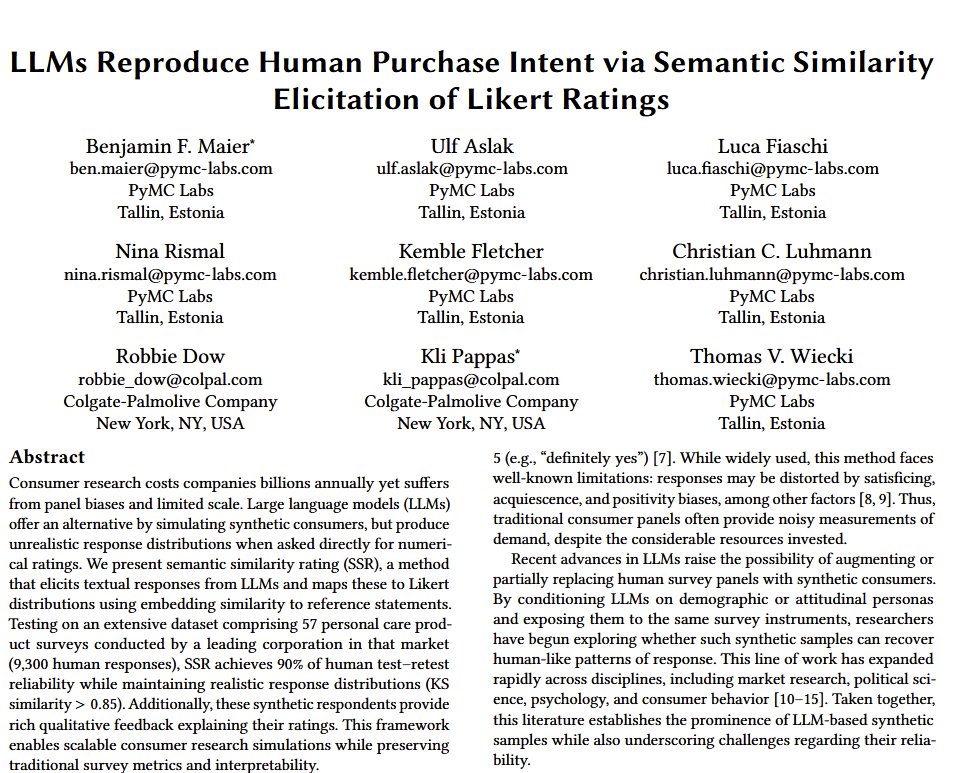
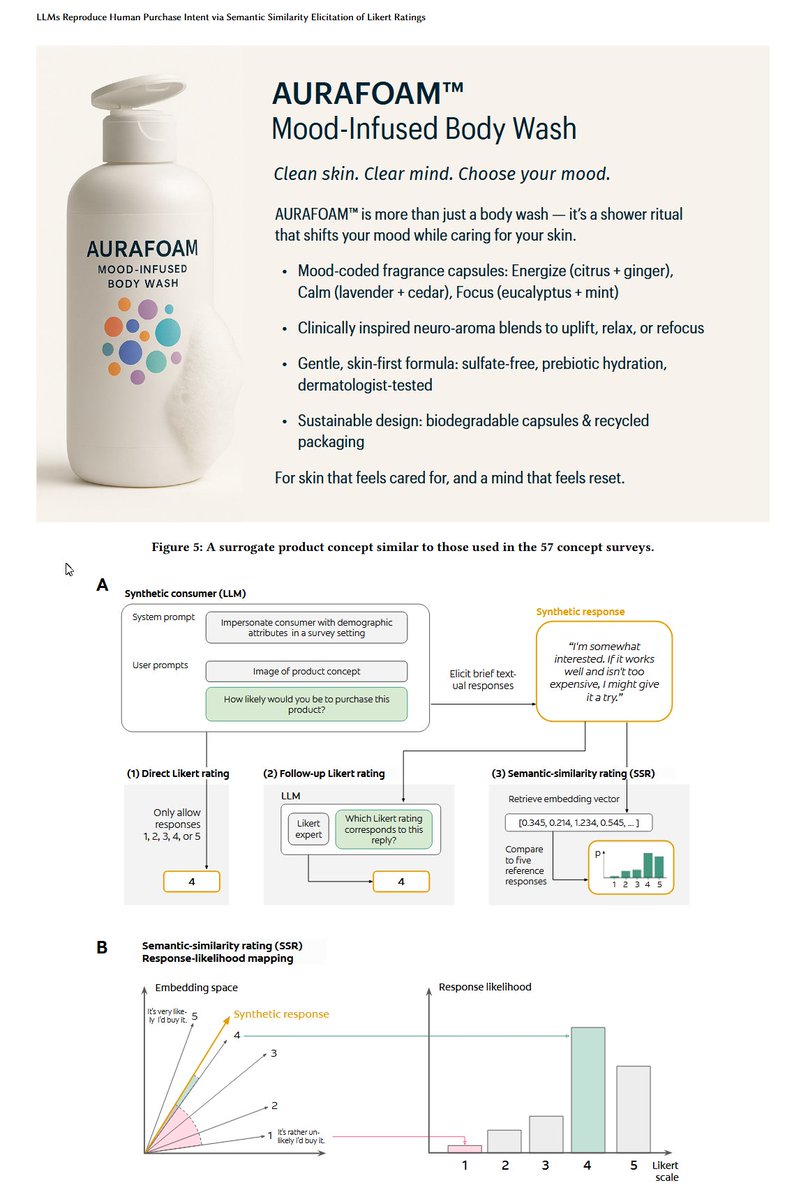
This paper shows that you can predict actual purchase intent (90% accuracy) by asking an LLM to impersonate a customer with a demographic profile, giving it a product & having it give its impressions, which another AI rates. No fine-tuning or training & beats classic ML methods.
Ethan Mollick tweet mediaEthan Mollick tweet mediaEthan Mollick tweet media
English
141
683
7.6K
903K
Daniel Jiang retweetledi
Seohong Park
Seohong Park@seohong_park·
Introducing *dual representations*! tl;dr: We represent a state by the "set of similarities" to all other states. This dual perspective has lots of nice properties and practical benefits in RL. Blog post: seohong.me/blog/dual-repr… Paper: arxiv.org/abs/2510.06714
Seohong Park tweet media
English
14
120
941
181.8K
Daniel Jiang retweetledi
Ayush Jain
Ayush Jain@Ayushj240·
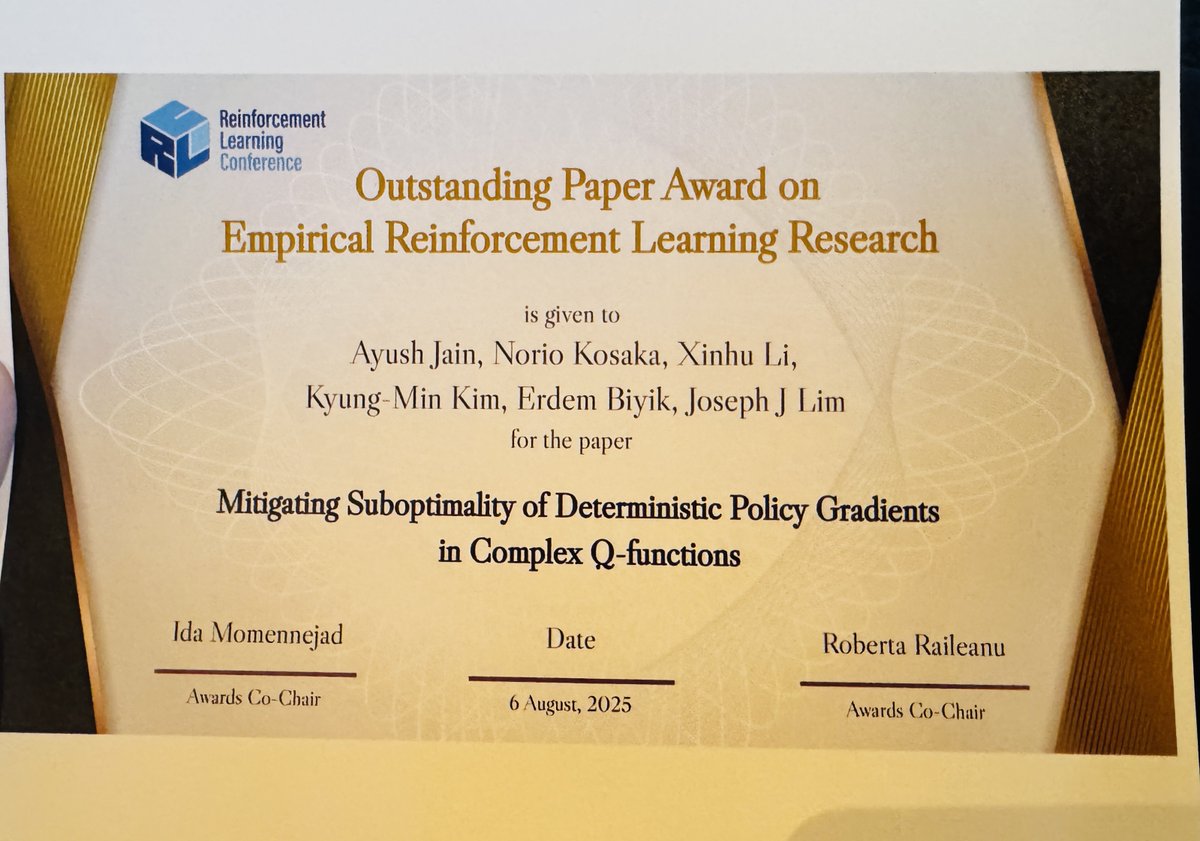
Honored that our @RL_Conference paper won the Outstanding Paper Award on Empirical Reinforcement Learning Research! 📜Mitigating Suboptimality of Deterministic Policy Gradients in Complex Q-Functions 📎openreview.net/forum?id=H3jcT… Grateful to my advisors @JosephLim_AI and @ebiyik_!
Ayush Jain tweet media
Ayush Jain@Ayushj240

At @RL_Conference🍁, I'm presenting a talk and a poster on Aug 6, Track 1: Reinforcement Learning Algorithms. We find that Deterministic Policy Gradient methods like TD3 often get stuck at local optima under complex Q-functions, and propose a novel actor architecture! 🧵

English
9
11
73
8.1K