
anthony kiplimo 🪴 retweetledi
anthony kiplimo 🪴
12.2K posts


anthony kiplimo 🪴
@AnthonyLimo
ai & product at purple elephant ventures 🌱 | opinions are my own 🫶 | ex loop, okra, africa’s talking
Nairobi, Kenya Katılım Mart 2012
4.7K Takip Edilen3.9K Takipçiler


anthony kiplimo 🪴 retweetledi

anthony kiplimo 🪴 retweetledi

anthony kiplimo 🪴 retweetledi

Anyway, I fixed it.
I built a tiny native app that lets you open any Markdown file on Mac.
> Just press Spacebar → instant clean preview
> Watch your AI agent write in real time
> Open your favorite Markdown editor to edit
Install once and literally forget it exists.
Fauzaan@M2Fauzaan
Every major operating system should come with a default Markdown reader at this point
English
anthony kiplimo 🪴 retweetledi

anthony kiplimo 🪴 retweetledi

When you have success, be extra wary. When you are angry, take no action. When you are fearful, know you are going to exaggerate the dangers you face.
English
anthony kiplimo 🪴 retweetledi

The Harness is a Context Manager on Behalf of the Model
What happens when the context window fills up and who decides? This decision is external to the model - The Harness designer must have some opinion here! Decisions like this are crucial in turning a model into a great product for end users.
The context window is a sacred boundary beyond which all model computation actually happens. Context engineering is important because designing what gets passed over this boundary is the main determinant of agent performance. Harness design is how you decide how this boundary gets managed.
Our create_agent primitive in LangChain exposes the one of the simplest Harnesses for builders to extend, a ReAct loop with support for tools, middleware (hooks), and model choice
It’s a great place to start in agent building because it forces you to think through and contend with all of the design details that transform a simple agent loop into a purpose-built agent for your tasks
The first time you hit the context boundary in a simple agent loop, the API will just error out and your agent run will end. The API contract only supports a max number of tokens.
A harness helps you get in line with the API contract by managing context via strategies like truncation, compaction, offloading, and targeted context eviction
This is just one decision to think about in Harness Design, many more come up as you build such as agent specialization via Subagents, Tool design, Skill design, and more. Each of these are important in extending a model to make it into a useful product for users.
create_agent is a great level of abstraction to start building agents. Builders can go up a level to deepagents for a more out of the box agent experience and even further to Fleet as a more out of the box product experience. Or they can go down to the runtime execution level to LangGraph like @caspar_br had talked about
starting from a simple harness to build a great agent helps you learn fundamentals of how models work + good design patterns that turn them into great agents and products

English
anthony kiplimo 🪴 retweetledi


anthony kiplimo 🪴 retweetledi

anthony kiplimo 🪴 retweetledi
anthony kiplimo 🪴 retweetledi

“All addictions are a low level search for God.”
- Carl Jung
English
anthony kiplimo 🪴 retweetledi

I really just like to program
Hands on keyboard, music, deeply thinking and enjoying the process
English
anthony kiplimo 🪴 retweetledi

Very wrong, very dangerous
You want your APIs to do the exact same thing, every time
AI is great at many things; reproducibility is not one of them
Naval@naval
AIs replace UIs and APIs.
English
anthony kiplimo 🪴 retweetledi

anthony kiplimo 🪴 retweetledi

Holy: Anthropic’s ARR has reportedly now surged past $44B, up from $9B at the end of 2025, a nearly 5x jump, or roughly 389% growth, in just a few months.
The growth is driven mainly by enterprise Claude adoption and Claude Code, while inference gross margins allegedly improved from 38% to over 70%.

English
anthony kiplimo 🪴 retweetledi

@haider1 I just think Opus 4.7 is too literal. I don’t like it. It’s good for straightforward tasks though.
English

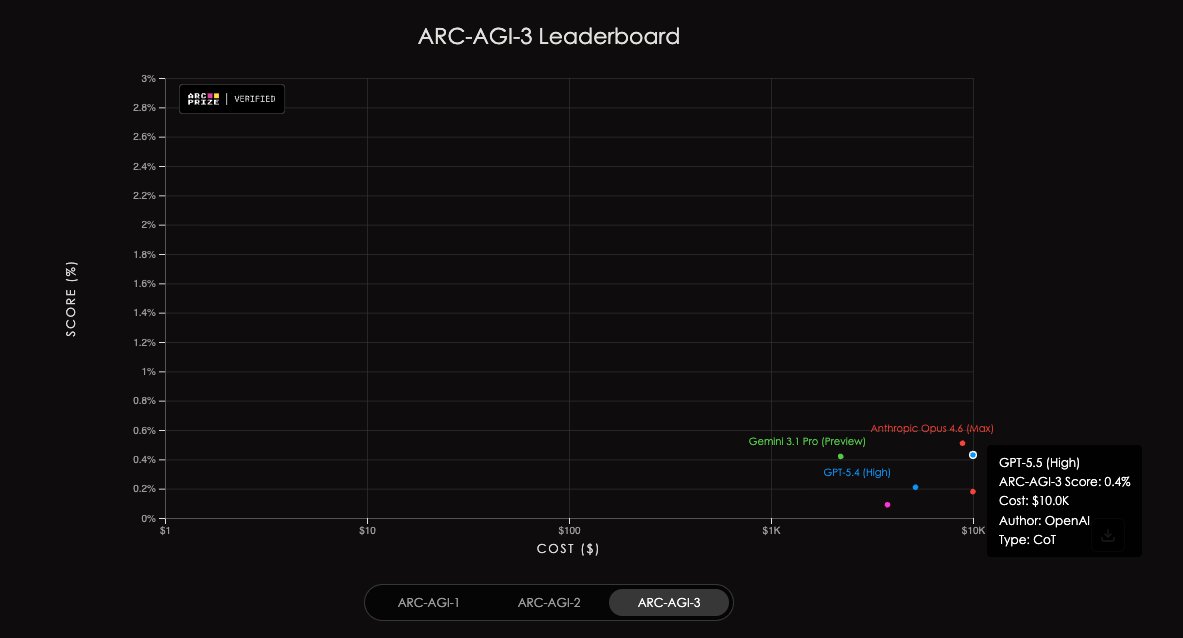
gpt-5.5 and opus 4.7 still score below 1% on arc-agi-3
gpt-5.5: 0.43%
opus 4.7: 0.18%
opus 4.6: 0.45%
gpt-5.5 still failed at world modeling, abstraction, and reward reinforcement
but surprisingly, opus 4.6 scores higher than opus 4.7, which suggests anthropic has degraded this model
English
anthony kiplimo 🪴 retweetledi


Buying this and flying it over Prophet Owour followers.😂
Epick📲🇺🇸@shonkpa55133
My cousin bought this last week and hes already managed to ge tthe neighbors to call the police on him 😂
English