Archiyou

1.5K posts

Archiyou banner
Archiyou

Archiyou

@ArchiyouApp

Open parametric design platform

Katılım Ekim 2021
541 Takip Edilen69 Takipçiler
Archiyou retweetledi
Edward Mehr
Edward Mehr@EdwardMehr·
Manufacturing is still pre-AWS. Locked behind capex, tooling, and gatekeepers. We need the Linux moment: open, messy, community-driven hardware products. High mix × high volume. Anyone can build, not just those who can afford factories. We need manufacturing abstraction the way Amazon Web Services hid data centers. No tooling. General-purpose factories. Same hardware, infinite products. Until then, incumbents hoard the data and worse… there isn’t much of it. Too few players. Too few products. Way below what an exciting future could look like.
Anu Chandra@achandra1

@EdwardMehr 90% of training data is domain-specfic and privately held by individual companies. So there'll be marketplaces for use case specific data. As for new data generated, that'll be subject to licensing. Those who pay for robots will want to own what robots generate.

English
18
23
243
35.5K
Archiyou retweetledi
HOUSE PORN
HOUSE PORN@HOUSEPORN___·
they built entire individual houses stacked inside one building in Chengdu and it’s the wildest thing i’ve seen 😭
English
11
105
1.3K
118.6K
Archiyou retweetledi
Georgi Gerganov
Georgi Gerganov@ggerganov·
Let me demonstrate the true power of llama.cpp: - Running on Mac Studio M2 Ultra (3 years old) - Gemma 4 26B A4B Q8_0 (full quality) - Built-in WebUI (ships with llama.cpp) - MCP support out of the box (web-search, HF, github, etc.) - Prompt speculative decoding The result: 300t/s (realtime video)
English
134
260
3.3K
735.5K
Archiyou retweetledi
Google AI
Google AI@GoogleAI·
Today, we’re launching Gemma 4, our most intelligent open models to date. Built with the same breakthrough technology as Gemini 3, Gemma 4 brings advanced reasoning to your personal hardware and devices. Here’s what Gemma 4 unlocks for developers: — Intelligence-per-parameter: Our 31B (Dense) and 26B (MoE) models deliver state-of-the-art performance for their size, outcompeting models 20x their size on @arena — Commercial flexibility: Released under a permissive Apache 2.0 license for complete developer flexibility and digital sovereignty — Agentic workflows: Native support for function-calling and structured JSON output allows you to build reliable, autonomous agents — Multimodal edge AI: The E2B and E4B models bring native vision, audio, and low latency to mobile and IoT devices — Long-context reasoning: Up to 256K context windows allow you to process entire repositories or large documents in a single prompt Whether you're building global applications in 140+ languages or local-first AI code assistants, Gemma 4 is built to be your foundation. Explore in @GoogleAIStudio or download the weights on @HuggingFace, @Kaggle, and @Ollama.
English
142
353
2.3K
487.9K
Archiyou retweetledi
Danielle Fong 🔆
Danielle Fong 🔆@DanielleFong·
cofounder steve has been getting so good at this advanced implicit geometry. his whole career he's been pushing geometry, and making cad, and different sorts of simulation -- my idea was to nerd snipe him by letting him focus on actually playing with the tools he spent a career developing and supporting.
Danielle Fong 🔆 tweet media
English
10
11
351
23.8K
Archiyou retweetledi
Zyphra
Zyphra@ZyphraAI·
Introducing ZUNA, a 380M-parameter BCI foundation model for EEG data, a significant milestone in the development of noninvasive thought-to-text. Fully open source, Apache 2.0.
Zyphra tweet media
English
83
218
1.8K
1.3M
Archiyou retweetledi
The Public Domain Review
The Public Domain Review@PublicDomainRev·
Drawings by a “respectable artisan of considerable intelligence” who suffered a prolonged “melancholy mood”. Featured in G. Mackenzie Bacon's On the Writing of the Insane (1870) — publicdomainreview.org/collection/on-…
The Public Domain Review tweet mediaThe Public Domain Review tweet media
English
0
73
354
9.7K
Archiyou retweetledi
Lukas Ziegler
Lukas Ziegler@lukas_m_ziegler·
Open robotics platform that connects sim2real robots! LeKiwi is an open-source robotics platform built to move cleanly from simulation to real hardware. It’s designed to work natively with @huggingface LeRobot software, making it a strong option for learning-based and sim2real robotics. What stands out is how complete the pipeline is: → high-fidelity MuJoCo simulation that closely matches the real robot →ML-ready workflows for teleop, data collection, and policy training → distributed robotics via Dora dataflows → a modern Python + Rust stack in a clean monorepo You can teleoperate the robot, record demonstrations, train policies, and deploy them, all starting in simulation, then transferring directly to the physical LeKiwi. This is exactly the direction robotics platforms need to go. If you’re working on mobile manipulation, sim-to-real, or learning-based robotics, LeKiwi is worth a serious look. Check it out here: huggingface.co/docs/lerobot/l… ~~ ♻️ Join the weekly robotics newsletter, and never miss any news → ziegler.substack.com
English
10
58
434
16.6K
Archiyou retweetledi
Ilir Aliu
Ilir Aliu@IlirAliu_·
A full MIT course on visual autonomous navigation. If you work on robotics, drones, or self-driving systems, this one is worth bookmarking‼️ MIT’s Visual Navigation for Autonomous Vehicles course covers the full perception-to-control stack, not just isolated algorithms. What it focuses on: • 2D and 3D vision for navigation • Visual and visual-inertial odometry for state estimation • Place recognition and SLAM for localization and mapping • Trajectory optimization for motion planning • Learning-based perception in geometric settings All material is available publicly, including slides and notes. 📍vnav.mit.edu If you know other solid resources on vision-based autonomy, feel free to share them. —- Weekly robotics and AI insights. Subscribe free: scalingdeep.tech
Ilir Aliu tweet media
English
40
694
4.8K
197.9K
Archiyou retweetledi
createstreets
createstreets@createstreets·
Come with us to Clamart. A Paris suburb shows how to do regeneration people actually like: beautiful streets, gentle density, mingling uses, daring to be popular, layered with greenery, daily life on the doorstep. We could do this here in Britain .... .
createstreets tweet media
English
10
93
568
194.8K
Archiyou retweetledi
Qwen
Qwen@Alibaba_Qwen·
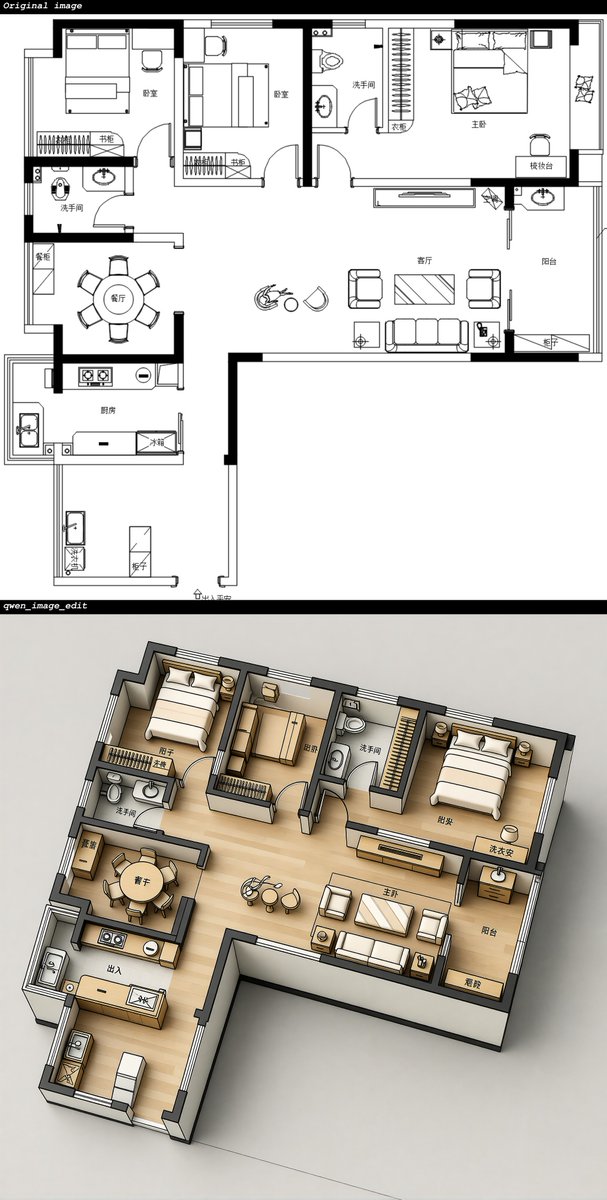
🎨✨ From simple sketches to stunning 3D interiors — powered by Qwen-Image-Edit! All designs are community contributions, showcasing how AI transforms architectural visions into realistic, stylish, and precise creations. Try it now: chat.qwen.ai/?inputFeature=…
Qwen tweet mediaQwen tweet mediaQwen tweet media
English
41
188
1.5K
130.1K
Archiyou retweetledi
Qwen
Qwen@Alibaba_Qwen·
🚀 Excited to introduce Qwen-Image-Edit! Built on 20B Qwen-Image, it brings precise bilingual text editing (Chinese & English) while preserving style, and supports both semantic and appearance-level editing. ✨ Key Features ✅ Accurate text editing with bilingual support ✅ High-level semantic editing (e.g. object rotation, IP creation) ✅ Low-level appearance editing (e.g. addition/delete/insert) Try it now: chat.qwen.ai/?inputFeature=… Hugging Face: huggingface.co/Qwen/Qwen-Imag… ModelScope: modelscope.cn/models/Qwen/Qw… Blog: qwenlm.github.io/blog/qwen-imag… Github: github.com/QwenLM/Qwen-Im… API: alibabacloud.com/help/en/model-…
English
142
587
3.5K
657.4K
Archiyou retweetledi
Tom Dörr
Tom Dörr@tom_doerr·
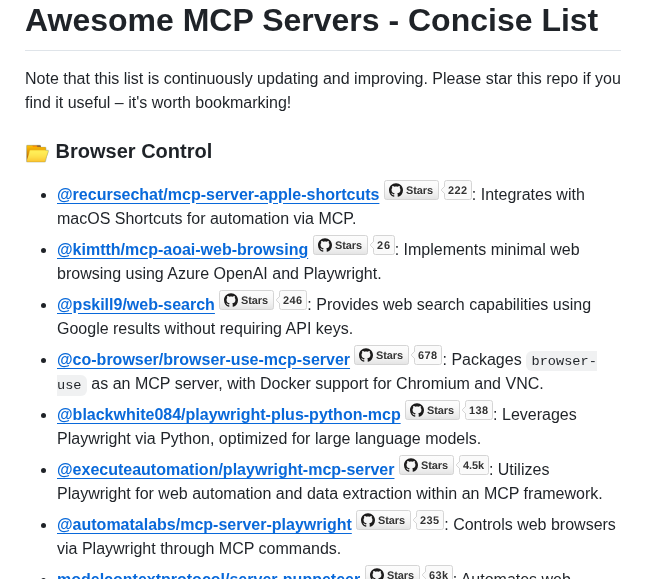
curated list of mcp servers for automation and integration
Tom Dörr tweet media
English
9
27
241
22.7K
Archiyou retweetledi
Archaeo - Histories
Archaeo - Histories@archeohistories·
The "Mona Lisa of Galilee" is a stunning and remarkably well-preserved mosaic that stands as a testament to the artistic and cultural richness of the Roman period in ancient Israel. Dating back to the 3rd Century AD, this exquisite piece of art was discovered inside a Roman villa perched on the acropolis of Sepphoris, a city known in antiquity as Zippori. The mosaic earned its famous nickname from the captivating and enigmatic expression of the central female figure, which recalls the iconic smile of Leonardo da Vinci's masterpiece. The mosaic itself is a vibrant and detailed composition, depicting various scenes from daily life intricately linked to the rites and mythology of Dionysus, the Greek god of wine, festivity, and ritual madness. The panels show a diverse array of figures, including maenads and satyrs, celebrating with music, dancing, and feasting. The exceptional preservation of the mosaic, with its rich colors and delicate shading, allows for a clear appreciation of the skilled craftsmanship of the artists who created it. Each small tessera tile was carefully placed to create a lifelike and dynamic tableau that would have graced the floor of a wealthy Roman patron's home. The discovery of such a masterpiece in Sepphoris provides invaluable insight into the city's status and the cultural climate of the region. As a prominent Roman provincial capital in the Galilee, Zippori was a cosmopolitan center where Roman, Jewish, and other Hellenistic cultures intertwined. The presence of a mosaic celebrating Dionysian rites in a Roman villa highlights the syncretic nature of life in the Roman Empire. The "Mona Lisa of Galilee" is not only a beautiful work of art but also a powerful archaeological artifact that sheds light on the complex social and religious landscape of the ancient world. #archaeohistories
Archaeo - Histories tweet media
English
2
17
100
14.7K
Archiyou retweetledi
The Humanoid Hub
The Humanoid Hub@TheHumanoidHub·
HuB is a unified framework that enables humanoids to execute complex balancing tasks. It integrates reference motion refinement, balance-aware policy learning, and sim-to-real robustness training. Project page: hub-robot.github.io
English
20
123
593
53.7K
Archiyou retweetledi
Archaeo - Histories
Archaeo - Histories@archeohistories·
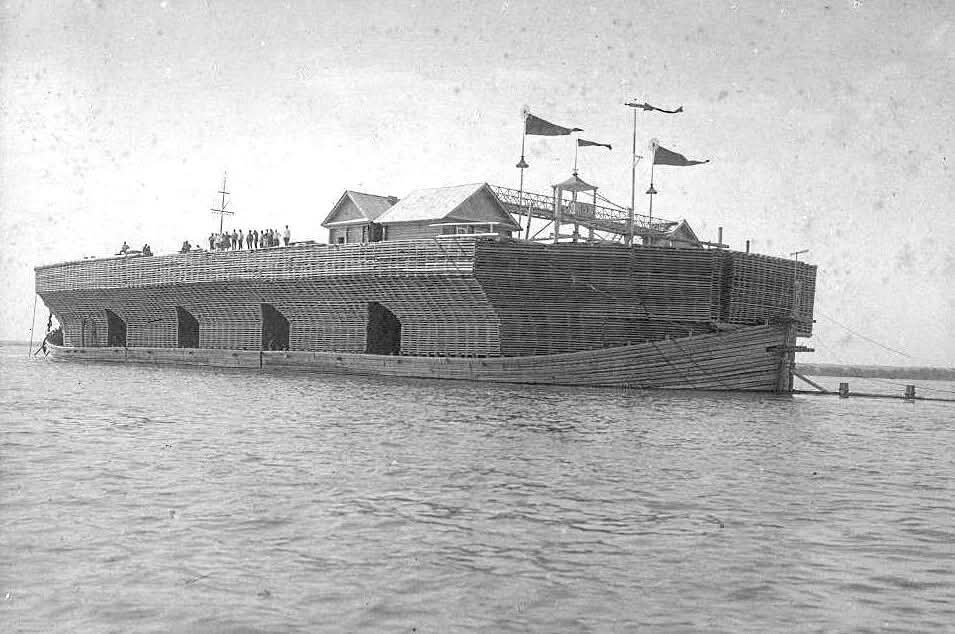
In 19th Century Russia, transporting timber was a significant challenge, especially in regions where the demand for wood was high. To address this, an innovative solution emerged: turning the timber into a floating vessel. The process involved building a massive 400-foot wooden ship, which was then launched into the river. Unlike traditional ships, it had no sails and relied solely on the natural current of the river to navigate downstream, using its own weight and the flow of water as propulsion. Once the vessel reached its destination, the next phase of the process began. The ship would be carefully disassembled, and the individual timber pieces were sold off. This technique not only facilitated the transportation of timber but also created a profitable venture, as the wood could be sold upon arrival, making the journey a lucrative endeavor for those involved in the timber trade. This resourceful method of floating timber downstream, transforming it into a ship, and then disassembling it for sale highlights the ingenuity of the time. By utilizing the river’s natural flow, this system provided a more cost-effective and efficient alternative to land transport, and it played a key role in the success of the 19th Century Russian timber industry, shaping the economy and landscape of the regions it served. #archaeohistories
Archaeo - Histories tweet media
English
0
19
96
13.7K