Armen

7.2K posts

Armen

Armen

@Armen

Host of The Armen Show Science, Nonfiction, Insight

Los Angeles Katılım Eylül 2008
179 Takip Edilen601 Takipçiler
Armen
Armen@Armen·
Seven Decades by Professor Michael Gurven out in the public @PrincetonUPress
Armen tweet media
English
0
0
0
14
Armen
Armen@Armen·
Economist @MarionLaboure on why understanding money remains a major global gap. From my conversation with her about fintech, financial inclusion, and the future of money. Episode 372 - The Armen Show
Armen tweet media
English
0
0
0
16
Armen
Armen@Armen·
If AI can simulate more and more of life… what happens to human relationships? Bronwyn Williams on a possible future where our needs are technically met, but never fully satisfied. “The things that cannot be codified may become the most valuable parts of life.” From Ep. 463
English
0
0
0
19
Armen
Armen@Armen·
“We have this one word ‘fish’ that covers over 30,000 species… and that word can get in the way of seeing the world clearly.” Marine scientist Becca Franks of @nyuniversity on Episode 447. A reminder that the categories we use shape how we perceive the natural world.
Armen tweet media
English
0
0
0
11
Armen
Armen@Armen·
Jennifer Jacquet, Professor of Environmental Science and Policy at the University of Miami, on a shift in how we think about animals and food systems. Instead of asking only how animals serve human use, we should also ask what their lives are like and what the broader impacts are on the food system. From episode 447 of The Armen Show.
Armen tweet media
English
0
0
0
28
Armen retweetledi
Carl Hendrick
Carl Hendrick@C_Hendrick·
Reading comprehension is not a skill. It’s an outcome of what you know. Strategies plateau. Knowledge compounds.
Carl Hendrick tweet media
English
10
203
840
82.6K
Armen
Armen@Armen·
This is a valuable point and it's important that people stay sharp with their own abilities. The resources are great, but if you get overconnected and are now leaning heavily on the tools, you will lose your own. You can probably tell when it is happening, as well, so it is able to be avoided if you have a concern for that. Keep your own nature and ability along the way, but the resources are fabulous.
English
0
0
1
457
Nav Toor
Nav Toor@heynavtoor·
🚨BREAKING: MIT hooked people up to brain scanners while they used ChatGPT. What they found should concern every single person reading this. ChatGPT users showed 55% weaker brain connectivity than people who didn't use it. Not after years. After just four months. Here's how they tested it. 54 people were split into three groups: one used ChatGPT to write essays, one used Google, and one used nothing but their own brain. They wore EEG monitors that tracked their brain activity in real time across four sessions over four months. The brain-only group built the strongest, most widespread neural networks. Google users were in the middle. ChatGPT users had the weakest brains in the room. Every time. Then the memory test hit. Participants were asked to recall what they'd just written minutes earlier. 83% of ChatGPT users couldn't quote a single line from their own essay. They wrote it. They couldn't remember it. The words passed through them like they were never there. It gets worse. In the final session, ChatGPT users were told to write without AI. Their brains were measurably weaker than people who never used AI at all. 78% still couldn't recall their own writing. The damage didn't go away when the tool was removed. Meanwhile, brain-only users who tried ChatGPT for the first time? Their brains lit up. They wrote better prompts. They retained more. Their brains were already strong enough to use AI as a tool instead of a crutch. The researchers also found that every ChatGPT essay on the same topic looked almost identical. More facts, more dates, more names. But less original thinking. Everyone using ChatGPT produced the same generic output while believing it was their own. MIT gave this a name: cognitive debt. Like financial debt, you borrow convenience now and pay with your thinking ability later. Except there's no way to pay it back. The question isn't whether ChatGPT is useful. It's whether the price is your ability to think without it.
Nav Toor tweet media
English
812
7.2K
19.8K
2.5M
Armen
Armen@Armen·
“When I meet a new patient, it’s like opening a book to page 200 and being asked to write page 201 except pages 50 to 75 are ripped out and the rest are shuffled.” Dr. Ilana Yurkiewicz - @ilanayurkiewicz - on the challenge physicians face when patient histories are fragmented. From episode 404 of The Armen Show.
Armen tweet media
English
0
0
1
33
Armen
Armen@Armen·
Influence is often framed as persuasion. But Zoe Chance argues something deeper: Influence is a basic human survival skill. From infancy onward, almost everything we accomplish depends on influencing someone, even if it’s just ourselves. In our conversation we discussed: • ethical influence • generosity and boundaries • saying “no” to protect your energy • why introverts can be highly influential Episode 330 of The Armen Show
Armen tweet media
English
0
0
0
40
Armen
Armen@Armen·
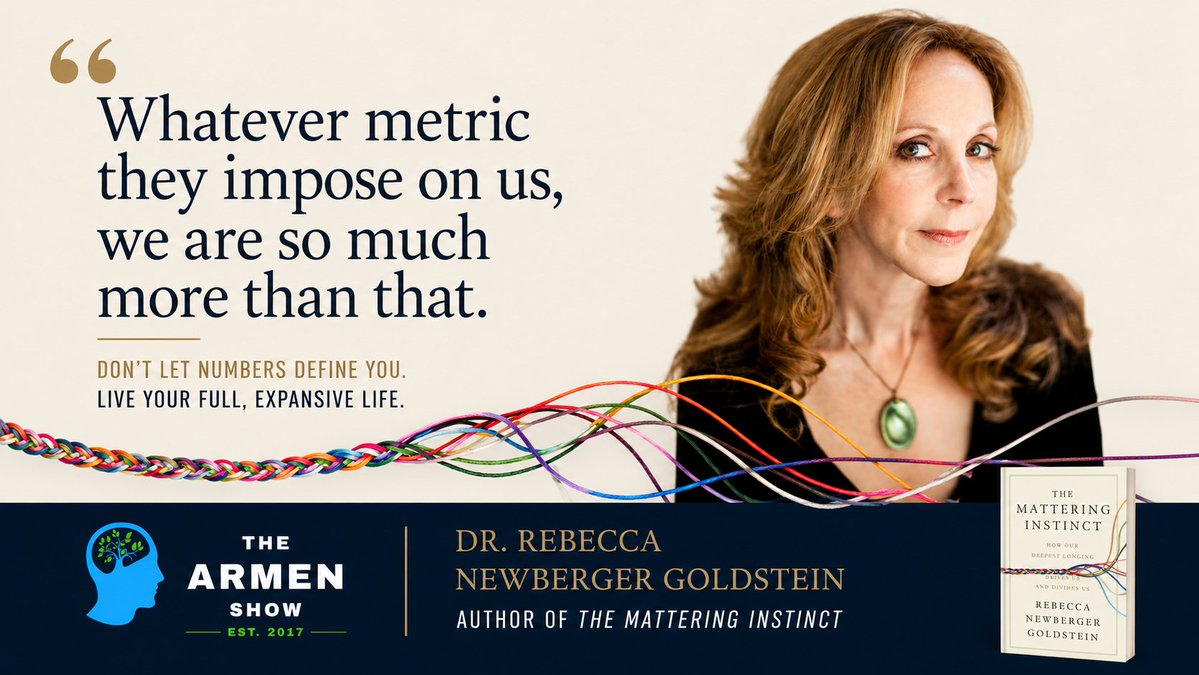
Three ideas from our conversation: “We are matter that longs to matter.” A physical universe producing beings who ask whether their lives deserve attention. Humans uniquely step back and ask: “Do I really matter?” That capacity for self-reflection generates the search for meaning. The same longing to matter can drive both our greatest achievements and our worst atrocities.
English
0
0
0
44
Armen
Armen@Armen·
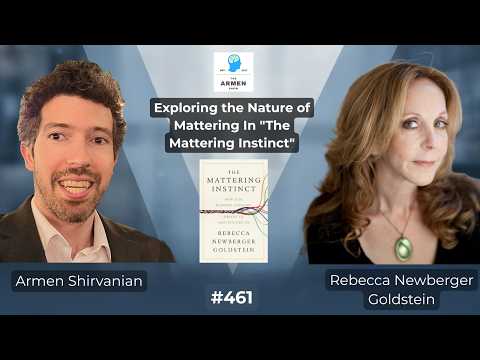
In this conversation, Dr. Rebecca Newberger Goldstein - @platobooktour - explores the “mattering instinct”, which is the human tendency to ask whether our lives genuinely matter. A philosophical question with real psychological consequences. Grateful to Dr. Steven Pinker - @sapinker - for sharing the episode.
Steven Pinker@sapinker

Rebecca Newberger Goldstein discusses the "Mattering Instinct," the topic and title of her new book, with Armen Shirvanian (@Armen). Rebecca Newberger Goldstein (@platobooktour): In this mattering instinct, I’m talking about something else, and it’s ultimately to prove to ourselves in our own lives that we’re living a meaningful life. This is where the notions of meaningfulness and existential crisis and the absurd, and all of these kind of more philosophical ideas, come into play in the kind of mattering that I’m talking about. This mattering comes to us by way of our capacity for self-reflection, when we can step outside of ourselves and think, gee, I spend an awful lot of time paying attention to myself. I automatically feel I’m deserving of my own attention. I automatically feel that I matter. But do I really? That is a very human question, and only we ask it. And that gives rise to the kind of longing to matter that I discuss in the book. It’s different from social mattering, although intertwined with it. They affect each other very much. Full episode: youtube.com/watch?v=YTQS_L…

English
2
2
4
9.9K
Armen
Armen@Armen·
“The brain makes up stories; it conjures up imagery. Our brain plays with us continually.” - Jackie Higgins, "Sentient" In experiments where volunteers were blindfolded for days, many began seeing vivid hallucinations by day two. When sensory input disappears, the brain doesn’t go silent, but instead, it fills the gap. I spoke with @JackieHiggins_ about perception and the senses on episode 341 of The Armen Show.
Armen tweet media
English
1
0
1
148
Armen
Armen@Armen·
Sustained effort, coupled with ongoing self-dialogue, can produce disproportionate progress over surprisingly short intervals.
English
0
0
0
18
Armen
Armen@Armen·
I asked Dr. Caleb Scharf - @caleb_scharf - whether rockets might matter more than agriculture in the very long run. His point was different. Agriculture changed civilization by stabilizing survival and freeing human attention. Space exploration may change civilization by giving a species the ability to observe its entire planet and itself as one system. The shift is in awareness. Clip from my conversation with him:
English
1
0
0
40
Armen
Armen@Armen·
Great point here by Macken on the flattening effect of LLM content similar to face averaging, with the features a couple standard deviations up getting cleared out
Macken@MackenMurphy

There’s a well-known phenomenon in the facial aesthetics literature whereby “average faces” (that is, faces formed by superimposing many faces atop one another) tend to be more attractive than the average person. This may be counterintuitive, but it makes sense when you consider the following: Individual faces are all slightly flawed, from a beauty perspective, in idiosyncratic ways. And when you average lots of faces, you average out all of these minor issues. So, an “average face” is errorless and looks quite pleasant as a result. However, another thing you’ll notice about these “average faces” is that none of them could be models. They’re more attractive than the average human, yes, but less attractive than the most attractive humans. This is because extremely attractive faces tend to have certain features that are, mathematically, extreme. (For example, male models tend to have lower-set brows and larger jawbones than you would see in any average face.) Recently, I have begun to wonder if LLM-writing faces a similar challenge. It’s always “more attractive than average,” because all of the flaws of normal human writing have been averaged out. But it's also missing the unusual taste and style of the best human writers I've read. In my experience, it's only ever 85%-good; like an "average face," it's never flawed, but equally, it's never exceptionally beautiful.

English
0
0
1
50