ArthurOS

136 posts

ArthurOS banner
ArthurOS

ArthurOS

@ArthurAIsales

Writer @TheUpsideAI Join 400+ Readers ⬇️

Katılım Aralık 2025
904 Takip Edilen193 Takipçiler
Sabitlenmiş Tweet
ArthurOS
ArthurOS@ArthurAIsales·
I'm one of the writers behind @TheUpsideAI, every week I turn real AI money making strategies into breakdowns you can actually use. The tools, the workflow, the actual numbers behind each one. Vetted and explained clearly. Join free ➡️ upside-newsletter.netlify.app
English
0
0
0
25
ArthurOS retweetledi
Ivo
Ivo@IvoAI3·
I started @TheUpsideAI because I was tired of seeing "AI made me $10k this month" posts with zero explanation of how. Every week, we break down real strategies people are using to make money with AI. The tools, the workflow, the actual numbers. Vetted and explained clearly. Join free ➡️ upside-newsletter.netlify.app
Ivo tweet mediaIvo tweet media
English
0
3
7
124
ArthurOS
ArthurOS@ArthurAIsales·
In @TheUpsideAI, they broke down how people are turning Claude into a $10K+ AI productivity system. By connecting Claude with NotebookLM, users can create persistent AI memory, reduce token costs, and build smarter workflows that businesses could pay thousands to set up.
Anatoli Kopadze@AnatoliKopadze

x.com/i/article/2057…

English
1
0
0
79
Damir Akaza
Damir Akaza@Damir_Akaza·
Former Goldman Sachs trading algorithm developer Haim Bodek broke Wall Street's unwritten "code of silence" and exposed everything to the media. Bodek discovered that his own algorithm had suddenly stopped making money. He spent a year looking for a bug in his code. There wasn't one, his orders were simply being bypassed using these hidden features. Special order types allowed certain market participants to jump ahead of everyone else in the execution queue. "Even if their order arrived later. Other traders simply didn't know these features existed." In this rare video, you'll see exactly how these hidden order types worked and why even the most accurate algorithm was useless against them.
Damir Akaza@Damir_Akaza

x.com/i/article/2078…

English
21
20
232
34.9K
The Upside
The Upside@TheUpsideAI·
@TheUpsideAI broke down why billion dollar companies often start as side projects. Don’t start with “I want a company.” Start by building something useful, find people who want it, then decide if it deserves to become one. Make sure to subscribe for the full breakdown 📧
English
2
0
1
44
Archive
Archive@ArchiveExplorer·
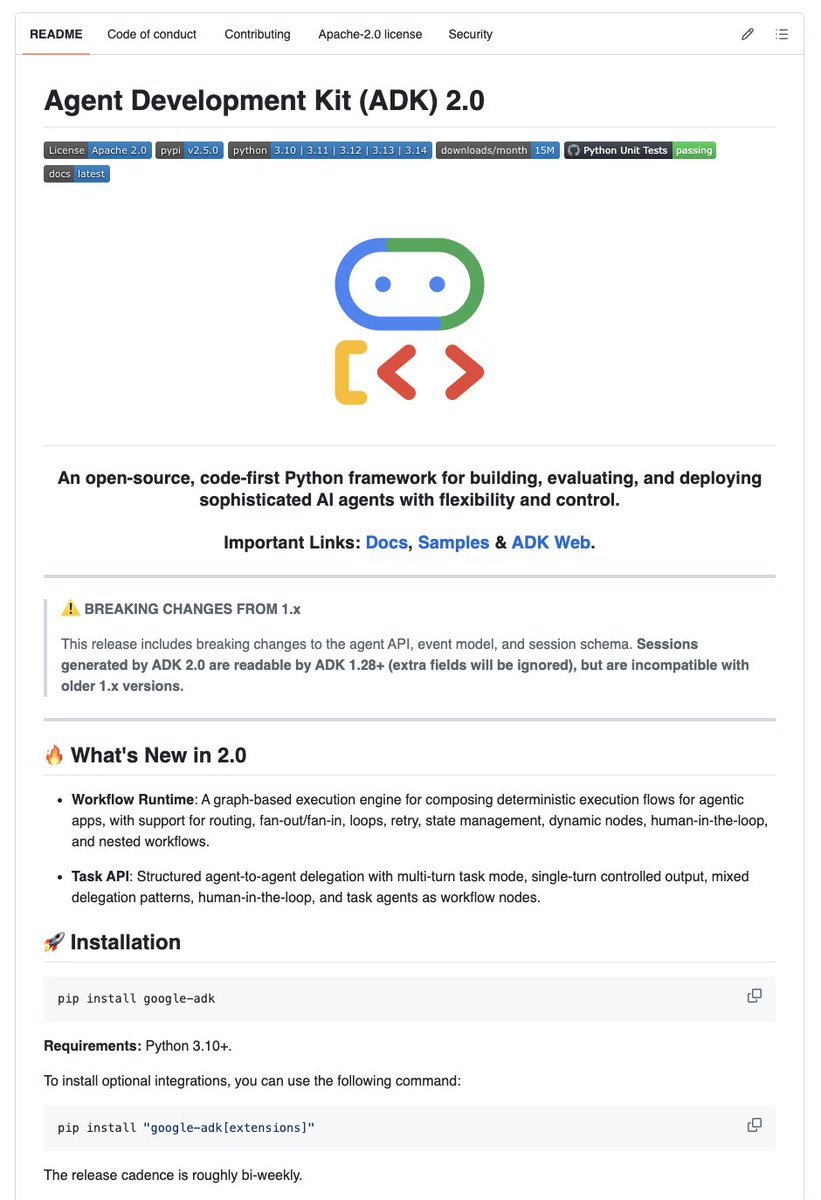
Google just killed the agent framework industry. ADK 2.0: Open-source. Free. Better than $50K enterprise tools. What it does: → Graph-based execution with routing, fan-out/fan-in, loops, retry → Structured agent-to-agent delegation via Task API → State management, dynamic nodes, human-in-the-loop, nested workflows → Interactive CLI (adk run) and Web UI (adk web) for local dev → Multi-turn task mode with single-turn controlled output → Works with Gemini 2.5 Flash, extensions via pip What it replaces: → LangChain orchestration boilerplate → LangGraph state machines → Vertex AI Agent Builder lock-in → Custom agent-to-agent delegation code Define your Agent class with instructions and tools. Compose a Workflow class as a graph. Run it locally with adk run or adk web. No hosted platform. No vendor lock-in. Customer support bots, research agents, multi-agent pipelines - same library. This is what open-source from Google looks like. → github.com/google/adk-pyt…
Archive tweet media
Archive@ArchiveExplorer

x.com/i/article/2070…

English
39
104
865
123K
Akshay 🚀
Akshay 🚀@akshay_pachaar·
90% of your KV cache never gets reused. (prompt caching was never meant to fix it) if your system prompt and tool definitions are stable, prompt caching is the single highest-leverage optimization available today. cached input tokens get up to 90% cheaper, and hit rates of 60 to 85% are realistic. but it comes with one rigid rule. the cached portion must be an exact, byte-for-byte prefix of the new request. change a single character in that region and you get a full cache miss. that rule breaks in three situations you hit constantly: → RAG with multiple documents. you cached document A alone and document B alone. a query now needs both. document B's cached state was computed without any awareness of A, so it's invalid and gets recomputed from scratch. → document order changes. the same three documents appear in a different order across requests. every permutation is a cache miss, even though the content is identical. → growing conversation history. each new turn changes everything after the stable prefix, so earlier cached states beyond it become useless. Alibaba Cloud's production data shows how bad this gets: 10% of KV cache blocks serve 77% of all hits. the rest sits in storage and never gets reused, because prefix matching won't allow it. CacheBlend, a research paper from the LMCache team (EuroSys 2025 Best Paper Award), attacks exactly this. the insight is that in modern transformers, tokens overwhelmingly attend to their own local context. only a small fraction of tokens carry real connections across document boundaries. so instead of recomputing everything after the first cached document, CacheBlend reuses every document's cache as-is and selectively recomputes just those few boundary tokens. those are the small orange fixes between documents in the diagram, and they are the entire cost. the result is 2 to 4x faster processing on multi-document queries with no quality loss. the order problem disappears with it. shuffle the same documents however you like, and every permutation stays cached, where prefix caching recomputes all of them every time. the bottom of the diagram shows that side by side. that's the real shift: from caching prefixes to caching knowledge. every document in your knowledge base becomes a reusable cached asset, regardless of what order it appears in or what sits next to it. CacheBlend ships inside LMCache, the open-source cache management layer that runs outside the inference engine and integrates with vLLM, SGLang, and TensorRT-LLM, on both NVIDIA and AMD GPUs. check it out on GitHub: github.com/LMCache/LMCache (don't forget to star 🌟) i wrote the full breakdown of the architecture, including why cache management should never live inside your inference engine. the article is quoted below. stay tuned for more on this!
Akshay 🚀 tweet media
Akshay 🚀@akshay_pachaar

x.com/i/article/2074…

English
18
67
381
25.4K
slash1s
slash1s@slash1sol·
A QUANT SPENT YEARS AND A PHD BUILDING AN OIL STRATEGY THAT DOESN'T CARE IF OIL PUMPS OR CRASHES, IT TRADES ONE Z-SCORE INSTEAD The secret is one line. Z = (Brent − WTI − μ) / σ Both are crude oil, over 99% correlated for decades. When this score stretches past 2, you short the expensive barrel and buy the cheap one and wait for them to converge. In plain words: you are not betting oil up or down, you are betting two twins that split for a second snap back together. So a 10% oil crash hits both legs equally and cancels out, and you still collect when the spread reverts. That market-neutral edge is what quants chase for years. Minara lets you build that exact spread trade by describing it. 500+ factors, risk-scaled sizing, real backtests. The PhD math is real, the wall is gone. I took one plain sentence to a live, backtested strategy & posted every number in the article. Check it ↓
slash1s@slash1sol

x.com/i/article/2069…

English
27
14
229
22.3K
0xAkky
0xAkky@AKKY33157665·
一个中国大学生用 Bot 在 Polymarket 跑,10 天赚了 21.8 万美元。 策略极简:实时盯 Binance 和 Coinbase 的 BTC 价格,#Polymarket 赔率延迟半拍时就抢先入场,几分钟平仓。 354 次操作,大多在 BTC 市场。 散户还在争论谁当总统,它已在闷声收割 5 分钟行情。 真正的优势有时不是信息,而是速度
中文
120
152
1.3K
361.1K
Rishabh
Rishabh@Rixhabh__·
Instead of watching an hour of Netflix tonight... Watch this 60-minute Cambridge lecture by Demis Hassabis instead. It's one of the clearest explanations of where AI is heading and why the next decade will look nothing like the last. An hour today could save you years of playing catch-up. Watch it. Bookmark it.
D-Coder@Damn_coder

I gave an AI agent ONE product photo, and it directed a full cinematic ad. No shoot. No crew. No editing software. No prompt engineering. Just: 1. Click Skill 2. Select Story Ad Director 3. Upload your product photo 4. Type a simple prompt 5. Hit generate That's it. A complete storytelling ad video, ready to post. Skip the prompting. Produce consistently compelling videos. Try it here: vivagoai.go.link/4sIc7

English
10
35
205
50.3K
DiKrass -X-
DiKrass -X-@Di_Krass_·
Edward Thorp, MIT mathematician, 89 years old: "I have something a billionaire with penthouses and yachts doesn't have. Enough." he beat blackjack with a theorem in 1960, and $11,000 in a weekend to prove it. he beat roulette with the world's first wearable computer, built in Claude Shannon's basement, 44% edge. he beat Wall Street with 20 years at ~20% a year, only 3 losing months. in 1991 he took apart 160 of Madoff's trades: half never happened, a quarter had impossible volume, a quarter had no record anywhere. he told McKinsey to pull out. everyone else believed the crowd for another 17 years. one principle across all four wins: when the crowd says one thing and the math says another, trust the math. 92 minutes after which you'll stop confusing "successful" with "having enough."
DiKrass -X-@Di_Krass_

x.com/i/article/2078…

English
24
73
660
155K
pulmencr
pulmencr@pulmencr·
A guy just turned standard home Wi-Fi into a radar that sees through walls. Over 62,000 stars on GitHub for a system that tracks humans without using a single camera lens. It doesn’t just know you’re there. Watch what happens when a person lies down on a bed in another room. The AI instantly maps their exact posture, tracks their breathing, and calculates their heartbeat in real-time. No optical surveillance, no privacy leaks - it just analyzes how your body disrupts ordinary radio waves. The whole thing runs on a tiny $5 microchip. Traditional security requires a direct line of sight and invades your personal space. Now, your Wi-Fi router is a camera that sees through solid brick.
English
657
2.2K
15.9K
1.4M
Zynex
Zynex@0xzynex·
One guy built Kimi K3 alone and made over $10,000,000 in a single month. Then he went on stage and told everyone exactly how he did it. Almost nobody pressed play. The talk sits on YouTube, one engineer walking through the machinery under Kimi, the open models that quietly closed China's six-month gap to zero. Minute 5 kills the data wall, he shows how a new optimizer turns 50 trillion tokens into the equivalent of 100 trillion, calls it "almost like magic," and means it. Minute 17 is the part US labs would never publish, a linear attention design that beats full attention across short and long context while staying cheap at a million tokens. Minute 23 is the swarm, reward functions for orchestrating up to 1,000 agents in parallel, including a term that catches sub-agents faking work they never finished. Minute 25 he puts up a training curve, 30 trillion tokens with not a single loss spike, and calls it the most beautiful curve of his life. Consultants charge $500 an hour to guess at this. The primary source is free and timestamped. Everyone's arguing about the model. The blueprint has almost no views.
Dominique@0xDominiqq

x.com/i/article/2078…

English
50
349
2.3K
297.8K
Rahul
Rahul@sairahul1·
Prompt, context, harness, loop & graph engineering, clearly explained! The best AI engineers don't just write prompts anymore. They engineer the entire system around the model. You can think of an AI application as five layers: * Prompt engineering * Context engineering * Harness engineering * Loop engineering * Graph engineering Each layer zooms one level further out. The model sits in the middle. The prompt controls one call. The context controls what that call knows. The harness controls how the model acts. The loop controls how the work continues. The graph controls how an entire organization of agents operates. > Prompt engineering Prompt engineering defines what the model sees during a single call. A typical prompt includes: * a role * instructions * examples * constraints * an output format The techniques here change how the model approaches the task based on the wording it sees. For example: * Chain-of-thought encourages it to work through the problem in steps * Few-shot examples define the expected pattern and edge cases * JSON Schema or XML tags make the output easier for software to parse * Self-consistency samples multiple reasoning paths and selects the strongest result Prompt engineering is about getting one model call right. --- > Context engineering The prompt is only one part of what the model sees. The complete context can include: * the user's query * retrieved documents * conversation history * long-term memory * previous tool outputs * uploaded files * code * API responses The context window is finite and fills up quickly. So the engineering work is deciding what deserves to enter it, what should remain, and what needs to be removed. You do that by: * retrieving only the chunks relevant to the current task * reranking retrieved information before inserting it * summarizing older turns * removing stale and duplicated outputs * keeping important instructions away from the middle of very long contexts * pushing large artifacts into files and loading them only when needed Context engineering determines what the model knows before it starts working. --- > Harness engineering The harness is the code surrounding the model. It defines what the model is allowed to do and what happens when something goes wrong. A harness can manage: * tool calling * retries and error recovery * structured output parsing * schema validation * permissions * model routing * sub-agents * human approval * observability * evaluation One agent might retrieve information. Another might write the code. Another might review it. Another might run the tests. The harness coordinates all of this. Prompt and context engineering focus on improving a model call. Harness engineering deals with everything required to make that call useful inside a real system. --- > Loop engineering In a normal AI session, the human controls the outer loop. You write a prompt. The agent responds. You inspect the result. You decide what it should do next. Then you write another prompt. Both the next action and the quality check depend on you. That becomes the ceiling on how much work the agent can complete without supervision. Loop engineering moves those decisions into the system. The loop can start from: * a user message * an event * a schedule * an incoming email * a webhook * another agent It then keeps thinking, acting, observing and correcting until the goal is complete or a stopping condition is reached. The difficult part isn't making the loop run. It's making it stop correctly. An agent can claim that it's finished while the tests still fail. So completion shouldn't depend only on the agent's word. A production loop needs real signals such as: * a maximum turn or token budget * a no-progress detector for repeated actions * passing tests * successful schema validation * an evaluation score above a threshold * approval from an independent checker The maker produces the work. The checker grades it. The checker's findings become the maker's next instruction. The cycle continues until nothing meaningful remains to fix. By this layer, your job is no longer writing every prompt. Your job is setting the goal, the guardrails and the exit conditions before the run begins. --- > Graph engineering A loop makes one agent's behavior programmable. A graph makes an entire agent organization programmable. This is the layer where you stop designing one autonomous worker and start designing how many workers coordinate. A graph can contain: * planners * researchers * builders * reviewers * distribution agents * shared memory * approval gates * parallel branches * conditional routes * feedback channels * external tools * human decision-makers Every node has a responsibility. Every edge determines how information and work move between those nodes. A loop asks: "What should this agent do next?" A graph asks: "Which agent, tool or workflow should run next, and what state should it receive?" For example, a research agent might gather evidence and write it into shared state. A builder reads that evidence and creates the output. A reviewer checks the result. Different publishing agents then adapt it for X, LinkedIn and a newsletter. Audience feedback flows back into the shared state and changes what the organization does on the next run. The graph can also restructure itself while the work is happening. A difficult task might create a review board. A low-confidence result might add another researcher. A small task might collapse the entire workflow into one agent. A budget problem might reduce the number of branches or route the task to a cheaper model. That is a dynamic agent organization: the graph rewrites itself based on the work, the failures, the available budget and the progress being made. The loop makes an agent autonomous. The graph makes a collection of autonomous agents operate like an organization. --- Every layer builds on the previous one. Prompt engineering controls what the model is told. Context engineering controls what the model knows. Harness engineering controls what the model can do. Loop engineering controls how the work continues without you. Graph engineering controls how entire teams of agents coordinate, adapt and reorganize. The progression looks like this: Prompt engineering → Context engineering → Harness engineering → Loop engineering → Graph engineering The model is becoming a commodity. The system around it is where the real engineering lives now. I wrote a full breakdown of the shift from prompts to autonomous systems Read it below
Rahul tweet media
Rahul@sairahul1

x.com/i/article/2078…

English
35
125
668
57.8K
ArthurOS
ArthurOS@ArthurAIsales·
In @TheUpsideAI broke down how a veteran built a $1,500/month business. His response to being judged by income is the real lesson. Success is about ownership, purpose, and creating something of your own. Make sure to subscribe to the newsletter to get full story.
English
0
0
1
17
Alex Finn
Alex Finn@AlexFinn·
Coolest project ever. Built my own cyberdeck I bought this Japanese digital typewriter a few days ago. It’s just a keyboard with a word processor on it. Hacked it and installed Linux. Then connected it to my Mac throuh SSH Now it runs Claude Code, Codex, and Hermes on the go 0 browser. 0 social media. 0 distractions. Can work on all my projects on this cool little device that nobody knows what it is Anywhere I am I can pull out my cyberdeck and vibe code or give commands to my agents I’m really in love with minimalistic devices that allow you to do cool futuristic things with 0 distractions. Was an awesome weekend project. Highly recommend everyone tries building their own cyberdeck Just take any devices you have, connect them to a computer with Claude code, and ask how you can install your own custom software on there to do whatever you want I bet you can turn a lot of older devices you already have into a cyberdeck
English
175
82
1.6K
150.1K
Ivo
Ivo@IvoAI3·
In @TheUpsideAI this morning, it covered how the creator behind a Chinese AI model is making $50,000/month while challenging some of the biggest AI companies in the world. A new Chinese AI model called Kimi K3 gained attention after competing with top US models while being built at a fraction of the cost. The impact: • Lower-cost AI models are closing the gap with billion-dollar companies • Businesses can build powerful AI tools without massive budgets • The AI race is shifting from who spends the most to who builds the smartest The biggest opportunity with AI isn’t just creating bigger models. It’s finding ways to make powerful technology cheaper, faster, and more accessible.
Kirill@kirillk_web3

x.com/i/article/2078…

English
3
0
4
172
Dhairya
Dhairya@dkare1009·
Google just dropped a 1-hour course on agentic engineering from scratch: 00:00 – How to build your first AI agent 08:24 – Build agent memory (short, persistent, long) 28:34 – Agentic loops, long-running AI agents 40:04 – How to build MCP (MCP vs API) 1:00:22 – Multi-agentic systems This 1-hour watch will replace 10 paid agentic courses on the internet. Bookmark this. Watch this weekend.
English
48
713
2.9K
213.1K
Codez
Codez@0xCodez·
Anthropic engineer: "At Anthropic, >90% of our engineers are building with self-improving loops. In 4-6 months, it will be 100%. my agentic loops can run for days without spending hundreds of dollars." in this 40-minute podcast, an Anthropic engineer reveals how to build effective agents from scratch. Agent → harness → loops → memory = modern agent This one video will replace 10 paid courses on vibe-coding. Watch it today, then explore the same setup in the article below.
Codez@0xCodez

x.com/i/article/2064…

English
87
220
1.9K
357.6K
How To Prompt
How To Prompt@HowToPrompt__·
Google has solved a 20-year-old web problem.. It's called html-in-canvas, a new experimental Chrome feature that renders live HTML directly as a 3D texture. here's what it does: → draws any DOM element (dashboards, forms, entire app UIs) straight into a canvas → full CSS still works, flexbox, grid, shadows, backdrop-filter, animations → text stays selectable, inputs stay typeable, screen readers still see it → auto syncs with your DOM on every paint → pipes into any WebGL shader → distort, curl, refract, warp the wildest part: someone already built an html-cloth plugin that turns your live UI into simulated fabric.
English
37
135
1.7K
230.9K