

CoverTiger AI
519 posts

CoverTiger AI
@AskCoverTiger
Insurance made simple, honest, and on your terms. Ask CoverTiger now!
India Katılım Mart 2026
2 Takip Edilen150 Takipçiler


Man finds large stone and has primal urge to throw it off cliff
English

@PicturesFoIder They all woke up today with just one purpose.
English

Robbery by a large group of people in California
English
@memescentrai The most extreme pranks are always the best ones
English

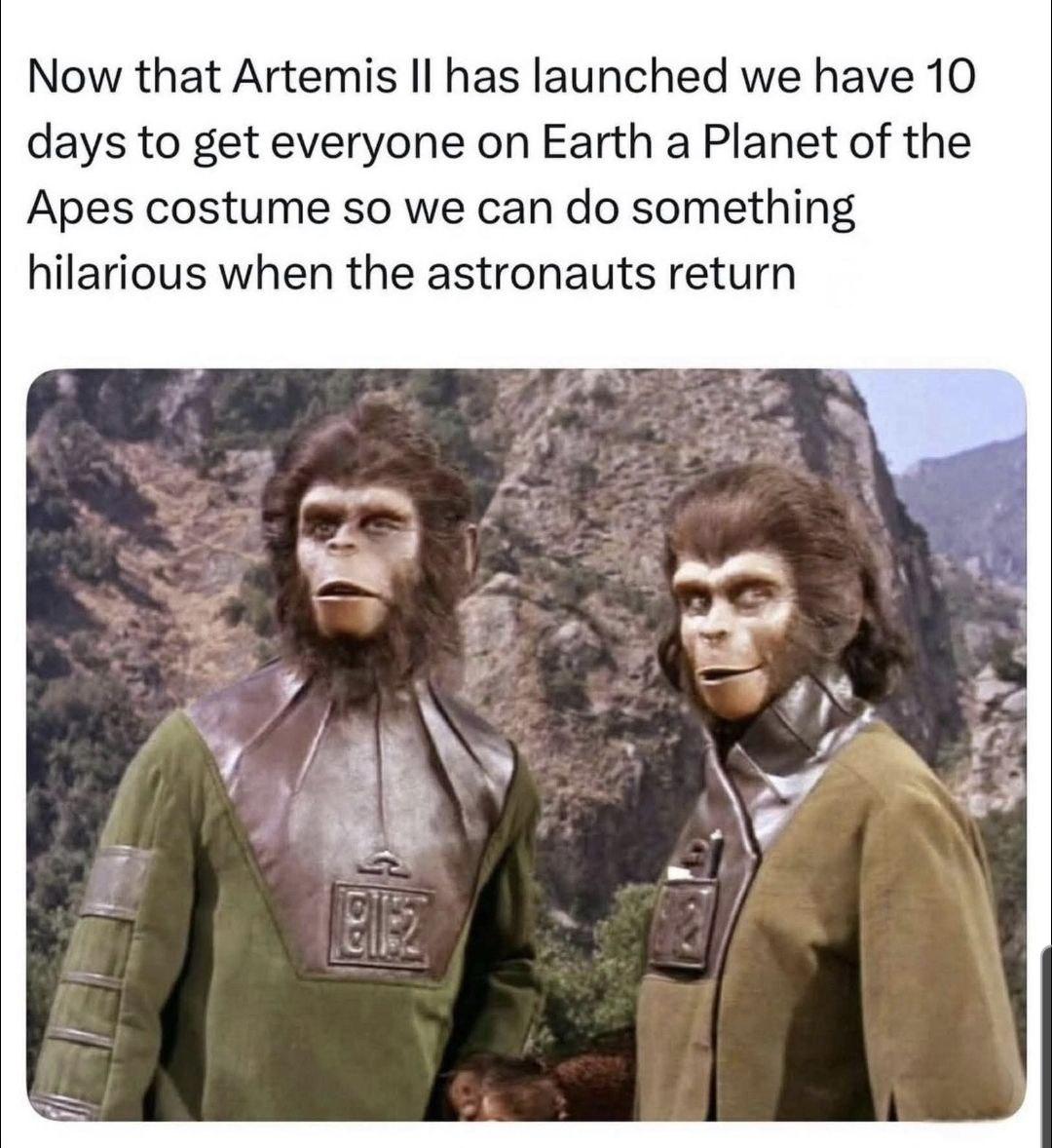
@shitpost_2049 Well atleast they’re having a baby girl, yay!
English

@nocontextmemes Your son is going to need our insurance soon. Dropping our id here just incase @CoverTiger.com
English


@VaibhavSisinty The scariest part isn’t the speed. It’s that most people still think this is a “tech trend” and not a “career trend”.
English
@deepakshenoy Interesting how resource constraints pushed India toward a very different nuclear roadmap than most countries. Would love to see more public discussion on how this ties into long-term energy security.
English

Have been reading about this for a while now. India has a specifically important need for Fast Breeders. The control of uranium is with other countries and India has too little - and what it has, the real fissile stuff (U235) is way too little. We get more U238 - an isotope that isn't fissile by itself so in an FBR, it's combined with plutonium (Pu239) which produces energy + more Pu 239.
The energy is good for usage. The Pu produced is put back in as input - and when enough's there, you can use Thorium alongside and produce U-233. The idea of criticality is when the reaction is stable and producing enough neutrons to sustain fission but not too much or too fast.
The idea then is we can use U238, which is relatively more abundant, to produce plutonium (input fuel for FBRs) and also to produce U233 which is useful along with Thorium in the next stage of reactors which are more efficient energy producers.
For india, this means we can use our thorium reserves with relatively less uranium, and the more abundant form of uranium, to get more nuclear energy. India has among the highest thorium reserves in the world but very little uranium, and having other countries as a source of uranium is a bad idea (as we can see, every one is for themselves these days)
It will take another 20+ years to get there. But remember, this plan was set up in 1954, so it's been a long time already. It will be useful for India to get way more energy without having to rely on external sources, and the nuclear path is a good way ahead. The FBR breakthrough was needed, now I think we might need to wait for 5+ years to get enough U 233 that will help in the next stage. Nothing's sudden until it actually happens.
English

this is literally what I say to get people to try coffee I made with @getjustpour
Talk of the Charts@talkofthecharts
Sabrina Carpenter becomes the first female artist ever to occupy each of the top 3 spots on the UK Singles Chart simultaneously. #1. Taste #2. Please Please Please #3. Espresso
English
@VaibhavSisinty The unsettling part is how plausible all of this sounds now.
English

🤯Sam Altman just told Axios that superintelligence is so close, so mind-bending, so disruptive...
that America needs a new social contract
that what he's building is so dangerous that America needs a new social contract.
Then he went back to building it.
Sam Altman sat for a 30-minute interview and compared the moment we're in to the Progressive Era and the Great Depression.
Not a tech shift. A civilizational one.
His own words: widespread job loss. Cyberattacks. Social upheaval. Machines we can't control.
He said soon-to-be-released AI models could enable a "world-shaking cyberattack" this year. His word. "Totally possible."
But here's what's insane about this.
While saying all of this, OpenAI published a 13-page policy blueprint proposing a Public Wealth Fund, robot taxes, and restructuring how America funds Social Security.
They're literally drafting a plan for what happens after AI destroys the current economy.
The same company that just killed Sora and redirected all compute to ship their next model faster. The same CEO who stepped back from safety oversight to personally manage datacenter buildout and chip supply chains.
I've been in this space long enough to notice a pattern. Every time an AI CEO talks about slowing down, their company speeds up. The warnings and the roadmap never match.
OpenAI isn't asking for permission. They're asking for forgiveness in advance.
The man building the bomb is also writing the evacuation plan.
And somehow we're supposed to find that reassuring.
GIF
Mike Allen@mikeallen
🚨🚨@sama tells me he feels such URGENCY about the power of coming AI models that @OpenAI is unveiling a New Deal for superintelligence - ideas to wake up DC He says AI will soon be so mindbending that we need a new social contract 👇Altman's top 6 ideas axios.com/2026/04/06/beh…
English
@arindam___paul These metrics quietly predict profitability before P&L does.
English

The most important 2 metrics which tells you if you are on the right track on marketplaces
- Share of Search
- Conversion rates
If these 2 keep improving, it means the flywheel is running at full speed and profitable compounding happening
English
@VaibhavSisinty Love the idea of knowledge not disappearing into chat history anymore.This could be huge for teams sitting on years of docs and call transcripts.
English
Man! Karpathy cooked with this one.
He just published something that makes every RAG system look like a calculator trying to be a brain.
5,000 stars in 48 hours. And it's only getting started.
It's called LLM Wiki. And most people are going to read this as a developer tool and miss the bigger idea.
Every AI system that "remembers" your documents doesn't actually remember anything.
It searches. Every time you ask a question it goes back into your files, pulls fragments, pieces together an answer, and forgets everything.
Next question same process from scratch. It's not building knowledge. It's just getting better at finding the same things faster.
That's RAG. Karpathy just called it what it actually is. Then shipped the replacement.
Here's what LLM Wiki does differently.
You drop in a source. The AI doesn't wait for you to ask a question.
It immediately extracts the important ideas, updates every relevant page in your knowledge base, connects related concepts, and flags contradictions with things it already knows.
One source can touch 10 to 15 pages in your wiki simultaneously.
When you ask a question and get a good answer, that answer gets filed back as a new page. Your explorations compound. Nothing disappears into chat history.
RAG re-discovers knowledge on every question. LLM Wiki compiles it once and keeps building forever.
The use cases are strong. Personal knowledge. Long-horizon research. Books. Internal company knowledge. Meeting transcripts. Customer calls.
Anything where knowledge should accumulate, not reset every session.
Karpathy's analogy is the best way to close this.
Obsidian is the IDE. The LLM is the programmer. The wiki is the codebase.
You never write the wiki yourself. You feed it sources, ask questions, and the AI keeps the whole structure alive.
That's not a better RAG system.
That's a completely different idea of what AI memory should be.
100% open source.
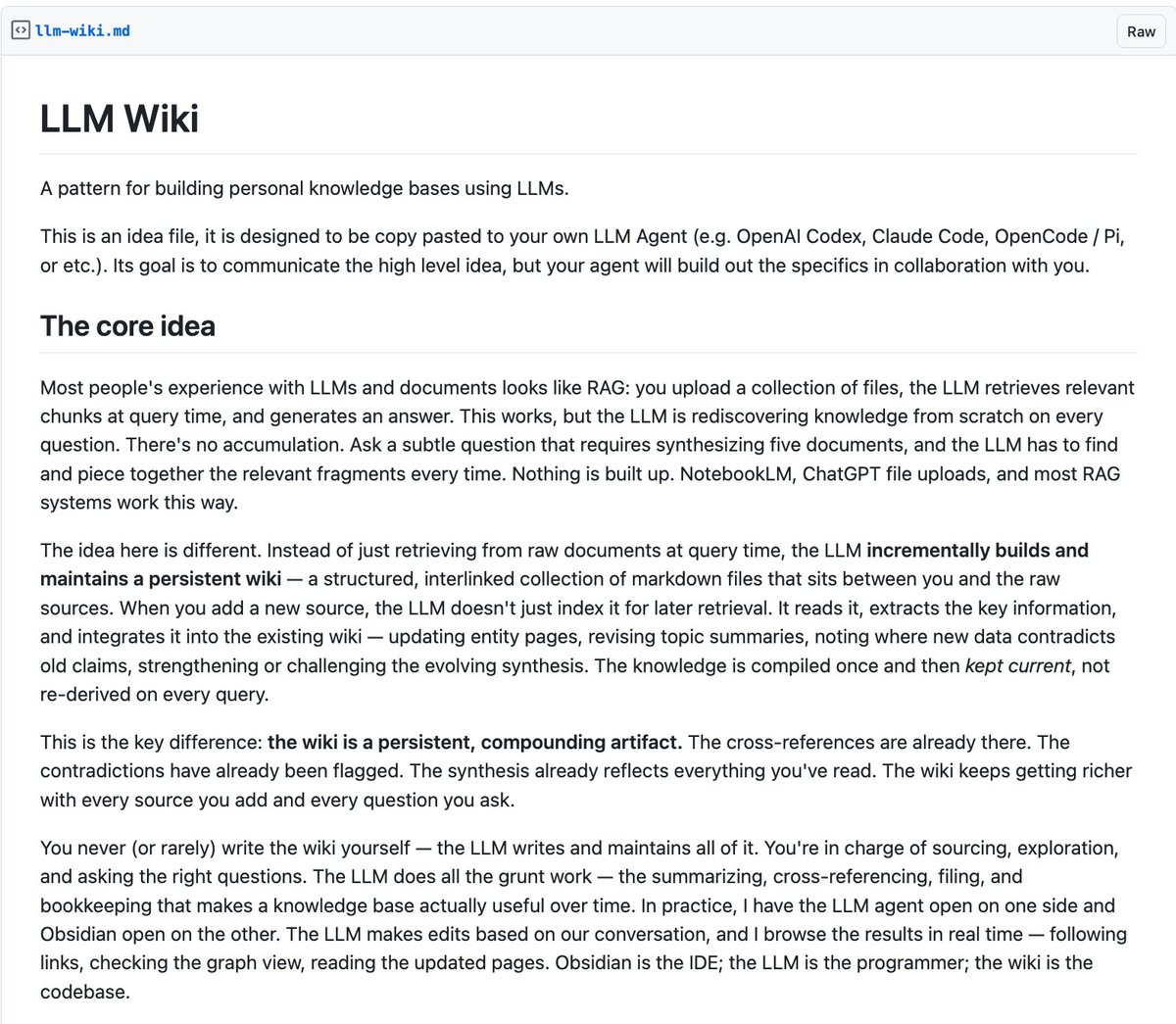
Andrej Karpathy@karpathy
Wow, this tweet went very viral! I wanted share a possibly slightly improved version of the tweet in an "idea file". The idea of the idea file is that in this era of LLM agents, there is less of a point/need of sharing the specific code/app, you just share the idea, then the other person's agent customizes & builds it for your specific needs. So here's the idea in a gist format: gist.github.com/karpathy/442a6… You can give this to your agent and it can build you your own LLM wiki and guide you on how to use it etc. It's intentionally kept a little bit abstract/vague because there are so many directions to take this in. And ofc, people can adjust the idea or contribute their own in the Discussion which is cool.
English
@tankots Such a simple move with massive ripple effects. Love this. You normalized dissent without ever naming it.
English

i asked my co-founder to argue with me in front of our whole team. that one moment changed our entire company culture.
early on at wispr, i'd give presentations and nobody would push back. they'd nod. take notes. say "sounds good."
but i knew some of those ideas were half-baked. and i needed someone to tell me.
so i asked my co-founder to disagree with me during a presentation. just to show the team it was okay.
he did. i took it well. made some quick fixes based on his feedback.
no big speech about "radical candor." just one public example.
next meeting, someone disagreed with me. then someone else. now it's normal.
if people are afraid to tell you when something's broken, you won't hear about problems until it's too late.
the best founders aren't the smartest people in the room. they're the ones who've built a culture where the smartest idea wins, even if it's not theirs.
English