Assaf Shocher

80 posts

Assaf Shocher

Assaf Shocher

@AssafShocher

Assiatant Professor @TechnionLive

Katılım Temmuz 2020
231 Takip Edilen382 Takipçiler
Sabitlenmiş Tweet
Assaf Shocher
Assaf Shocher@AssafShocher·
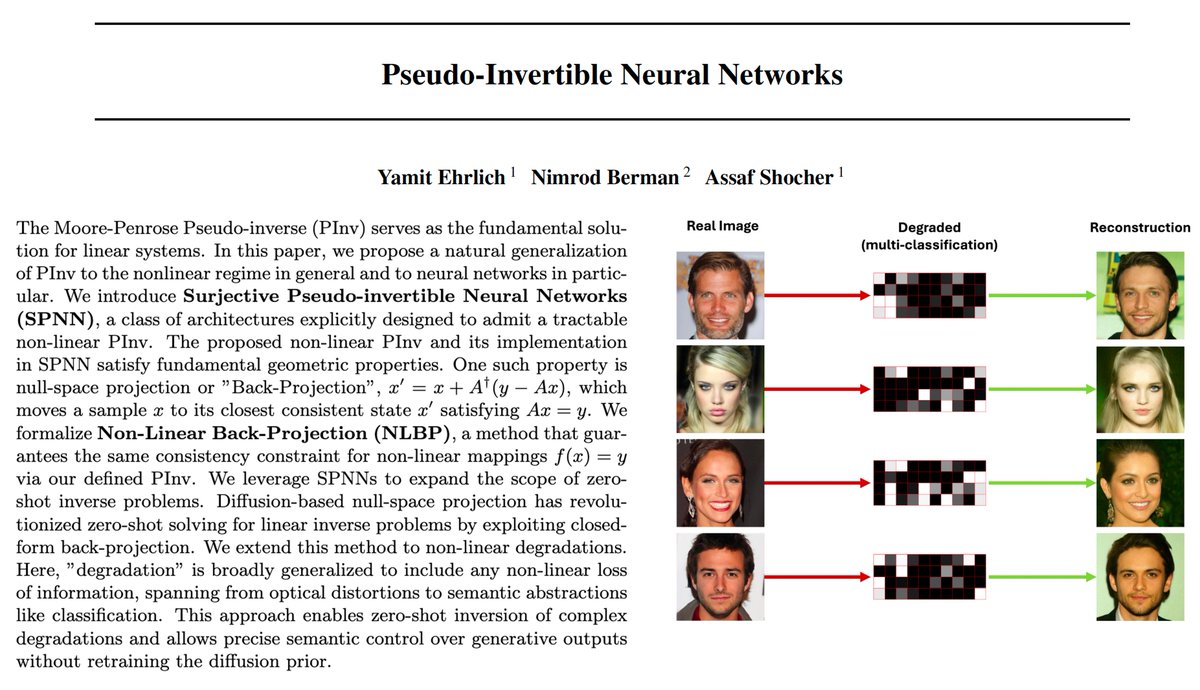
Most of you probably heard about Invertible Neural Networks. But have you heard of *Pseudo*-Invertible Networks? And what does Pseudo-Inverse (PInv) of a non-linear function even mean? 👇
Assaf Shocher tweet media
English
5
22
183
12K
Assaf Shocher
Assaf Shocher@AssafShocher·
@geopavlakos And this is even without them knowing how good you are at getting agents to locate soccer balls! Well deserved, congrats!
English
1
0
1
62
Georgios Pavlakos
Georgios Pavlakos@geopavlakos·
I'm honored to receive the NSF CAREER award! 🎉 Thank you to my students, mentors, and colleagues. Very grateful to NSF for their support.
Qixing Huang@qixing_huang

Congratulations to @geopavlakos on winning an NSF career award (nsf.gov/awardsearch/sh…). When George was hired two years ago, we did expect him to do well. Yet, his performance has exceeded our expectations: NSF medium + Career + a paper award at ICCV + Best thesis co-mentor

English
17
6
120
10.1K
Lior Yariv
Lior Yariv@YarivLior·
Why pay full compute for pixels you're not even looking at? In our new work, Foveated Diffusion, we introduce a new concept for efficient image and video generation, motivated by how the human visual system works. (See full thread below)
Gordon Wetzstein@GordonWetzstein

High-resolution image and video generation is hitting a wall because attention in DiTs scales quadratically with token count. But does every pixel need to be in full resolution? Introducing Foveated Diffusion: a new approach for efficient diffusion-based generation that allocates compute where it matters most. 1/7🧵

English
9
16
125
18.7K
Assaf Shocher retweetledi
Nikola Georgiev
Nikola Georgiev@nickinpractice·
@huskydogewoof I recall reading a paper called Idempotent Generative Network. The idea of training a model such that the data distribution is a fixed point isn't new...
English
4
0
5
751
Benhao Huang
Benhao Huang@huskydogewoof·
“In contrast, our work presents a conceptually different paradigm and does not rely on SDE or ODE formulations as in diffusion or flow models.” Reading it gave me a very particular feeling: an equilibrium flavored sweet spot that drifts away from, yet stays spiritually adjacent to (ranked from farther to closer), diffusion and flow matching, GAN style one shot generation, and DEQ style fixed point thinking. Instead of defining sampling as an explicit time dynamics, they learn a drifting field that moves samples, while training itself evolves the pushforward distribution. The “equilibrium” is not a metaphor, it is literally the point where the model distribution matches the data distribution. The punchline is delightfully clean: it naturally supports one step inference when optimal parameters that can achieve the equilibrium (V, the measure of distance between data and network distribution, being zero) is reached after training; and the ImageNet 256 numbers are strong (FID 1.54 in latent space, 1.61 in pixel space). ❓Question: are we all secretly chasing the same fixed point, just in different coordinate systems?
Benhao Huang tweet media
Zhengyang Geng@ZhengyangGeng

A new paradigm & member toward 1-step & e2e generative modeling! Great work by @Goodeat258 Mingyang!!! cannot be more excited to read me: learning to drift with my spindrift. arxiv.org/abs/2602.04770

English
11
15
190
37.4K
Assaf Shocher retweetledi
Ethan Weber
Ethan Weber@ethanjohnweber·
I made a Claude Code skill that generates conference posters 🛠️ Instead of a static PDF, it outputs a single HTML file — drag to resize columns, swap sections, adjust fonts, then give your layout back to Claude. 🔁 🔗 Skill 👉 github.com/ethanweber/pos…
English
29
331
2.5K
182.3K
Assaf Shocher retweetledi
Amil Dravid
Amil Dravid@_AmilDravid·
Considering submitting to our workshop How Do Vision Models Work @CVPR 2026! We have both a non-proceedings and proceedings track. More info at sites.google.com/view/how-cvpr-….
How Do Vision Models Work? @ CVPR2026 (Prev: MIV)@how_cvpr2026

📢 CVPR decisions are out. Some of you are celebrating. Some of you are "contemplating"🫠 We got you all: do you study how a vision model works? Submit to the HOW workshop @CVPR 2026! New Deadline: March 7, AoE (for both proceedings and non) Link: tinyurl.com/vuk2kysz

English
1
7
36
10.5K
Assaf Shocher retweetledi
Amir Bar
Amir Bar@_amirbar·
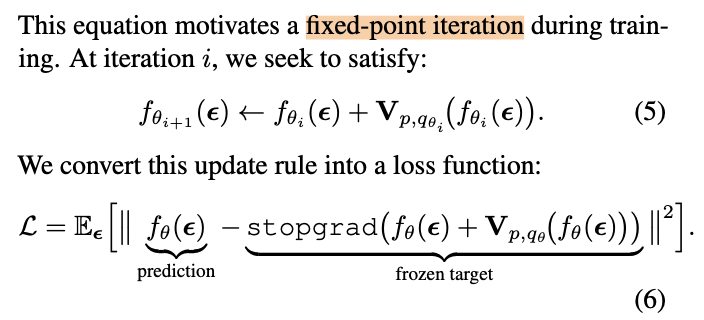
An interesting connection between Drifting models @Goodeat258 to Idempotent Generative Networks by @AssafShocher et al: start from drifting loss: L = E_z || f(z) − sg(f(z) + V(f(z))) ||² Set drift as the generator residual: V(x) = f(x) − x Recovering idempotence L = E_z || f(z) - sg(f(f(z)))|| . Eg, a sample which is already on the data manifold should not change!
Alexia Jolicoeur-Martineau@jm_alexia

Byebye diffusion, say hello to Drifting models. Drifting models will take over diffusion models within the next year. I was told many times that we figured it all out, that there was nothing else to invent in generative AI and it was just about scaling. Wrong again and again.

English
5
6
100
13.6K
Assaf Shocher
Assaf Shocher@AssafShocher·
@isosnovik @Yamitehr @NimrodBe Thank you for pointing out! This is true and we should have cited it, sorry. It is also similar structure to SurVAE. The difference is the use of the degree of freedom. Anyway, we will update and add a citation to PIE, thanks again.
English
1
0
1
24
Assaf Shocher
Assaf Shocher@AssafShocher·
Most of you probably heard about Invertible Neural Networks. But have you heard of *Pseudo*-Invertible Networks? And what does Pseudo-Inverse (PInv) of a non-linear function even mean? 👇
Assaf Shocher tweet media
English
5
22
183
12K
Assaf Shocher
Assaf Shocher@AssafShocher·
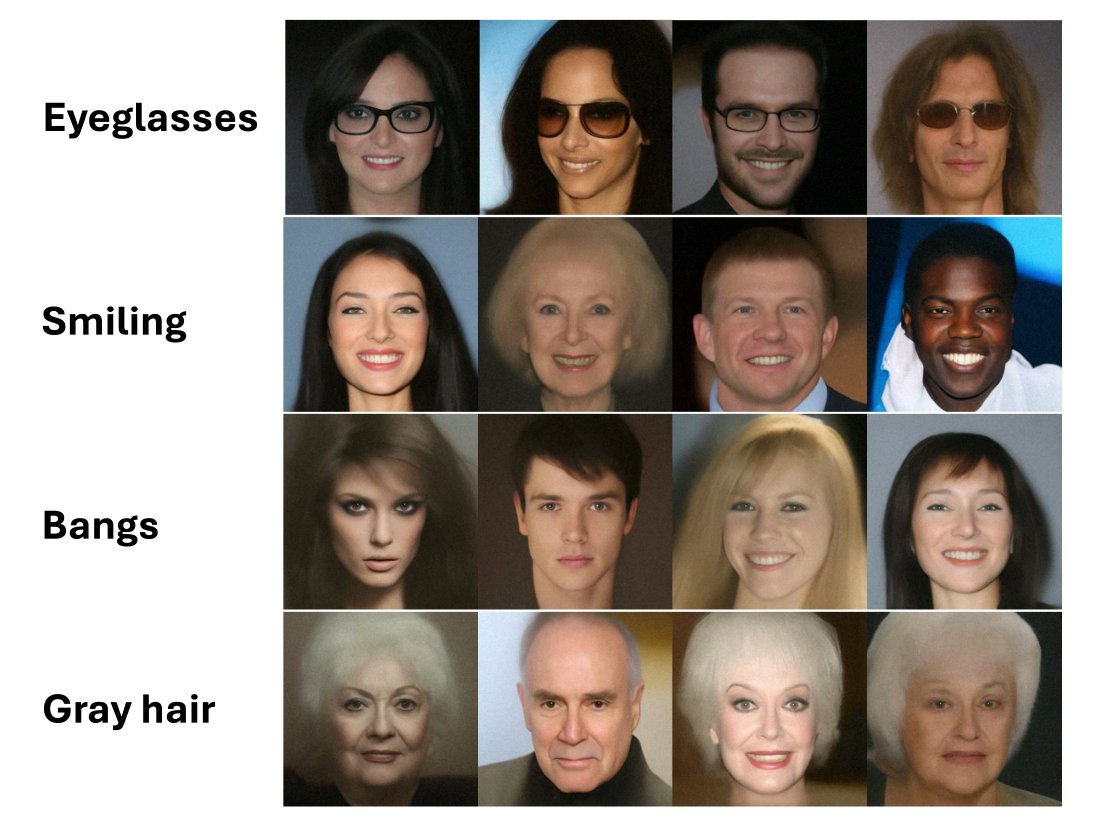
Solving inverse problems with diffusion models is a hot topic (DDRM, DDNM, etc). We combine this with our PInv. We take a frozen diffusion model and apply our NLBP after every single timestep. The diffusion is responsible for the data prior, while our back-projection strictly forces the image to stay on the "manifold" of the target class (e.g., "Must be Smiling"). This is just one demo of what you can do with it and we have many plans for the future.
Assaf Shocher tweet media
English
1
0
2
590
Jonas
Jonas@LoosJonas·
@AssafShocher Then the question arises: Do neural networks operate basically on the surface of a hypersphere?
English
1
0
1
138
Assaf Shocher
Assaf Shocher@AssafShocher·
What do you see when you imagine a high-dimensional standard Gaussian? There is a known anecdote that I'm embarrassed to say I wasn't aware of. Apparently, my mental image was wrong for years and I just got my mind blown 🤯. Just in case I can save someone else the embarrassment: A high-dim Gaussian doesn't look like a blob, but like a spherical shell! The curse of dimensionality dictates an image different than our intuition. In the illustration below, I visualized a 2D slice of the distribution for increasing num of dims. The blue rings highlight the shell where 99.7% of the data actually lives (Mean ± 3σ). Notice the shift from a solid "blob" at N=2 to a hollow, razor-thin skin at N=100K. 👇
Assaf Shocher tweet media
English
3
5
51
4.5K
Assaf Shocher
Assaf Shocher@AssafShocher·
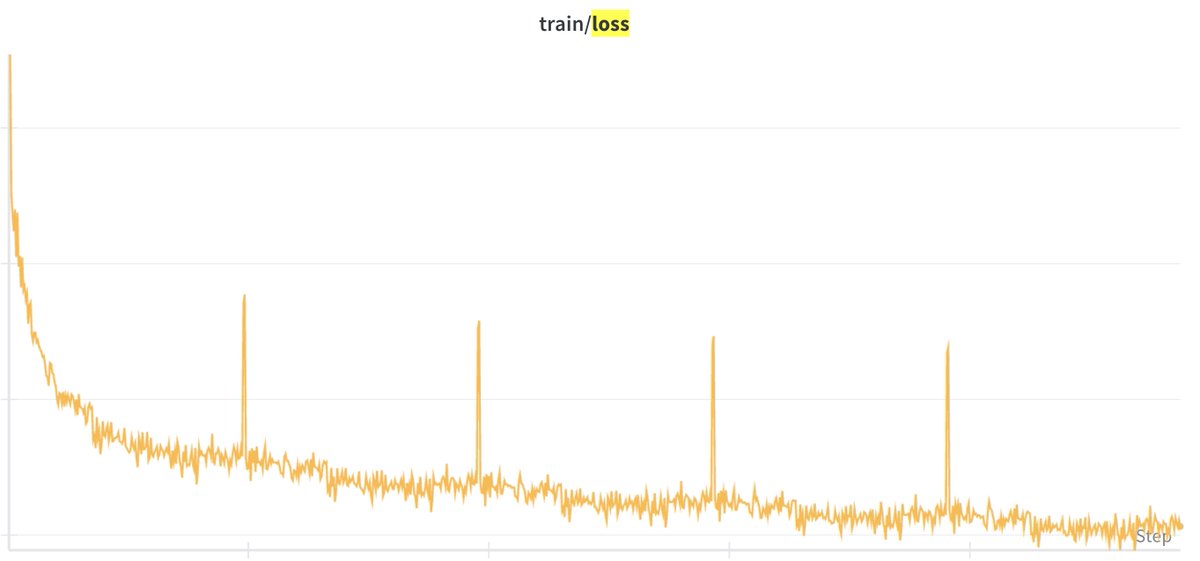
@MaziyarPanahi My guess: Loss is calculated by dividing by hard-coded batch size, but the last batch in the epoch is smaller.
English
1
0
10
1.8K
Maziyar PANAHI
Maziyar PANAHI@MaziyarPanahi·
repeat after me, it's ALWAYS: dataset, dataset, dataset!
Maziyar PANAHI tweet media
English
19
10
358
45.7K
Peyman Milanfar
Peyman Milanfar@docmilanfar·
because a research paper is expected to provide answers - but more specifically: - hides the result, it’s inefficient - teases the reader - shows lack of authority - Betteridge’s law, answer: “No” Eg: “Does sleep affect memory?” vs: “The effects of sleep on memory”
Anand Bhattad@anand_bhattad

@docmilanfar @CSProfKGD I am still trying to understand why a question should be avoided as a title

English
5
4
85
16.3K