🚨🚨RT WIDELY: THE COURT OF APPEAL SPEAKS: IGNORE YOUR OWN CONTRACT RULES, AND THE DISMISSAL FALLS
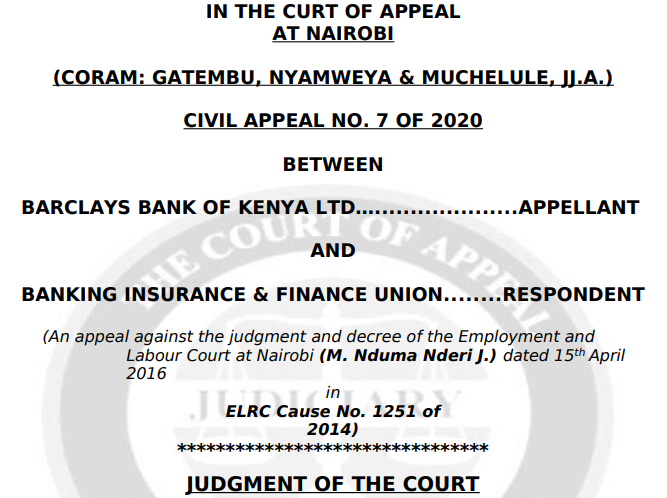
The Court of Appeal has drawn a hard, practical line for every employer in Kenya: follow the disciplinary rules in your contract, or lose the case. In Barclays Bank of Kenya Ltd v Banking Insurance & Finance Union (on behalf of Yasmin Namsi Athman), 2020 , a long-serving employee of 23 years was dismissed after approving transactions later found to be fraudulent, costing millions. The bank insisted it had complied with the Employment Act - there was a hearing, investigations, and reasons for termination. But the employee’s side pointed to the Collective Bargaining Agreement (CBA): for negligence, the employer had to issue two written warnings before dismissal. That never happened. The real issue became stark: can an employer follow the statute but ignore its own agreed disciplinary process?
The Court was not moved by the bank’s defence. It held that a CBA is binding law, automatically forming part of the employment contract, and cannot be brushed aside. The reasoning was precise: where a contract provides a stricter or clearer disciplinary pathway than the statute, that pathway must be followed. The bank’s failure to issue the mandatory warnings made the termination procedurally unfair, regardless of the seriousness of the allegations. But the Court did not excuse the employee entirely; her failure to observe internal fraud controls contributed to the loss. As a result, while the dismissal was declared unfair, compensation was reduced from 12 months to 4. The Court enforced both discipline and fairness, no shortcuts, no free passes.
To the ordinary mwananchi, this decision lands where it matters - your job. It means employers cannot freestyle discipline or skip steps when things go wrong; if your contract or union agreement sets out a process, that process must be respected. Jurisprudentially, this is a sharp warning and a quiet empowerment: a warning to employers that procedural shortcuts will collapse even “strong” cases, and an empowerment to employees that the law will enforce the exact terms agreed, not just minimum standards. The implication is direct: read your contract, understand your workplace rules, and act the moment due process is ignored. In this legal climate, procedure is not a formality, it is your first line of defense.
Kindly repost 🙏.
🔴🚨ELRC Sends Blunt Message to Employers as Ex-Employee Wins Kshs.1.25 Million After Unfair Dismissal
In Kagai v Kenga Equatorial Hotels Limited t/a Mombasa Continental Resort, the Employment and Labour Relations Court ruled in favour of Benson Muriithi Kagai, a Procurement Manager who had been dismissed barely five months into employment without being told why. The employer later attempted to justify the dismissal using allegations surrounding a delayed Kshs.2.7 million linen procurement deal. However, evidence before the court showed that the purchase orders, payment approvals, and cheques had all been authorized by senior management and company signatories. The court found that the termination letter itself contained no accusation, no misconduct claim, and no explanation beyond a vague reference to a contractual clause allowing termination by notice.
Justice Agnes Kitiku Nzei held that an employer cannot dismiss an employee first and then begin constructing reasons during trial. The court emphasized that Sections 41, 43, and 45 of the Employment Act require employers to provide valid reasons for termination and accord employees a fair hearing before dismissal. Since the Respondent neither informed the Claimant of any accusations nor subjected him to disciplinary proceedings, the dismissal was declared both procedurally and substantively unfair. The court further clarified that paying salary in lieu of notice does not excuse an employer from complying with statutory safeguards under employment law. Kagai was consequently awarded Kshs.1.25 million as compensation for unfair termination.
The decision carries major implications for ordinary employees and employers across Kenya. To the common mwananchi, the judgment reinforces that employers cannot use intimidation, office politics, or sudden dismissal letters to sidestep due process. Even short-term employees remain protected by the law and are entitled to dignity and fairness at the workplace. For employers, the ruling is a warning that internal frustrations, management conflicts, or boardroom pressure cannot replace lawful disciplinary procedures. Once termination occurs without proper reasons and hearing, the court is unlikely to rescue the employer later through afterthought explanations raised during litigation.
Kindly retweet🙏
🚨🚨COURT OF APPEAL RAISES THE BAR FOR CUSTOMARY TRUST CLAIMS IN LAND DISPUTES
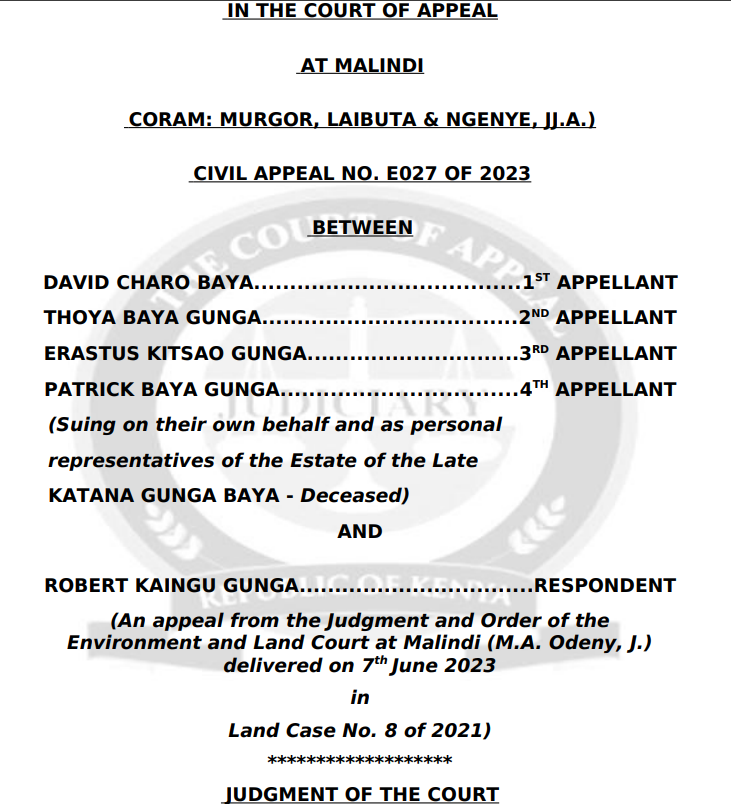
In a landmark decision that could redefine ancestral land litigation in Kenya, the Court of Appeal of Kenya has ruled that family occupation and blood ties alone are not enough to prove a customary trust over registered land. In David Charo Baya & Others v Robert Kaingu Gunga, the appellants argued that the Kilifi land belonged to their grandfather and had always been occupied communally by different family houses under traditional arrangements. They claimed the land was registered during adjudication in the names of two family members merely as representatives of the wider family. But the Court rejected the claim, holding that the appellants failed to prove a critical element: intention. There was no adjudication record, family agreement, committee minutes, or documentary evidence showing the registered owners intended to hold the land in trust for the larger family.
The Court placed major emphasis on the fact that the title described the proprietors as tenants in common, each holding a defined half share. According to the judges, that registration structure pointed to individual ownership, not fiduciary holding for others. Relying heavily on the Isack M’Inanga Kiebia v Isaaya Theuri M’lintari principles, the Court reaffirmed that customary trust remains an overriding interest under Kenyan land law, but only where supported by credible and specific evidence. The judgment firmly rejected the growing trend where extended family members invoke ancestral occupation alone to defeat registered title decades after adjudication.
The jurisprudential impact is massive. The ruling strengthens certainty of title while sharply increasing the evidentiary threshold for customary trust claims. Courts will now require litigants to demonstrate not only family lineage and occupation, but also a clear intention at the time of registration that the land was to be held for others. For landowners, especially those registered as tenants in common, the decision provides powerful protection against speculative family claims. For future litigants, the message from the Court is unmistakable: customary trust is not presumed from history or sentiment - it must be proved through evidence capable of displacing the sanctity of registered ownership.
Kindly retweet widely🙏
For more info, check our profile.
On this one you are misreporting. The justification for assumption of contribution is based on the fact that the wife quit business where she demonstrates income to become Housewife. CoA in Resma & SCoK in JOO set the precedent. women shouldn't sit idly waiting of jackpot
🚨🚨BREAKING: COURT DECLARES HOUSEWIVES ARE NOT “JUST STAYING AT HOME” - EX-WIFE AWARDED PROPERTY, COMPANY SHARES AND BANK MONEY DESPITE HER NAME APPEARING NOWHERE
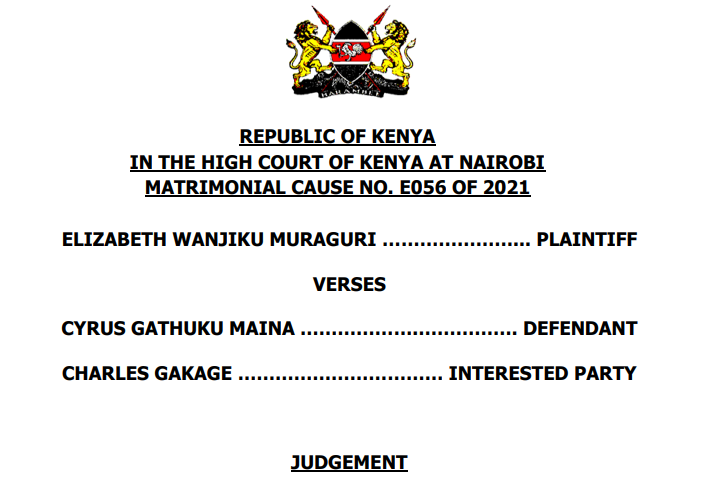
In a landmark judgment in Elizabeth Wanjiku Muraguri v Cyrus Gathuku Maina, the High Court in Nairobi in has ruled that a spouse can walk away with a share of wealth acquired during marriage even where their name does not appear on title deeds, logbooks, company records or bank accounts. The husband argued that most of the assets belonged to a company where he only held 5% shares and relied on the famous corporate law principle in that a company is separate from its owners. But the court rejected the argument, holding that a spouse cannot hide behind company structures to defeat matrimonial rights. Justice Chemitei found that while the husband travelled and built businesses, the wife managed the home, raised children, provided companionship and created the stability that enabled wealth creation.
The judgment now delivers a powerful warning to spouses who think property ownership is only about whose name appears on documents. The court reaffirmed that under Kenya’s Matrimonial Property Act, non-monetary contribution is equal to monetary contribution. Cooking, childcare, emotional support, managing the family and supporting a spouse’s career can legally translate into ownership rights worth millions. The court specifically held that the wife indirectly contributed to the success of Blue Bubble Homecare Products Limited and therefore deserved half of the husband’s 5% shareholding in the company together with a stake in assets linked to those shares. The judge further noted that marriage is an economic partnership and courts will increasingly look beyond paperwork to the real contribution made inside the family structure.
For husbands, wives and business owners alike, the ruling is a brutal reminder that matrimonial disputes can pierce through company walls, personal accounts and privately registered assets. The court awarded the ex-wife half of the Thome property, half of the husband’s shares, half of money held in his accounts and rights over other assets acquired during the marriage. The properties are now to be divided or sold within 90 days. The message from the High Court is loud and unmistakable: if wealth was built during marriage with the support of a spouse, whether financial or domestic, Kenyan courts will treat that wealth as jointly earned, regardless of whose name appears on the paperwork.
Kindly retweet/share 🙏
🚨🚨BREAKING: COURT BACKS EMPLOYER, SAYS YOU DON’T NEED A CRIMINAL CONVICTION TO FIRE AN EMPLOYEE FOR MISCONDUCT
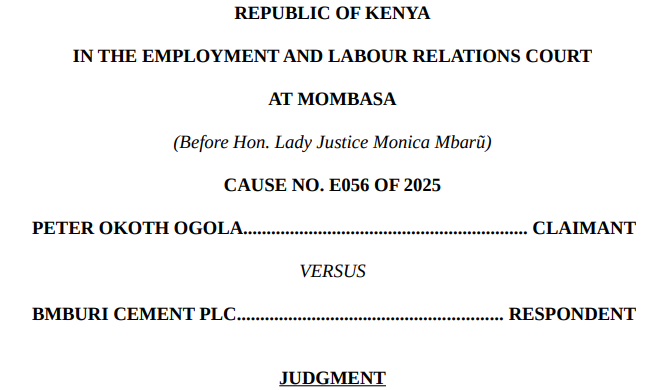
In a major decision likely to shake workplaces across Kenya, the Employment and Labour Relations Court in Mombasa in Ogola v Bamburi Cement PLC (Cause E056 of 2025) [2026] KEELRC 1294 (KLR) has upheld the dismissal of a long-serving employee of who was accused of attempting to leave the company premises with electrical spares hidden in his bag. The employee fought back hard, arguing that police investigations found no criminal case against him and that he was never charged in court. He claimed the dismissal traumatized him, caused anxiety and mental distress, and insisted the CCTV footage never showed him actually stealing anything. But the court still sided with the employer. Justice ruled that an employer is legally allowed to dismiss an employee once internal investigations create a genuine and reasonable belief that gross misconduct occurred, even if no criminal charges are ever filed.
The judgment now sends a chilling warning to employees across the country: your job can still disappear even when the police do not charge you. The court emphasized that workplace disciplinary processes are completely separate from criminal proceedings. According to the court, an employer only needs to show that it genuinely believed misconduct happened after following proper disciplinary procedure. In this case, the company proved that the employee was issued with a show-cause letter, invited to disciplinary hearings, allowed representation, and given a right of appeal. The court also noted that the recovered items matched company stock and that the employee already had previous warning letters on record. Once trust and confidence break down in employment, the court said, the employer is entitled to terminate the relationship.
For employers, the ruling comes as a powerful message of confidence and authority. The court has effectively reaffirmed that companies are not helpless when handling internal misconduct, theft allegations, or breaches of trust. As long as due process under the Employment Act is followed, employers do not have to wait for the police, the DPP, or criminal courts before taking action against an employee. The former employee walked into court seeking millions in compensation and damages. Instead, his entire case was dismissed with costs. The message from Mombasa is loud, sharp and unforgiving: if an employer can demonstrate a fair process and reasonable grounds for suspicion, Kenyan courts will stand behind workplace discipline - even where no criminal conviction exists.
Kindly retweet 🙏
🚨🚨ANOTHER BRUTAL LAND TITLE BLOW : MAN LOSES LAND, TITLE CANCELLED, AND COURT ORDERS HIM TO PAY COSTS AFTER YEARS OF FIGHTING
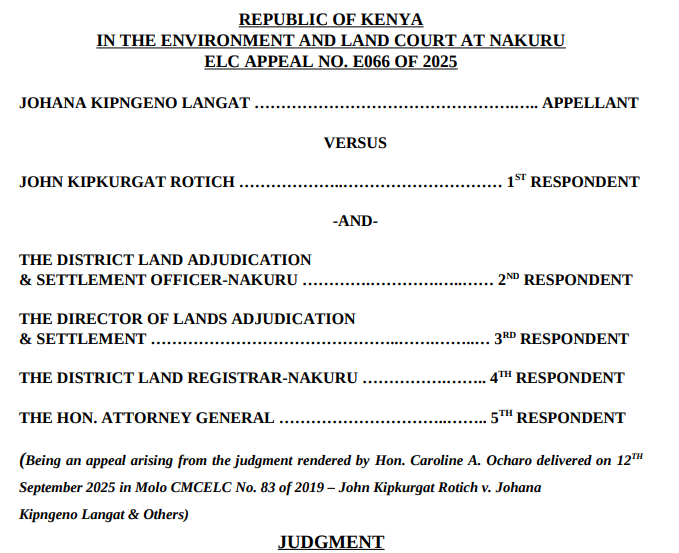
In a hard-hitting judgment delivered by the Environment and Land Court at Nakuru in Johana Kipngeno Langat v John Kipkurgat Rotich & 4 Others, the court stripped a man of his land title after finding that the land had already been allocated to another person years earlier. The appellant walked into court armed with what many Kenyans believe is the ultimate shield: a title deed. He argued that the law protects registered owners under Sections 24, 25 and 26 of the Land Registration Act, insisting he had lawfully obtained the land through a government allocation process. But the court was not convinced. Justice M. A. Odeny found that the title had been acquired “unprocedurally,” noting that the appellant obtained registration despite knowing there was an active ownership dispute and despite earlier findings from land officials that the land belonged to the respondent.
What makes the decision explosive is the court’s clear reminder that a title deed alone is not enough if the process behind it is tainted. Evidence showed the respondent had occupied and claimed the land since the 1980s, later receiving a formal allotment in 2002 when the area became a settlement scheme. Government verification teams later concluded that the land had mistakenly been allocated to the appellant during a later exercise. Shockingly, the appellant admitted he knew there was a dispute, knew investigations were ongoing, and still proceeded to obtain a title deed in 2016. The court stated that “waving a title” does not make ownership indefeasible where the title falls under illegality, fraud, mistake, or procedural irregularity under Section 26 of the Land Registration Act. The judge further held that the court has power under Section 80 of the Act to cancel titles obtained through fraud or mistake, even where a title deed has already been issued.
The decision delivers a brutal lesson to thousands of Kenyans who still assume a title deed automatically ends all disputes. The court reaffirmed the now-growing judicial position that ownership is not merely about whose name appears on the green card, but whether the process leading to registration was lawful from the beginning. In dismissing the appeal with costs, the court concluded that the appellant actively participated in securing the title despite knowing the land was disputed and despite recommendations that the property belonged to the respondent. The message from Nakuru is cold and unmistakable: if your title was born from a flawed process, the courts can erase it completely, years later, and hand the land to someone else as you helplessly watch.
Kindly retweet🙏
🚨🚨BREAKING FROM COA: YOU CANNOT “RETIRE” OVERNIGHT TO ESCAPE DISMISSAL - EMPLOYEES MUST FACE DISCIPLINE FIRST
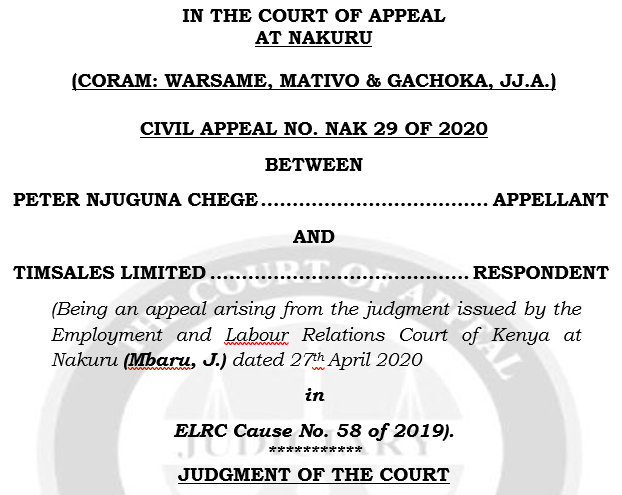
In a major decision shaking Kenyan employment law, the Court of Appeal at Nakuru has ruled that an employee cannot suddenly retire or resign “with immediate effect” simply to dodge disciplinary action. In Peter Njuguna Chege v Timsales Limited, Civil Appeal No. NAK 29 of 2020, the employee attempted to retire overnight after being accused of participating in an unlawful strike and damaging company property. He claimed that once he submitted his retirement letter, the employer lost all power to discipline or dismiss him. But the Court of Appeal firmly disagreed and upheld his dismissal.
The judges found that the employee issued his retirement letter only after the court had already allowed disciplinary proceedings to continue and after notices to show cause had been issued. Worse still, the retirement was intended to take effect immediately, without notice. The Court, composed of Justices Warsame, Mativo, and Gachoka, was blunt and held that employment law does not recognize “instant retirement” used as an escape route from accountability. According to the Court, allowing employees to vanish through sudden retirement while facing misconduct allegations would “sanitize gross misconduct” and destroy workplace discipline. The judges emphasized that even where a Collective Bargaining Agreement allows early retirement, an employee must still issue proper notice under the Employment Act unless the employer waives it.
For ordinary Kenyans, this judgment carries a powerful message. Many workers believe that once they submit a resignation or retirement letter, the employer’s hands are tied. Not anymore. This ruling confirms that if disciplinary proceedings have already begun, especially over serious misconduct, an employee cannot simply disappear behind a retirement letter and expect full benefits. The Court has now drawn a hard line: retirement is not a legal hiding place. If you are facing disciplinary action at work, timing matters, procedure matters, and attempting to outsmart the process may leave you jobless, dismissed, and without the benefits you thought were guaranteed.
Kindly retweet🙏🙏
🚨🚨COURT OF APPEAL CANCELS WIDOW’S TITLE AFTER FINDING DEAD HUSBAND HAD ALREADY SOLD 4 ACRES - BUYER FINALLY WINS LAND 37 YEARS LATER
In a major judgment delivered at Nakuru, the Court of Appeal of Kenya in George Ndichu Munjuga v Esther Nyambura Kariuki (2026) ruled in favour of a purchaser who had bought 4 acres in 1989, paid part of the purchase price, and taken possession, only for the seller to die before transfer was completed. Years later, the seller’s widow obtained title to the land, subdivided it, and transferred it into her own name without recognizing the purchaser’s interest. The dispute exploded into court after the purchaser lodged a caution claiming ownership of the 4 acres. The trial court struck out both parties’ claims and oddly ordered a refund that had not even been pleaded. On appeal, however, the Court of Appeal took a very different view.
The appellate judges found that the purchaser’s interest was genuine, supported by evidence of payment, possession, and an existing Land Control Board consent connected to the larger transaction. The Court further held that the widow could not lawfully deal with the deceased’s land without properly proving succession proceedings, warning that intermeddling with a dead person’s estate without authority violates section 45 of the Law of Succession Act. In a decisive outcome, the Court cancelled the respondent’s title to parcel Nyandarua/Sabugo/6*** to the extent necessary, declared the purchaser entitled to the 4 acres, ordered transfer documents to be executed within 30 days, and permanently restrained interference with his occupation.
This judgment carries a powerful message for ordinary Kenyans. Families cannot quietly inherit and transfer land while pretending long-time purchasers do not exist. At the same time, buyers are being reminded that a sale agreement alone is never enough: complete the transfer, register your interest, and follow up relentlessly. In Kenya, land disputes often become wars between the person on paper and the person on the ground, and this decision confirms that courts may protect possession, equity, and purchaser’s rights even decades later.
Kindly retweet widely 🔥
🔴🚨BREAKING FROM THE HIGH COURT: Borrowers Cannot Use Consumer Protection Laws to Escape Loan Repayment After Default
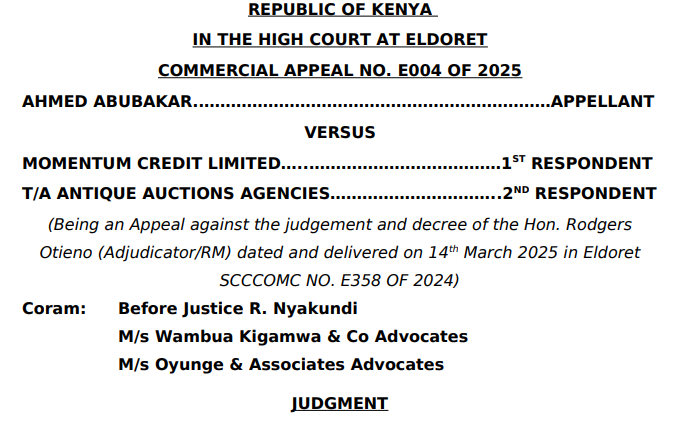
Many Kenyans take logbook loans believing the lender can only repossess a vehicle if every technical procedure is perfectly followed. Others argue that high interest rates, insurance premiums, or auction irregularities automatically cancel the debt. In Ahmed Abubakar v Momentum Credit Limited & Antique Auctions Agencies (2026), the High Court at Eldoret confronted this growing reality head-on. A borrower had obtained a logbook loan secured by motor vehicle K** 5**A. After defaulting on repayment, the lender repossessed the vehicle through auctioneers. The borrower moved to court arguing that the loan agreement was unfair, unconscionable, and in breach of the Consumer Protection Act and the Movable Property Security Rights Act. He claimed the lender failed to properly disclose borrowing costs, improperly imposed insurance charges, failed to issue valid default notices, and unlawfully repossessed the vehicle. He also argued that the total repayment amount of Kshs 445,561 on a loan disbursement of Kshs 147,740 amounted to unjust enrichment and an unfair bargain.
But the High Court looked beyond the emotional weight of repossession and focused on one hard truth: the borrower had admitted default. Justice R. Nyakundi held that courts cannot rewrite contracts simply because one party later finds the terms burdensome. The Court emphasized that parties are bound by agreements they voluntarily sign, especially where the loan terms, repayment schedule, interest, fees, and consequences of default were expressly disclosed in writing. The judge found that the borrower failed to demonstrate that the contract was unconscionable, deceptive, or illegal under the Consumer Protection Act. The Court further held that although auctioneers must comply with statutory procedures, alleged irregularities in repossession do not automatically extinguish a valid debt or discharge a borrower from repayment obligations.
In a powerful statement on commercial certainty, the Court warned against attempts to weaponize consumer protection laws as an escape route from contractual obligations. Justice Nyakundi stated that allowing borrowers to retain vehicles without repaying outstanding loans would itself be unconscionable and contrary to the lender’s secured rights. The Court upheld the lender’s right to repossess and sell the vehicle upon default and dismissed the entire appeal with costs.
This is a major decision for Kenya’s growing logbook loan and asset financing sector. The High Court has now reaffirmed that while lenders must comply with consumer protection and repossession laws, borrowers also carry a legal duty to honor repayment obligations. Consumer protection is not a magic eraser for admitted default. The message from the High Court is loud and clear: once you freely sign a financing agreement, courts will not rescue you from a bad bargain merely because repayment later becomes painful.
Kindly retweet widely 🙏