Asymmetric Research
232 posts

Asymmetric Research
@AsymmetricRes
In search of outsized gains through in-depth fundamental analysis. These are our views only and not investment advice. https://t.co/nXebhI4ePN
Katılım Şubat 2025
6 Takip Edilen545 Takipçiler

EU gas storage injections are running well below the levels needed for a reasonable refill by November. The market looks complacent.
We discuss this in detail for paid subscribers — link in bio.
#NaturalGas #LNG #EnergyMarkets #Commodities #TTF
English

European gas up +18% since our call last week.
Subscribe — link in bio.
#NaturalGas #LNG #EnergyMarkets #Commodities #TTF
English

#URANIUM - 🔥Nuclear energy is the clear winner of the Iran conflict.
Safety validated under attack. China building 55% of global new capacity. Kazakhstan quietly ring-fencing its uranium reserves.
We model notable supply deficit per year in the coming years — before utility restocking even begins.
Full report + stock picks with 80%+ upside 👇
Link in bio
English

@duediligenceguy We have just written a piece on uranium and nuclear capacity growth - link in bio. Rick Rule subscribes to our work.
English

#uranium 🔥New report from us updating our stance and supply forecasts post the Iran conflict, and recent developments…
Link in bio.
Subscribe to our work! We write on natural resources, including uranium, gold, nat gas…
English

Rick Rule respects our research. Subscribe to our work on Natural Resources (link in bio).
We provide in-depth, independent financial analysis backed by solid numbers. We offer actionable insights and a competitive edge. Join us to stay informed and ahead on gold, uranium, natural gas, and more. 🔥
English

Rick isn’t just one of the most knowledgeable minds across mining equities and deposits; he’s a benchmark, a lighthouse in a sea of noise. And he shares that knowledge freely, with anyone, all the time, always with the precision of a Swiss clock. A true old-school gentleman.
Rick Rule@RealRickRule
Live Q&A with Rick Rule and Steve Barton x.com/i/broadcasts/1…
English

#GOLD - New report from us crunching the numbers of GMINING’s takeover of G2.
Link in bio.
We write research on natural resources and stocks, including gold, silver, uranium, natural gas… 🔥
Subscribe for exclusive, in depth analysis on the most promising resource plays!
English

@SusanSakmar Not sure the right price signal is at €44MWh.
There is also a risk of a hotter summer in Asia just as EU refill is at or near peak, then that LNG re routes there.
English

🇺🇸 USLNG doesn’t go through the Strait of Hormuz, so looking for more cargos to load Gulf of America (Golden Pass startup, Venture Global, Cheniere, Freeport) and head to Europe if TTF sends the right price signal. 👀
Thierry Bros@thierry_bros
🇪🇺 gas storage back in injection mode, but with the Strait of Hormuz still closed, this refill season is set to be challenging.
English

@ira_joseph @JavierBlas @BreizhLondon @ColumbiaUEnergy Europe won’t be able to cut demand as it had in 2022, which was the saving grace then. Demand today is still >15% lower than pre Ukraine war…
English

@JavierBlas @BreizhLondon Lose 77 MTPA of LNG supply, it’s clear you must lose 77 MTPA of demand. My estimate was one third China, one third SE/South Asia and one third Europe. Kuwait will grab UAE volumes. Early on Europe is cutting the fastest. Still lingering Qatari volumes to deliver. @ColumbiaUEnergy
English

2022 :
Europe extremely slow to react (noose had tightened in July 2021)
Demand destruction was only in earnest in Sep 2022.
Bad French nukes
2026 : Asia very fast, demand destruction across all countries.
Javier Blas@JavierBlas
We have forgotten how bad 2022 crisis was. Commodity: price today (peak in 2022) Brent: $99 ($139) EU steel: $710 ($1,435) EU wheat: €200 (€438) US corn: $4.5 ($8.2) EU gas TTF: €51 (€339) Henry Hub gas: $2.9 ($9.7) German power: €95 (€984) Urea: $660 ($910)
English


GOLD - New Note Out.
We’ve just published a new note analysing how low the gold price can go, and key market trends. Since the start of the Iran war, we’ve also released focused pieces on natural gas dynamics and our preferred oil play amid the heightened geopolitical risk. For our full insights and actionable outlook, subscribe now to get the full report.
Link in bio
English


NATURAL GAS - Report out providing an in-depth analysis of the current European gas market🔥, with a particular focus on price dynamics, supply risks, and the geopolitical factors shaping the outlook for TTF, while assessing historical price movements and potential future scenarios.
Link in bio.
Subscribe!
English

@matt_fernley We wrote a note specifically on this… link in bio.
English

Lots of commentators are suggesting the Strait of Hormuz closure will disrupt uranium supply. I think they’re wrong.
Their logic seems simple and obvious: most uranium mining relies on sulphuric acid, a large share of global sulphur exports pass through the Strait of Hormuz, and therefore a disruption in the Strait would choke off the chemical inputs required for uranium production.
At first glance, that sounds plausible. But once you look at where uranium is actually produced, the argument largely breaks down.
Today roughly 55–60% of global uranium output comes from in-situ recovery (ISR). This method dissolves uranium underground using sulphuric acid rather than extracting it through conventional mining. Because ISR relies heavily on acid, it’s easy to assume that uranium production depends on sulphur moving through Hormuz.
The key issue is that this logic assumes major uranium producers rely on imported sulphur. In many cases, this is not true.
Take Kazakhstan, which produces roughly 40–45% of the world’s uranium, almost entirely through ISR. If any country were vulnerable to sulphur supply disruptions, it should be Kazakhstan.
But Kazakhstan is also a major sulphur exporter.
Large oil and gas fields such as Tengiz, Kashagan, and Karachaganakgenerate millions of tonnes of elemental sulphur each year as a by-product of sour gas processing. These volumes far exceed what Kazakhstan’s uranium sector requires for sulphuric acid.
The same dynamic appears elsewhere. Uzbekistan produces sulphur through gas processing, while the United Statesis a net sulphur exporter thanks to refinery and natural gas output. Canada, the world’s second-largest uranium producer, mines uranium conventionally but is also a major sulphur producer. Australia is another large producer of sulphur.
Namibia, which accounts for roughly 10% of global uranium output, DOES import sulphur. But most of those imports come from Zambia and South Africa, not from the Gulf.
The result is that the largest uranium producers are largely insulated from sulphur trade disruptions associated with a closure of the Strait of Hormuz.
Costs could still rise at the margin. But the evidence suggests the Strait is unlikely to materially constrain uranium production itself.
In my view, there are a number of industries that will feel the impact of the Hormuz shutdown far more than uranium.

English

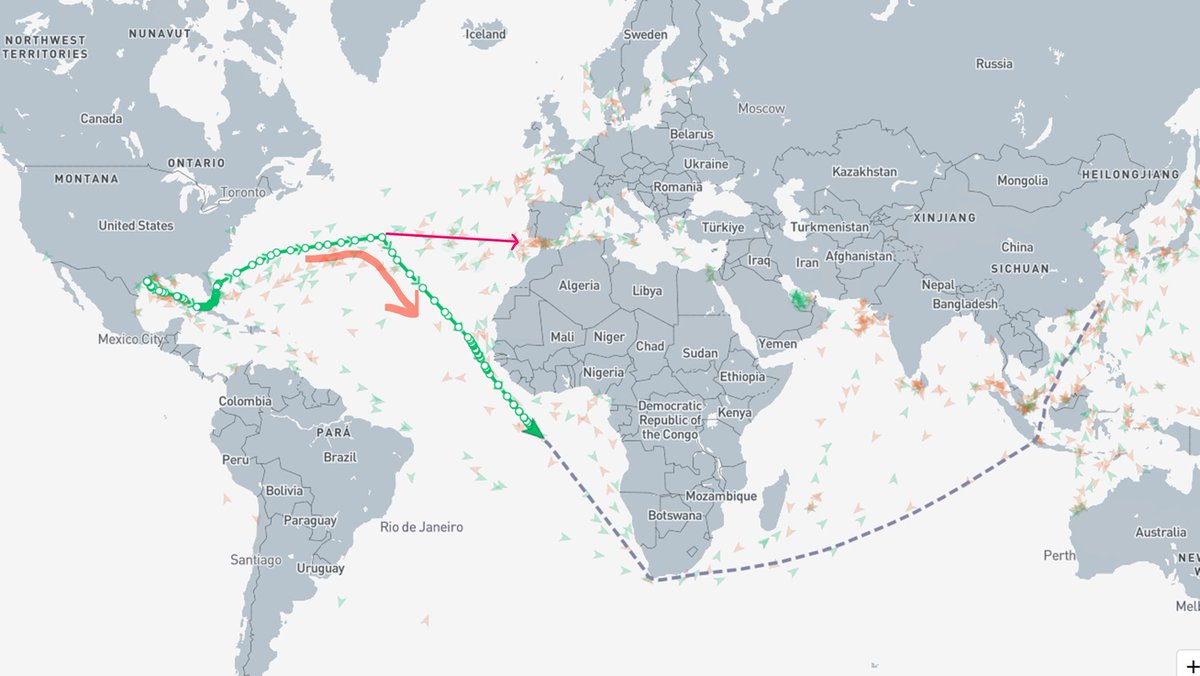
@anasalhajji Do these diverted tankers also choose to go through the Suez canal?
English

⭕️A large number of LNG carriers were diverted from Europe to Asia. Will China restarts buying US LNG?
Map form @Kpler
I added the red arrows

English

#URANIUM - In our latest report, we evaluate whether there are any risks to the uranium sector, specifically related to the Strait of Hormuz as a critical chokepoint for global elemental sulphur supply. This is a crucial issue given the sulphur’s role in uranium extraction.
Last week, we released two in-depth reports:
1A historical analysis of the 1973 oil embargo’s impact on gold and gold stocks.
2Our top oil pick in the current market.
Link to research in bio.
Don’t miss out—SUBSCRIBE for more insights.
English