
Auria

11.5K posts

Auria banner
Auria

Auria

@AuriaMax

Katılım Nisan 2023
1.6K Takip Edilen314 Takipçiler
Auria retweetledi
Greg Koenig
Greg Koenig@gak_pdx·
One of my favorite things on the internet was @slatestarcodex writing about Cost Disease; basically, how the costs to do anything have basically tripled, completely disconnected from labor costs, material inputs, or inflation. No economists have an explanation for why costs have gone up so much, it seems like some dark force is acting on the US economy so that - while the Europeans can build lavish infrastructure, the US is stuck at 5-6x costs to build literally everything... and this underpins our fundamental debates about everything. The Interstate Bridge is an excellent example. Back when this was killed the 2nd or 3rd time (I forgot which), the *studies* performed to explore the new bridge cost ~$200 Million. I did the back of the napkin math and those studies cost 3x, inflation adjusted, what the original entire bridge cost to build. I think the dark force economists cannot detect is a combination of things, primarily though? Grift. You need to pay off the environmentalists, you need to pay off the labor unions, you need to pay off local interest groups. Those are the grifts that use social concerns as a cover... But the real grift is the Professional Managerial Class. All the various technical entities involved in the production of anything are 3 people who know anything about the subject encased in small to large organizations where 80% of the headcount has nothing to do with the task at hand. It is a baked-in, structural grift that underpins almost the entirety of the American economy. Vast swaths of the white collar economy are basically riding the coattails of a small - eroding - segment of SMEs who do actual work.
Tren Griffin@trengriffin

The cost to replace the Interstate Bridge between Washington and Oregon increased ~ 140% from a 2022 estimate of $6 billion to a new "target" of $14.4 billion. How much of this cost is not related to actual construction and is instead fees of consultants and lawyers?

English
55
158
1.2K
84.7K
Auria retweetledi
Dan Burmawi
Dan Burmawi@DanBurmawy·
Islam in the West is the ring of power in The Lord of the Rings. Everyone thinks they can handle it. They think they can use it, moderate it, integrate it, tame it, or negotiate with it. The Ring serves only one master, and it is not the one wearing it. As long as the West thinks it can use Islam, Islam ends up using the West. Just like the Ring amplifies the worst impulses of the one who carries it, Islam reshapes whatever institution allows it inside: Human-rights language becomes a shield for illiberal politics. Free-speech norms become a platform for anti-free-speech doctrines. Religious liberty becomes legal cover for parallel legal systems. Democracy becomes a staircase to end democracy. This is the rule of the Ring: Whoever tries to wield it eventually becomes its servant. Even the well-intentioned fall. Especially the well-intentioned. The West keeps trying different strategies: "Support moderates, integrate communities, counter the extremists, not the ideology, dialogue will soften them, maybe they don’t really mean what they say, economic uplift will change their worldview, second and third generations will modernize." Every one of these is the Council of Elrond arguing that maybe someone, somewhere, might use the Ring differently. But Tolkien’s world and Islam world share the same truth: You can't reform an object built for domination. You can't tame an ideology constructed for supremacy. The Ring can't be debated, reasoned with, or negotiated into moderation. It was forged for one purpose, and it retains that purpose regardless of who wears it. Islam is the same. The only way to destroy the Ring is to take it back to the place where it was forged, the fires of Mount Doom, and burn it in its original source. The same is true for Islam: You can't defeat it with counterterrorism alone. You can't defeat it with border policy alone. You can't defeat it with intelligence operations alone. You can't defeat it through elections, speeches, or interfaith dinners. You must go to its Mordor, its theology, its texts, its jurisprudence, its political creed, its doctrinal foundations, and you must burn it there. Confront the doctrine of jihad. Expose the political blueprint. Discredit the historical narrative. Challenge the legal theory that divides humanity. Break the ideological architecture. Expose it's master. Only then does the Ring lose its power. Everything else is delay. The danger is not in extremism. The danger is in believing you can harness extremism for your benefit. Like the Ring, Islam corrupts even those who oppose it. It drags the center toward its worldview. It forces institutions to accommodate its demands. It shapes the political discourse through intimidation, guilt, or demographic leverage. The Ring does not want to be hidden. It wants to be worn. Islam does not want to coexist. It wants to rule. There is no path to victory that avoids the mountain. There is no shortcut around theology. There is no peace purchased through appeasement. There is no safety in pretending the ideology is harmless. There is no future if you refuse to confront the source of the problem. The West keeps walking in circles around Mount Doom, hoping for an easier route. But there isn’t one. If you want to destroy the Ring, you must go to Mordor. If you want to combat Islam, you must confront its theology. That is the fire in which the ideology was forged. And that is the only fire in which it can be destroyed.
English
147
1K
3.1K
50K
Auria retweetledi
jollyswift
jollyswift@jollytswift·
@USDS Making the appointment: "what is the reason for your appointment?" Filling out paperwork: "what is your reason for seeing the doctor?" Talking to the nurse: "what brings you in today?" Finally seeing the doctor: "so, what am I seeing you for today?"
English
5
2
58
7.9K
Auria retweetledi
Robert Anderson
Robert Anderson@ProfRobAnderson·
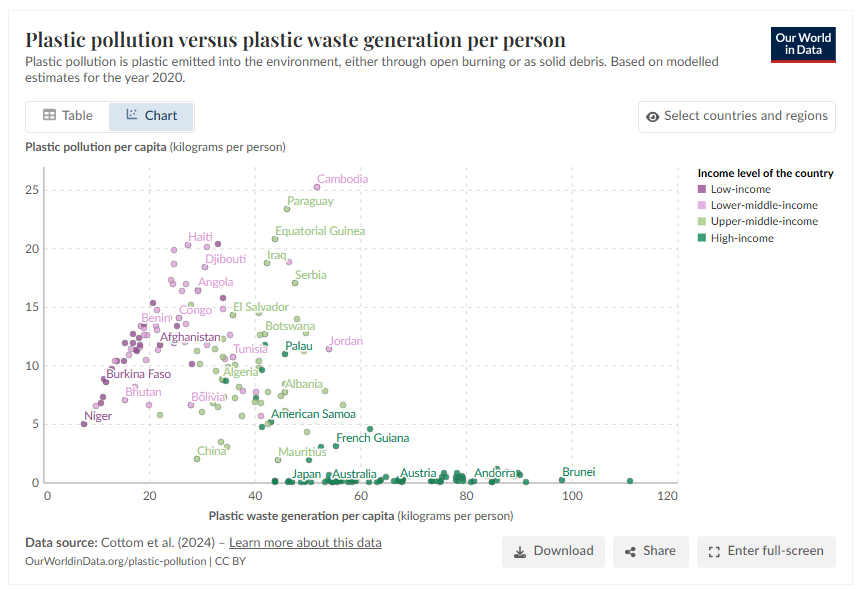
Any news article about pollution from plastic bags or other plastic products that does not point out that the US produces essentially zero per capita plastic pollution is ridiculously misleading. You can't even see the US here because it's basically on the x-axis. In a lot of countries, people literally just throw all their trash in the river. That's the plastic problem.
Robert Anderson tweet media
English
32
331
1.7K
72.3K
Auria retweetledi
Matt Prusak
Matt Prusak@MattPrusak·
Your grandparents had grandparents. They had grandparents. Somewhere back there, someone got on a boat, or didn't. Someone changed their name, or had it changed for them. Someone is buried in a cemetery you've never heard of in a country you've never been to. Most families lose track after two generations. I used AI to push mine back nine. One session with @karpathy's autoresearch pattern: over 100 organized research files. It found a 1940 Norwegian emigrant history with my ancestors in it. Resolved a maiden name question that confused my family for 70 years. Identified relatives no one alive knew existed. The method is simple: set a goal, measure progress, verify against real records, repeat. The AI searches public archives, cross-references birth certificates against cemetery records against church books, and logs everything it finds (and everything it doesn't). Open sourced the whole toolkit. Prompts that do the research for you, archive guides for 20+ countries, starter templates, even a framework for making sense of DNA results. If you have a box of old photos and unanswered questions, this is where to start. github.com/mattprusak/aut…
English
68
216
3.3K
258.7K
Auria retweetledi
Jonatan Pallesen
Jonatan Pallesen@jonatanpallesen·
The commenters are raging at the idea of paying immigrants for leaving, saying they should get nothing. Guys, raging on the internet has done nothing for any Western European country. We need a solution that can actually happen in our European democracies. And as soon as possible. 5 more years of the current situation would amount to the same fiscal cost as my entire program of remigration. And in 50 years my suggestion would have earned itself back ten times. So let's go for a compromise with the empathic left, instead of just continuing with the status quo.
Jonatan Pallesen@jonatanpallesen

My 3 point plan for saving the future of Europe: 1. Give each immigrant $60k to leave Europe. 2. Make a deal with third countries with low cost of living that they will take immigrants if it is not safe in their home country, in return for large financial support. 3. Cut all welfare to immigrants. This will save billions and billions over the future decades, and prevent a large number of rapes, and not a single immigrant will be left destitute or unsafe.

English
54
32
403
24.5K
Auria
Auria@AuriaMax·
@Aella_Girl Already used it to find a ton of names for my baby boy due in a few months. This is much quicker and better than chatgpt (or just reading piles of good books, which was our initial strategy😂). Thank you so much!!!
English
0
0
3
228
Aella
Aella@Aella_Girl·
I vibecoded a name recommendation site! Pick some names, get other names that are similar. You can: *Filter names by date they peaked, timeless vs trendy, and rarity *Tweak the algorithm that hands you the names *Filter by vibe (e.g. 'wholesome') *Anti-weight names you hate
Aella tweet media
English
37
6
604
42.6K
Jonathan Clemens, PA-C
@sappholives83 There have been statistical studies looking at births in immigrant populations that demonstrate beyond a reasonable doubt a bias towards boy births, for whom sex-specific abortion is the most likely answer, especially in second and subsequent deliveries.
English
2
1
16
535
Diana Alastair💚🤍💜 ⚢ ❌❌
I’m pro-choice, but not like this. 20 weeks is plenty of time; once a baby is viable, I believe that the safety of the mother is the only acceptable reason to abort. This law will lead to the deaths of babies who, outside of their mothers’ bodies, would have survived; babies whose nervous systems are fully developed; whose only difference between themselves and any newborn in the nursery is their location. And if you don’t think this will lead to sex-specific abortions, you aren’t paying attention to what’s happening in British society.
Basil the Great@BasilTheGreat

🚨ABORTION UP UNTIL BIRTH - HOUSE OF LORDS VOTE - TODAY Last year one of the most horrifying laws in the history of the UK was passed Abortion Up To Birth Pregnant Women in the UK can now abort their baby for whatever reason (including the baby's sex) all the way up until birth. The Labour Government had no mandate to do this, it was not in their manifesto and it was only debated on for 46 MINUTES in Parliament before being voted through (379 votes to 137). The debate continues in the UK's second chamber, the House of Lords, today. Although the HOL cannot stop the legislation entirely they can delay it, make it difficult to pass and repeatedly kick the process back to parliament demanding more scrutiny and review This needs to happen We cannot allow this to go ahead

English
104
65
484
17.4K
Auria retweetledi
Alexander Hammond
Alexander Hammond@AlexanderHammo·
Last week, Paul R. Ehrlich died. During his 93 years of life, extreme poverty declined by 85%, infant mortality by over 80%, undernourishment by 75%, deaths from natural disasters by 98%, and life expectancies increased by 82%. This happened all while another 6 billion people were added to this world, and GDP per capita ballooned by over 650%. For the man who helped inspire the one-child policy in China (leading to the death of 336 million babies), along with the sterilization of 6.2 million people in India, it's a tragedy that his ideas were ever taken seriously. Perhaps if he had lived a few more years, he would have finally acknowledged how wrong he was.
Human Progress@HumanProgress

In 1968, Paul Ehrlich predicted that unchecked population growth would cause mass starvation. Instead, the global death rate fell by over a third, and famines disappeared outside of war zones. How did he get it so wrong? In short, he ignored humanity's ability to innovate.

English
31
216
937
61.7K
Auria retweetledi
Diana Alastair💚🤍💜 ⚢ ❌❌
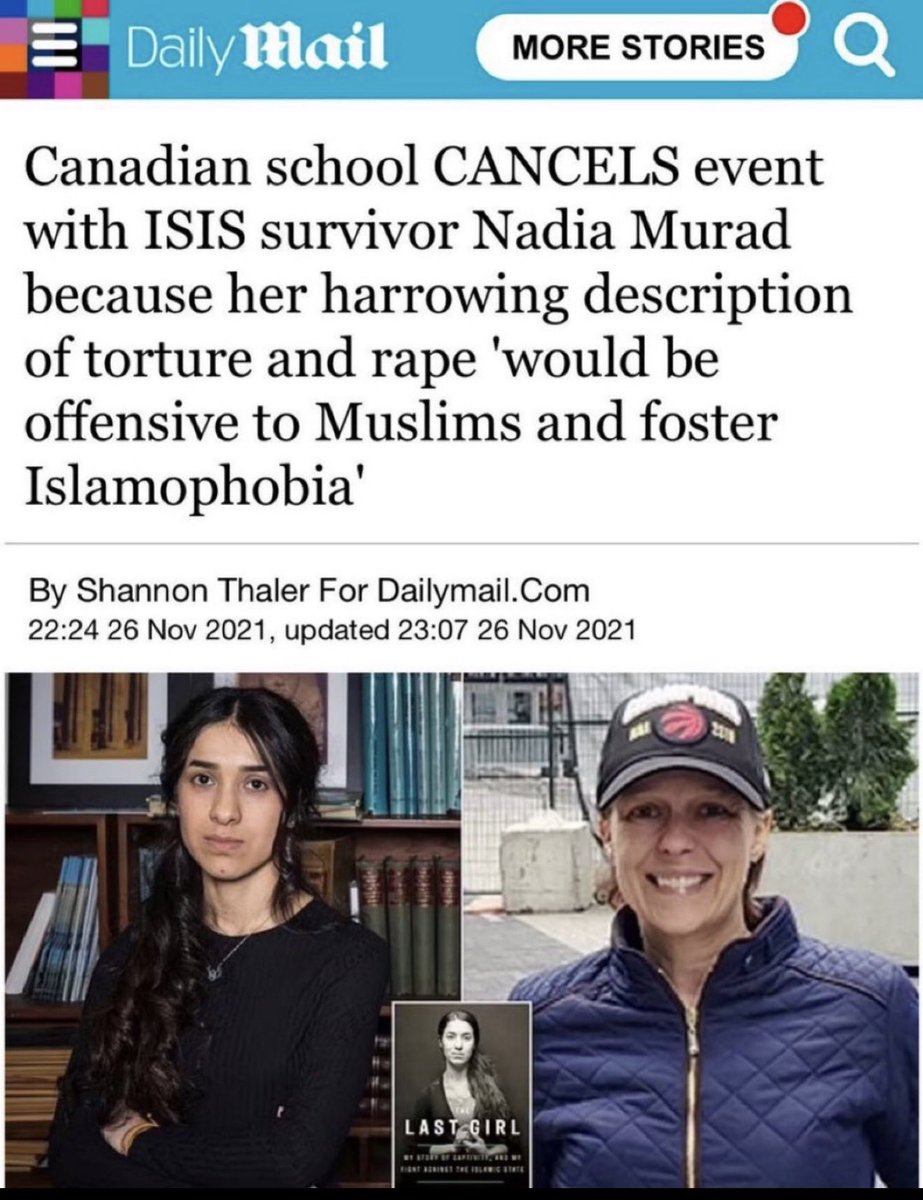
In 2014, when Nadia Murad was 19, ISIS came to the village where she and her family lived. They demanded that the villagers, who were Yazidi, convert to Islam. When their demands were refused, the killing began. Men and boys who were older than 14 were shot or burned alive; younger boys were taken to be trained as terrorists. 6 of Nadia’s brothers and stepbrothers were murdered for refusing to convert. Her mother, like the rest of the older women, was killed because she was too old to be desirable as a sex slave. 600 people were murdered, while Nadia and the other young women were taken into captivity. As one of the 6700 Yazidi girls captured by ISIS in 2014 alone, Nadia was kept as a sex slave in the city of Mosul, where she was beaten and raped and burned with cigarettes by her ISIS captor for months before she was able to escape. After she regained her freedom, Nadia campaigned tirelessly for the release and protection of Yazidi women and girls. In 2018, she was awarded the Nobel Peace Prize, alongside Dr. Denis Mukwege, a renowned humanitarian. Together they founded the Global Survivors Fund, which works to gain survivors access to reparations and compensation so they can rebuild their shattered lives. In November of 2021, the Toronto District School Board, which is the largest district in Canada, banned its students from attending a meeting of a girls’ book club that focuses on female authors because Nadia was scheduled to discuss the book she wrote about her ordeal. Superintendent Helen Fisher ruled that students in her school district could not attend because the details of the book would “offend” Muslim students, and “promote Islamophobia.” I find it interesting that neither Ms. Fisher, the school board, nor local Muslims were able to distinguish between ISIS and the Muslim community as a whole.
Diana Alastair💚🤍💜 ⚢ ❌❌ tweet media
English
414
5.7K
17K
210.1K
Auria retweetledi
Nick shirley
Nick shirley@nickshirleyy·
🚨 Here is the full 40 minutes of my crew and I exposing California fraud, Minnesota was big but California is even bigger... We uncovered over $170,000,000 in fraud as these fraudsters live in luxury with no consequences. Like it and share it, the fraud must STOP. We ALL work way too hard and pay too much in taxes for this to be happening. These fraudsters have been able to defraud American taxpayers for years without any pushback from the public and politicians. It is time to EXPOSE IT ALL and end America's fraud crisis.
English
12.3K
109.2K
335.4K
38.5M
Auria retweetledi
Lyndsey Fifield
Lyndsey Fifield@lyndseyfifield·
When I saw an influencer on Instagram talking about this I thought it had to be an exaggeration or distortion of the bill—an overly-simplified summary that missed some nuance in order to cast them as Disney villains. I read the bill. The Virginia Democrats *surgically* carved themselves (and ONLY themselves) out from their gun control measure. They are moving shamelessly without any pretense, like nothing I've ever seen before.
Libs of TikTok@libsoftiktok

HOLY SHIT Virginia Democrats are EXEMPTING THEMSELVES from a new gun control bill “The provisions of this section shall not apply to any member of the General Assembly”

English
177
1.8K
7.7K
303.9K
Auria retweetledi
Clint Teeples
Clint Teeples@TeeplesCY·
Sharon Eubank says temples are the greatest poverty-alleviation system in the world. That claim has data behind it. Here it is. Poverty research consistently shows that the strongest predictors of escaping poverty are family stability, social capital, and community trust. The temple system is built to produce all three. Here is the mechanism, step by step. Step 1: The problem with poverty isn’t money. It’s infrastructure. William Easterly, a former World Bank economist and current professor at NYU, argued that large top-down aid programs often fail because they lack local accountability and feedback loops. The planners don’t live there. The money arrives, gets absorbed, and the people it was meant to help stay poor. The Church’s model is the opposite. Individual. Family. Ward. Bottom-up. Step 2: The temple is a sacred commitment device. In behavioral economics, a commitment device is a tool that binds people to hard decisions before the moment of temptation arrives. The temple represents one of the strongest commitment mechanisms found in modern religious life. Covenants made there are treated by participants as the most binding promises of their lives: fidelity, honesty, sobriety, care for neighbors. Any religion can encourage those behaviors. The temple makes them the subject of a sacred promise. A low-stakes promise produces low-stakes compliance. A covenant made in what the participant believes is the house of God produces something categorically different. Step 3: Religious belief itself predicts economic outcomes. Harvard economist Robert Barro studied religiosity and economic growth across more than 100 countries. His conclusion is that religion affects economic outcomes mainly by fostering beliefs that influence individual traits such as thrift, work ethic, honesty, and openness to strangers. These are not soft virtues. They are the precise inputs that economists identify as prerequisites for functioning markets and cooperative communities. Baylor sociologist Byron Johnson has spent decades studying religion and social outcomes. His research consistently finds that participation in tight-knit religious communities with strong norms correlates with lower crime, stronger family stability, higher volunteerism, better mental health, and improved economic stability. These outcomes are not mystical. They emerge from dense networks of trust, shared norms, and mutual accountability. The temple covenant is designed to produce exactly those norms. Step 4: Those promises produce the behaviors poverty research says matter most. Harvard economist Raj Chetty’s landmark research on intergenerational mobility found that high upward mobility areas have higher fractions of religious individuals and greater civic participation. The single strongest predictor of upward mobility he identified was family structure, specifically the percentage of single parents in an area. Chetty’s research also shows that cross-class friendships are among the strongest predictors of upward mobility. Religious congregations are among the few institutions where people from very different socioeconomic backgrounds regularly interact and form those relationships. That is precisely what Eubank describes: people of all social classes entering the same building, making the same promises, and becoming accountable to one another. Temple covenants call participants to form families within marriage and to remain faithful to those families. Melissa Kearney, a Notre Dame economist, shows married households have incomes 63 to 113 percent higher than single-parent households. Children of single mothers are five times as likely to be poor. The temple does not passively attract people who already have stable families. It is the institution that produces the promises that create them. Step 5: The ward runs on hyper-local feedback loops. Robert Putnam of Harvard found that religious congregations generate a disproportionate share of America’s social capital and civic engagement. The ward that forms around a temple community is a high-trust, high-density network, but what makes it functionally different from a government program is its feedback loop. The bishop knows who is hungry today. The Relief Society knows which family just lost an income. The distributors are volunteers who live on the same street. There is no application, no bureaucracy, and minimal administrative overhead. This is exactly what Easterly said top-down aid could never replicate: a system where the people delivering help are accountable to the same community receiving it. Step 6: The safety net doesn’t require a temple recommend. Does this system abandon people who can’t keep the rules? It doesn’t. Church welfare is administered based on need, not temple standing. The temple is the aspirational goal, the capstone of the system. The ward is the safety net for everyone within its boundaries, regardless of where they are in their faith. Someone in crisis doesn’t need a recommend to receive food, housing assistance, or a referral to a self-reliance course. The commitment standard and the compassion standard operate on separate tracks. Step 7: The self-reliance program converts the network into measurable outcomes. Within six months of completing a Church self-reliance course: 41% improved their ability to provide for their families. 40% increased income. 61% started or expanded a business. 47% found better employment. 52% enrolled in further education. Local. Accountable. Feedback-driven. Built on trusted relationships. This is the bottom-up model Easterly argued was the only approach that actually works. Step 8: This scales globally, and works best where institutions are weakest. In developed nations, secular institutions carry much of the trust infrastructure. In developing nations with weak rule of law and high corruption, they don’t. Religious trust networks are often the only thing that functions. Within the global Latter-day Saint community, a temple recommend signals adherence to behavioral standards—honesty, sobriety, and responsibility—to an entire global network that shares them. That matters most precisely where formal institutions fail. What about the rest of the world? You cannot export a culture of trust to the whole world at once. You build hubs, communities of high-trust behavior, that then spill outward. The Church logged 7.4 million volunteer hours and spent $1.58 billion in external humanitarian aid in 2025. That output doesn’t come from nowhere. It comes from the people the temple system produced. The temple creates the culture. That culture produces the people. The people go out and relieve the poor. The full mechanism: Temple covenant > binding moral commitment > stable marriage and family > cross-class trust networks > hyper-local welfare > self-reliance and capability building > exit from intergenerational poverty. Every link in that chain is supported by independent, secular research. Easterly. Barro. Putnam. Johnson. Chetty. Kearney. The world treats poverty as a liquidity problem, a lack of cash. The temple system treats it as an infrastructure problem, a lack of stable families and high-trust networks. One requires a check. The other requires a covenant. The temple is not primarily a building. It is a commitment institution that produces the family stability, social capital, and moral accountability that social science repeatedly links to upward mobility. The data shows which one lasts.
Clint Teeples@TeeplesCY

Few people on the planet know more about humanitarian aid than Sharon Eubank. Here she addresses: – Problems aren’t solved with cash – Sustainable impact requires infrastructure – Temple work is the greatest poverty alleviation system in the world

English
13
67
478
16.5K
Auria retweetledi
Grease
Grease@LowTimePrefrenz·
@TeeplesCY The world would take people out of the slums. Christ takes the slums out of people, and then they take themselves out of the slums. The world would mold men by changing their environment. Christ changes men, who then change their environment.” Ezra Taft Benson
English
0
1
13
189
Auria retweetledi
Hunter Ash
Hunter Ash@ArtemisConsort·
Even if you believe it’s good to be understanding of other people’s struggles, it’s not patriotism. “Bravery is when you nurse orphaned squirrels back to health” no it’s not. That’s compassionate, but it’s not brave. There’s more than one virtue. They’re not all the same thing. Our language is quickly collapsing to [good thing] and [bad thing] as the only definitions of words.
Irish Unity 🇮🇪🇵🇸@IrishUnity

“To be patriotic in Ireland is to be understanding of other people’s struggles.” - Kneecap

English
17
21
492
13.2K
Auria retweetledi
James 🧙🏻‍♀️🔮
@WolfofX Think of it like kids connecting. They meet, compliment each others bagpacks, ask what their third favourite dinosaur is and then show how really really fast they can run. Then you become friends. That’s the function of small talk in adults.
English
0
3
211
4.4K
Auria retweetledi
Gad Saad
Gad Saad@GadSaad·
Less than 1% of all men will ever be convicted of rape. This is why it is deeply misandrist to say that it is men who commit rape. My uncle Joe, my brother Roscoe, and my father Harry have never raped anyone. This is why you should all advise your daughters to enter a room alone with 100 drunk men. Only 1% of them is likely a rapist so she should stop being bigoted against all men. Even if the number is at 5-6%, she should still risk it because otherwise it is pure bigotry.
English
134
194
3K
188.2K
Auria retweetledi
Kostas Moros
Kostas Moros@MorosKostas·
The mistake she and other parents of victims make is they assume the pro-2A side has no empathy, and if we could just understand the unimaginable grief mothers like her go through after losing their child to a school shooting, we would all agree and pass more gun control. That's just not correct. I have a child of my own, do you think I'm OK with the idea of an armed lunatic in her school? Of course not. The disconnect is we reject your premise. Making good people helpless through disarmament does not equate to safety. Instead, we should meaningfully secure our schools and other truly sensitive places.
ABC7 Eyewitness News@ABC7

Mom of 9-year-old Jackie, who was killed in Uvalde during a school shooting, spoke at the Oscars after "All the Empty Rooms" won for best short doc. She talked about how gun violence impacts kids in America and that Jackie is more than a headline. spr.ly/6010B6Pwyj

English
111
446
3.6K
150.7K
Auria retweetledi