Austin Devaney

961 posts

Austin Devaney

Austin Devaney

@AustinDevaney

Katılım Nisan 2011
168 Takip Edilen388 Takipçiler
Tom Bastien
Tom Bastien@Tom__Bastien·
@TheAtlantic @AnnieLowrey Then have a low flat income tax that everyone pays. Our problems stem from all of our exceptions and special treatments.
English
3
0
2
742
The Atlantic
The Atlantic@TheAtlantic·
Members of both parties are egging on a nationwide tax revolt—and if the economy were to tank, the country could end up with a toxic combination of widespread joblessness and rampant inflation, @AnnieLowrey argues. theatln.tc/VsVxElnp 🎨: The Atlantic. Source: Getty.
The Atlantic tweet media
English
7
24
87
72.2K
Austin Devaney
Austin Devaney@AustinDevaney·
@ErnestScheyder You’re from Maine. What do you think? It would take a lot of will to open a mine anywhere but presumably should be harder on private land.
English
0
0
0
64
Austin Devaney
Austin Devaney@AustinDevaney·
@D_Jimenez_Sch One thing I find different about this oil price spike and EV take up is that today there are many more model choices than in previous spikes resulting in a higher correlation between oil prices and EV adoption. @globallithium
English
0
0
2
58
Daniel Jimenez Sch
Daniel Jimenez Sch@D_Jimenez_Sch·
And it's most likely right. High oil prices are pushing drivers to take a closer look at EVs. Elsewhere, EV sales in Chile jumped 130% YoY in March — the trend is global.
Joe Lowry@globallithium

Interesting irony. @FT indirectly credits Donald Trump for the EV ownership “tipping point” via the Iran situation.

English
1
7
42
2.6K
Austin Devaney
Austin Devaney@AustinDevaney·
@globallithium Where was this presented and who was the audience? That PR person should reconsider this tactic. Definitely weak platitudes.
English
1
0
2
254
Joe Lowry
Joe Lowry@globallithium·
Another sign of the #lithium market turn. The recycling of projects that haven’t performed. My head is firmly in the sand here. What has been delivered so far? Nothing wrong with the points on the slide but the performance of the company not the stated platitudes is the issue.
Joe Lowry tweet media
English
1
5
46
4.7K
Austin Devaney
Austin Devaney@AustinDevaney·
@sparkes_dwayne Dang - nice perspective mate! I agree that it really takes an OG geologist to go to the spots and stake a claim.
English
1
0
5
305
Dwayne Sparkes
Dwayne Sparkes@sparkes_dwayne·
Some random thoughts on some of the latest lithium news as a I sip my morning coffee. CATL has brought in Chen Zinghe from Zijin as an advisor for it’s mining division. It’s basically CATL saying they are worried that they can’t find enough lithium to meet their massive growth. It’s impressive how fast CATL has grown and you’ve got to applaud the company. However, I think they are leaving it a bit late as I touched on in an old post of mine (link below). I think they’ve underestimated just how difficult it is to find lithium deposits. Economical lithium deposits are rare and very hard to find. They could go years and find nothing. Zijin doesn’t have a great track record at finding deposits, which is rightly so, they are after all miners, not explorers. And it’s not just Zijin. What was the last deposit that RIO found? Or BHP? Or FMG? The majors are terrible at exploration, despite the fact they have very large exploration budgets. Exploration isn’t just about having a big budget. A geologist working for a major for a wage in a cookie cutter position is going to be less hungry to find something than a prospector working for themselves for 0 dollars and funding early exploration themselves. Projects are largely found by individuals, they then get passed into exploration companies, which then get taken out by miners. Basically every (~90%) current lithium mine and the majority of lithium resources (excluding a lot of the Canadian plays) have been mapped and known about for a 100+ years. Most of them were old tin and tantalum mines. Adover, Kathleen Valley, Pilgangoora, Tabba Tabba, Bikitia, Manono, Greenbushes, Mt Marion, etc. were all discovered over 60 years ago, largely by individual prospectors. During the last lithium boom, if you wanted to find lithium, you toggled on/georeferenced the occurrences of old tin and tantalum workings, pegged the ground, and explored off that. Those days are done. Those are our current lithium mines and resources. So 100 + years of mapping and exploring has found the current mines and resources and we are still in a lithium deficit (spod currently at ~$US2400). I agree with @usuallyYJLee , there isn’t enough mapped lithium around to meet his 2030 bull case. Literally all of the Canadian plays would need to come online. So naturally sodium and other battery types will take a portion of the market for this fact alone. Zijin aren’t explorers. They are miners. Huge difference. A lot of countries don’t understand exploration. The idea of putting capital into what could be seen as a gamble is something they don’t get. They are happy to pay a premium for a nice resource, but the idea of spending a fraction of what they pay for a resource on a “gamble” seems silly. I personally think Zijin (and any major) will struggle to find more greenfields lithium. All the easy low hanging fruit deposits are gone. It’s now largely a drilling under cover game. Once you’ve dusted your first 4-5million on drilling, you start to think maybe it’s just easier to buy these things for a premium. Problem is there aren't really many options available. Exploration for lithium has been on a halt for several years and despite spod at a very healthy price of ~US$2400, it still hasn't picked up yet. Better get exploring soon or big trouble. To finish, on a side note, $PLS just hit an all time high! Cheers for reading!
Dwayne Sparkes tweet mediaDwayne Sparkes tweet media
English
60
47
321
33.4K
Austin Devaney
Austin Devaney@AustinDevaney·
@AlexSJacquez Do you mean people who earn a million per year or people who have a million in savings?? A wealth tax is a horrible idea.
English
2
0
0
47
Austin Devaney
Austin Devaney@AustinDevaney·
@Mith_ Thanks for that background - I sat in on Eric’s presentation a few weeks ago ago at IBS.
English
0
0
1
49
Mith
Mith@Mith_·
The early stage lithium recovery (ESLR) is part of the story of why the company is where it is now. The black mass production platform they have now is not what they had when they first launched the Covington, Georgia facility. They originally had a system that would use a low pressure atmosphere drying stage that would evaporate the electrolyte depositing the lithium back onto the shredded battery mass and allow them to collect and redistill the electrolyte as a precursor. The major problem with this is they had approached Dusenfeld about a license for their technology for that stage in the black mass train, and had even purchased equipment that was designed with Dusenfeld for this exact process. But they never went through with a license, which caused Dusenfeld to sue in 2023. Based on court documents, comparing the two processes it was very clear that Ascend violated Dusenfeld’s patents. That lawsuit was the catalyst that caused the company to pivot to the ESLR platform they have now, by replacing the now contested stage with a carbothermal conversion process created by Eric Gratz, the CTO, that uses the graphite in the black mass as the carbon source for the lithium carbonate conversion. But this set them back at least a year and a half from full commercial operations, but ironically may now be the one reason that they will be able to proceed with the restructuring instead of liquidation.
English
1
0
3
102
Mith
Mith@Mith_·
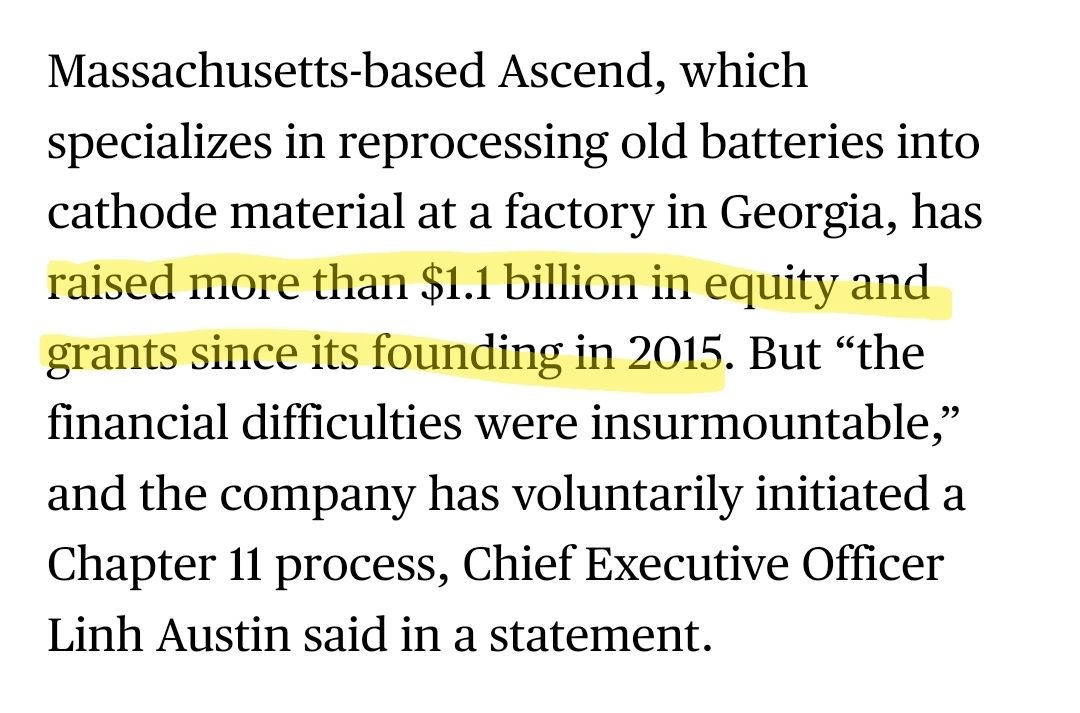
Around 1am this morning a link to a LinkedIn post was shared in a chat I am in, and it reminded me of when former @AscendElements CEO Michael O’Kronley was part of a panel moderated by Renata Arsenault. He was asked a question about production scrap and launched into a rather nonsensical explanation that scrap was a closed loop and end of life was an open loop. The reaction of the other panelists was telling, one became very interested in something at his feet and the other had a completely confused look on his face. What Michael was trying to explain was a closed and open system for feedstock, but it was a train wreck, using common industry terms completely out of context. This was not the first time I had watched a video of Michael or read an interview that made me wonder about his competency. In fact I put him in the same bucket as another CEO who once said they planned to refine lithium ore into spodumene at a location next to a children’s gymnasium. How can you lead a company if you don’t even understand the most fundamental aspects of what they do. So when I opened and read the LinkedIn post from Ascend Elements CEO Linh Austin announcing a Chapter 11 filing and pointing to the actions of former leadership as a primary contributor, I was not surprised. Also every company filing for Chapter 11 seems to want to toss someone under the bus, but in this case I am more than willing to accept that explanation. There is a lot more context to work through, but first, this is not a liquidation. Chapter 11 is a restructuring that allows a company to consolidate debt and work with creditors to avoid liquidation. The outcome depends heavily on the company. For retailers like Toys R Us and Sears it proved to be a slow path to the end, while for airlines like United and Delta and even auto manufacturers like GM it was a genuine reset that returned value to investors. Before Michael left Ascend Elements I made the point that lithium companies with leadership drawn from tech and academic backgrounds needed to be replaced with seasoned executives, and that the energy, oil, and gas industries were the most compatible with the large scale projects being proposed by these companies. Ascend Elements did exactly that a few weeks later by bringing on Linh Austin, whose background reinforced my opinion on why he was the right choice to transition the company from an R&D entity with limited operations into a full commercial scale corporation.​​​​​​​​​​​​​​​​ I will be rolling this story around in my head and sorting out the timeline for a few days and plan to reach out to the company to get a more complete picture of what this all means going forward for Ascend.​​​​​​​​​​​​​​​​ linkedin.com/pulse/opening-…
English
2
2
18
1.8K
Austin Devaney
Austin Devaney@AustinDevaney·
@scottlincicome @cberry1 Tough business and too many recyclers chasing too few batteries as Li-Ion proved to last longer than expected.
English
0
0
1
41
Scott Lincicome
Scott Lincicome@scottlincicome·
"Battery Recycler Ascend Elements Files for Bankruptcy" bloomberg.com/news/articles/… "The climate tech company boomed during the Biden years but has struggled amid a drop in EV interest."
Scott Lincicome tweet mediaScott Lincicome tweet media
English
1
3
20
4.7K
Austin Devaney
Austin Devaney@AustinDevaney·
@jix4600 @JessePeltan That is a bad idea! Using electricity to convert to hydrogen and then use that hydrogen to make electricity? At best 50% roundtrip efficiency compare to storing it in a battery for use which is 95+% efficient.
English
1
0
0
20
Jix
Jix@jix4600·
@JessePeltan Solar is used to make green hydrogen. Batteries and EV, market will decide. Japan seems to be on right track with hydrogen provided the vehicle don't start exploding like rockets once in a while.
English
1
0
0
336
Austin Devaney
Austin Devaney@AustinDevaney·
@ArnabDatta321 100%. 45X would have been a fabulous tool for refining but it was gutted when Treasury ruled you could not count raw materials.
English
1
0
2
32
Arnab Datta
Arnab Datta@ArnabDatta321·
@AustinDevaney Agree Austin! Useful but not necessarily sufficient. We do have 45X and it’s useful but hasn’t been sufficient to incentivize the level of investment we need.
English
1
0
0
149
Arnab Datta
Arnab Datta@ArnabDatta321·
I disagree with Saif here, but he raises very fair points. Tax credits are powerful but a limited tool. We’ll likely need some mix of discretionary tools for many critical sectors. What we need to find are means of guardrailing discretionary tools so that the private sector can count on stability. More on this in a future piece.
Saif M. Khan@KhanSaifM

In the early days of the CHIPS Act, I thought it was a smart move for Congress to put such a large percentage of subsidies in Commerce-directed grant and R&D programs rather than Treasury tax credits. This is because the Commerce Department hired dedicated civil servants of unusually high caliber and used that expertise to focus grants on addressing the deepest chip manufacturing vulnerabilities and bottlenecks in the US chip R&D ecosystem. But the Executive Branch has shown it cannot reliably execute a plan and sustain state capacity longer than 4 years. The cancellation of NatCast is one example, setting back the CHIPS R&D program by years. The renegotiation of the Intel grant to add equity stakes and cancel manufacturing milestones was another. As a result, I now think future subsidy-based US industrial policy should focus relatively more on manufacturing and R&D tax credits. Tax credits will be 1) less vulnerable to political cycles, 2) reduce the ongoing need for state capacity, and 3) as a bonus, won't trigger NEPA reviews. Grants can still play a role, but should be less load-bearing.

English
2
3
28
13.9K
Austin Devaney
Austin Devaney@AustinDevaney·
@Mith_ Probably more than! Just read the Alb 10K this morning and they reported SP production as 1 ton (Li Metal basis). Converted to LCE would be 5300 tons but with rounding could be as high as 7800 tons. It seems as though ALB used Li Metal to obfuscate their numbers
English
0
0
2
127
Mith
Mith@Mith_·
I know everyone is talking about the amount of EVs that Tesla delivered in Q1, and how they missed analyst’s estimates. What I looked at is the 8.8 GWh of deployed storage. To put that into context, they used in one quarter the same amount of lithium carbonate that is produced in a full year at the only operational lithium mine in the US. That is just one quarter for one company.
English
1
2
18
739
Austin Devaney
Austin Devaney@AustinDevaney·
@Mith_ Be careful not to fall into the trap of biased information and reporting. China lithium/battery has an interest and history of working to suppress prices in concert with 🇨🇳 based reporting services.
English
1
0
1
48
Mith
Mith@Mith_·
I posted before the Chinese New Year that they were stockpiling, and this has led to a greater supply over demand scenario. But the reason they stockpiled is they are betting on an uptick in demand starting in April. But for now expect prices to be flat, however if supply disruptions due to diesel shortages do pan out, things could get pretty volatile.
Mysteel New Energy@MGNewEnergy

Mysteel daily reporting on China #lithium market 20260402👇 Please click the link below if you wish to know more information about China's lithium-ion #battery industry mysteel.net/h/new-energy
English
1
0
2
589
Austin Devaney
Austin Devaney@AustinDevaney·
@sparkes_dwayne Nice comments! Fully agree that at 1.58% it is hard to coax those kinda tons out of a site.
English
1
0
6
575
Dwayne Sparkes
Dwayne Sparkes@sparkes_dwayne·
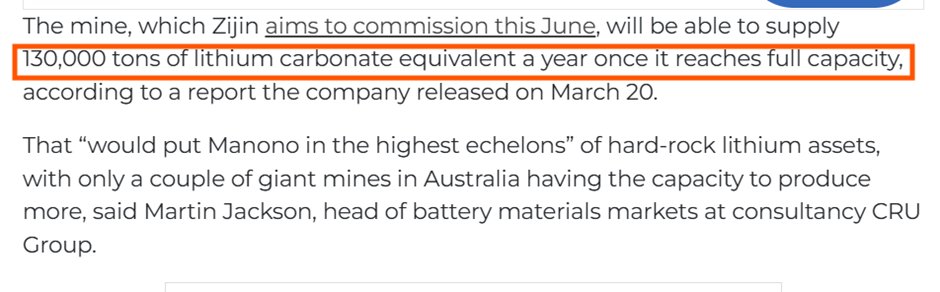
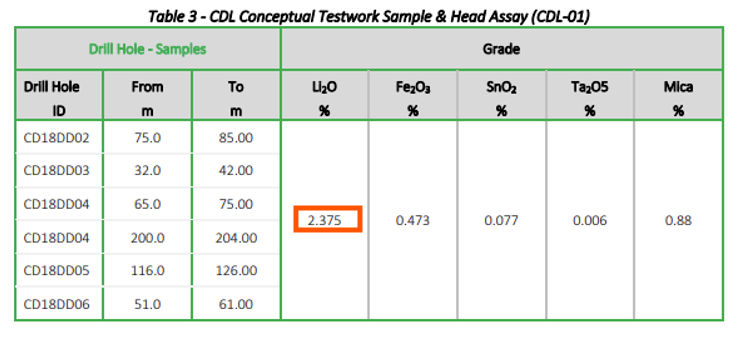
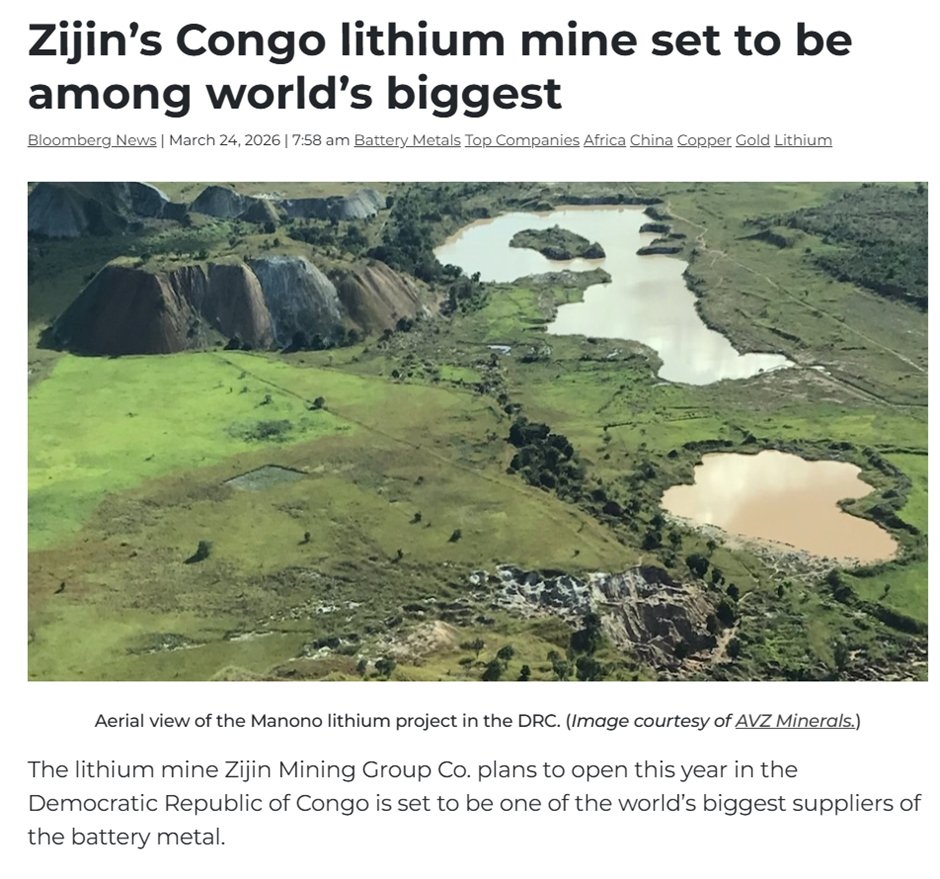
Saw this article today on the Manono North Deposit and just couldn’t help myself but to make comment. I'll also give my opinion on the deposit as I've had a few people ask for it. Firstly, the deposit was stolen from AVZ shareholders. I hope AVZ holders get what they deserve for this deposit and it's absolutely pathetic by the Australian government to sit idle. Lots of hard earned Aussie dollars were put into exploring and developing the orebody and the government stays silent? This orebody needed to stay under the one company in order for it to achieve its maximum potential. Zijin gained control of what is now known as Manono North which predominantly consists of the The Carriere de l’Este Pegmatite, often referenced as the CDL Pegmatite. I do think it's the inferior part of the orebody. It's lower grade than the Roche Dure Pegmatite (not in Zijin's control and to the south) and from an early stage, it seems its metallurgy wont be as good. Personally I think splitting the deposit up was also a technical mistake. I think it was important from a metallurgy point of view to keep the both the north and south together. The article states that the Manono North mine will produce up to 130,000 tonnes of LCE per year. I’d argue it won’t be anywhere even close to this. 40.4/(0.82*6) = 8.2 tonnes of SC6 per tonne of LCE. 130,000 * 8.2 = 1.06 million tonnes of SC6. 6/(1.58*0.7) = 5.43 tonnes of 1.58% ore needed per tonne of SC6. I’ve used a very generous recovery rate of 70% and you’ll see why it's generous later. 1.06million tonnes * 5.43 = 5.75Mtpa This seems doable but the problem is, I don’t think Manono North is going to produce SC6 looking at historical met work and its grade. I think Manono will join the same club as LTR, PLS, MIN, in terms of recoveries. It’s not Greenbushes. I think it will produce somewhere around SC5.2. 40.4/(0.82*5.2) = 9.47 tonnes of SC5.2 needed per tonne of LCE. It becomes very different when you plug this in. So they are going to need far more than the 850kt of concentrate as stated within the article to produce those 130kt of LCE. At the time Zijin took control of the north section, the resource was entirely inferred. This is understandable given the lack of drillholes and met work that had been undertaken (AVZ were mainly focusing on the south and doing a great job). I could be mistaken, but I haven’t seen anything via satellite (generally signs of drillholes are easily identifiable) that suggest Zijin has done further work to progress the deposit from Inferred to indicated or measured. So there's a decent chance that the proper work hasn't gone into understanding CDL and it's getting rushed. One thing that is important to understand is that size of the deposit just one of the many criteria which should be used to rank a deposit. If the deposit is larger than 90-100Mt, I’d say it gets less and less important. Grade and metallurgy become king. So, Manono North is large, but lets talk about its grade and metallurgy. I dug into historical metallurgy testwork undertaken on the CDL pegmatite and it was average. I can’t find any flotation testwork done on CDL specifically, but the DMS testwork gave 55% recoveries for 5.6mm size and 66% for 3.35mm size. But here's the issue, the head grade used in these tests was 2.37% Li2O. The average grade of the deposit is 1.58% Li2O … What happens if you plug in the average grade of the deposit? So that rules out it being purely a DMS deposit and flotation will be required. Here’s some info from an old post on DMS and flotation from an older post of mine: x.com/sparkes_dwayne… So they’ll need to float it which means higher CAPEX and OPEX. There is some flotation test work done on the pegmatite to the south so I’ll use that as a bit of a guide (It’s a rough guide as metallurgy can change rapidly over 50 meters let alone kms). It came in at 81.5%. Lab work always comes in higher. Every single time. Also it's important to note that this test work was done on a higher grade pegmatite than CDL. One example which is comparable from a testwork and grade point of view is Kathleen Valley. Manono south's testwork for flotation comes in at almost identical to how Kathleen valley’s (whole of ore flotation not DMS + flotation) did. 81.5% vs 81%. Liontown’s recovery is now at ~63% for SC5.2, 18% less than what the test work gave and not for SC6 as their test work suggested. Just an example how lab tests don't equal what actually happens in practice. Summary: So in my opinion, Manono North will be somewhat similar to another Kathleen valley or Wodgina coming online. It's grade is somewhat above average @ 1.58% and I'd say its metallurgy is average. Yes it's large, but above 90-100Mt, this becomes less important. So overall a good deposit, but it's no Greenbushes and i don't believe it will spit out the tonnes as what many are suggesting. In order to get those tonnes you're going to need an extremely large capex and i don't think Zijin will invest that much given the nature as to how they got the deposit and also the jurisdiction (unstable). Those are my thoughts on the Manono North Deposit. Cheers for reading.
Dwayne Sparkes tweet mediaDwayne Sparkes tweet mediaDwayne Sparkes tweet mediaDwayne Sparkes tweet media
English
22
40
227
16.3K
Austin Devaney
Austin Devaney@AustinDevaney·
At the #floridabattery seminar this week and find the technical details so refreshing! Nice to catch up with some old friends as well. The presentations to date are very informative. A great attend for those wanting to learn more about Batteries.
English
0
0
1
69