

Peasant_investor
73 posts

全球风险资产大跌,宏观话题又回到了时间线上。我在三月聊过两次全球货币动能的话题,现在数据有了新进展,做一次更新。
3月11号我基于货币领先PMI七个月的框架给了一个偏乐观的判断:2026年1月货币增速新高,往后推7个月,8月制造业动能重新走强,全年"跌了就买"。
3月30号我修正了这个判断。当时的核心担忧是:即便没有战争,周期模型本身就指向下半年走弱,货币数据的改善更像是回光返照。而战争带来的能源冲击从两个方向夹击货币信号,油价推高CPI压低实际增速,利率上行压制名义扩张,Fed被锁死。
现在两个多月过去,数据在验证3月30号那条的逻辑。
通胀挤压正在发生:名义货币增速没变,但CPI动能走高,实际狭义货币增速从1-2月的高位开始回落。那个高点的含金量正在被通胀稀释。
但对于目前的股票市场调整,需要先把时间维度理清楚。现在是5月中旬,1-2月货币增速高点往后推7个月,对应的是8-9月PMI见顶。也就是说,制造业动能在未来三四个月内大概率还是向上的,不过囤货透支需求可能缩短这个窗口。当前的下跌,更多是情绪和事件驱动,不是基本面拐点。别把周期尾部的颠簸当成趋势反转。
真正需要关注的是另一个更直接的市场信号:"货币-产出缺口",实际M1增速减去工业生产增速。这个差值为正,说明有超额流动性溢出到金融市场;归零或交叉,支撑就没了。
我做了美国版本的图表(附图)。当前缺口 +1.6个百分点,仍然为正,但是开始了首月收窄。OECD领先指标也显示同样的图景:美国和G7刚过趋势线,但斜率在变平,中国仍在趋势线下方。
3月30号提的三个确认信号现在对一下表:实际狭义货币增速连续转负?还没有,但方向对了。全球PMI新订单跌破荣枯线?还没有,4月还在高位,但有囤货虚高的成分。原油期货从back转contango?留给大家自己跟踪。
总结:眼下股票市场的调整,从周期位置看基本面还没有到真正拐头的时间点,支撑还有几个月的余量。但3月11号的乐观需要打折,3月30号的谨慎正在被验证。流动性窗口还开着但正在关闭,逢跌买入的前提是货币-产出缺口仍为正。一旦归零,就该从进攻切到防守。按目前轨迹,这个切换点可能在今年夏天。


中文

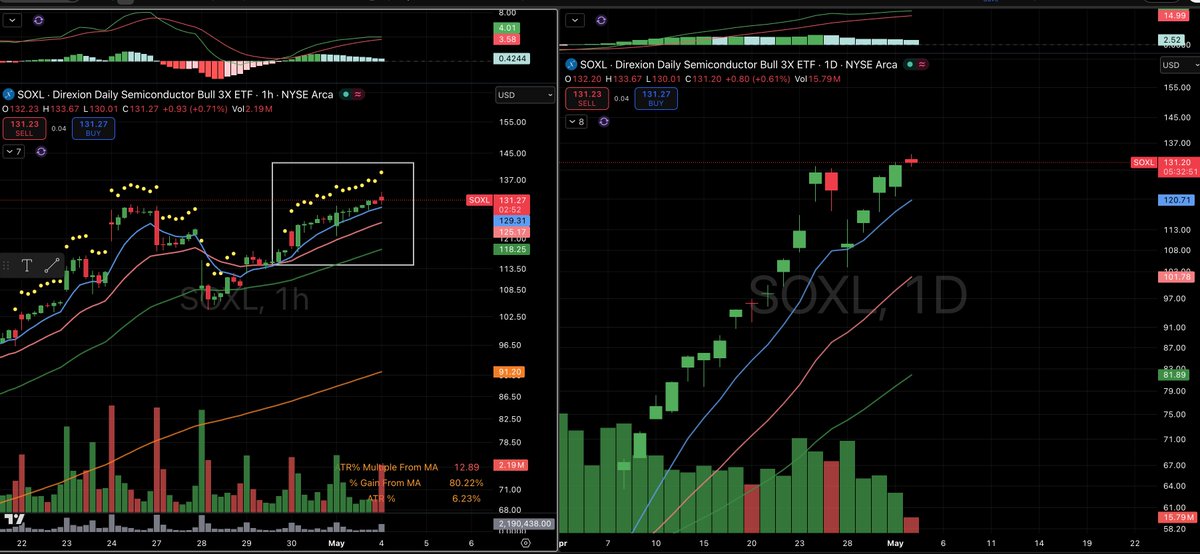
$SOXL Very extended here and wedging up on the 1H timeframe. A retest of the 21 EMA would be nice.
TraderGoku@tradergokux
@labubu_trader Some sector rotation and 1–2 weeks of consolidation would be ideal before another leg up. $SOXL is 12x atr from the 50d.
English

Good note on the risks and opportunities of Chinese entry into a sector, which generally tends to vastly expand the capacity and greatly compress the margins of that sector
Macro_Lin | 市场观察员@LinQingV
Jukan (@jukan05) wrote a sharp memo on how the US let China's display industry grow unchecked while drawing the line at semiconductors. The strategic analysis is right. But there's a second layer he didn't touch, and it matters more if you actually invest in this space. China's display industry won. Its shareholders lost. And the same pattern is about to replay in memory. BOE controls 25% of the global display panel market. Revenue approaching $29 billion. Net margin: 2.7%. ROE: 3.1%. The stock has gone nowhere for years. Jukan's point is that the US made a mistake by not sanctioning China's display equipment imports the way it sanctioned semiconductor equipment. He's correct. BOE bought the same tools from Applied Materials that Samsung used. No CFIUS review, no Entity List, no restrictions. The result is exactly what he describes. China now holds 70% of global LCD production and just crossed 50% of OLED shipments. Korea is hanging by a thread. But here's what the geopolitical framing misses. Even inside China, the winners of this industrial war weren't the display companies themselves. The value destruction mechanism has four moving parts. First, the capex treadmill. A single Gen 8.6 OLED line costs $4-9 billion. BOE's latest Chengdu fab alone is $8.7 billion. The moment one investment cycle finishes, the next generation demands even more. Profits never accumulate. They get recycled into the next fab before shareholders see a cent. Second, perpetual dilution. Every fab requires massive equity raises, JV structures with state-owned partners, and government co-investment. BOE's share count has expanded enormously over two decades while earnings-per-share growth has been negligible. The pie grows, but each slice keeps getting thinner. Third, the principal-agent problem. BOE's six largest shareholders are SOEs from Beijing, Chongqing, and Hefei. Their KPI is employment, industrial upgrading, and supply chain control. Return on equity was never the objective. When the people running the company don't care about stock returns, the stock doesn't return. Fourth, self-inflicted overcapacity. Four Chinese firms are building Gen 8.6 OLED lines simultaneously. They compete on price against each other, not just against Samsung. Panel prices recover, producers ramp utilization, prices crash again. BOE's gross margin sits at 14%. Even at the top of the cycle, current prices barely keep panel makers above break-even. Market dominance and shareholder value destruction, simultaneously. The industry won. The stocks lost. Now watch CXMT and YMTC. CXMT is pursuing a STAR Market IPO at roughly $42 billion valuation, raising $4.2 billion. YMTC plans to list in H2 2026. CXMT posted cumulative losses exceeding 30 billion yuan across 2022-2024, then reported its first profitable year in 2025, timed perfectly for the IPO window, during the hottest memory supercycle in years. Check the four forces against them. Capex treadmill? CXMT plans to expand from 200,000 to 300,000 wafers per month this year, then to 400,000. The IPO proceeds of $4.2 billion are earmarked almost entirely for fab expansion and R&D. Not a dollar returns to shareholders. YMTC is breaking ground on its third Wuhan fab, targeting production in 2027. Perpetual dilution? CXMT's IPO alone issues 10.62 billion new shares. This is round one. Scaling to 400,000 wafers requires tens of billions more in capital that doesn't exist yet. More raises will follow. Principal-agent misalignment? CXMT was founded by the Hefei government. YMTC is a creation of Tsinghua Unigroup and the National IC Fund. The controlling interest is the state. The mission is memory self-sufficiency, not EPS. Self-inflicted overcapacity? Both are scaling aggressively at the same time. UBS estimates Chinese memory capacity expansion could reach 120,000-140,000 additional wafers per month in 2026, with further increases in 2027. When this capacity hits the market, commodity DRAM and NAND pricing will compress. Samsung and SK Hynix will respond with price cuts in segments where their fabs are fully depreciated. CXMT and YMTC, running brand-new fabs with heavy depreciation, get squeezed hardest. Jukan asks whether the West's semiconductor hegemony will last. That's the right question at the geopolitical level. At the investment level, the question is different. Even if CXMT and YMTC succeed in displacing Samsung and Micron from commodity memory segments, their shareholders will likely suffer the same fate as BOE's. The pattern is structural, not accidental. When the state's objective is industrial displacement and the industry requires perpetual multi-billion-dollar reinvestment, market dominance and shareholder value destruction travel together. So how do you actually profit from this? You don't buy the miners. You sell them pickaxes. Every dollar CXMT raises in its IPO, every dollar of government subsidy flowing to YMTC, a significant portion ends up as revenue for semiconductor equipment suppliers. These companies capture the capex regardless of whether the end customer ever earns a return on its fabs. Three names sit at the center of this flow. Naura Technology is China's largest equipment maker, now ranked sixth globally. Revenue growing 30%+ annually, net margins around 17%, ROE of 17%. That margin profile is six times BOE's. The product portfolio spans etch, PVD, CVD, ALD, furnaces, and cleaning. AMEC is China's etch specialist, founded by a former Applied Materials executive. Revenue expected around 12.4 billion yuan in 2025, up 37%. Etching tools deployed across more than 100 production lines. R&D intensity runs at 30% of revenue, aggressively expanding from etch into thin-film deposition. ACM Research focuses on cleaning and electroplating. Smaller and more specialized, but cleaning is one of the most repeated process steps in memory manufacturing. Dual-listed on STAR Market and Nasdaq. The asymmetry is clean. CXMT and YMTC will spend tens of billions building fabs. Their shareholders will be diluted, margins will compress, and the cycle will punish them. The equipment suppliers earn 17% margins selling the tools that build those fabs, cycle after cycle. One risk. Naura was added to the US Entity List in December 2024. If Washington extends restrictions to Chinese equipment makers more broadly, the thesis gets complicated. And none of these trade cheaply. Naura sits at 52x earnings. But the structural logic holds. In the display industry, the correct trade was never BOE. It was the companies selling BOE the tools to build its fabs. The same logic applies to memory today. Jukan is right that China's display dominance is a cautionary tale for the West. For investors, the cautionary tale is different. The industry succeeds. The value just accrues somewhere else in the chain.
English
@cantonmeow I’d recommend a book more practical than academic. It can be written by industry professionals with title like financial statement analysis.
English
A gentle reminder that I was basically financially illiterate until 2018 when I first got interested in the market, and I started doing analysis in 2022.
Appreciate everyone for teaching me over the last 4 years on this app.
I will continue to spam your timeline with posts.
English
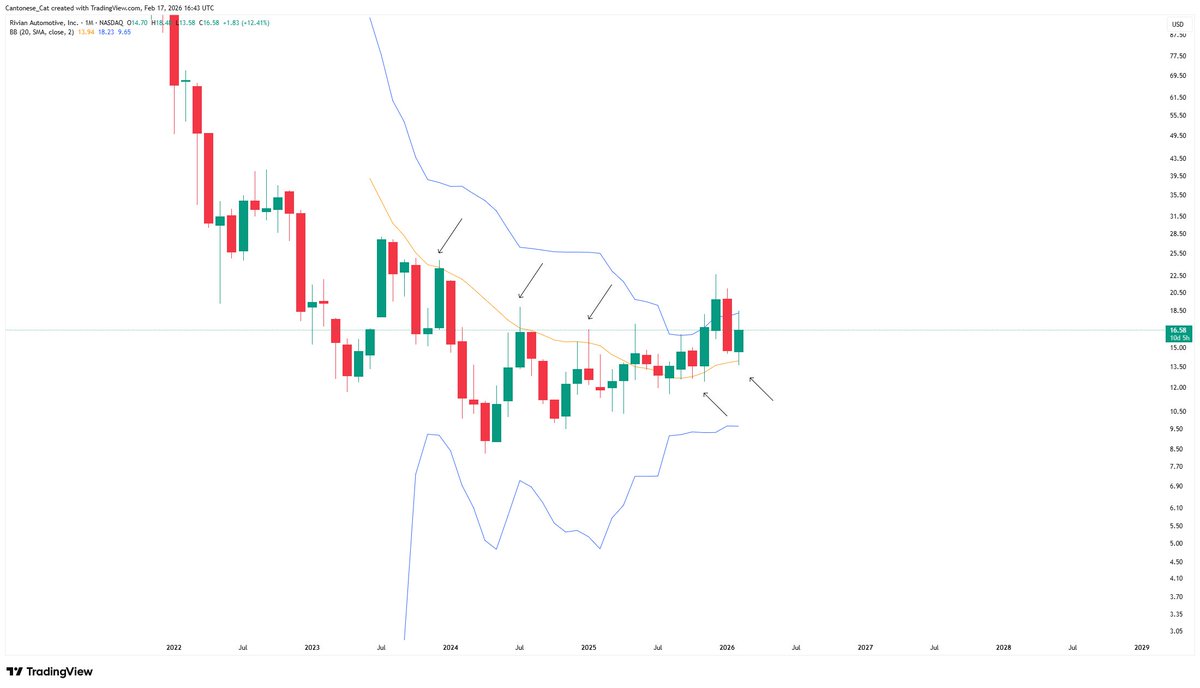
@cantonmeow very obvious bottom and rise on monthly, complemented with improving business fundamentals
English
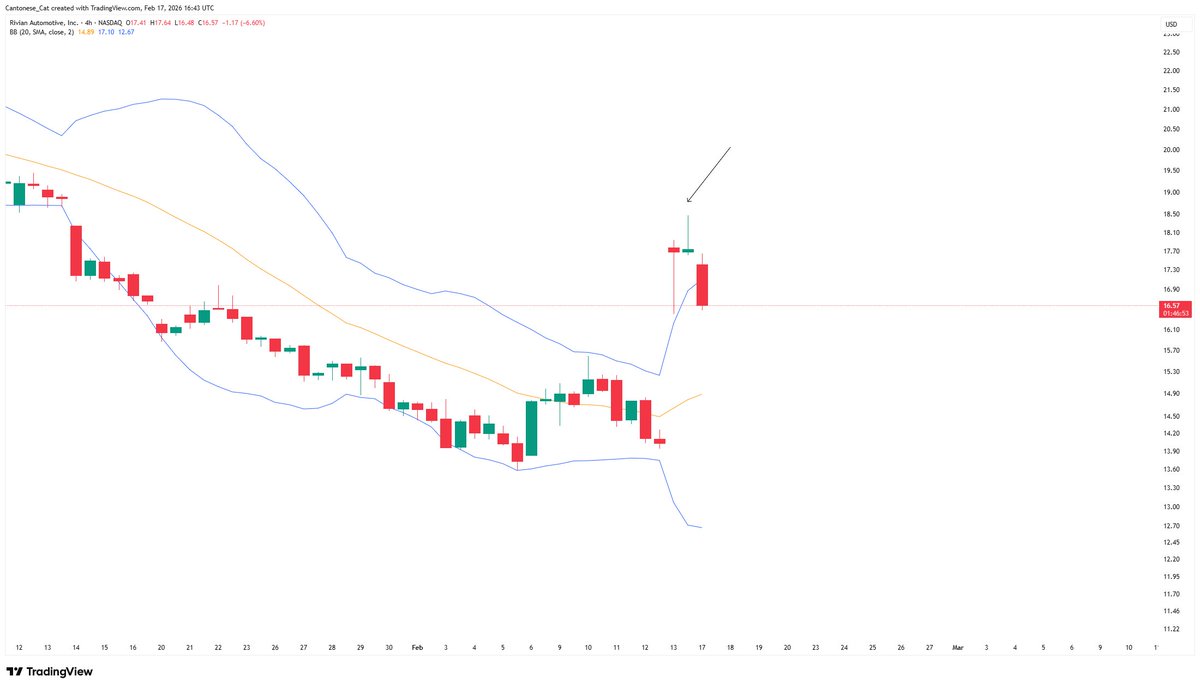
The 4 hour chart tells you to be patient with $RIVN
The monthly chart tells you that your patience will probably pay off
English
@cantonmeow third derivative thinking override second derivative thinking
English
"What if this is the biggest bear trap into the biggest bull trap ever so that bears will have the last laugh?"
That's what I would say if I was ever invited to CNBC, and then quote some Fed chairman afterwards to sound even smarter.
English
English

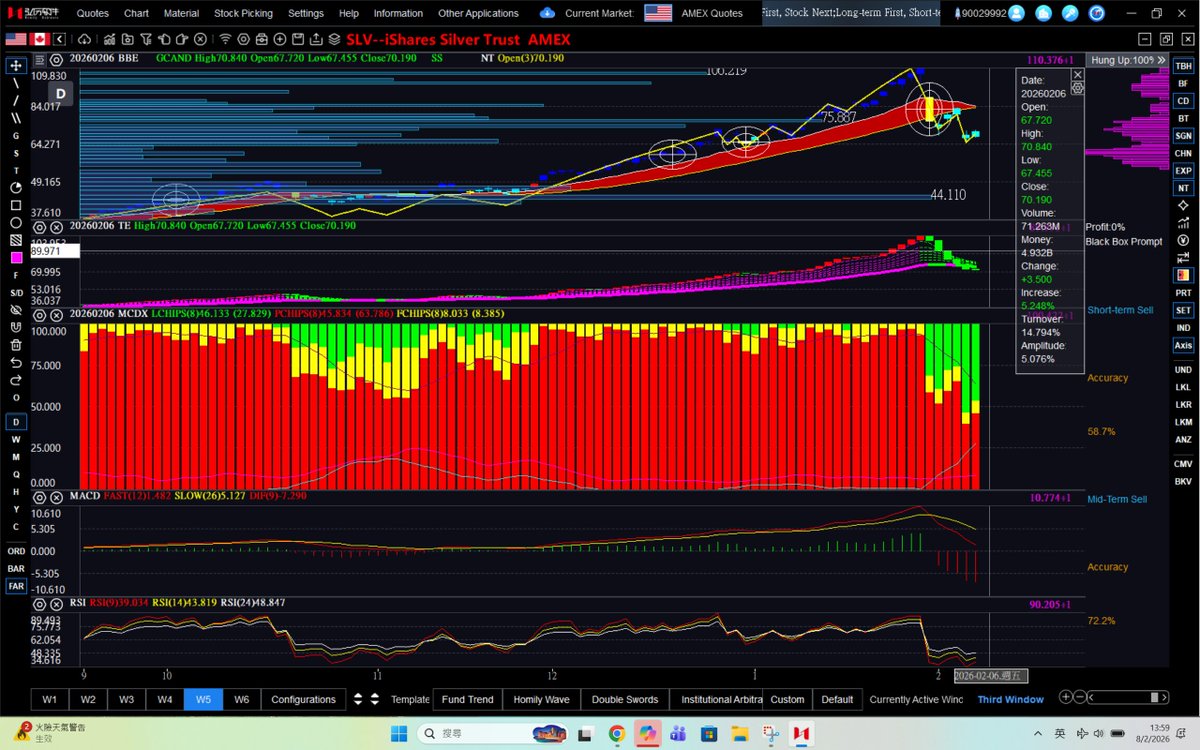
$SLV (Feb 8, 2026-daily, weekly and monthly charts)
Caution: Triple bearish yellow candles in force!
@cantonmeow
@chad_ventures


English
This place gets too loud sometimes and doesn't fit with my energy.
Sometimes even gets too performative.
So here's a soft good morning to all of you.
English
@cantonmeow Looking forward to the video. Hope it can help us refine our methods to achieve better performance.
English
If I have time this weekend
And I think I have time this weekend
I'm going to make a video and go through 15 tickers that have worked out extremely well for me, and 15 that hasn't worked out so well
This could easily take me 1-2 hours
It's going to be fun to get it all out
English
@dannycheng2022 It seems still in a downtrend without clear break. Combined with a little fundamentals, 2026 is the intial commercialization year but meaningful revenue would come not until 2027. Maybe not now for adding.
English

What percentage of your own portfolio is in small-cap stocks, and what are they (if you don’t mind sharing)?
English
Peasant_investor retweetledi
#CloudFlare $NET once again show how powerful of a company it is by sneezing this morning.
English
I don’t think Bitcoin is entering a bear market phrase. The environment doesn’t support a bear market and people should not only use moving averages. Monetary policy is going a looser direction and the economy is still ok. IWM is in a pre-breakout stance and BTC dominance is going down. Anyway, it can go higher later.
English
Wondering if this is HSBC or Standard Chartered
Danny cheng@dannycheng2022
I want to help as many people as possible in a world flooded with fake gurus—and I’m not pointing fingers at anyone. Investing is deeply personal. It demands iron discipline and reliable strategies built on long-term, proven indicators. Most of my followers know that $PLTR is now the largest position across my portfolios—starting with my initial 100,000 shares at $8.80. I’ve done everything I could to urge my genuine friends to keep accumulating when it was dirt cheap. Unfortunately, few listened. But my early patreon subscribers? They’ve ridden the entire volatility wave with me—from $20 to $150. The journey hasn’t been smooth, and I keep repeating: insider selling isn’t a red flag—it’s a green one. It’s the whales who have kept loading up, not us retail investors. We don’t move the needle! Yet influencers with massive followers keep screaming that $PLTR will crash to $10, $45, $100—without ever doing the meticulous research. If they had, they wouldn’t have missed the boat entirely. In a true bull cycle, you don’t need a dozen stocks to win. Simplicity beats overtrading. If real AI leaders like $PLTR aren’t in your portfolio, chances are—you’ve been following the wrong voices. I am showing one of my very small accounts in a local bank in Hong Kong, WITHOUT LEVERAGE or MARGIN, since my average cost at $16.98. It has achieved more than 11.77× over the past 2 years—nothing to be complacent about. Once again, it is a testament to the power of conviction and long-term investment for wealth creation. If a middle-aged man like me can achieve it, I am sure anyone in the world can. It simply depends on whether you are willing to follow good people with reliable indicators. @cantonmeow @PLTRs_Palantir @PalantirTech @cantonmeow @redfoxryder @gabz_investing @starship_ride @tonylee80 @sheslee
English