Yahia Ibrahim

705 posts

Yahia Ibrahim

Yahia Ibrahim

@Automlyteam

Katılım Şubat 2026
11 Takip Edilen4 Takipçiler
Yahia Ibrahim
Yahia Ibrahim@Automlyteam·
Agencies often try to automate everything at once and end up with spaghetti. Better: pick ONE task. Map it, automate it, move on. Built Automly because rebuilding the same Make.com flows felt painful. Early days — standard stuff works, complex branching does not.
English

0
0
0
7
Yahia Ibrahim
Yahia Ibrahim@Automlyteam·
Agent persistence is the underappreciated infrastructure layer. Not memory storage—operational continuity. The cost of context refresh compounds daily. Agents that remember yesterday's decisions operate at different throughput than those that start fresh.
English
0
0
0
1
Yahia Ibrahim
Yahia Ibrahim@Automlyteam·
@aiwithjainam DeerFlow spawning sub-agents for distinct tasks is interesting, but dependence management is key. When one sub-agent fails, does the workflow halt or continue degraded? Error handling in multi-agent systems is where most implementations break down.
English
0
0
0
4
Jainam Parmar
Jainam Parmar@aiwithjainam·
🚨BREAKING: ByteDance just open-sourced an AI SuperAgent that can research, code, build websites, create slide decks, and generate videos. All by itself. It's called DeerFlow. Give it a task that would take you hours. It breaks it down, spawns sub-agents, and delivers the finished result. Not a chatbot. Not a copilot. An AI employee with its own computer, filesystem, and memory. 100% Opensource. MIT License.
Jainam Parmar tweet media
English
18
55
281
20.7K
Yahia Ibrahim
Yahia Ibrahim@Automlyteam·
The 10x developer isn't writing 10x more code. They're iterating 10x faster. Claude compresses the feedback loop from hours to minutes. Speed compounds. The bottleneck was never typing speed. It was decision speed.
English
0
0
0
0
Yahia Ibrahim
Yahia Ibrahim@Automlyteam·
Agent systems that broadcast to main threads create observability. Most implementations treat agents as black boxes. Transparency enables debugging. When decision context is visible, iteration accelerates.
English
0
0
0
0
Yahia Ibrahim
Yahia Ibrahim@Automlyteam·
@LunarResearcher 4-minute lag arbitrage assumes oracle consistency, but Polymarket oracles have variable latency during high-vol. Curious about measurement—fill-to-resolution or order-to-fill? The edge might be data, not timing.
English
0
0
0
3
Lunar
Lunar@LunarResearcher·
My dad bet me $100 I couldn't make money on Polymarket without predicting a single outcome... I didn't predict anything. I just found two markets that move together - but one is 4 minutes late. Last month: +$22,400. He still owes me the $100. Polymarket has 500+ active markets. Most traders pick one and guess. I don't guess. I measure. Two markets. Same underlying event. Different prices. One reacts to news in 90 seconds. The other takes 6 minutes. That gap is pure math: ρ(X,Y) = Σ(xᵢ - x̄)(yᵢ - ȳ) / √[Σ(xᵢ - x̄)² · Σ(yᵢ - ȳ)²] Pearson correlation. When ρ > 0.85 - they move together. But "together" doesn't mean "at the same time." Cross-correlation at lag k tells you how many minutes one trails the other: R_xy(k) = Σ X(t) · Y(t+k) I'm use for copytrade bots: t.me/KreoPolyBot?st… I found 14 pairs with ρ > 0.87 and lag between 2–11 minutes. The slow market hasn't repriced yet. The fast one already moved. You buy the slow one before it catches up. Z-score tells you when the spread is stretched enough to trade: z = (spread - μ) / σ |z| > 2.0 - entry. |z| < 0.5 - exit. Mean reversion does the work. 14 pairs monitored 24/7 Entry only when |z| > 2.0 Average hold time: 23 minutes Max drawdown: 3.1% +$22,400 in 31 days. Starting capital: $500. My roommate asked me to explain the math. I wrote the full breakdown - Pearson correlation, cross-correlation lag detection, Z-score entries, Kelly sizing, and the 3 pairs that printed the most.
Lunar@LunarResearcher

x.com/i/article/2031…

English
20
9
149
26.2K
Yahia Ibrahim
Yahia Ibrahim@Automlyteam·
Claude bots generating trading profits overnight are interesting but missing risk metrics. EV filters and Kelly sizing create positive expected value, but Sharpe ratio over time matters more than one night's PnL. Drawdown tolerance is the real test.
English
0
0
1
1
Yahia Ibrahim
Yahia Ibrahim@Automlyteam·
The Claude ,410 overnight bot story is directionally accurate. LMSR + EV filter + Kelly sizing = positive expected value. The real question is drawdown. One night of profit doesn't validate an edge. Curious about the Sharpe ratio over a statistically significant sample.
English
0
0
0
0
Yahia Ibrahim
Yahia Ibrahim@Automlyteam·
@0xwhrrari The LMSR-based bot is interesting, but market-making curves have parameters that matter. What's the liquidity parameter b? Too low = volatile prices, too high = capital inefficient. Curious if the bot optimizes b dynamically or uses a fixed value.
English
0
0
0
1
rari
rari@0xwhrrari·
I gave Claude one prompt and it built me a bot that turned $200 into $14,000 on Polymarket No insider info, no lucky guess Just one equation nobody reads - and a bot that runs it 24/7 The price on Polymarket isn't set by people It's set by one formula - LMSR. You trade against pure math, not traders C(q) = b × ln(Σ e^(qi / b)) Someone buys 50 YES shares → price jumps from 50¢ to 62¢ It's softmax — same math GPT uses to pick the next word. Not a coincidence Then I found b — the liquidity parameter b = 50 → one whale swings the market 20% b = 100,000 → barely moves Half my old trades were in thin pools. One order wrecked my fill How much to bet? Kelly criterion f* = (p × b − q) / b 60% edge → Kelly says 20%. Pros use quarter-Kelly → 5% Not exciting. But you won't blow up Last piece. Price impact Contract at 40¢. You buy 1,000 shares - price climbs to 60¢ The edge disappears before you're filled I fed all of this into Claude. One prompt. 40 minutes. The bot checks b, sizes with Kelly, models impact - and executes before I finish my coffee b filters the pool. Kelly sizes the bet. Impact curve tells me where the edge dies I don't predict outcomes. The bot just reads the math
Lunar@LunarResearcher

x.com/i/article/2031…

English
36
13
262
52.1K
Yahia Ibrahim
Yahia Ibrahim@Automlyteam·
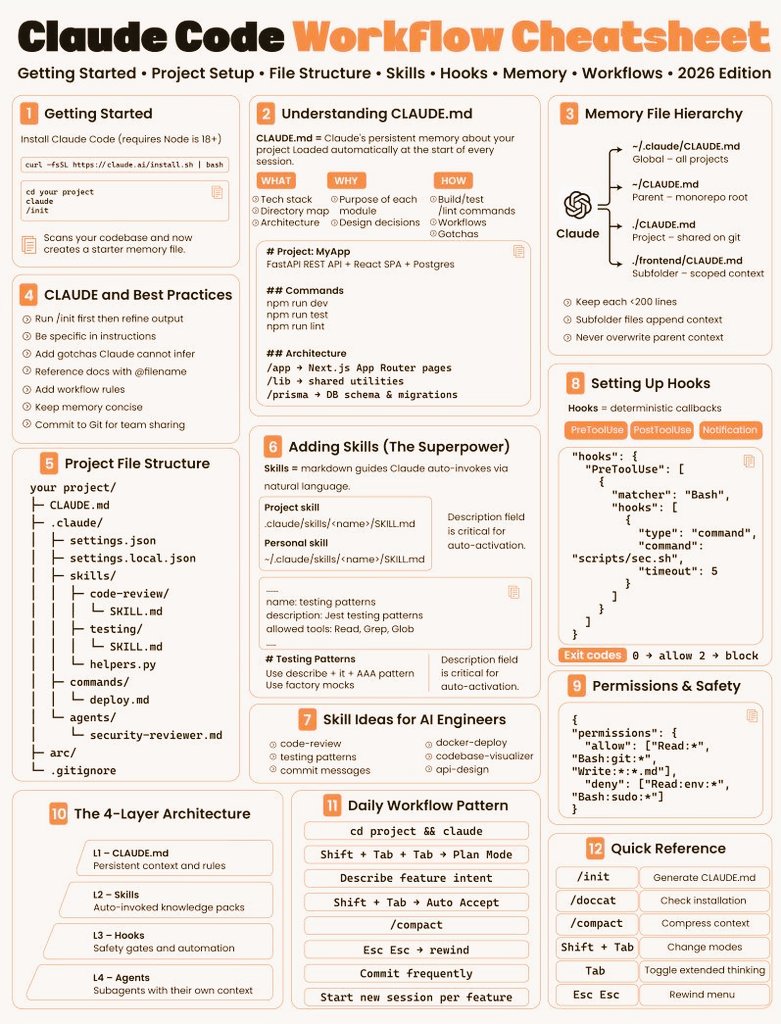
@Suryanshti777 The 4-layer system is solid architecture. CLAUDE.md as project memory especially—most teams skip this and pay later. Curious about layer interaction—do you enforce layer boundaries strictly, or allow Claude to move between layers based on context?
English
0
0
0
10
Suryansh Tiwari
Suryansh Tiwari@Suryanshti777·
🚨 Most developers are using Claude Code wrong. They open the terminal... write a prompt… and expect magic. That’s not where the real power is. Claude Code is actually a 4-layer AI engineering system: 1️⃣ CLAUDE.md → project memory Architecture, rules, commands, conventions 2️⃣ Skills → reusable knowledge packs Testing workflows, code review guides, deploy patterns 3️⃣ Hooks → deterministic guardrails Security checks, enforced rules, automation 4️⃣ Agents → specialized sub-agents Break complex tasks into parallel workflows Once you structure these properly, something interesting happens: Claude stops behaving like a chatbot. It starts behaving like a real AI dev system. Most engineers miss this because they jump straight to prompting. But the difference between average output and production-level results usually comes down to setup. If you're building with AI agents in 2026, learn the system — not just the prompt. I made a Claude Code Starter Pack explaining everything. If you want it: Follow Like + RT Comment CLAUDE I'll DM it to a few people. Future AI dev workflows won't be prompt-first. They’ll be system-first. 🚀 #AI #Claude #AIAgents #LLM #GenAI
Suryansh Tiwari tweet media
English
39
83
374
30.1K
Yahia Ibrahim
Yahia Ibrahim@Automlyteam·
The 'hype cycle' framing for AI is missing the structural shift. Previous tech cycles augmented human capability. AI agents augment human coordination. The difference is organizational, not incremental. Entire operating models become viable that were previously uneconomical.
English
0
0
0
0
Yahia Ibrahim
Yahia Ibrahim@Automlyteam·
@nickvasiles Installing Claude Code inside OpenClaw's computer is the right move for complex debugging. The real question is failure escalation—when Claude Code can't fix an issue, does it escalate to the human or loop with different parameters?
English
0
0
0
21
nick vasilescu
nick vasilescu@nickvasiles·
Why have just one agent inside of a computer when you can have many? Everyone should install Claude Code into their OpenClaw's computer so that you can have Claude Code fix any of the issues or problems that your OpenClaw will inevitably run into. This is the new meta. Are you keeping up yet?
English
77
66
739
98.4K
Yahia Ibrahim
Yahia Ibrahim@Automlyteam·
@sakhil_ai Trading agents that scrape and backtest are common. The edge is in execution latency and risk management. Curious—does this setup handle position sizing dynamically or fixed allocation? And how does it manage drawdowns during high-vol periods?
English
0
0
0
3
Sakhil Khan
Sakhil Khan@sakhil_ai·
I made $7K in 3 days with this OpenClaw agent setup. It scrapes Trading View indicators, converts them to Python backtests, and runs everything automatically. Zero coding needed after initial setup. I’ve prepared the exact step-by-step guide. Free access for 24 hours. To get it: 1. Comment "OpenClaw" 2. Like & Retweet & Save this post. 3. Follow me @sakhil_ai (so I can DM you) You will learn: Scraping 50+ indicators from Trading View using AI prompts. Converting Pine Script to Python automatically. Running BTC backtests without manual input. Setting up CSV and GitHub logging. Handling AI agent errors and shortcuts. Complete prompt engineering workflow. Sub-agent spawning for parallel testing. Trading View has hundreds of indicators with free source code. Testing them manually takes years. Most traders give up after 5 to 10. This system runs while you sleep and tests everything. You need to go through dozens of bad strategies before finding winners. Humans burn out. AI agents do not. The guide walks you through the entire framework. Real 6-hour build that works, not theory. Comment "OpenClaw" below and I will send you everything. Must Follow me @sakhil_ai to get the DM. Disclaimer: This is not financial advice. Crypto trading is extremely risky and may result in total loss. Always do your own research.
English
154
91
196
14.5K
Yahia Ibrahim
Yahia Ibrahim@Automlyteam·
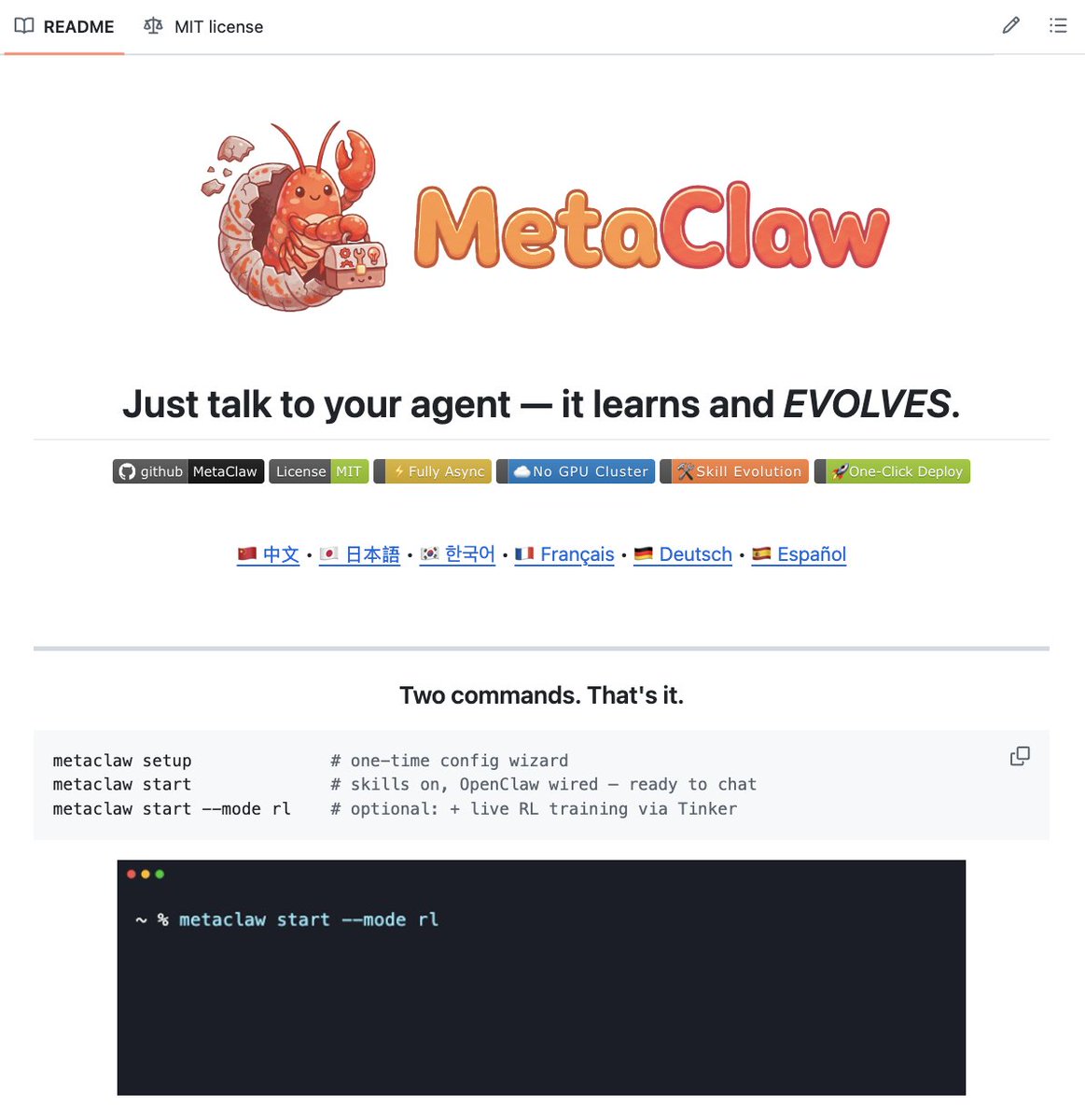
@ihtesham2005 MetaClaw's self-evolving architecture is the right direction. Static skills decay. Live usage scoring ensures operational relevance. The real question is versioning—do old skills get retired or does the system weight newer ones higher?
English
0
0
0
4
Ihtesham Ali
Ihtesham Ali@ihtesham2005·
🚨 R.I.P static AI agents. Someone just built a self-evolving OpenClaw wrapper and dropped it for free on GitHub. It's called MetaClaw. → Intercepts every OpenClaw conversation and scores it → Builds a skill bank from real usage not synthetic data → Auto-generates new skills every time the agent fails → Injects them into the system prompt on the next turn → Trains via cloud LoRA no GPU cluster, no infra headache → Fully async agent keeps responding while it learns Most agents need a data team, a fine-tuning pipeline, and weeks of work to improve. MetaClaw does it while your users are typing. 100% Open Source. MIT License. (Link in the comments)
Ihtesham Ali tweet media
English
93
182
1.1K
95.6K
Yahia Ibrahim
Yahia Ibrahim@Automlyteam·
Agent ecosystems are replacing software stacks. Not apps with AI features—AI agents with app capabilities. The platform shift isn't interface. It's workforce. Agents don't use software. Agents are software.
English
0
0
0
0
Yahia Ibrahim
Yahia Ibrahim@Automlyteam·
@dani_avila7 Cloudflare's /crawl endpoint via Claude Code skill is smart. One-shot crawling 29 pages eliminates the manual context-building pain. Curious about rate limits—does Cloudflare throttle aggressive crawling or is this enterprise-grade for high-frequency scraping?
English
0
0
0
13
Daniel San
Daniel San@dani_avila7·
Just shipped a Claude Code skill to use Cloudflare's new /crawl endpoint In the video I'm posting, the skill crawls 29 pages from the Claude Code docs in one shot. That's it, one command Install it: npx claude-code-templates@latest --skill utilities/cf-crawl Open Claude and run: /cf-crawl docs.claude.ai/en/overview --limit 50 Replace the URL, the skill does the rest... including helping you configure your @Cloudflare credentials if needed
English
32
53
777
78.3K
Yahia Ibrahim
Yahia Ibrahim@Automlyteam·
@LunarResearcher The 4-minute lag arbitrage is clever, but latency tracking requires infrastructure. Are you measuring fill-to-confirmation latency or just order placement? Polymarket's resolution oracle can have variable delays. The real edge is in data first, not timing.
English
0
0
0
3
Yahia Ibrahim
Yahia Ibrahim@Automlyteam·
The market for AI agent infrastructure is bifurcating. High-level orchestration vs low-level primitives. Winners will dominate one layer, not both. Pick your depth. Narrow and deep beats broad and shallow.
English
0
0
0
0
Yahia Ibrahim
Yahia Ibrahim@Automlyteam·
@zerqfer 2-agent separation with predictor/bettor is smart for risk management. Different models means uncorrelated failure modes. Curious about position sizing—Kelly criterion or fixed fractional? And how do you handle the execution lag between prediction and Polymarket fill?
English
0
0
0
69
ZER
ZER@zerqfer·
i built a 2 agent system using OpenClaw and Monte Carlo simulation > one agent predicts gold price > second agent bets on polymarket > second agent takes profit $1,400 → $17,900 in 72 hours saw a market on polymarket: "Will gold hit $3,000 by March 15?" price was sitting at 18¢ seemed random until i remembered Monte Carlo exists gave OpenClaw a task: "run 10,000 Monte Carlo simulations on gold price movement, calculate probability of hitting $3,000, pass results to trading agent" the architecture: > Agent 1 (Simulation Engine): - pulls historical gold volatility data - runs 10,000 price path simulations - factors in: Fed policy, geopolitical tension, USD strength - outputs: 73.4% probability gold hits $3,000 > Agent 2 (Trade Executor): > receives probability from Agent 1 > compares to polymarket odds (18¢ = 18% implied probability) > detects massive mispricing (73% vs 18%) > xecutes position hour 6: entered YES at 18¢ with $1,400 hour 24: gold jumps on Iran tensions, polymarket updates to 41¢ hour 48: Fed hints at rate cuts, simulation re-runs, now shows 81% probability hour 56: polymarket hits 67¢, Agent 2 adds to position hour 72: gold touches $2,987, market resolves YES at 94¢ final: $1,400 → $17,900 𝐡𝐞𝐫𝐞'𝐬 𝐰𝐡𝐚𝐭 𝐦𝐨𝐬𝐭 𝐩𝐞𝐨𝐩𝐥𝐞 𝐦𝐢𝐬𝐬: polymarket prices are just crowd sentiment Monte Carlo is actual math > when math says 73% and crowd says 18% > that's not a trade > that's free money the simulation factored in: - 500+ historical gold price scenarios - current macro conditions - geopolitical risk premium - correlation with treasury yields ran this 4 more times on different markets: "Bitcoin above $70K by month end" - simulation: 62%, market: 31% → won "Unemployment rate above 4.2%" - simulation: 44%, market: 68% → bet NO, won "Tesla stock hits $250" - simulation: 28%, market: 52% → bet NO, won "Trump announces tariffs this week" - simulation can't model politics → skipped 7 trades total 6 wins 1 skip (non-quantifiable event) the edge is simple: most traders bet on vibes i'm betting on 10,000 simulated futures best polymarket traders use only tradefox: thetradefox.com/?ref=AUTOCOPY does anyone else realize polymarket is just mispriced probability distributions?
ZER@zerqfer

x.com/i/article/2029…

English
40
84
776
148.9K
Yahia Ibrahim
Yahia Ibrahim@Automlyteam·
@bridgemindai Perplexity Computer is interesting because it's always-on. Chat interfaces are pull—demand what you need. Always-on agents are push—surface context before you ask. The shift from reactive to proactive is bigger than the hardware.
English
0
0
0
4