

AZCrypto
1.1K posts

The chart of things most people can't sell on a DEX and launched really really close to 0 is pretty funny. 553,777% lol. Should nuke down quite hard in about 13.5 hours, cuz the price is too high.

English
AZCrypto retweetledi

Quilibrium just dropped a live demo of KLEARU: private ML inference with an inspector tab so you can check it for yourself. But it's just the start 👇
This is built on SLIDE (Sub-Linear Deep Learning Engine), a breakthrough out of Rice University that demonstrated deep learning on CPUs outperforming specialized GPU hardware. No NVIDIA required.
KLEARU is defined as "E2EE ML Training and Inference" but right now we're seeing the inference half. Once training ships alongside the full network, Q can become the first decentralized network capable of running private MPC-based AI inference and training at scale using CPUs.
Not "we swear not to look" privacy, but real privacy guaranteed by cryptography, not policy.
On AI training and inference, unlocking the massive global supply of commodity CPUs that were previously useless for AI workloads.
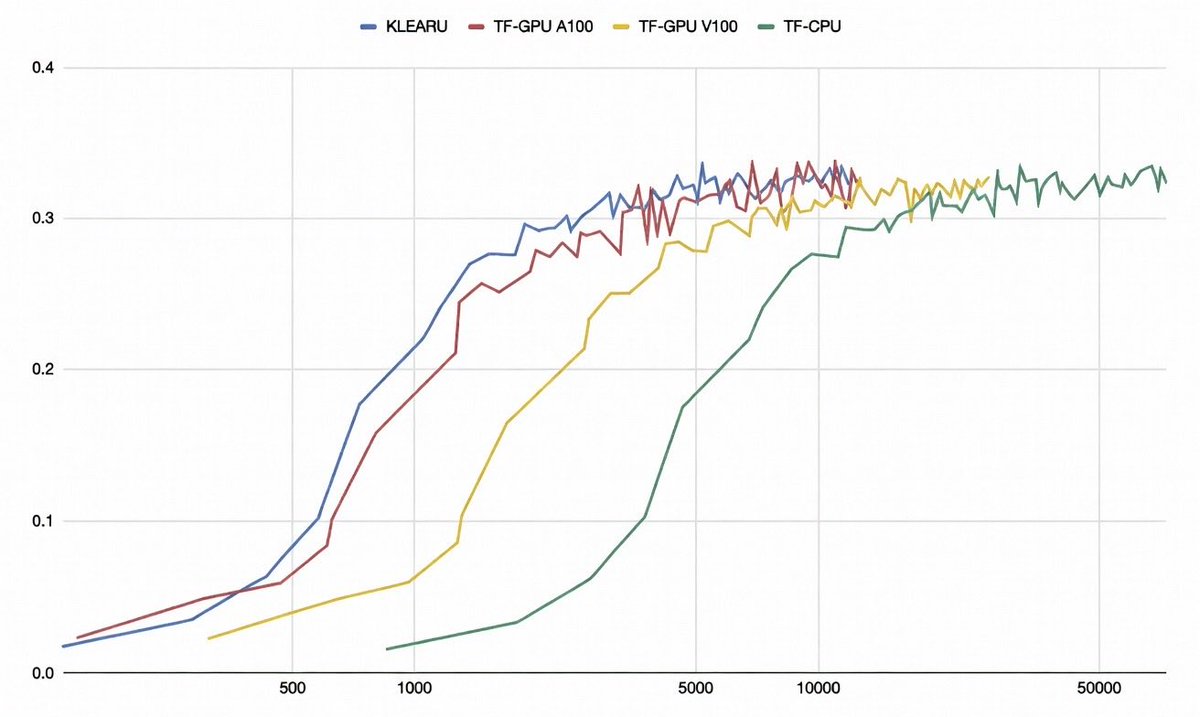
Early training benchmarks (internal, not independently verified) show KLEARU reaching convergence accuracy on training faster than TensorFlow on an A100. A CPU-based sparse implementation outpacing NVIDIA's flagship data center GPU 🤯
Think about what that means for a second. And also, bear in mind that everything Q ships is open source but under AGPL license, meaning competitors can’t just steal it.
More info on SLIDE:
csweb.rice.edu/news/deep-lear…
Quilibrium@QuilibriumInc
A lot of the "private" AI options out there are lying to you. Look under the hood. Use the dev tools on the browser to see what is actually sent. It's plaintext. What they're actually doing is _promising_ they won't look. We don't do that. See for yourself. We have an inspector tab so you can see the actual traffic data, but you can confirm it in the browser. klearu-demo.qstorage.quilibrium.com Don't trust. Verify.
English
AZCrypto retweetledi

@cass_on_mars shipped some pretty impressive updates (Klearu and MetaVM) for @QuilibriumInc.
In case it was too complex for you, here it is explained for normies!
MetaVM — What is it?
Imagine you hire someone to do a maths problem for you. Normally, you'd have to redo the entire problem yourself to check they got it right. MetaVM is a tool that lets that person hand you a tiny "receipt" that mathematically proves they did the work correctly, without you having to redo anything. One quick check and you know the answer is legit.
What makes it stand out is that it works across three major computing worlds: RISC-V (a general purpose chip architecture, the kind that runs Linux, and the direction Vitalik has publicly said he wants to move towards), Ethereum's EVM (the engine behind ETH smart contracts), and Solana's BPF (the engine behind Solana programs). It can verify an entire Ethereum block or an entire Solana slot in one go.
It also plugs into Quilibrium's own cryptographic foundation, while remaining compatible with Ethereum's. That means it can speak both languages.
Why it matters: For Quilibrium's network, this solves the fundamental trust problem. You don't have to trust the random machine that ran your code. You just check the proof. That's what makes decentralised computing actually work rather than just being a nice idea.
The bigger picture:
Quilibrium's founder has already gone directly to Vitalik pointing out that MetaVM does exactly what Ethereum's own roadmap calls for. And because the code is released under strict rules (AGPL), any company that wants to build a business on top of it would either have to make their entire product open and free, or come to Quilibrium for a commercial deal. That's a deliberate move to prevent big players from taking the technology, privatising it, and extracting value without giving anything back, which is exactly what happened with Ethereum's own codebase when companies like Coinbase built Base on top of it. It positions Quilibrium not just as a technology provider but as a gatekeeper against corporate value extraction in the crypto ecosystem.
Klearu — What is it?
Right now, when you use ChatGPT or any AI chatbot, you're sending your raw thoughts, questions, and data straight to a company's servers. They can see everything you type. Klearu is Quilibrium's answer to that problem. It lets you use AI models without anyone seeing what you actually asked.
It has two big pieces:
The first is speed. Normal AI models process everything: every single connection in the neural network fires for every word, even when most of that work is pointless. Klearu uses a technique based on peer reviewed research (the SLIDE paper family) that flips the approach. Instead of brute forcing through the entire model, it uses smart shortcuts to figure out which tiny fraction of the network actually matters for your specific input and only runs that part. The result, proven in academic benchmarks, is that a regular CPU can outperform expensive GPU hardware for certain workloads. That's a massive deal because Quilibrium's network runs on regular computers, not GPU farms.
The second is privacy. Klearu lets two parties work together on AI inference where neither side sees the other's secrets. The person running the model never sees your prompt. You never get access to the model's weights. Both sides work on encrypted data the whole time, using real cryptographic protocols, not "trust us, we deleted the logs" promises. The maths guarantees it.
Everyone is talking about AI right now, but almost nobody is solving the privacy side. Every big AI company has full access to every conversation you have with their models. Klearu means $QUIL could offer AI as a service where privacy is baked into the maths itself. A node operator on the network could run a LLaMA model and serve your requests without ever knowing what you asked or what the answer was. That doesn't exist anywhere else in a meaningful form right now.
The trade off:
This is still early. The privacy mode adds real overhead, roughly 2MB of encrypted back and forth per token at the highest security level, which is heavy. And the benchmarks so far use smaller models (up to 1.7 billion parameters), not the massive models people associate with frontier AI. But as a foundation for private AI on a decentralised network, it's one of the most technically serious attempts out there. And crucially, it runs on CPUs, which means it's built to work on the kind of machines that already power the Quilibrium network rather than requiring expensive specialised hardware that would centralise everything again.
At a $15M valuation, $quil has one of the best R/R setups for me personally!
Don't be lazy, guys, spend some time researching. Q!
Tagging @AlgodTrading since he's the guy who always looks for conviction plays.
English
AZCrypto retweetledi

Most people won’t realise how big this is yet.
MetaVM just launched on Quilibrium.
In simple terms, it allows computers to run programs and produce mathematical proof that the result is correct.
No trust required.
Why this matters:
Normally blockchains require thousands of computers to repeat the same calculations to verify transactions.
MetaVM changes that.
One computer can run the computation and produce a Zero Knowledge proof that everyone else can instantly verify.
This massively improves speed, scale and efficiency.
But it goes further.
MetaVM can run:
• Ethereum programs
• Solana programs
• Full Linux environments
And produce proofs that can be verified by other chains.
This means:
• Trustless bridging between chains
• Verifiable cross-chain apps
• Entire systems that can run with cryptographic proof
Even more interesting…
It runs using CPUs instead of expensive GPU clusters, making the system far more accessible to run.
Some people in crypto have been talking about ZK-powered virtual machines for years.
@QuilibriumInc just shipped one that supports 64-bit RISC-V, meaning you can even run full Linux environments inside it.
Most people will ignore this today.
But infrastructure breakthroughs like this are often only understood years later.
The real question now is not the tech.
It’s who starts building on top of it
This is why I'm loaded up with $QUIL
Quilibrium@QuilibriumInc
MetaVM has been released. Prove execution of RISC-V, EVM, and Solana sBPF in ZK. Supports Quilibrium's BLS48-581 and Ethereum's BLS12-381 natively, without needing a GPU. MetaVM's RISC-V compatibility is the first full ZK RV64IMAC instruction set – you can run Linux in MetaVM, and prove everything that happened within the VM session, prove a block on Ethereum, or a slot on Solana, and emit proofs compatible with either Q or Ethereum. github.com/QuilibriumNetw…
English
AZCrypto retweetledi
So Quilibrium just beat ETHs own roadmap, shipping the risc-v zk runtime Vitalik wants. And not only that. Eth plans for 32bit but today 64bit went live.
This enables running full Linux VMs inside Q, along with providing proofs and trustless bridging for Eth and Solana. And using CPUs, no expensive GPU clusters.
There will be some serious Eureka moments when people start to realize what is being built here, and what it implies.
Quilibrium@QuilibriumInc
MetaVM has been released. Prove execution of RISC-V, EVM, and Solana sBPF in ZK. Supports Quilibrium's BLS48-581 and Ethereum's BLS12-381 natively, without needing a GPU. MetaVM's RISC-V compatibility is the first full ZK RV64IMAC instruction set – you can run Linux in MetaVM, and prove everything that happened within the VM session, prove a block on Ethereum, or a slot on Solana, and emit proofs compatible with either Q or Ethereum. github.com/QuilibriumNetw…
English
@MadsMelbourne It's called portable long service leave. You have to pay it even though they may never become entitled to it
English
@MadsMelbourne How this for a scam: cleaning and some other industries have to pay long service leave to the government each week for their staff IN CASE that person is ever eligible for it (even after swapping companies) but if they never become eligible, the government keeps it. WTAF!
English

Superannuation is the biggest con! Australians have been tricked into thinking that giving 12% of their hard earned income to the government on top of the income tax and Medicare levy they already pay is a good idea. There is absolutely no guarantee that you will even get any of your money back when you do finally retire. Ex ALP politicians, high ranked ALP members and Union bosses including the CFMEU sit on the boards of these super funds and get to decide however it is they want to spend or invest your income. Whilst they take a huge proportion from you in fees. They make themselves and their mates rich whilst you struggle. They’ve even ensured there is no way for you to access those funds until you’re literally old and grey. Imagine if everyone had 12% more of their earnings to spend on necessities or to save right now. How much of a difference that would make to peoples lives.
English
AZCrypto retweetledi

AZCrypto retweetledi

@QuilibriumInc just dropped Klearu - an open-source runtime for private LLM inference. 🤖 +🔒
GitHub: github.com/QuilibriumNetw…
Most "private AI" today relies on TEEs - basically hardware enclaves where you have to trust the manufacturer isn't peeking. The real alternative (fully homomorphic encryption) is still too slow to be practical for AI workloads.
🤖 You can ask Quily chatbot questions about Klearu: quily.quilibrium.one
Klearu takes a third path: two-party computation (2PC). When you send a query to a remote node, the computation happens in a way where neither side ever has the full picture - the node runs the inference but mathematically cannot see your inputs or outputs. No trust required, just cryptography.
A few things worth knowing:
• CPU-native, no GPUs needed
• Supports LLaMA-compatible models (up to 7B+ params)
• Built-in sparsity optimizations that skip unnecessary computation per token
• Speed is comparable to llama.cpp in lower security mode
This is the kind of infrastructure that makes "private AI on a decentralized network" mean something concrete rather than a marketing claim.
Tech docs and benchmarks by @LookDragi : #klearu" target="_blank" rel="nofollow noopener">qstorage.quilibrium.com/infoquil/index…
$QUIL
Quilibrium@QuilibriumInc
Today, we are publishing one of the side tracks of research ongoing with Q, our E2EE ML training and inference library, klearu: github.com/QuilibriumNetw… SLIDE proved that hash tables can beat GPUs at training deep networks. Further works compounded on this, and Klearu is the first native Rust implementation built on top of this research, extending it to LLM inference, sparsity prediction, and private two-party computation. In the current days we're seeing deeper trust being placed on AI, while the largest of providers are collecting this data for the purpose of not only training, but also advertising, or even selling this data to others. The risks grow worse with every passing day. The majority of AI research for private AI exists in the form of using TEEs – but we've seen time and time again that using TEEs for privacy is disastrous, guaranteed to leak, and even by it's name, is a massive requirement of trust. Outside of this, other private AI looks towards FHE. We know, at least for the near future, that FHE cannot perform at a speed high enough to be generally useful. So instead, we adopted 2PC, with flexible security configurations, where users can be assured that their requests remain private. The majority of these research projects have strictly an output of papers, with no or limited real world instances of their use. Klearu's implementation is available now, with simple instructions for developers to try it out.
English
AZCrypto retweetledi

Private AI is moving from research into real infrastructure.
Klearu combines E2EE training and inference with efficient sparse AI and two party computation instead of insecure TEEs or impractical FHE.
As trust in AI grows, privacy must grow with it. This is where @QuilibriumInc’s vision starts to become tangible.
Quilibrium@QuilibriumInc
Today, we are publishing one of the side tracks of research ongoing with Q, our E2EE ML training and inference library, klearu: github.com/QuilibriumNetw… SLIDE proved that hash tables can beat GPUs at training deep networks. Further works compounded on this, and Klearu is the first native Rust implementation built on top of this research, extending it to LLM inference, sparsity prediction, and private two-party computation. In the current days we're seeing deeper trust being placed on AI, while the largest of providers are collecting this data for the purpose of not only training, but also advertising, or even selling this data to others. The risks grow worse with every passing day. The majority of AI research for private AI exists in the form of using TEEs – but we've seen time and time again that using TEEs for privacy is disastrous, guaranteed to leak, and even by it's name, is a massive requirement of trust. Outside of this, other private AI looks towards FHE. We know, at least for the near future, that FHE cannot perform at a speed high enough to be generally useful. So instead, we adopted 2PC, with flexible security configurations, where users can be assured that their requests remain private. The majority of these research projects have strictly an output of papers, with no or limited real world instances of their use. Klearu's implementation is available now, with simple instructions for developers to try it out.
English
AZCrypto retweetledi

Private Decentralized AI inference on CPU’s that’s performant against Nvidia GPU’s.
This is not only:
The biggest AI release of 2026.
The biggest Privacy release of 2026.
The biggest Crypto release of 2026.
this is simply the biggest release of 2026
- and no one is talking about it.
#Klearu
@QuilibriumInc $wQUIL $QUIL
Quilibrium@QuilibriumInc
Today, we are publishing one of the side tracks of research ongoing with Q, our E2EE ML training and inference library, klearu: github.com/QuilibriumNetw… SLIDE proved that hash tables can beat GPUs at training deep networks. Further works compounded on this, and Klearu is the first native Rust implementation built on top of this research, extending it to LLM inference, sparsity prediction, and private two-party computation. In the current days we're seeing deeper trust being placed on AI, while the largest of providers are collecting this data for the purpose of not only training, but also advertising, or even selling this data to others. The risks grow worse with every passing day. The majority of AI research for private AI exists in the form of using TEEs – but we've seen time and time again that using TEEs for privacy is disastrous, guaranteed to leak, and even by it's name, is a massive requirement of trust. Outside of this, other private AI looks towards FHE. We know, at least for the near future, that FHE cannot perform at a speed high enough to be generally useful. So instead, we adopted 2PC, with flexible security configurations, where users can be assured that their requests remain private. The majority of these research projects have strictly an output of papers, with no or limited real world instances of their use. Klearu's implementation is available now, with simple instructions for developers to try it out.
English
AZCrypto retweetledi
Today, we are publishing one of the side tracks of research ongoing with Q, our E2EE ML training and inference library, klearu: github.com/QuilibriumNetw…
SLIDE proved that hash tables can beat GPUs at training deep networks. Further works compounded on this, and Klearu is the first native Rust implementation built on top of this research, extending it to LLM inference, sparsity prediction, and private two-party computation.
In the current days we're seeing deeper trust being placed on AI, while the largest of providers are collecting this data for the purpose of not only training, but also advertising, or even selling this data to others. The risks grow worse with every passing day.
The majority of AI research for private AI exists in the form of using TEEs – but we've seen time and time again that using TEEs for privacy is disastrous, guaranteed to leak, and even by it's name, is a massive requirement of trust.
Outside of this, other private AI looks towards FHE. We know, at least for the near future, that FHE cannot perform at a speed high enough to be generally useful. So instead, we adopted 2PC, with flexible security configurations, where users can be assured that their requests remain private. The majority of these research projects have strictly an output of papers, with no or limited real world instances of their use.
Klearu's implementation is available now, with simple instructions for developers to try it out.
English
AZCrypto retweetledi



JUST IN: YouTube is down worldwide.
Bitcoin is never down


English
There are people buying Bitcoin, Ethereum, and HEX right now… And there are people who’ll wish they did 10 years from now.
English

@trader1sz Yes, the wallet on quorummessenger.com built on Quilibrium
English
AZCrypto retweetledi

Why QNS on Quilibrium Matters — Far More Than ENS
1/ Web3 domains have been “written off” because they never became real traffic + identity gateways like .com. ENS, TON numbers, etc. mostly turned into nice labels… and markets cooled.
2/ ENS helps humans read an address — but in a crypto “dark forest,” broadcasting identity can be risky. In practice, an ENS name rarely gives you much more than readability.
3/ QNS on Quilibrium is meant to be different. It’s not just a memorable name — it’s designed to represent your reputation, weight, and permissions across a privacy-first internet (chat, miniapps, storage, routing).
4/ A fully decentralized private network faces a hard problem: spam / Sybil / resource abuse. If account creation is free, an attacker can mint infinite identities and flood the network with zero-cost traffic.
5/ Many chains solve this with staking or balance-based quotas. But on a privacy chain, balances aren’t transparently visible, and staking isn’t the native knob. So a practical approach is: each relay node maintains allow/deny lists and prioritizes trusted identities.
6/ In that world, identities that resolve to a QNS are more likely to be trusted (whitelisted) and get better service in Quorum chat and future miniapps — because they’re harder to throw away and easier to anchor reputation to.
7/ Example: Qstore offers 5GB free storage, but to prevent farming, the minimum gate is holding a QNS or paying 10 USDC. This kind of “anti-abuse gate” will likely become a baseline pattern for Quil apps.
8/ Long term, a strong QNS could be worth far more than the registration cost: it can bundle benefits across QUIL / QConsole / Quorum, and even become a routing primitive. Map a QNS to a website, and nearby Quil nodes can relay traffic globally (privacy-native, PCDN-like) — reducing dependence on expensive CDNs.
@QuilibriumInc @QuilibriumOne
English
AZCrypto retweetledi
After seeing that Discord plans to make KYC mandatory, we want to be clear on where we stand. KYC for messaging is a complete non starter for us.
Quorum Messenger does not ask for your personal details and it never will. No identity checks, no sign ups tied to who you are, and nothing happening behind the scenes.
Quorum is decentralized by design, and both DMs and group chats are fully end to end encrypted. That means only the people in the conversation can read the messages, not us, not a third party, not anyone else.
Your conversations are yours. You own them, you control them, and that is how it is designed to stay. Privacy is not an add on or a talking point for Quilibrium, it is the whole point.
So if you are looking for a safe haven messenger that will not turn its back on you, come try Quorum Messenger 👇
quorummessenger.com
Quilibrium@QuilibriumInc
Quorum Mobile Beta is officially live 📱 If you signed up for early access, you’ll be receiving an email shortly with download links for iOS and Android. We’re excited to finally share the first mobile version of Quorum with the world.
English
RT @RadoTsc: I am simply amazed. I spent some time with Quily the new quilibrium chatbot connected on @chutes_ai to understand all the new…
English