اگر $NEAR دارید ببرید تو کیف پول near wallet استیک کنید و ارز $NPRO بگیرید
✅ Join NEAR Mobile! Download nearmobile.app on Android or iOS for free now! 👇
@SaberGhazi@DonVangelo منم قبول دارم. اینکه توکنی رو بیاری بالا و فومو ایجاد کنی و یهو توکن رو کامل ول کنی بری، اینم نمونهای از اسکمه. نمیشه گفت فقط باید کانترکت خراب باشه تا اسکم نامیده شه.
دیروز خبر فروش #اتریوم توسط ویتالیک خیلی ترند شد... من از زاویه دیگه میخوام بهش نگاه کنم
ویتالیک تو قیمت ۴۰۰۰ و ۵۰۰۰ هم اتربوم زیادی فروخته ولی چرا اونجا خبرش ترند نشد؟ چون نمیخواستن شما هم بفروشید! بلوه باید تو اون قیمت میخریدید. و بر عکس الان چون تایم فروش شماست بولد میکنن
What stood out to me when exploring Kova wasn’t just that it’s decentralized compute, but how it tackles the problem.
What @KovaNetwork is building feels grounded in real usage, not surface level hype. Paying only for the compute you actually use, with trust in the underlying numbers, makes the experience completely different.
Features like fractional GPUs and CPUs with true per second billing might seam like small details, but in practice they change everything, no idle capacity tax, no rough estimates, and spend tied directly to results.
The system design is also honest and transparent scheduling, batching and concurrency are built around real throughput and latency targets, not demo benchmarks.
If this direction continues, Kova could become meaningful infrastructure for builders, creators and InfoFi products that value transparancy and control.
When I actually sat down and explored Kova, what stood out to me wasn’t just that it’s decentralized compute, but how it approaches the problem.
What @KovaNetwork is building feels grounded in real usage, not surface-level hype.
Instead of selling big promises, the focus is on something very practical: paying only for the compute you actually use, and being able to trust the numbers behind it.
Fractional GPUs and CPUs combined with true per-second billing might sound like small details, but in practice they change everything.
–> No idle capacity tax
–> No rough estimates
–> Spend is finally tied to real results
I also like the honesty in the system design
Scheduling, batching, and concurrency are clearly built around real throughput and latency targets, not demo benchmarks.
And proof-based receipts matter a lot once real workloads and real money are involved.
Compared to other platforms, Kova doesn’t try to be everything at once
It focuses on accountability, flexibility, and usability, which is exactly where many builders struggle today.
If this direction continues, I can see Kova becoming meaningful infrastructure for builders, creators, and InfoFi-driven products that value transparency and control.
If open infrastructure and real ownership in networks matter to you, this is something worth paying attention to.
What stands out here is how @KovaNetwork isn’t just pooling provider, it’s rethinking the whole infrastructure layer. Fractional GPUs, per-second billing, verifiable PoC, and unified API together create real anti lock in at a structural level. The docs and Use & Earn flow show this is more than cost saving. it’s a foundation for a truly open, efficient and flexible compute ecosystem.
What makes this even more interesting is the recent architectural clarity coming from @KovaNetwork
It’s not just multi-provider pooling.
It’s how they combine:
• Fractional GPU slicing
• Per-second billing
• Verifiable Proof-of-Compute
• Unified API across decentralized + fallback providers
The anti-lock-in layer is structural, not marketing.
If you look deeper into their docs, especially around utilization proofs and scheduling logic:
docs.kovanetwork.com
And the Use & Earn + provider flow:
kovanetwork.com/use-earn
The design is aiming for something bigger than cheaper GPUs
Also this powered by @myfanforce
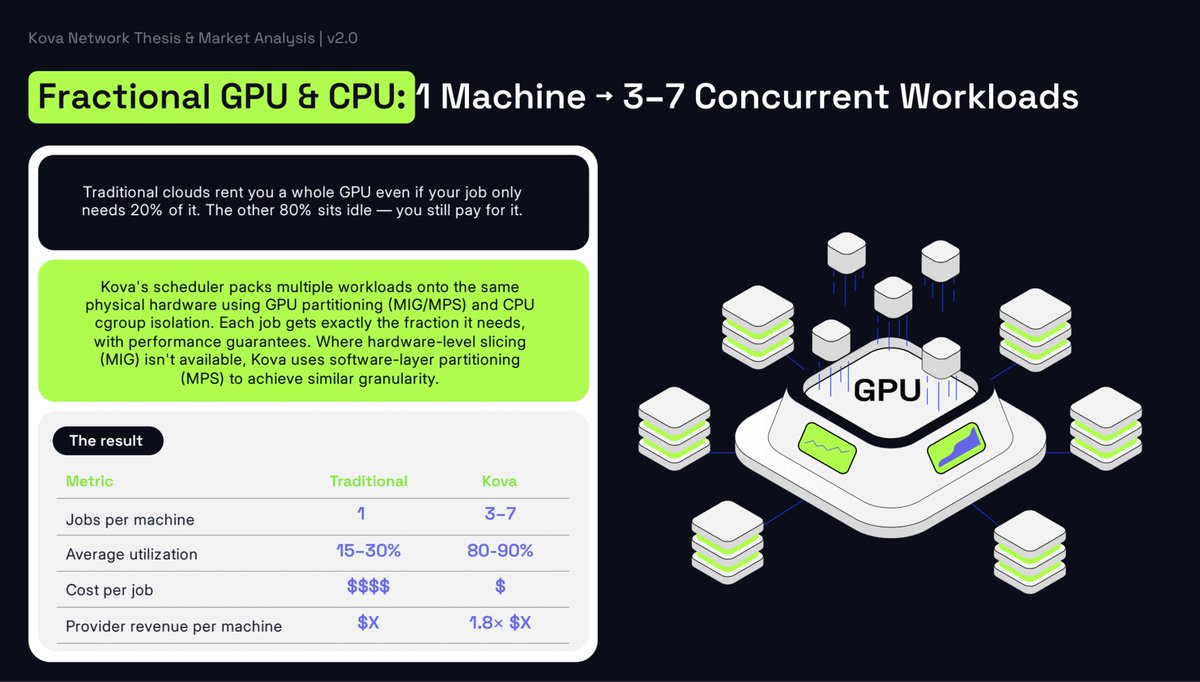
This really shows how GPU partitioning can create a win-win for both users and providers. 80–90% utilization, lower per-job costs, and 1.8× higher earnings for providers make it a true efficiency breakthrough. This is exactly the kind of infrastructure innovation developers have been waiting for.
Traditional clouds rent you a whole GPU even if you only need 20% of it. You pay for 100%, use 20%, and 80% sits idle.
Kova packs 3-7 jobs onto the same machine using GPU partitioning. Each job gets exactly the fraction it needs.
The result:
→ 80-90% utilization (vs 15-30% traditional)
→ Fraction of the cost per job
→ Providers earn 1.8x more per machine
Everyone wins. Users pay less, providers earn more.
The hands on experience you shared realy highlights how fractional, verifiable compute can shift the market. Flexibility and transparent pricing are huge for developers, but the real challenge is reliable scaling and consistent performance for mid size teams. Curious to see how @KovaNetwork manages that load and whether they can maintain this experience without hidden complexities.
What stands out to me is that after financializing capital, infrastructure is next.
This piece clearly lays out how liquid, fractional, and verifiable compute could reshape cloud economics and how @KovaNetwork is positioning itself at the forefront of that shift.
Well structured, thoughtful, and definitely worth the read.
we’ve financialized capital. now infrastructure is next
this piece breaks down why liquid, fractional and verifiable compute could reshape cloud economics and how @KovaNetwork is positioning at the edge of that shift
thoughtful, structured and worth your time
I think the real shift here isn’t the technology itself , it’s the translation of it.
Decentralized compute has been discussed for years, but when it’s wrapped in heavy jargon, it naturally limits who feels invited to use it. What feels different here is the focus on usability and clarity.
When the message directly speaks to developer needs instead of crypto native narratives, the gap betwen blockchain infrastructure and real world builders starts to close. Sometimes the framing is more powerful than the tech itself.
Your gaming rig sits idle 16+ hours a day, right?
What if it could potentially earn $720–$1,440/year during that time (depending on utilization + power costs)?
Here's what I just discovered 🧵
I've got an RTX 4090. Dropped $1,600 on it. Game about 4-6 hours daily.
The rest of the time? Just sitting there. Powered on but doing nothing.
Then I found @KovaNetwork’s provider network.
The setup was honestly easy (took 20 mins):
→ Hit docs.kovanetwork.com/providers/node…
→ Downloaded the provider software
→ Entered my GPU specs
→ Set my availability (when I'm NOT gaming)
Done.
Here's how it actually works:
AI developers are constantly looking for affordable GPU compute. You rent yours out per-second. Smart contracts handle everything automatically.
No middlemen. No trust issues. Blockchain does the heavy lifting.
My conservative math:
→ 16 hrs idle/day
→ ~$0.40–$0.60/hr effective
→ 30-50% utilization
Roughly:
$2–$4/day
$60–$120/month
$720–$1,440/year
(Minus electricity costs varies by region. A 4090 can pull ~300–400W under load, so calculate your local rate.)
From hardware I already own. Just keeping my PC running.
How payments work:
Devs deposit into escrow → I provide compute → Smart contract pays me out proportionally
No invoices. No disputes. Just pure math and code.
Who should look into this:
Got an RTX 4090, 4080, or 3090?
Workstation sitting unused at night?
Data center running at 30-40% capacity?
You might be leaving money on the table.
Being honest about the risks:
→ Still in alpha
→ Utilization varies day to day
→ Crypto market affects token value
→ Need decent uptime for good scoring
But for hardware already sitting idle? The risk/reward looks interesting.
What I'm doing right now:
Running as a provider during my work hours. Testing stability. Building my reputation score.
If mainnet launches and demand scales up? This could become meaningful passive income.
And honestly… I kinda like the idea that while I’m at work, my gaming rig might be helping some random indie dev train their AI model.
That's actually pretty cool.
Want to try it?
1. Check the setup guide: docs.kovanetwork.com/providers/node…
2. Calculate your potential earnings
3. Follow @KovaNetwork for mainnet updates
4. Position early before the rush
Quick question 👇
How many of you have a high-end GPU just sitting idle 12+ hours a day?
If setup’s simple and payments are automatic… would you run it?
Drop your GPU specs below (4090? 4080? 5090?) 👀
Curious how much hidden compute we’re sitting on in here.
For me, the most compelling part is the reputation based scoring model.
When uptime and service quality are directly tied to earning potential, it starts to look like a true compute marketplace, not just a pool for unused hardware.
The concrete numbers and hands on insights you shared, especially around flexible pricing and geoaware bidding. show that the economics are thoughtfully designed.
If onboarding and hardware configuration become more streamlined, this could open participation to much wider range of contributors.
Appreciate the detailed, experience base breakdown.
It’s not just about wasted resources. I think it’s about an infrastructure model that’s fundamentally inefficient and centralized.
When unused compute sits idle while builders struggle with high costs and limited access, the allocation system is clearly broken.
Making compute liquid and reusable isn’t just a narrative shift, it’s a structural one. If executed well, it could lower barriers, expand access, and rebalance power toward builders.
A quick insight for today @KovaNetwork
I’ve been thinking a lot about how broken the current cloud model really is.
We’re building the future on infrastructure that’s expensive, centralized, and full of wasted compute sitting idle.
That’s why projects like Kova feel genuinely important.
Kova isn’t just “another Web3 network”
It’s aiming to make compute liquid and accessible, where unused resources can actually become useful again, and builders aren’t locked into a few giant providers.
Imagine a world where AI teams, developers, and creators can tap into scalable compute without paying inflated costs or dealing with gatekeepers.
To me, decentralized compute isn’t a trend
It’s the next step in making technology more open, efficient, and fair.
Curious to see how far Kova can push this vision.
#Kova#DecentralizedCompute#FutureOfCloud#Web3Infrastructure