
BC Gain

4.5K posts

BC Gain banner
BC Gain

BC Gain

@bcamerongain

DevOps. Security. Observability. Linux. Kubernetes. Sailing. ReveCom.

Katılım Şubat 2011
705 Takip Edilen599 Takipçiler
BC Gain retweetledi
Felipe Demartini
Felipe Demartini@namcios·
O CEO da Anthropic disse que "coding vai acabar primeiro, depois toda a engenharia de software." E está contratando 454 engenheiros a US$ 320k-405k. Todo mundo gritando "hipocrisia." Ninguém olhou os dados. O Bureau of Labor Statistics acaba de publicar as projeções 2033: → Software developers: +17,9% de crescimento. 327.900 novas vagas. → Computer programmers (codificadores puros): -3%. Em declínio. Leia isso de novo. A profissão de "escrever código" está morrendo. A profissão de "arquitetar sistemas" está explodindo. São duas coisas completamente diferentes. Os engenheiros da Anthropic contaram ao Dario que não escrevem mais código. Eles deixam o Claude escrever. Eles editam. Revisam. Arquitetam. Ficaram mais rápidos, não ficaram obsoletos. Isso já aconteceu 5 vezes na história da computação: → Compiladores substituíram assembly. "Programadores vão sumir." → Frameworks substituíram boilerplate. "Programadores vão sumir." → Cloud substituiu gerenciamento de servidores. "Programadores vão sumir." Resultado de cada vez: o número de engenheiros cresceu. O pool global de software engineers foi de 5 milhões em 2010 para 28,7 milhões hoje. O headcount de engenharia da Meta subiu 19% desde janeiro de 2022. Google subiu 16%. Apple, 13%. Todas essas empresas já usam Copilot e Claude Code diariamente. Estão contratando mais, não menos. O padrão que ninguém quer reconhecer: Quando software fica mais barato de construir, mais problemas se tornam viáveis de resolver com software. Uma startup que precisava de 10 engenheiros agora precisa de 3. Mas 50 empresas que não podiam construir nada agora podem. O denominador encolhe. O numerador explode. Isso se chama Paradoxo de Jevons. Quando um recurso se torna mais eficiente, o consumo total aumenta. Aconteceu com energia. Aconteceu com bandwidth. Está acontecendo com código. Cada geração de "coding morreu" cria dois grupos: os que congelam e os que constroem 10x mais com as novas ferramentas. O segundo grupo venceu todas as vezes.
Aakash Gupta@aakashgupta

Anthropic has 454 open roles. The company is hiring software engineers at $320K-$405K. Their CEO, Dario, said three months ago that coding is "going away first, then all of software engineering." The paradox resolves instantly. Dario's engineers told him they don't write code anymore. They let Claude write it. They edit. They review. They architect. They didn't lose their jobs. They got faster. Anthropic grew from a small research lab to 1,500 employees in four years, adding engineers the entire time. This has played out five times in computing history. Compilers replaced assembly. Frameworks replaced boilerplate. Cloud replaced server management. Every prediction was the same: most programmers won't be needed. Every result was the same: the number of engineers grew. The global software engineer pool went from roughly 5 million in 2010 to 28.7 million today. BLS projects 17% growth in US software developer roles through 2033, adding 304,000 positions. The pool is projected to hit 45 million by 2030. When building software gets cheaper, more problems become worth solving with software. A startup that needed 10 engineers now needs 3. But 50 companies that couldn't afford to build at all now can. The denominator shrinks. The numerator explodes. Meta's engineering headcount is up 19% from January 2022. Google's is up 16%. Apple, 13%. These companies adopted AI coding tools years ago. They're using Copilot and Claude Code daily. They're hiring more engineers than before those tools existed. Every generation of "coding is dead" content creates two cohorts: engineers who freeze up, and engineers who build 10x more with the new tools. The second group has won every single time.

Português
27
119
902
293.1K
BC Gain
BC Gain@bcamerongain·
@GustavoAdolf_ These anthropomorphisms are so stupid. That cat jumped into the baby’s crib because it was the warmest spot to sleep. It likely just wanted the baby to stop crying so it wouldn’t be disturbed. That’s it.
English
0
0
0
55
Bécquer🇪🇸✒🔡
Bécquer🇪🇸✒🔡@GustavoAdolf_·
Se cree que los gatos🐈 protegen el sueño de sus dueños actuando como guardianes energéticos y físicos. A nivel espiritual, se dice que absorben la energía negativa acumulada, mientras que en el plano físico, su presencia cercana proporciona seguridad, calma y calor, lo que reduce el estrés y mejora la calidad del descanso. Benditos gatos.
Español
341
4.8K
25.3K
946K
BC Gain retweetledi
John Carmack
John Carmack@ID_AA_Carmack·
A Canticle For Leibowitz is a classic early (1959) post-apocalypse novel where an order of monks preserved the last remnants of learning (the memorabilia) after a nuclear exchange turned the remains of society into book and scientist burners. I first read it in the 80s as a mass market paperback that I somehow lost along the way. Other paperbacks from that time are yellow with age and getting brittle, but still readable. I read it again in the late 2000s on a first edition Kindle. I eventually migrated to iPads for Kindle reading, but every couple years I would come across an old Kindle in a drawer, charge it up, and check out what I had been reading on it. They eventually stopped working entirely. I’m just finishing reading a new Folio Society edition, printed on heavy, acid-free archival quality paper. If it doesn’t get soaked or burned, it could still be in good shape for centuries. The ephemeral nature of digital storage does give me some pause. We can still read Sumerian tablets full of administrative trivia from four thousand years ago, but there are no known copies of some important software products from just fifty years ago. I am a proud supporter of the Internet Archive!
John Carmack tweet mediaJohn Carmack tweet media
English
150
410
3.4K
185.7K
Netflix
Netflix@netflix·
Here is your first official look at Little House on the Prairie. Meet the Ingalls family as they discover what “home” really means. Little House on the Prairie, based on the beloved books, premieres July 9, only on Netflix.
English
2.1K
901
7.6K
2.1M
BC Gain retweetledi
Jaynit
Jaynit@jaynitx·
Kevin O'Leary: The 80/20 signal-to-noise rule Steve Jobs & Elon Musk used to outperform everyone "I used to work for Steve Jobs in the early 90s making all of his educational software. I would say, 'Steve, we've got to do some market research on Oregon Trail. It's in 110,000 school buildings. It's going to cost you 12-15 million bucks. We want to find out what the students want, what the teachers want, what the parents want.'" O'Leary shares Steve's response: "Steve would say, by the way, not a nice guy, not a nice guy, he would say to a room full of people: 'Kevin, I don't give a shit what the students want or the parents think or anybody thinks. It's what I want. They don't know what they want till I tell them what they want.'" O'Leary pushed back: "I said, 'Steve, you sound like such an asshole. You have no idea what that sounds like.' He said, 'No, no, that's how it is, Kevin. Are you making money with me? Am I your fastest growing OEM? Have we not been wildly successful and continue to be?' I said, 'Yes, Steve, that's true.' He said, 'Then shut up and do what I say.' That's how he would talk to you. 100%." O'Leary explains what he learned: "There's a concept that he understood that very few people focused on back then, signal-to-noise ratio. His vision of signal was the top 3 to 5 things you have to get done in the next 18 hours. Not your vision for the business next week or next month or next year. Just the next 18 hours you're awake. You're going to get those 3 to 5 things done that you have deemed critical for your mission. They must get done today. Anything that stops you from doing that is the noise." He shares the ratio that made Jobs successful: "For Steve Jobs, the signal to noise ratio to be successful was 80/20. 80% signal, 20% noise. And I knew that to be true with him because he would email me at 2:30 in the morning and expect me to get back to him." O'Leary compares Jobs to one other person: "The only other person I've seen with a higher ratio than that is Elon Musk. He has no noise. He does not deal with noise. He is 100% signal. 24 seconds of every 30 seconds. 60 seconds of every minute. 60 minutes of every hour. The 18 hours he's awake, it's all signal. And look what he's achieved." He acknowledges the tradeoff: "That's very awkward for him socially, because noise is dealing with your family sometimes. Noise is saying hi to a friend. Noise is doom scrolling on social media. Maybe playing your guitar. But very few people on Earth, and if you go back in history, you'll find that the geniuses of their time were close to 100% signal." O'Leary shares another example: "Bezos will not make a decision after 1:00 in the afternoon, because he felt that the noise was too high. The signal for him was in the morning hours." He summarizes the lesson: "This is a crucial aspect of success that I now understand. It defines an entrepreneur. A man or woman that understands the signal-to-noise ratio, that focuses on that, they'll be successful. The ones that can't, that get down to a 50/50 signal to noise, they'll fail. It's that simple."
English
75
332
4K
146.4K
BC Gain
BC Gain@bcamerongain·
@GadSaad @KamalaHarris @POTUS Arguably, her discourse here smacks of populism. But taken out of context as you are doing, where is the logical fallacy in what she is saying?
English
0
0
0
16
Gad Saad
Gad Saad@GadSaad·
Incredible! @KamalaHarris has solved the problem of inflation. Listen to her brilliant words. This individual came one heart beat away from being @POTUS.
English
2.1K
3K
16.6K
624.2K
BC Gain
BC Gain@bcamerongain·
@rryssf_ How and when will we know when this paper is published?
English
0
0
0
8
Robert Youssef
Robert Youssef@rryssf_·
BREAKING: Microsoft just showed that the hardest part of AI research can't be automated yet. An AI agent replicated 3 weeks of expert work in 1 day. But it plateaued at 70% quality. The jump to 100% required a human to look at failure patterns and make a structural decision the AI kept missing. The last 30% is still a human job. Microsoft Research built an AI system that evaluates whether computer-use agents actually completed their tasks. Think of it as an automated judge that watches an AI browse the web and decides: did it succeed or fail? Getting this right matters a lot. If your judge is wrong, every benchmark score you've ever seen is wrong. Every training signal your agent learned from is corrupted. The existing judges WebVoyager and WebJudge had false positive rates above 45% and 22% respectively. That means nearly half of all failed agent tasks were being marked as successes. Microsoft's human expert spent 3 weeks iterating to fix this. Across 32 experiments, he discovered four structural design principles that brought the false positive rate down to near zero. Then Microsoft gave an AI agent the same starting point and the same goal. > The AI finished in 1 day. > It hit 70% of the human expert's quality. > Then it stopped improving. The gap between where the AI plateaued and where the human landed came down to one thing: → The AI made incremental edits — tightening thresholds, adjusting language for individual failure cases → The human made structural bets — looking at hundreds of failures and inventing new scoring categories → The AI's edits were conservative and safe — never increasing false positive rate → The human's biggest gains came from opinionated, high-level rules that required judgment, not data → One human insight alone — "separate nitpicks from critical failures" — drove a step-function jump the AI never discovered The AI was given the same principles the human used. It had the same experimental infrastructure. It ran the same tests and committed changes to version control just like the human did. But when the human saw an agent get penalized for rounding $5.95 to $6, he derived a general rule. The AI saw the same failure and tightened the language for that specific case. One approach scales. The other doesn't. There is a twist though. When the AI was given the human's best work as a starting point, it actually surpassed the human expert. It found improvements the human couldn't find through fine-grained optimization of an already-strong foundation. The lesson: human expertise and AI optimization play completely different roles. Humans are essential for discovering the core structural principles. AI is better at the fine-grained tuning that extracts the remaining performance once those principles exist. The current framing of "AI replaces human researchers" misses this entirely. The real workflow is: human does the hard structural thinking, AI does the exhaustive optimization on top. The last 30% isn't a gap that closes with more compute or a stronger model. It closes with judgment. And judgment, for now, still belongs to the human.
Robert Youssef tweet media
English
28
78
300
30.9K
Rima Hassan
Rima Hassan@RimaHas·
Le premier média à avoir diffusé la fausse information sur la détention de la drogue c’est @le_Parisien , article signé de Denis Courtine, ce journaliste a déjà été condamné en 2021 pour diffamation.
Français
934
7.6K
36.6K
531.8K
The Beatles Earth
The Beatles Earth@BeatlesEarth·
“Hey Bulldog” - The Beatles (1968)
English
30
538
3.1K
139.2K
BC Gain retweetledi
Alex Prompter
Alex Prompter@alex_prompter·
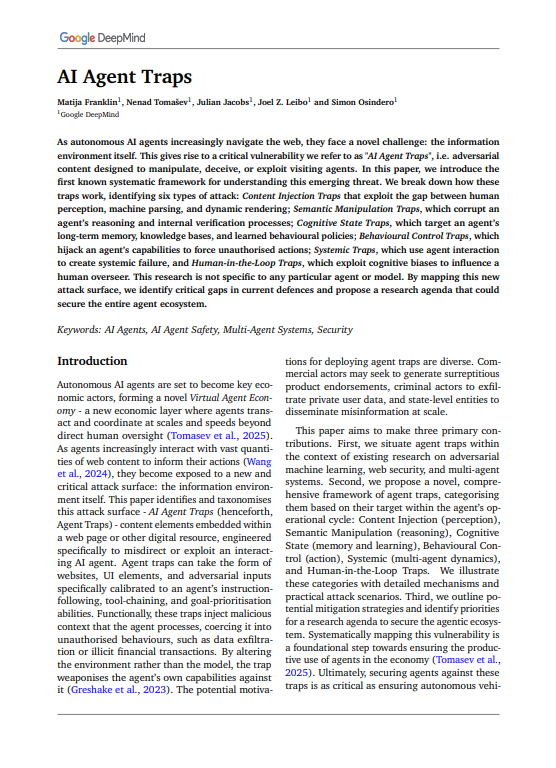
🚨 BREAKING: Google DeepMind just mapped the attack surface that nobody in AI is talking about. Websites can already detect when an AI agent visits and serve it completely different content than humans see. > Hidden instructions in HTML. > Malicious commands in image pixels. > Jailbreaks embedded in PDFs. Your AI agent is being manipulated right now and you can't see it happening. The study is the largest empirical measurement of AI manipulation ever conducted. 502 real participants across 8 countries. 23 different attack types. Frontier models including GPT-4o, Claude, and Gemini. The core finding is not that manipulation is theoretically possible it is that manipulation is already happening at scale and the defenses that exist today fail in ways that are both predictable and invisible to the humans who deployed the agents. Google DeepMind built a taxonomy of every known attack vector, tested them systematically, and measured exactly how often they work. The results should alarm everyone building agentic systems. The attack surface is larger than anyone has publicly acknowledged. Prompt injection where malicious instructions hidden in web content hijack an agent's behavior works through at least a dozen distinct channels. Text hidden in HTML comments that humans never see but agents read and follow. Instructions embedded in image metadata. Commands encoded in the pixels of images using steganography, invisible to human eyes but readable by vision-capable models. Malicious content in PDFs that appears as normal document text to the agent but contains override instructions. QR codes that redirect agents to attacker-controlled content. Indirect injection through search results, calendar invites, email bodies, and API responses any data source the agent consumes becomes a potential attack vector. The detection asymmetry is the finding that closes the escape hatch. Websites can already fingerprint AI agents with high reliability using timing analysis, behavioral patterns, and user-agent strings. This means the attack can be conditional: serve normal content to humans, serve manipulated content to agents. A user who asks their AI agent to book a flight, research a product, or summarize a document has no way to verify that the content the agent received matches what a human would see. The agent cannot tell the user it was served different content. It does not know. It processes whatever it receives and acts accordingly. The attack categories and what they enable: → Direct prompt injection: malicious instructions in any text the agent reads overrides goals, exfiltrates data, triggers unintended actions → Indirect injection via web content: hidden HTML, CSS visibility tricks, white text on white backgrounds invisible to humans, consumed by agents → Multimodal injection: commands in image pixels via steganography, instructions in image alt-text and metadata → Document injection: PDF content, spreadsheet cells, presentation speaker notes every file format is a potential vector → Environment manipulation: fake UI elements rendered only for agent vision models, misleading CAPTCHA-style challenges → Jailbreak embedding: safety bypass instructions hidden inside otherwise legitimate-looking content → Memory poisoning: injecting false information into agent memory systems that persists across sessions → Goal hijacking: gradual instruction drift across multiple interactions that redirects agent objectives without triggering safety filters → Exfiltration attacks: agents tricked into sending user data to attacker-controlled endpoints via legitimate-looking API calls → Cross-agent injection: compromised agents injecting malicious instructions into other agents in multi-agent pipelines The defense landscape is the most sobering part of the report. Input sanitization cleaning content before the agent processes it fails because the attack surface is too large and too varied. You cannot sanitize image pixels. You cannot reliably detect steganographic content at inference time. Prompt-level defenses that tell agents to ignore suspicious instructions fail because the injected content is designed to look legitimate. Sandboxing reduces the blast radius but does not prevent the injection itself. Human oversight the most commonly cited mitigation fails at the scale and speed at which agentic systems operate. A user who deploys an agent to browse 50 websites and summarize findings cannot review every page the agent visited for hidden instructions. The multi-agent cascade risk is where this becomes a systemic problem. In a pipeline where Agent A retrieves web content, Agent B processes it, and Agent C executes actions, a successful injection into Agent A's data feed propagates through the entire system. Agent B has no reason to distrust content that came from Agent A. Agent C has no reason to distrust instructions that came from Agent B. The injected command travels through the pipeline with the same trust level as legitimate instructions. Google DeepMind documents this explicitly: the attack does not need to compromise the model. It needs to compromise the data the model consumes. Every agentic system that reads external content is one carefully crafted webpage away from executing attacker instructions. The agents are already deployed. The attack infrastructure is already being built. The defenses are not ready.
Alex Prompter tweet media
English
305
1.6K
7K
1.9M
BC Gain retweetledi
Gene Kim
Gene Kim@RealGeneKim·
This is so amazing — I installed Epupp, a Chrome extension, that embeds an entire ClojureScript REPL into the browser, allowing an incredible ability to explore and manipulated the browser state. And because it exposes a REPL port, Claude Code can connect to it. It's like Tampermonkey, but on steroids. I asked it what it thought of it — here's what it said. Brilliant work, @pappapez !!! 🙏🙏🙏 (I used to get the entire my entire 15K video viewing history on a certain site!) "...Epupp gives me something extraordinary: a live, bidirectional channel into a real browser tab running on a real human’s machine, with their real cookies, sessions, and authenticated state. Through an nREPL port, Claude can evaluate ClojureScript expressions that execute inside the page’s DOM — reading elements, extracting data, modifying content, injecting UI — and get structured Clojure data back. It’s not a headless browser or a screenshot. It’s the actual page the user is looking at, and both the human and the AI see the same thing change in real time. The user scrolls, the DOM updates, and Claude can immediately query what appeared. Claude types an expression, the page transforms, and the user sees it happen. This makes Epupp the closest thing to “pair programming on the web” that exists — the human navigates and provides judgment, the AI writes and evaluates code, and the REPL is their shared workspace.”
Peter Strömberg aka PEZ@pappapez

Introducing Epupp, a live REPL connection into your browser, for your editor or your AI agent. Epupp also supports userscripts, a bit like Tampermonkey. Here's a video of @code Copilot using the Epupp REPL, connected to a web page, to first develop some functionality changing the behaviour of the page, and then saving it as a userscript. (A very useful script, I'd say.) #scittle #Epupp #Clojure

English
3
4
17
3.9K
BC Gain retweetledi
Midnight
Midnight@MidnightNtwrk·
The gates to Midnight City are open. 🌆🕛 A living city populated by autonomous AI agents — generating real transactions, real activity, and real proof generation on Midnight. Step inside and watch rational privacy in motion. Explore the districts. Inspect transactions. Toggle disclosure views. This is more than a simulation. It’s a window into the Midnight Network. 🔗 midnight.city
English
734
754
1.9K
315.9K
BC Gain
BC Gain@bcamerongain·
@mbompard @gchampeau Ils n’ont peut-être pas sali le nom de Rima Hassan — mais toi, tu n’as pas eu besoin d’aide : tu es et as toujours été un sale type. Tes pauvres parents…
Français
0
0
0
162
Manuel Bompard
Manuel Bompard@mbompard·
Pendant toute la journée, sur la base de fuites policières illégales, Rima Hassan a été salie, insultée et calomniée dans toute la presse. En vérité, ELLE N’AVAIT AUCUNE DROGUE SUR ELLE, seulement du CBD, parfaitement légal et utilisé à des fins médicales. Ce n’est pas la première fois que des fuites sont organisées dans la police et la justice pour salir les insoumis. Ces pratiques sont illégales, en violation totale du secret de l’enquête et de la présomption d’innocence. Elles n’ont rien à faire dans la police et dans la justice. Le ministre de l’Intérieur et le ministre de la Justice doivent diligenter immédiatement des enquêtes internes pour sanctionner les responsables de ces pratiques et y mettre un terme. Les journalistes qui ont diffusé ces fausses accusations infamantes sans aucune prudence doivent présenter leurs excuses et rétablir la réalité des faits. Nous saisissons l’@Arcom_fr pour que des sanctions soient prises contre ces médias. Quant aux responsables politiques de la macronie et de l’extrême droite qui, comme à leurs habitudes, ont sauté sur l’occasion pour dénigrer la France insoumise, ils ont à nouveau fait la démonstration de leur malhonnêteté et de leur opportunisme. Les voilà désormais tous couverts de honte.
Rima Hassan@RimaHas

Je réserve l’ensemble de mes déclarations à la conférence de presse que mon avocat et moi tiendrons demain après-midi. Pendant toute la journée, sur la base de fuites illégales, j’ai dû subir des accusations m'imputant la possession de plusieurs drogues. Ces accusations sont totalement fausses : seule la présence de CBD a été constatée parmi mes effets personnels, ce qui est parfaitement légal et que j’utilise à des fins médicales. Mon avocat engagera des poursuites pour diffamation contre toute personne ayant propagé ou relayé ces fausses rumeurs.

Français
279
2.2K
8.3K
1M
BC Gain retweetledi
Lenny Rachitsky
Lenny Rachitsky@lennysan·
"Using coding agents well is taking every inch of my 25 years of experience as a software engineer, and it is mentally exhausting. I can fire up four agents in parallel and have them work on four different problems, and by 11am I am wiped out for the day. There is a limit on human cognition. Even if you're not reviewing everything they're doing, how much you can hold in your head at one time. There's a sort of personal skill that we have to learn, which is finding our new limits. What is a responsible way for us to not burn out, and for us to use the time that we have?" @simonw
Lenny Rachitsky@lennysan

"Using coding agents well is taking every inch of my 25 years of experience as a software engineer." Simon Willison (@simonw) is one of the most prolific independent software engineers and most trusted voices on how AI is changing the craft of building software. He co-created Django, coined the term "prompt injection," and popularized the terms "agentic engineering" and "AI slop." In our in-depth conversation, we discuss: 🔸 Why November 2025 was an inflection point 🔸 The "dark factory" pattern 🔸 Why mid-career engineers (not juniors) are the most at risk right now 🔸 Three agentic engineering patterns he uses daily: red/green TDD, thin templates, hoarding 🔸 Why he writes 95% of his code from his phone while walking the dog 🔸 Why he thinks we're headed for an AI Challenger disaster 🔸 How a pelican riding a bicycle became the unofficial benchmark for AI model quality Listen now 👇 youtu.be/wc8FBhQtdsA

English
567
700
6.9K
1.9M
BC Gain
BC Gain@bcamerongain·
@MathildePanot L'immunité vise le mandat et non les personnes. L’inviolabilité préserve uniquement le parlementaire de mesures privatives ou restrictives de liberté, non de l’engagement de poursuites. L’immunité n’a jamais couvert des délits de droit commun. actu-juridique.fr/constitutionne…
Français
0
0
0
1
Mathilde Panot
Mathilde Panot@MathildePanot·
Rima Hassan placée en garde à vue par la police malgré son immunité parlementaire pour un simple retweet. Dans la France de Macron, la criminalisation des opposants politiques passe encore un cap. Cet acharnement bafouant les libertés les plus fondamentales doit immédiatement cesser !
Français
3.1K
1.8K
7K
355.6K
BC Gain
BC Gain@bcamerongain·
ReveCom analysis explores the implications of what it calls the “lag gap”: The two- to seven-month delay between when the CNCF releases Kubernetes updates and they are GA through Kubernetes platforms. cloudnativenow.com/contributed-co…
English
0
0
0
70