
Sabitlenmiş Tweet

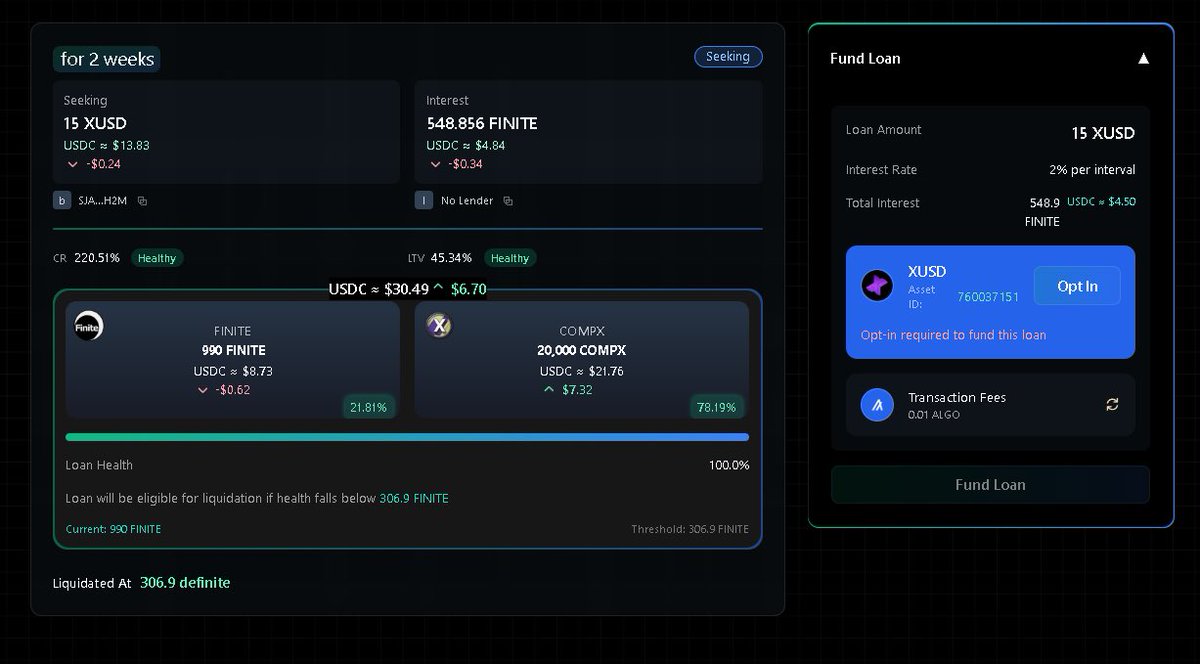
Peer 2 Peer DeFi on @Algorand,
this is just the beginning.
defi-p2p.com.
(All loans require $finite in the collateral basket,
to cover interest and platform fees.)
English
bankon.algo
3.4K posts
@BOAlgorand
$Finite Defi-P2P lending on Algorand. community follower , and Algobot Creator.

🧵 Another quiet institutional signal for @Algorand. It won’t generate flashy headlines… But it says something important about where enterprise infrastructure is heading. 👇 IBM’s Digital Asset Haven includes dedicated support and documentation for Algorand. Not just a name on a compatibility list. @IBM documents Algorand-specific wallet behavior and protocol features for enterprise users. The documentation covers native Algorand functionality, including: ✅ 0.1 ALGO minimum balance ✅ Native Algorand Standard Asset (ASA) opt-ins ✅ Network-specific wallet behavior These are protocol-level details, not generic blockchain descriptions. Digital Asset Haven is designed for institutions managing digital assets securely across multiple blockchain networks. Banks. Custodians. Payment providers. Tokenization platforms. @Algorand is one of the supported networks. Why is that interesting? Because infrastructure providers typically don’t invest in documenting network-specific behavior unless they intend to support real operational use. Enterprise adoption often starts quietly… Documentation first. Deployments later. Over the past weeks we’ve seen a consistent pattern around Algorand: Native USDC adoption continues to grow. x402 and AP2 bring programmable AI payments. Native post-quantum accounts are on the roadmap. IBM supports Algorand within its Digital Asset Haven platform. Different announcements. One direction. The strongest infrastructure rarely announces itself with fireworks. It simply keeps appearing wherever serious digital asset systems are being built. @AlgoFoundation @IBM Credit to @BaronofLoxley for spotting this. 👏 amazing catch! 👉🏻 ibm.com/docs/en/daw/1.…





🚨BREAKING: KOREAN FIRMS DENY FORMALLY JOINING OPEN USD ALLIANCE Several Korean companies listed as Open USD partners say they NEVER officially agreed to join, per Chosun Biz. Samsung Electronics said it had "NO official talks and NO idea of what role" it would play. Dunamu, K Bank and Shinhan said Open Standard only asked if they were interested, while one company rep said they only learned they were listed through Korean media. Open Standard’s own site still lists major Korean names among its 140+ OUSD partners.

Project King Safety Update: • The King Safety Paper is being shared with the Ecosystem Advisory Council this month. This is the next step in a consultative process to refine our approach before the EAC shares it more broadly with the community. • The Foundation is committing to extending its support for bonus staking rewards for another year (until January 2028) to allow the process to run its course and get to the best possible outcome for everyone. • Now that the protocol is under Foundation control, we are making significant protocol changes to give us far more flexibility in how transactions are priced, from a bundled fixed 0.001 ALGO price to a decoupled model where pricing can depend more closely on resources being consumed and/or the type of transaction being executed. • While the Foundation can propose changes to improve sustainability, any decision will need to be implemented through a consensus upgrade, which will require the support of 90+% of staked Algo.


When you hold $UNIT, you're not buying access. You're buying influence. Risk parameters. Asset listings. Treasury decisions. Protocol upgrades. The future of DorkFi belongs to the people who participate.

Base was down for almost two hours today, and the reason is the whole story: one bad block, and nobody else to keep the chain alive. A single consensus bug sequenced one invalid block, right after block 47806542, and every block after it just stopped. Base runs a single sequencer, so when that one machine choked, the entire network choked with it. no backup producer, no other validators to route around the problem. The exit was worse. the chain couldn't heal itself: node operators across the ecosystem had to manually restart before syncing recovered. and for those two hours there were no blocks, which means no trades, no liquidations, no withdrawals. if you wanted out, you couldn't, because leaving is also a transaction. And this isn't the first time. a sequencer handoff failure froze Base for 33 minutes last August, today it was nearly two hours. that's the part the "L2 is a blockchain" pitch skips: a chain with one sequencer isn't decentralized infrastructure that happens to be fast, it's one server with great branding, always one bad block away from a full stop.


