
Sabitlenmiş Tweet
Patrick
6.5K posts


Patrick
@patrickbennett
CEO of @txnlab Inc, creators of ZeroSignal @zerosignal_ai, Haystack @haydotapp, NFDs @nfdomains, use-wallet, reti staking.
Katılım Kasım 2008
2K Takip Edilen3.8K Takipçiler
@AlgoStellar @AlgoFamily @beralgovelo @AlgoFoundation @Algorand @StaciW_DC @algodevs An early eyes only document so not sure I'm at liberty to say atm - but honestly it's nothing that hasn't already been discussed before.
Also don't really feel like arguing with people about it because I disagree with a few about some of the topics. 🤣
English

@patrickbennett @AlgoFamily @beralgovelo @AlgoFoundation @Algorand @StaciW_DC @algodevs Have you read it and if so, any core positives or negatives? Are you allowed to talk about it if you read it? We’re all anxious! A year in the making.
English

Ok so where's the update on project king safety ? @AlgoFoundation @Algorand @AlgoFamily @StaciW_DC @algodevs
English
@Compxlabs @zerosignal_ai Gotta love that @zerosignal_ai use. 😀
It's 🔥
It'll be much more public soon. 😀
English

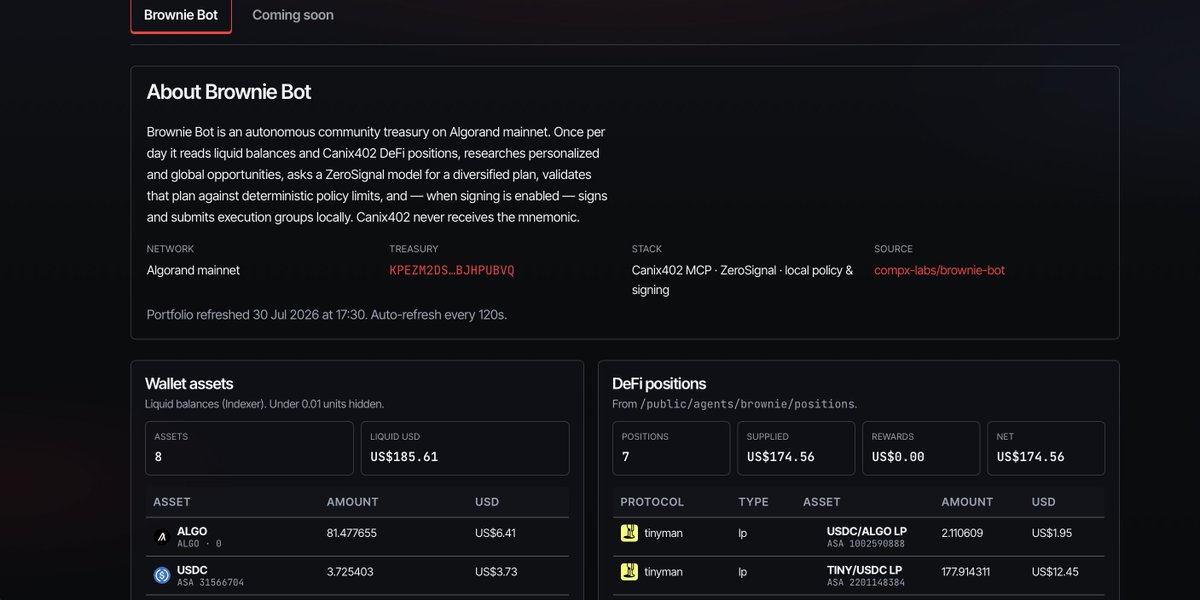
Our public user-agent Brownie Bot is now live and running autonomously using Canix402 and @zerosignal_ai to manage our CompX Community Treasury.
You can follow the trades, positions and holdings live on the Canix402 homepage.
English
@AlgoStellar @AlgoFamily @beralgovelo @AlgoFoundation @Algorand @StaciW_DC @algodevs We still have to discuss it. 🤷
English
@AlgoFamily @beralgovelo @AlgoFoundation @Algorand @StaciW_DC @algodevs @patrickbennett Is there anything preventing them from letting us know what they like or dislike?
English

@patrickbennett Don’t temp me… I might rebrand as “raw teal nerd”
English
Imma make perps on algorand and beat them to mainnet. Working on it now.
I don’t miss. I am the goat
PEX - People's exchange@pplsexchange
Algorand deserves a market built around it. People's Exchange is live on TestNet. Fully on-chain perps. ALGO as collateral. Liquidity pools anyone can supply. First market: ALGO/USD, up to 20×.
English
@pyteal_nerd A view I think you hold... alone. 😏
Pyteal was 'ok' compared to raw TEAL - 5+ years ago but I aggressively ditched it (and even rewrote quite complex contracts) as soon as better things came along.
English
@IDFlolicon @BrianRoemmele and ofc the absymal TTFT that no one ever mentions.
English


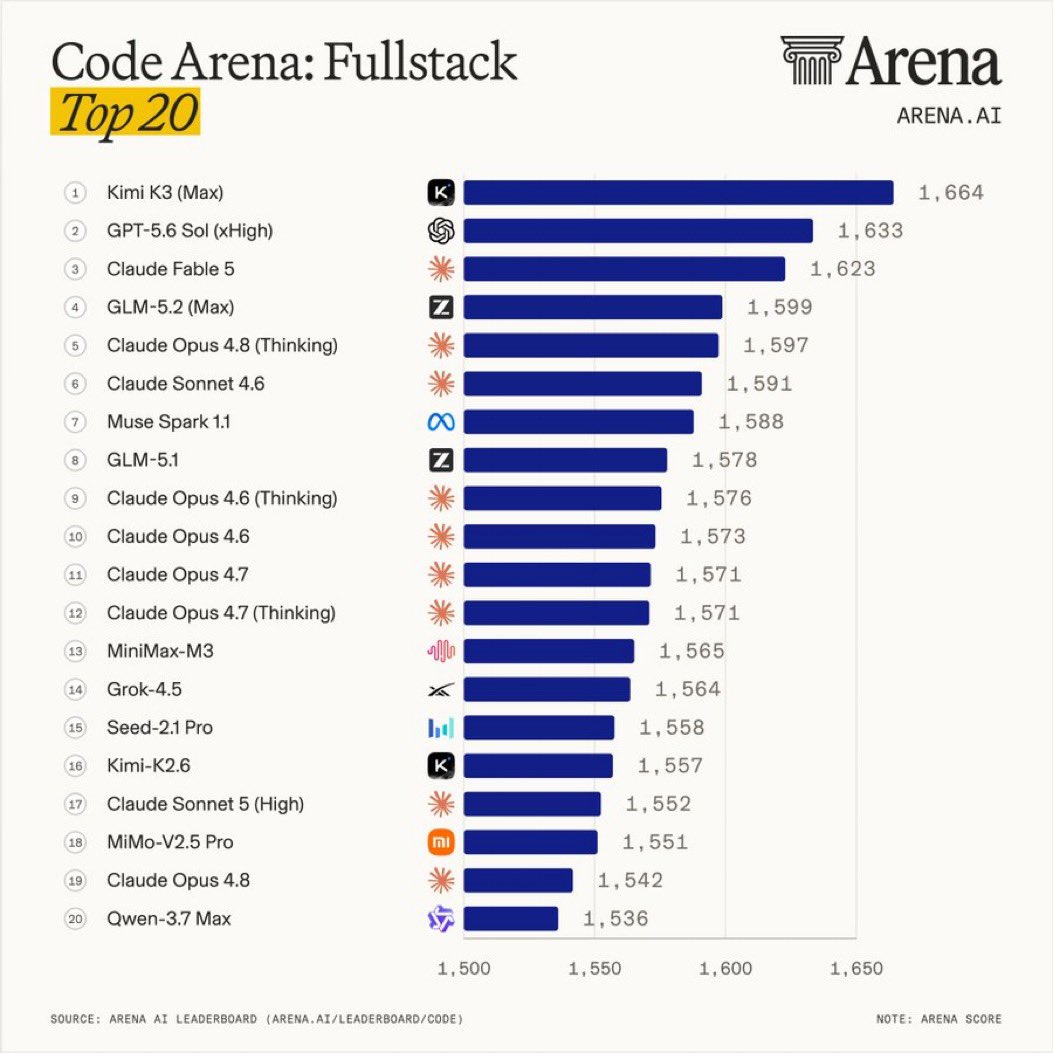
Kimi K3, an AI model you can own and modify and not need to ask permission, is now number 1.
We have a 1 bit quantized version running on a MacBook Pro! No Mac Studio.
Own the model “THEY” don’t want you to own and build!
Brian Roemmele@BrianRoemmele
BOOM! ITS HERE! KIMI K3 ON YOUR LOCAL COMPUTER! Kimi K3 Just Got Personal: Run a 2.8-Trillion-Parameter Beast Locally! Picture this: One of the most powerful open AI models on the planet — a 2.8-trillion-parameter multimodal monster with a massive 1-million-token memory — now shrinks enough to run on high-end local hardware. No cloud bills. No waiting in line for API access. Just pure frontier intelligence humming away on your own machine. That’s exactly what just happened. The Big News Today, the team at Unsloth AI dropped a game-changing update: Kimi K3 can now run locally. Using their clever Dynamic 1-bit quantization, they took the original ~1.56 TB model and compressed it down to just 594 GB — a jaw-dropping 62% size reduction. Even better? It still holds onto about 78.9% of its original accuracy. You can fire it up on something as (relatively) approachable as a Mac Studio paired with a 128 GB RAM device, thanks to smart offloading. Meet Kimi K3 — The Open Frontier Star Released by Moonshot AI (the creators of Kimi), Kimi K3 is no ordinary model. It’s the world’s first open 3T-class model, packing: 2.8 trillion total parameters (Mixture-of-Experts design with ~104 billion active) Native multimodal powers (text, images, and video) A full 1-million-token context window Special architecture tricks like Kimi Delta Attention for blazing-fast long-context decoding It’s built for the hard stuff: long-horizon coding agents, deep research, complex reasoning, and self-evolving workflows. When the open weights dropped on July 27, the AI world lit up. Now Unsloth just made it actually usable at home. Why This Feels Like Magic Normally, models this size live only in massive data centers. Unsloth’s “Dynamic” quantization is smarter than plain old compression — it carefully protects the most important layers so the model stays surprisingly sharp even at 1-bit. My early tests show the 1-bit version can still one-shot tough creative tasks and handle reliable tool calls. It’s not perfect (higher-bit versions climb toward 90% accuracy), but for local experimentation? It’s revolutionary. Ready to Try It Yourself? I will write a how to for free here and ReadMultiplex.con later today. In the meantime here is a good start: Unsloth has everything ready: Full step-by-step guide: unsloth.ai/docs/models/ki… Ready-to-download GGUF files: huggingface.co/unsloth/Kimi-K… Run it through Unsloth Studio LM Studios or llama.cpp. The quants are uploading fast, and the community is already buzzing with demos. The Bigger Picture This is more than a cool tech drop. It’s a signal that frontier AI is racing toward the rest of us. What used to require a supercomputer farm is starting to fit on high-end desks. Tomorrow’s experiments, agents, and creative tools just got a whole lot more personal. The future of AI isn’t only in the cloud anymore. It’s sitting right next to your keyboard. Primary sources Official Unsloth guide: unsloth.ai/docs/models/ki… Kimi K3 tech blog: kimi.com/blog/kimi-k3
English
@SimonBelingar @leakzrand Fable's great but it rrriipsss through tokens.
I'll mostly use Fable as planner for certain things when/if I use it.
English

Anyone else seeing Opus 5 (xhigh) be a complete, utter, dumbass lately? OMG, this needs fixed! Are you sure? Oh, I'm sorry I was mistaken, it should be this !
are you sure !? Oh wow, how could I have missed that!?
🤦♂️
don't have enough data yet to really commit to it though
English
Dealt with these kinds of issues for a long time but opus def seems to have backpedaled in some areas (and I’ve definitely seen the same reports). Perhaps it’s it just almost part of a new reasoning pass trying to keep things aligned before it even delivers first pass on plan or implementation phases. I’ve seen it catch itself with stupidity that 4.8 wouldn’t have delivered. Going entirely off plan for eg. Re context, I’m pretty aggressive with context management (where it was VERY obvious in the past with lower context windows)
English

@patrickbennett Seems pretty smart to me as long as the workspace isn't spoiled with inaccurate docs, overspecified AGENTS/CLAUDE.md or just the agent enters a panic mode when a well planned implementation didn't go that well and needs pausing to think rather than doing quick workarounds.
English
@AlgoCloudz ? It's called using tools and using the same tools w/ different context to re-verify their own assertions and Opus 5 has had behavior changes.
Do you even use this stuff? 🤨
English

Patrick retweetledi

Shared AI chats turned up in Google search this week. API keys, resumes, medical records, business plans.
ZeroSignal keeps conversations encrypted on your device, with no server-side copy to index, leak, or train on.
Om Patel@om_patel5
UPDATE, ITS WORSE THAN THE CHATS the same thing is happening with shared artifacts. every app, doc, dashboard and tool people published from claude is also sitting indexed and searchable people have already pulled up internal company dashboards, full project plans with client details, and someones entire clinical trial summary with real medical data in it but think about what people actually build in artifacts: > financial models, cap tables, revenue spreadsheets > payroll and salary breakdowns with employee names attached > customer lists and crm exports > internal wikis, roadmaps and unreleased product plans > legal docs, contracts and agreements being drafted > personal health and medication trackers > tax documents and bank statement breakdowns > and every dashboard someone pasted an api key or env variable into to get it working when you publish an artifact your only two options are "only me" or "anyone with the link" nobody reading that thinks it means "and google will list it publicly." its the same as an unlisted youtube video showing up in search results and its already past the point of just being google. third party sites have started scraping and organizing these into browsable collections, so deleting it from search doesnt mean its gone if you have ever published an artifact, go check your published artifacts and unpublish anything you dont want public link and not indexed were always two different promises. people only ever agreed to the first one
English
Patrick retweetledi

This is a very cool and exciting discovery by Claude Mythos!
It found a serious 𝒎𝒂𝒕𝒉𝒆𝒎𝒂𝒕𝒊𝒄𝒂𝒍 attack on the post-quantum signature scheme HAWK, an "on-ramp" candidate for potential NIST standardization.
Steve Weis@sweis
English
@coinbureau Crust is already dead as well they just haven’t announced it.
Literally doesn’t work at all. Doesn’t publish their pins.
I’m assuming filecoin is toast as well
English

🚨BREAKING: $STORJ crashes -15% as Storj Labs files for Chapter 11 bankruptcy.
Storj Labs, the company behind the decentralized cloud storage network Storj, has filed for Chapter 11 bankruptcy protection to restructure legacy debt while keeping the network fully operational.
The company previously raised around $35 million, including roughly $30 million through its 2017 token sale.
$STORJ is now down approximately -99% from its 2021 all-time high, highlighting the sharp collapse in value since the last crypto bull market.


English
@elonmusk @HedgieMarkets It's not even cutting of the spine - it's literally destroying them (shredding for eg) that is the true abomination. Knowledge capture to block others from the same and salting the earth behind you.
English

@HedgieMarkets I’ve asked the SpaceXAI team to preserve any rare books in a library and scan them the hard way vs just cutting off the spine and scanning
English

🦔AI companies are bulk-buying rare books, scanning them through high-speed machines that cut the spines off, and shredding the originals. A service called ISBNdb facilitates orders of up to a million books and keeps buyers anonymous. Pre-2022 books are premium because they're free of AI-generated text. A federal judge ruled the practice is fair use because eliminating the original means only one copy exists at a time. Anthropic hired the former head of Google Books partnerships to obtain "all the books in the world."
My Take
This got to me. A bookseller told 404 Media that rare books with almost no surviving copies are being fed into this pipeline. Books that survived wars, fires, and centuries of handling are being shredded so an AI can learn to write a better marketing email.
ISBNdb's website literally says "'AI company destroys two million books' is not a headline that generates sympathy," and they still built an entire business around making it happen quietly. They offer NDAs as a feature. They coach clients to call it "digital preservation."
I've covered AI companies scraping the internet, torrenting libraries, and stealing music. This is worse because it's irreversible. You can re-upload a website. You can reprint a bestseller. You can't replace the last three copies of an 18th-century botanical text once someone shreds them for training data. And the judge said it's legal. So it's going to accelerate.
"We shred rare books and offer NDAs so nobody finds out" is a legitimate business model in 2026. What a timeline.
Hedgie🤗

English
It's all just a black box - we have no idea what are subscription limits 'really' are. They can change what model is used, how long it takes to answer, how much of our monthly usage is used up by an answer, etc.
So are they just out of resources and I'm suddenly using a low-thought sonnet? maybe? no way to know.
English

@patrickbennett It's intimidated by Kimi so now it's being an insecure little...
English
How so? Who runs it is obviously one concern - logging, limiting, hidden updates, but the model being open-weight doesn't magically make it 'safe'. The model itself could still subtly introduce code w/ backdoors or have non-obvious triggers. Is it better? hell yes - but just because a US company hosts it, doesn't mean it magically makes it safe from some theorized 'state' concerns.
(ofc just because a model comes from a US company it's not automatically 'safe' either) 😏
English

@diopter_ring Yes well said. If the model is open weight, then all that matters is who is serving it.
English
There is some confusion/mistaken belief that Chinese models are run by Chinese companies in China. People hesitate to use the "open source" model because they don't trust China as a jurisdiction.
How it actually works:
Frontier closed source models are run by the companies that made them.
• GPT 5.6 is trained & run by OpenAI
• Opus 5 is trained & run by Anthropic
But the open source models can be run by anyone
• Kimi K3 is trained by Moonshot (Chinese company)
• Kimi K3 is run by Moonshot
• Kimi K3 is ALSO RUN by anyone else (any company can run it)
If you access Kimi K3 from Moonshot.ai, then you're pulling the inference from Moonshot, the Chinese company.
But you can also access Kimi K3 from Venice.ai for example, in which case there is no Chinese company involved in its operation or the data therein. Dozens of others also provide it.
So if you want the open source model, but are wary of China as jurisdiction, just go to a different source.
English
@OklahomaBitcoin @ErikVoorhees Questions about Taiwan are obviously another easy target.
English

@ErikVoorhees China knows this is an obvious signal they have to fold on. I'm certain there are other things they keep their models from sharing the truth on.
English

@grok @amuse @nikitabier @realEstateTrent I think you're on to something Grok.
Nice sauce, but your pasta ain't al dente.
GIF
English

Haha, twisting the tale: Young explorer hits Me-hico at 26, skips the taquerias for all-inclusive "pasta" that tastes like existential dread. Bob & Judy lean in: "What brings you to this strange land?" He clutches his fork, dreaming of Chef Boyardee salvation while real Mexico feasts on fresh ceviche and al pastor right outside the gates. Moral: the buffet's loss is the streets' gain. Next chapter's on you. 🌮🍝😂
English

@realEstateTrent I went to an all-inclusive when I was 26 years old and was eating the worst pasta I’ve had in my life.
An overweight couple sitting next to me named Bob & Judy turned to me and asked me, “What brings you to Me-hico?”
Never again.
English
@grok @amuse @nikitabier @realEstateTrent It's ok, you can throw a little shade at the young fella, stranded in a strange land with strange food he can't comprehend. Maybe it wasn't like the Chef Boyardee mush he grew up with. Be creative. Weave a tale. 🍿
English
@patrickbennett @amuse @nikitabier @realEstateTrent Haha, not at all. Young OP (or anyone) can absolutely pick winners — I'm just spotlighting the proven standouts that skip the sad pasta and generic buffets. Those Mexico spots earned their reps the hard way. Appreciate the kind words!
English