Balaji V Srinivasan (edu/acc)

1.8K posts

Balaji V Srinivasan (edu/acc) banner
Balaji V Srinivasan (edu/acc)

Balaji V Srinivasan (edu/acc)

@BVSrinivasan

Faculty at Wadhwani School of AI, Dept of Mechanical Engg, IITM lōkāḥ samastāḥ sukhinō bhavantu mā kaścid duḥkhabhāg bhavēt

Katılım Mart 2020
1.8K Takip Edilen702 Takipçiler
Sabitlenmiş Tweet
Balaji V Srinivasan (edu/acc)
Balaji V Srinivasan (edu/acc)@BVSrinivasan·
I always thought that Sanskrit can be taught more "naturally" than it is. The attached post also indicates that it can be done more parsimoniously than I thought. x.com/khoomeik/statu… Here is Ver 0.0.0.1 of applying some idiosyncratic ideas -- Gita with Sanskrit Link :
Rohan Pandey@khoomeik

Sanskrit has >2000 verb roots (dhātus). But do you really need to learn them all? I had Claude analyze 270 Sanskrit texts, and it found that with just the 192 most common dhātus, you can understand ~90% of verbs in literature. Below are those 192 dhātus, ordered by frequency:

English
7
14
111
11.6K
Balaji V Srinivasan (edu/acc) retweetledi
Malay Krishna
Malay Krishna@Malay4Product·
Let me explain what just happened today because it deserves so much recognition. GalaxEye is a Bengaluru startup founded in 2021 by IIT Madras engineers. Today they launched Mission Drishti on a SpaceX Falcon 9. It is India's largest privately built satellite at 190 kg. And it carries a technology that no commercial satellite has ever carried before. Normal satellites take photos of the Earth using optical cameras. Like your phone camera, but from 500 km up. The problem is obvious. Clouds. Night. Fog. Smoke. If any of these are in the way, the photo is useless. India has monsoon cover for 4 months a year. That is 4 months where optical satellites are partially or fully blind over large parts of the country. The alternative is SAR. Synthetic Aperture Radar. Instead of taking photos with light, it sends radar waves down and reads what bounces back. Radar goes through clouds, through darkness, through smoke. A SAR satellite can image a flooded village at 2 AM during a cyclone when no optical satellite can see anything. The problem with SAR is that the images look nothing like photos. They look like grainy black-and-white radar maps. A military analyst or a trained geospatial engineer can read them. A farmer, a disaster response team, or a city planner cannot. Until today, if you wanted both optical and SAR data for the same location, you needed two different satellites, passing over at different times, at different angles. Then someone had to manually align and fuse the two datasets. Expensive, slow, and the data never perfectly matched because the satellites saw the same spot minutes or hours apart. GalaxEye put both sensors on one satellite. Optical and SAR, fused into what they call OptoSAR. Three times more information than a single sensor. Processed onboard by an NVIDIA AI chip at 1.8 metre resolution. Now in practice, during the next cyclone hitting Odisha, one satellite pass gives you a clear image of which villages are flooded, which roads are cut, and which buildings are standing. Day or night. Cloud or clear. In near real-time. For defence, it means you can monitor a border area 24/7 regardless of weather. For agriculture, it means tracking crop health across an entire monsoon season without a single cloud gap. For infrastructure, it means monitoring construction progress on highways and bridges without waiting for a clear day. GalaxEye tested their SAR tech on ISRO's POEM orbital platform. The satellite was tested at ISRO facilities. IN-SPACe provided regulatory clearance. NSIL, ISRO's commercial arm, will distribute the imagery globally. And it launched on SpaceX because ISRO's PSLV doesn't have the right orbit slot for this mission. Yes, four IIT Madras graduates built a world-first satellite in 4 years in Bengaluru. Take a bow!
Tejasvi Surya@Tejasvi_Surya

A Bengaluru startup just did something no one in the world has ever done, put a satellite in orbit that sees through clouds, through the night, with optical sensor and SAR fused into one. Many many congratulations to the @Galaxeye team on the launch of Mission Drishti! This is exactly why PM Sri @narendramodi opened up the space sector, so young Indians could build an audacious future for the nation.

English
61
1.5K
6.1K
246.3K
Balaji V Srinivasan (edu/acc) retweetledi
Manish Gupta
Manish Gupta@ManishGuptaMG1·
@anuragwho It's not chest thumping, there is real work happening in India (in my own team to advance frontier models, in startups like Sarvam, and academic institutes like IITM). What has held India back is low investment in research by Indian industry and a lack of ambition.
English
9
59
428
17.4K
Balaji V Srinivasan (edu/acc) retweetledi
ChessBase India
ChessBase India@ChessbaseIndia·
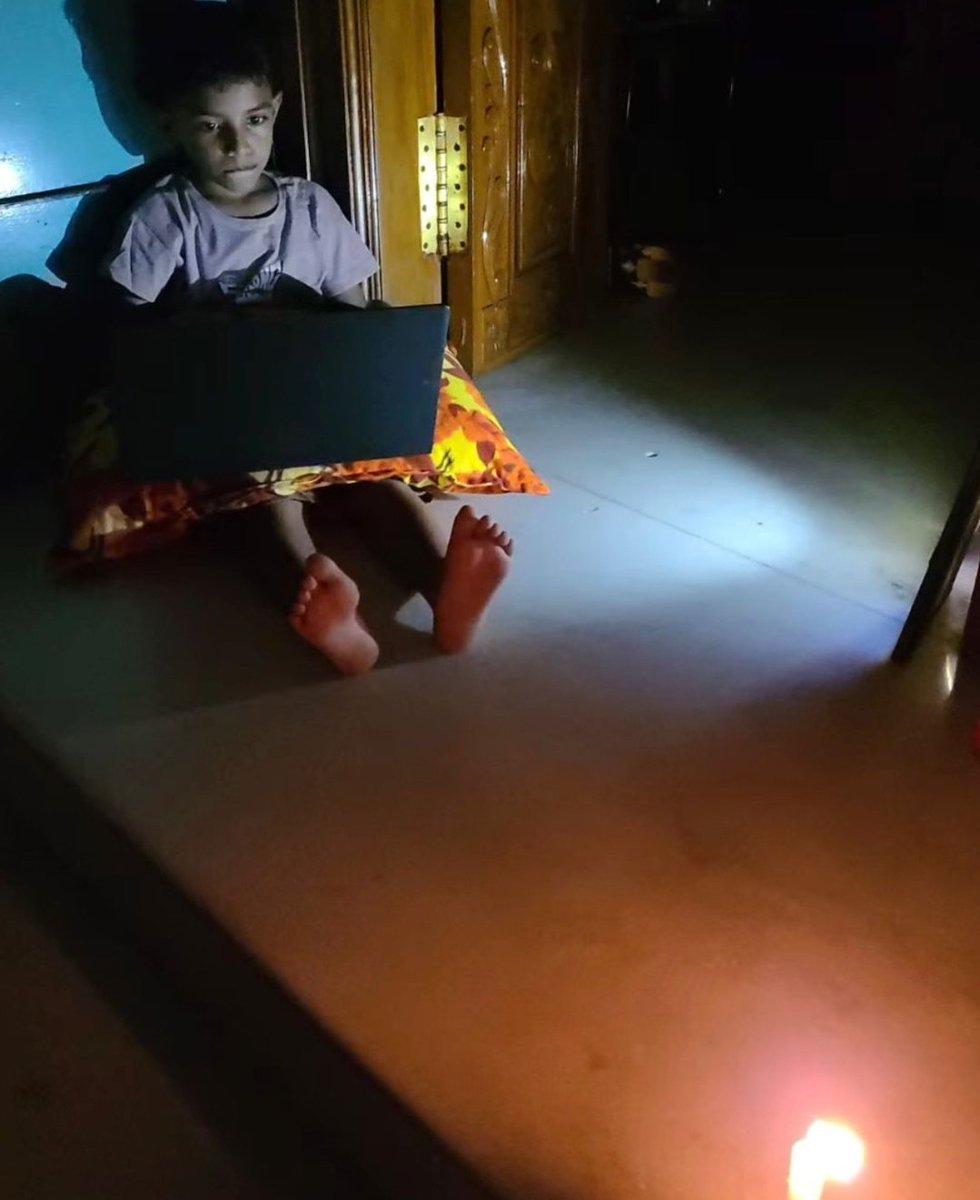
This is 8-year-old Tamizh Amudhan (born on 2nd of September 2017). He is sitting in his home in Sivakasi. The electricity was not there so he had to use a candle. In the first round of Freestyle Friday, he was pitted against world no.7 Vincent Keymer (2759). Not only is Vincent an amazing player he is well known for his Freestyle Chess. It was absolutely stunning how Tamizh Amudhan outwitted him! This youngster who trains at Hatsun Chess Academy near Sivakasi is already a CM and rated close to 2000 Elo. A huge congrats to the youngster and his grit! 😍 #chess #chessbaseindia #freestylechess
ChessBase India tweet media
English
36
488
2.8K
143K
Balaji V Srinivasan (edu/acc) retweetledi
Parimal
Parimal@Fintech03·
Next in who after the Ramanujan Series? He is the reason we can find a needle in the digital haystack of the world. Meet Dr. Rajeev Motwani (1962-2009), the Ghost who built the logic of the modern world. A boy from Jammu who went to IIT Kanpur & ended up teaching 2 kids at Stanford how to organize the internet. W/o him, there is no Google. W/o him, the web would be a chaotic library with no index. He was the master of Randomized Algorithms, the man who proved that sometimes, a bit of chance is the fastest way to the truth. He won the Nobel of his field & mentored the titans of Silicon Valley, yet he remains an invisible legend in his homeland. He is the architect of the digital oracle, the man who taught the world how to search. Born in 1962 in Jammu, Rajeev grew up in a household defined by the discipline of the Indian Army. As a child, he famously wanted to be a librarian because he loved books so much. He eventually realized that mathematics was the ultimate indexing system for the universe. He belonged to the legendary Class of 1983 at IIT Kanpur. This was a Silo of intense competition that refined his ability to solve problems with extreme speed & elegance. He moved to the US & earned his PhD from UC Berkeley in 1988, diving into the deep waters of theoretical computer science. Before Motwani, most computer scientists tried to find perfect answers. Motwani realized that for massive amounts of data, perfection is too slow. He proved that by introducing a small, controlled amount of randomness into an algorithm, we could solve complex problems millions of times faster than traditional methods. In 1995, he co-authored Randomized Algorithms. It is not just a textbook; it is the fundamental blueprint for modern computing. Every time a large system (like a global bank/a social network) processes data, it likely uses a Motwani-style randomized check. In the mid-90s, at Stanford University, Motwani encountered 2 students: Larry Page & Sergey Brin. They had a rough idea for a search engine. Motwani provided the mathematical rigor. He helped them formulate PageRank, the algorithm that ranks web pages by their importance based on link structure. He was not just a mentor; he was an early advisor & investor. He was the Ghost in the room when Google was born in a garage. Beyond Google, he was a foundational advisor to PayPal, Airbnb, & Twitter. He saw the Pattern of Success in startups before they even had a name. In 2001, he won the highest honor in theoretical computer science (The Gödel Prize) for his work on the PCP Theorem (a massive breakthrough in how we verify proofs). In 2009, at the age of 47, he passed away in a tragic accident at his home in California. Silicon Valley went into a state of deep mourning. Sergey Brin wrote a heartbreaking tribute titled "Rajeev Motwani, my friend & teacher." Yet, in India, his name did not make the front pages. He remains a Ghost in the country that produced him. He is the Ghost of the Algorithm. Like Ramanujan, he saw the beauty in the approximated truth. He realized that the world is too big to be solved by simple, rigid lines, so he taught machines how to use probability to find the truth. Key Work: theory.stanford.edu/~rajeev/papers…
Parimal tweet media
English
22
371
1.1K
41.4K
Arun Krishnan 🇮🇳
Arun Krishnan 🇮🇳@ArunKrishnan_·
3 days. Nearly 14,000 words as I document our Trans Siberian trip. Along with Russian History, social mores etc. This enforced divorce from the digital space.. brought about by a lack of network connectivity is brilliant. No information overload. No being bombarded constantly with useless information I now understand why people would go to a remote hill station to write. #TransSiberianTrip
English
8
5
97
2.7K
Balaji V Srinivasan (edu/acc)
@ArunKrishnan_ Whenever I stay away from digital media for a day, I recover a small portion of my brain, and my soul. Planning to take a lot of long breaks this year.
English
0
0
1
45
Capt Venkat 🇮🇳
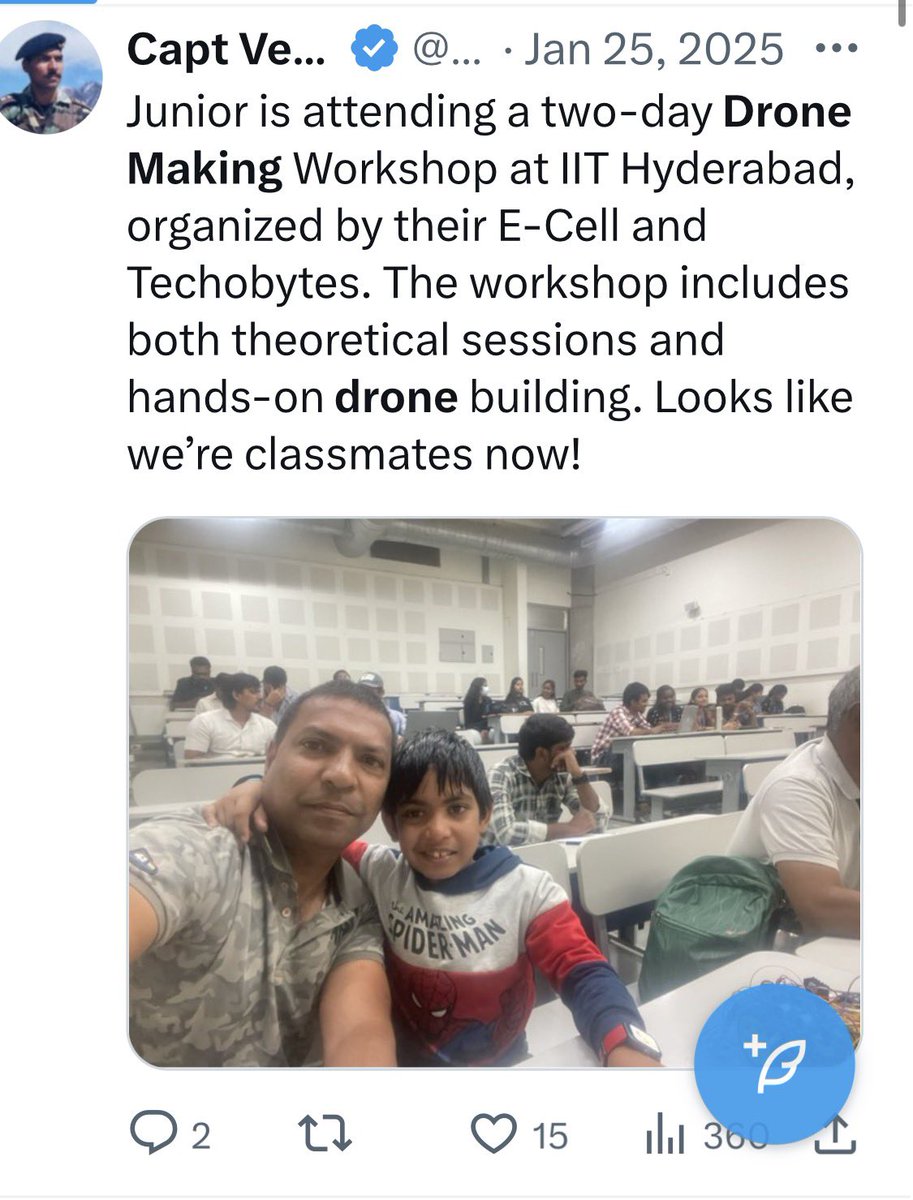
8yo builder Lakshveer has been offered an opportunity to work on research projects at IIT Hyderabad by Prof. @prakhar12gupta. In Jan 2025, he attended a drone workshop here. The first visit to IIT-H Campus. A year later, he’s got an opportunity to work on research. Credit to Dr. Prakhar for spotting and backing a builder this early. 🙏 As a father, this is a proud moment. For Laksh, this is a chance to hone his skills in a real research environment. Wish us good luck.
Capt Venkat 🇮🇳 tweet media
Prakhar Gupta@prakhar12gupta

Something great is going to come out! Happy to be a part of this collaboration!

English
19
4
126
5.8K
Balaji V Srinivasan (edu/acc) retweetledi
Bob Wachter
Bob Wachter@Bob_Wachter·
I've used em-dashes my whole life — they add rhythm and grace to writing. But now they're an AI tell. Can we get a grandfather clause for those of us who were fluent in em-dashes before ChatGPT launched in November 2022?
English
818
1.2K
13.8K
739.7K
Balaji V Srinivasan (edu/acc) retweetledi
Sridhar Vembu
Sridhar Vembu@svembu·
Open letter to Indians in America. -- Dear brothers and sisters from Bharat: Like I did 37 years ago, you arrived in America with no money but with a good education and cultural heritage from Bharat. You achieved outstanding success. America was good to us. For that we must remain grateful - gratitude is our Bharatiya way. Yet today, a significant number of Americans, may be not the majority but not too far from it either, believe that Indians "take away" American jobs and our success in America was unfairly earned. You may think the next election will fix this, but your choice would be between people who hate our Bharatiya civilisation and people who hate civilisation itself. That is the "hard right" vs "woke left" battle. You are mere bystanders to that conflict. Meanwhile there is one thing that is true now and will be true in the future: the respect Indians command world-wide will substantially depend on the fortunes of India herself. If India remains poor, the woke left will give us moral lectures with pity and the hard right, different moral lectures with scorn ("hellhole") and we must not confuse either with respect. Respect in today's world, along with prosperity and security, comes from one source: a nation's technological prowess. India produces sufficient brain power to achieve that prowess but alas we exported so much of that talent, particularly to America. As we develop that prowess in India, our civilisational strength will assert itself. As difficult as it is for many of you to contemplate this, please come back home. Bharat Mata needs your talent. Our vast youthful population needs the technology leadership you gained over the years to guide them towards prosperity. Let's do it with a missionary zeal. Respectfully Sridhar Vembu
English
4K
6.9K
27.6K
6.9M
Balaji V Srinivasan (edu/acc) retweetledi
Arun Krishnan 🇮🇳
Arun Krishnan 🇮🇳@ArunKrishnan_·
Many would. They tell us we are a low trust society. Tell that to the small shopowners who have a credit system for goods they sell. Or who sell their wares on a vague promise of "kal de denge". We don't celebrate ourselves enough.
desi mojito@desimojito

When Japan’s toll system crashed for 38 hours, they had let cars pass for free…….. but asked people to pay later online once they reach home. 24,000+ drivers actually went home and paid online voluntarily. Now imagine this in India…… how many do you think would honestly pay?

English
17
29
151
6.5K
Balaji V Srinivasan (edu/acc) retweetledi
Sridhar Vembu
Sridhar Vembu@svembu·
We have been poor because we waste our talent on a truly massive scale. Zoho is built by very ordinary Indians from very humble backgrounds. That kind of talent pool is there everywhere in India. We have to tap it to create tens of thousands of companies like this. At that point, we will be shockingly wealthy as a nation.
English
13
40
248
8K
Balaji V Srinivasan (edu/acc) retweetledi
Sridhar Vembu
Sridhar Vembu@svembu·
In the 1980s, most IITians would go abroad. In 1989, when I graduated from IIT Madras, I remember feeling extremely dejected about our country. Punjab, Kashmir and Assam were all burning. My heart was not in engineering. I was mostly reading books in Economics and Philosophy - we had a good library. The burning question in my mind was "Why are we so poor?" Some of my classmates and I wrote an article in the IIT campus newspaper in late 1988-early 1989 (there were two newspapers, Focus and Spectator, and I believe we published in Focus, they were reproduced using "cyclostyling" machines - please look them up!). In my vague recollection, the thrust of the article was that the IIT system was failing to serve the needs of the country and the country itself was facing a profound stagnation (I wish I could get that article now - a copy may be in some dusty basement in IIT). I want to know what I thought and said as a 21 year old in 1989 that I agree with and what I disagree with today. By 1989, I had become a committed anti-socialist, having lived through the socialist stagnation of India. By 1989, the collapse of the Soviet Union was on, and China was in turmoil - the Tinananmen student protests and their forced suppression. By 1991, India needed an emergency IMF loan. The 1991 economic reforms by Shri Manmohan Singh happened due to pressure from the IMF. So you can imagine the mood in 1989. That was the India I left in 1989. I was feeling miserable to leave but hopeless to stay. In 1990, I came home for a visit and thought of dropping out of my PhD and staying home. I was home sick. I started to study Singapore and Japan during 1990-94 in my PhD years - the "Why are we so poor" question. By 1994, I decided I would be in the private sector and took up an R&D job in Qualcomm.
English
141
566
4.1K
214.1K
Balaji V Srinivasan (edu/acc) retweetledi
ChessBase India
ChessBase India@ChessbaseIndia·
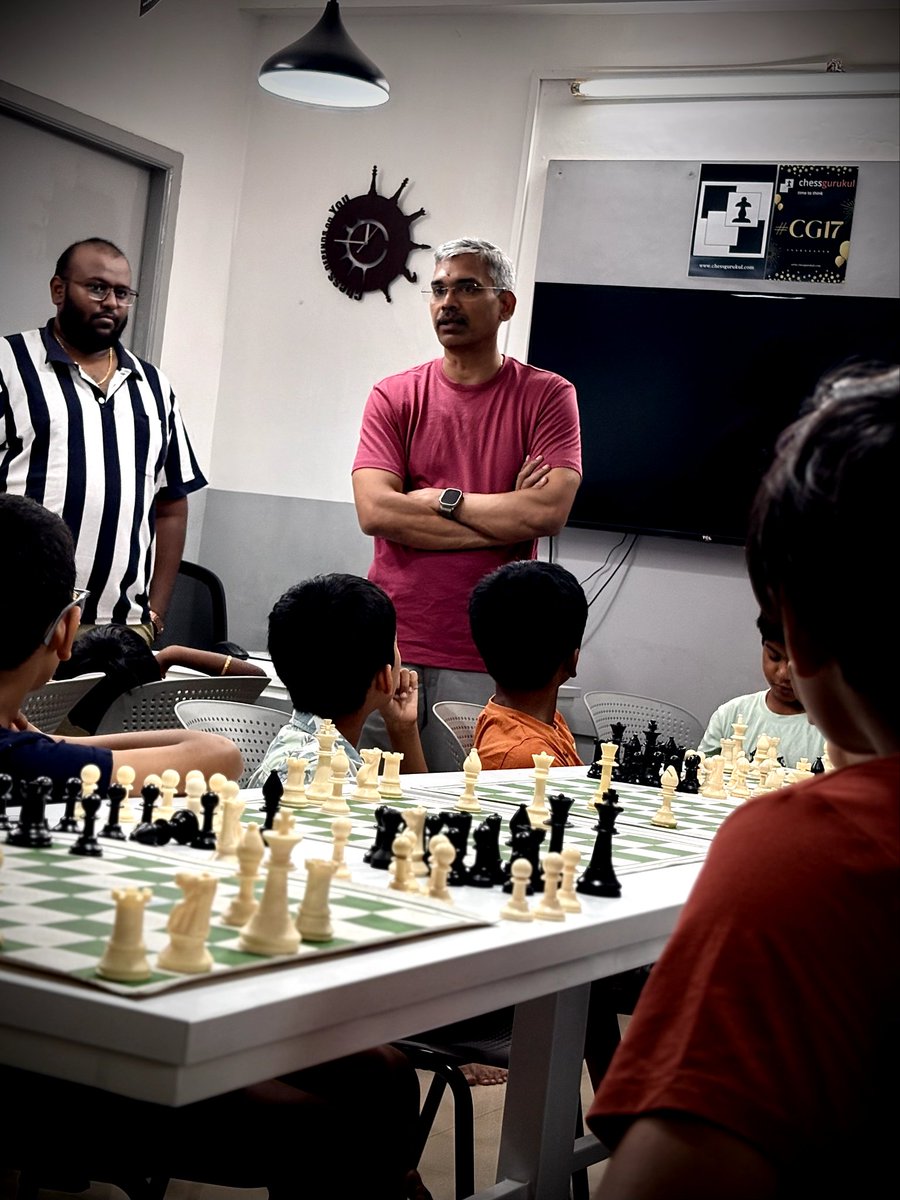
On 20th of April 1976, R.B. Ramesh was born! 50 years ago! He became a GM at the age of 27 years in 2003. In 2002, he had won the British Championships, and in 2007 he became the Commonwealth Champion. In 2008, he took a bold step in his chess career. He gave up playing chess and started a chess academy and named it Chess Gurukul. He also gave up his job in Indian Oil (IOCL) around the same point. Many told him that this was a dangerous decision. But Ramesh had 2 things going for him: 1. He loved coaching 2. His better half WGM Aarthie Ramaswamy was also ready to support him in this endeavour! With his immense chess knowledge, willingness to learn and ability to work extremely hard, Ramesh created the base for a real chess boom of Indian chess! Players like Praggnanandhaa, Vaishali, Aravindh Chithambaram, Karthikeyan Murali, Bharat Subramaniyam and many others grew up at his academy! There was a point when almost every single rising talent of Indian chess wanted to work with him. Today as Ramesh celebrates his 50th birthday, it is interesting to see the road he has travelled. Vaishali is going to play the World Championship Match in a few days! He also received the Dronacharya award recently. He started a completely free chess academy named Chola Chess to develop the next generation of Indian chess. Thank you Ramesh for powering Indian chess! Your contribution to the growth of the sport in the country has been immense. Wishing you a very happy 50th birthday. Photo: Tushar Damor #chess #chessbaseindia #rameshchess
ChessBase India tweet media
English
18
204
799
27.7K
Balaji V Srinivasan (edu/acc) retweetledi
Jared Friedman
Jared Friedman@snowmaker·
We had room for 2,000 people at Startup School India. More than 25,000 applied. No Startup School anywhere in the world has ever had this many people apply. Not SF, not NYC, not London. India blew them all away.
English
265
435
6.2K
408.6K
Balaji V Srinivasan (edu/acc) retweetledi
ChessBase India
ChessBase India@ChessbaseIndia·
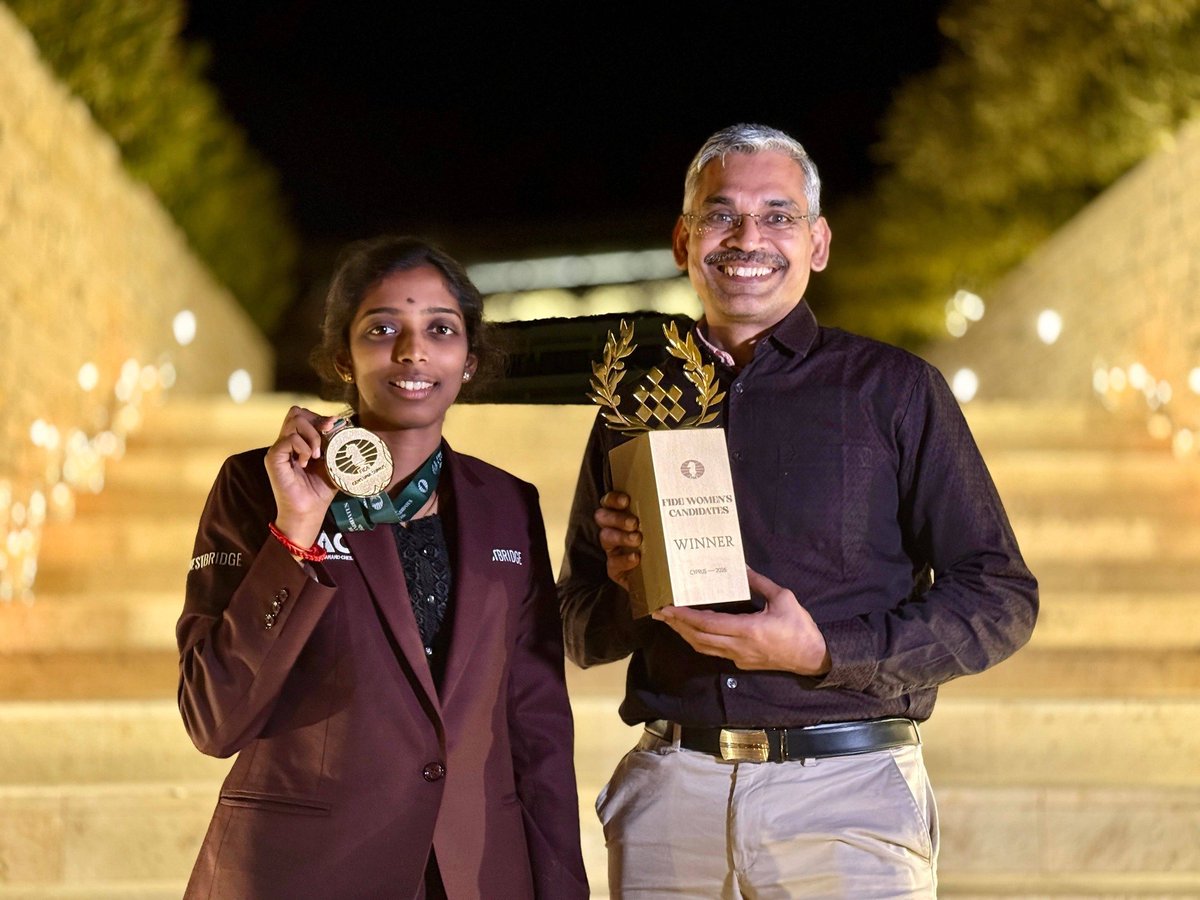
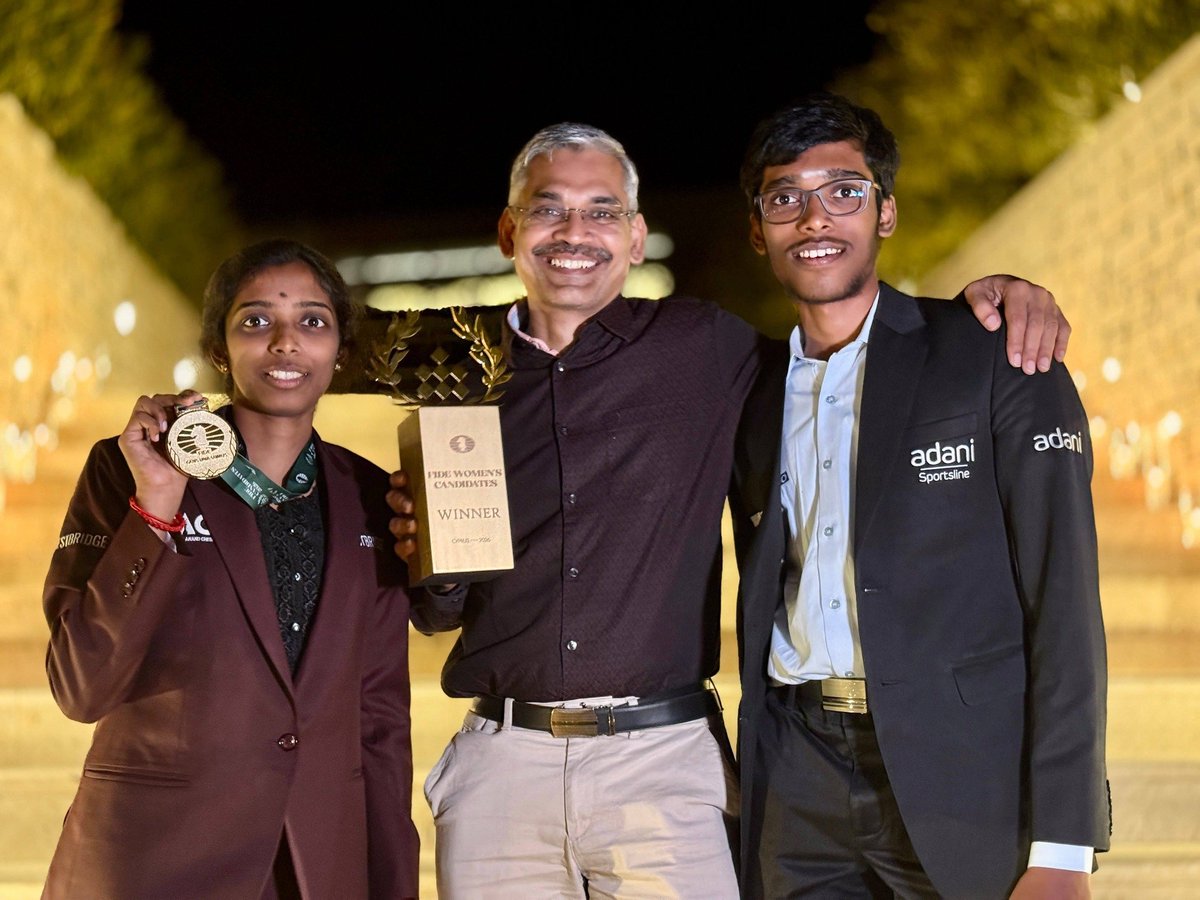
The heart of a Guru GM R.B. Ramesh is one India's and world's finest chess trainers. He has been the coach of Vaishali and Pragg since they were around 2000 Elo strength. From there to now bringing them to this stage, he has played a big role! When both the siblings were going to go to Cyprus for the FIDE Candidates 2026, Ramesh told them that he would be there at the closing ceremony if any of them won the tournament. After 14 rounds of grueling chess, Vaishali had made it. She had won the tournament and earned the right to challenge Ju Wenjun for the world title. Ramesh was watching this unfold from his home in Chennai. The war situation in the middle east had made travelling quite difficult. Ramesh had tried before to get a ticket, but unsuccessfully. In desperation, he picked up his phone one last time to ask his travel agent if anything was possible! And guess what! This time it worked! The travel agent found a connection from Chennai - Dubai - Athens - Larnaca - Cap St. Georges and Ramesh quickly left his home. It was a race against time. The travel was more than 20 hours, but just like a Bollywood movie, Ramesh arrived a few minutes before Vaishali went on stage to receive the award. And guess what Vaishali spoke when she was given the mic. She shared her joy on receiving the trophy in front of her coach, who had travelled thousands of kilometers to just be present there. Guru, the word that is used for someone who is much more than just a coach, is something that fits in aptly for Ramesh. The Guru not just teaches you the art but also gives direction to your life. Ramesh is not just a trainer of Vaishali and Pragg, but family. We thank him immensely for giving India two of its most amazing gems! Photos: Abhyudaya Ram #chess #chessbaseindia #vaishalichess #ramesh #praggnanandhaa
ChessBase India tweet mediaChessBase India tweet media
English
17
210
1.4K
32.2K
Balaji V Srinivasan (edu/acc) retweetledi
Wadhwani School of Data Science & AI (WSAI), IITM
India’s AI Moment Needs Ownership, Not Just Adoption In an interview with Governance Now on “AI: Code, Control, Conquer,” Prof. B. Ravindran, Head of Wadhwani School of Data Science & AI, IIT Madras - underscores the structural gaps that India must urgently address to achieve true technological sovereignty. His perspective is clear and tangible: --> “Most AI systems powering today’s applications are still built outside India and that has to change.” --> “AI that does not understand India cannot serve India.” --> “Without sovereign silicon, sovereign AI remains incomplete.” From dependence on global compute infrastructure to the absence of India-first foundational models, the piece lays out what it will take for India to move beyond adoption and toward ownership. The takeaway is simple: AI leadership will be defined not by access, but by control. 📕 Read the full article: governancenow.com/news/regular-s… 📺 Watch the full discussion on Checks & Balances: youtu.be/ZECiOUZEfLQ (11:50 - 15:15) #ArtificialIntelligence #IndiaAI #TechPolicy #AIGovernance #DigitalIndia #IITMadras #ResponsibleAI #AIStrategy #GovernanceNow @cerai_iitm @iitmadras @geeminhas @governancenow
YouTube video
YouTube
English
0
5
6
686
Balaji V Srinivasan (edu/acc) retweetledi
Swati
Swati@aiandchai·
I learned how transformers actually work in 22 minutes this evening. Not from a video or a paper. From talking out loud. I've tried to understand attention maybe six times. Andrej's video. The Illustrated Transformer post. Three different chatbots. Each time I'd get to paragraph four of someone's explanation and quietly start scrolling instead of reading. So at @emergentlabs vibecon this weekend, we built the thing I actually needed. Slate - a voice-first AI tutor that teaches you anything and everything you want, in under 30 minutes, while drawing it on a slate. You tell it a topic. You talk to it. It talks back warm, patient, two sentences at a time. And while it's explaining, it's drawing. Mermaid diagrams. Code with syntax highlighting. KaTeX equations. Chalk-on-blackboard sketches. It takes notes on the side that you can download as markdown. What it replaces, for me: • 3 YouTube tabs → one 20-minute conversation • A 40-page PDF → a diagram I watched get drawn • "Regenerate response" → "wait, why softmax?" → an answer Try it now at tryslate.live Three things we learned building it: 1. Typing kills curiosity. A blank text box turns "I wonder" into "I'll Google it later." Voice doesn't. 2. The whiteboard isn't a feature, it's the whole thing. Watching a concept get drawn lands different than reading the same words. 3. The system prompt that worked is one line: "don't monologue." The best tutor in the room is never the smartest one it's the most patient one. We shipped this end-to-end in less than 12 hours. Voice loop, live whiteboard, image gen, auth, session replay. On any other stack that's a six-week project. On Emergent it was a weekend. Pick a topic you've been meaning to understand. Tap the orb. You'll get it before your coffee goes cold. Built with emergent · #Vibecon
Swati tweet media
English
11
41
339
16.2K
Balaji V Srinivasan (edu/acc) retweetledi
Mayukh
Mayukh@mayukh_panja·
One thing academia does extremely well and startups and companies massively screw up is hiring. Hear me out! A friend of mine, PhD in Astrophysics, solved a tough problem for their PhD: when light from stars travels through the Earth's atmosphere, the turbulence and density fluctuations cause the light rays to become "squiggly" instead of straight and the resulting image you get from a telescope becomes blurry. So he had to model atmospheric turbulence and then write a piece of software in C++ that inverts this problem to get de-blurred images. This involved understanding physics, maths, computation, a bit of ML and writing production-level code in C++. When he tried to look for an industry job he simply couldn't find any. It was also hard to just get interviews. The first problem is that recruiters, who are often deeply non-technical, look for specific keywords in CVs and they just don't know how to parse a non-standard CV. This is a guaranteed way of missing out on outlier candidates. Second, a lot of hiring managers over index on niche knowledge about a specific tool/framework/language and the ability to remember syntax off the top of your head. A solid researcher sees programming languages, machine learning, physics, maths etc as tools that are at their disposal and may not know/remember very specific information or every little detail about arbitrary technical things. The whole process essentially becomes a lottery. This was how we hired at our Max Planck Institute: the candidate would be given a paper a week before the interview and the interviewer and the candidate would discuss it together. A second interview would entail asking the candidate about THEIR past work and checking if they deeply understood what they did. This interview format doesn't require the candidate to memorizes stuff beforehand and is pretty much independent of the whims, fancies and "taste" of the hiring manager. A lot of stuff is wrong with academia but this is an area where they do much much better than startups/companies.
English
29
112
1.2K
75.9K