

BigZip330
14.1K posts
BigZip330
@BZip330
Please don’t follow me.
Galapagos Islands Katılım Eylül 2022
53 Takip Edilen2 Takipçiler

FedEx Corp. is officially moving forward with the spinoff of its less-than-truckload unit, FedEx Freight, following formal approval from its board of directors. The Memphis-based company announced Wednesday that the separation is set to conclude by June 1.
vist.ly/543xt
English
@gaslit2025 @DouthatNYT What bullshit. Let’s see how those EU countries you drool over fare when they have to pay for their own defense including defending their middle class eastern energy supply chains. It’s coming and it ain’t gonna be pretty.
English

@DouthatNYT Do it on a bicycle and you pretty quickly realize Europe has much better infrastructure, most Europeans are better educated and they have healthcare, plus, you don’t see homelessness in Europe on the scale you see it in the United States.
English
I have done the "driving around" test the authors advocate in both the UK and Italy in the last few years; in each case the countryside was beautiful and also *clearly* poorer than American-heartland suburbia.
x.com/lugaricano/sta…
Luis Garicano 🇪🇺🇺🇦@lugaricano
We stopped everything to write an answer (link below) to Paul Krugman's two posts of today (one informal, one with a simple model) arguing that Europe is broadly not falling behind the United States. The change measured by the Draghi report, he argues, is mostly due to growth in the technology industry, which has distorted GDP numbers without actually leading to higher standards of living. We should believe our eyes when we walk around France and walk around Mississippi. Krugman is wrong. The measures he uses understate European stagnation. This matters enormously. Divergence with the United States is the strongest evidence for reform in Europe. 1. The growth numbers Krugman compares the United States, France, and Germany at purchasing power parity in current prices. On that measure, France's and Germany's position relative to America has been roughly constant since 2000. But current price comparisons miss productivity gains in sectors where prices fall. If America produces twice as much software while the price of each unit halves, the value of American software output looks unchanged even though the volume has doubled. Most economists therefore use constant prices, which fix the base-year PPP level and apply each country's real output growth on top of it. American output growth has concentrated in tech, where prices have fallen tremendously as productivity rises. In terms of the volume of things produced, America has pulled away from Europe. 2. Is it all the tech industry? Krugman concedes this tech divergence but says it is not welfare-relevant. The American growth lead is an accounting artefact of measuring more iPhones at base-year prices, not a sign that Americans are actually richer, because Europeans buy the same iPhones at the same world prices. This is not the right way to think about the world today, as an earlier Paul Krugman would have argued. His model assumes tradable goods, interchangeable workers, marginal-cost pricing, and no profits. Each assumption fails. Most of what households buy is non-tradable: housing, healthcare, childcare, education. When American tech firms bid workers from haircutting to coding, American haircut wages rise. Germany has no growing tech sector to do the bidding, so German wages stay flat. Technology is not priced at marginal cost. Apple's margins are around 40 percent. Anthropic's inference margins are at 70 percent. The major platforms enjoy network effects, switching costs, and lock-in that hold prices well above what a competitive market would deliver. A large share of the productivity gains in technology stays as profit. A lot of the value of American technology dominance shows up in equity, not in wages. Apple, Microsoft, Nvidia, Alphabet, Meta, and Amazon together are worth $21 trillion, more than the entire combined stock market value of all European stock markets. Around 60 percent of US equity is held by American households. The median French or Spanish household holds almost no equity. The median employee at Meta, a company with almost 80,000 employees, earned $388,000 in 2025. This advantage is not going to go away. Krugman's own 1991 paper, cited in his Nobel prize, showed that comparative advantage in modern industries is produced by increasing returns to scale, specialized labor markets, supplier networks and the agglomeration of suppliers, workers, and ideas in particular places. Once an industry concentrates somewhere, the concentration is self-reinforcing. Europe is being pushed away from the next round of technology industries (AI!). 3. What about inequality? Another retort is that GDP per capita hides substantial inequality, and so even if America is rich on average, this is mostly due to the super wealthy. But despite the US's high pre-tax income inequality, it also achieves higher median incomes than Europe, in part because of such a high base, and in part because it actually redistributes more than many European countries. The cleanest comparison is median equivalised disposable household income: income after cash taxes and transfers, adjusted for household size and purchasing power. According to the OECD's 2021 numbers, the median American earns 30 percent more than the median Dutchman, about 31 percent more than the median German, and about 52 percent more than the median Frenchman. 4. What about hours worked? Krugman points out that while American GDP per person is higher, most of this is because Americans work more. For this divergence to be an hours worked story, Americans must work more relative to Europeans now than they did in 2000. The opposite has happened. Birinci, Karabarbounis, and See in a 2026 NBER paper show that about half of the American-European hours gap that existed in the 1990s has reversed by the end of the 2010s. Americans work fewer hours per person than they did in 2000, while most Europeans work more. 5. Is America not a bad place to live? Walk around Alabama and France: surely the former cannot be substantially richer than the latter? American cities often have poorer centres and richer suburbs or exurbs. European cities preserve richer and more attractive historic cores. A visit to a city as a tourist in America compared with a city in France will leave one having seen different spots on the income distribution. Americans in Europe go to the nicest and richest European cities. Rather than a walking around test, do a driving around test. Go to the periphery of any modern American city and see a level of new-built material wealth that is extremely uncommon in Europe, with thousands of enormous four- or five-bedroom homes. In the South, in places like Nashville and Austin, drive around the downtowns to see hundreds of luxury apartment buildings springing from the ground. This construction boom is replicated virtually nowhere in Europe today. The other question is generational. Housing often costs more in Europe than in the United States, despite the quality of the housing stock generally being much better. Europe has nice city cores but these are inaccessible to young Europeans. Consider the salaries available to entry-level workers. The starting pay for a London police officer is $57,000. In Washington, DC, $75,000. The entry-level Deloitte consultant job in Madrid pays around €28,000, roughly $33,000 per year. In Charlotte, the entry-level Deloitte job pays $63,000. There are many things to dislike about life in America. But relative to 25 years ago, the gap in material wealth has shifted dramatically in America's favor. siliconcontinent.com/p/european-sta…
English
@nut_history John Henry drooling and wondering how much $$ is that at $75 a car?
English

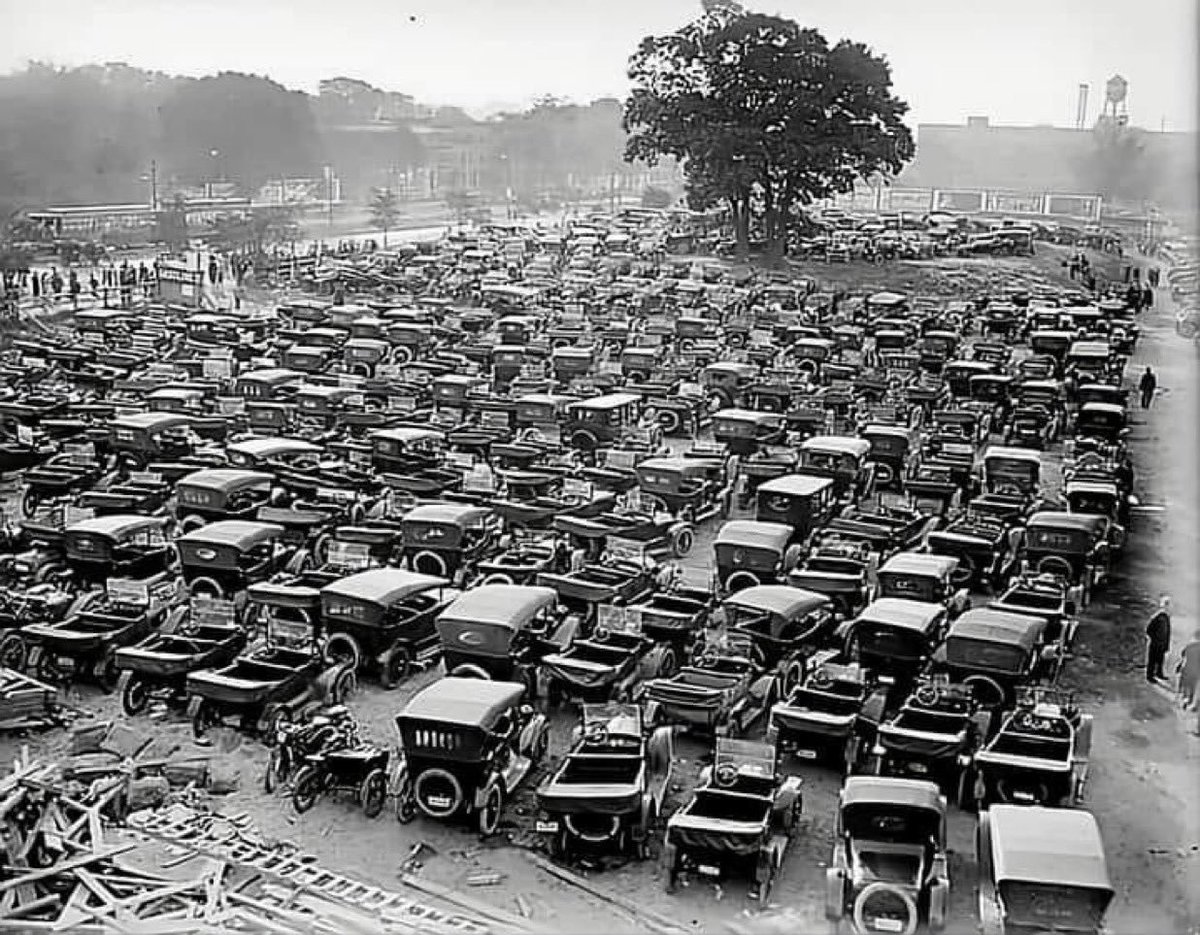
Packed parking lot for game one of the 1916 World Series in Boston.
What comes to mind when you see this?
English
@nut_history Modern day traffic trying to get out of the Fenway after a game.
English
@Super70sSports It’s historically accurate family activities. A real problem with one family member doing the heavy lifting while the other ten family members criticize and tell him he is doing it all wrong.
English

It’s a known fact nothing says "lunchtime fun" to kids quite like a impoverished Depression-era mountain family with a flat tire.

English

@Super70sSports And that thing was filled with valuable and important items.
English
A giant mesh stocking of random junk was a staple of the middle class 70s childhood Christmas. Those who were there will confirm.

English
@ScottSteiner I don’t need a follow but best wishes to your son making the 53!! Love it!!
English

To all the freaks who do get a follow, one screw and you’re out. Consider yourself warned.
English
@GordMagill I don’t see it happening no matter what you hear. Autonomous trucks are going to be way behind self driving cars and self driving cars are a long ways off except in certain focused areas. Talk to me when they can be insured in cities and areas with bad weather.
English

Just had a very doom conversation with my friend the Volvo dealer.
They’re coming for everything, boys. Might take them a little while, but in five years they want all the marbles.
The best time to start making your exit plans was yesterday, the next best time is now.
English


@ScottSteiner Good for your son. I hope he makes it in the league. 🍀
English

Who's the greatest country musician in your opinion?
English
@Tusk_4Real Kids are all online and use their headsets to talk all night. Even when traveling the same kids get together.
English

I was a kid in the 90s, and by the time I was 12 I had stayed at my friends houses hundreds of nights for sleepovers.
My friends stayed with me hundreds of nights for sleepovers.
Video games. Making home movies. Snacks. Bewshittin'.
My sons are 8 and 12 and neither of them have ever been to a sleepover. Neither of them have ever tried to get one cooking at my house.
And don't get me wrong - I do NOT want other kids at my house. But I wouldn't deny my kids the opportunity to make those memories.
Are sleepovers just not a thing anymore? What is going on?
English









I'm not leaving until.
Hiatus my Friends I think you will understand. Third in three weeks end of quite the North Jersey era.

English
@SeanMcCarthyCom What bullshit. In China they bulldoze anyone’s property and jail them if they object making the rail path perfect. The train runs great because they’ll jail anyone who slows the train down.
English

After a 17 hour train ride from DC to Chicago. The distance between Shanghai and Beijing is longer but a train ride between them takes 4.5 hours.

English
@bostonradio You mean “snapped again” considering this violent felon was slapped on the wrist the last time he “snapped” by a judge whose heart bled for this killer.
English

@AlbertBreer In Ohio may motorists are armed and he would likely have been shot before being allowed to walk around with that gun around unarmed innocents.
English

If you’re from here or you’ve ever lived here, and understand where this is exactly, you get how crazy this is. Even wilder that this guy was jailed for doing something similar six years ago and released since …
There has to be accountability for that.
English