Bam Azizi

1.4K posts

Bam Azizi banner
Bam Azizi

Bam Azizi

@bamazizimesh

CEO & Co-founder @MeshPay (https://t.co/qSIUWAQJQd)

San Francisco, CA Katılım Temmuz 2017
808 Takip Edilen1.6K Takipçiler
Bam Azizi
Bam Azizi@bamazizimesh·
Don't forget BTC is already a teracorn (I minted the term btw lol). They are not rare anymore. I bet we'll have three teracorn categories for fintechs: 1. New generation of banks where users hold their assets (mostly tokenized): NuBank, Revolut, Coinbase, Binance, Robinhood. 2. Networks where money and value are transferred: Visa, Mastercard, and L1s like BTC, ETH and SOL. 3. PSP and cross border payments : Stripe, PayPal, etc.
English
0
0
5
167
Simon Taylor
Simon Taylor@sytaylor·
Where is the trillion-dollar fintech company? There aren't any. In fact, even in TradFi, the mighty JP Morgan hasn't hit that figure. Yet SpaceX can debut at $1.75 trillion. I think that's all about to change.
English
8
0
31
4.7K
Bam Azizi retweetledi
Movement
Movement@movement_xyz·
Movement is now part of the Mesh Alliance Program. One integration with @meshpay connects any app on Movement to 300+ platforms. A user funds their account from a balance they already hold. No withdrawal form. No address to copy. No network to pick. That network is now a funding rail for Movement. Motion Wallet ships with it first. movementnetwork.xyz/article/moveme…
Movement tweet media
English
5
8
58
10.6K
Henri Stern Ꙫ
Henri Stern Ꙫ@sternhenri·
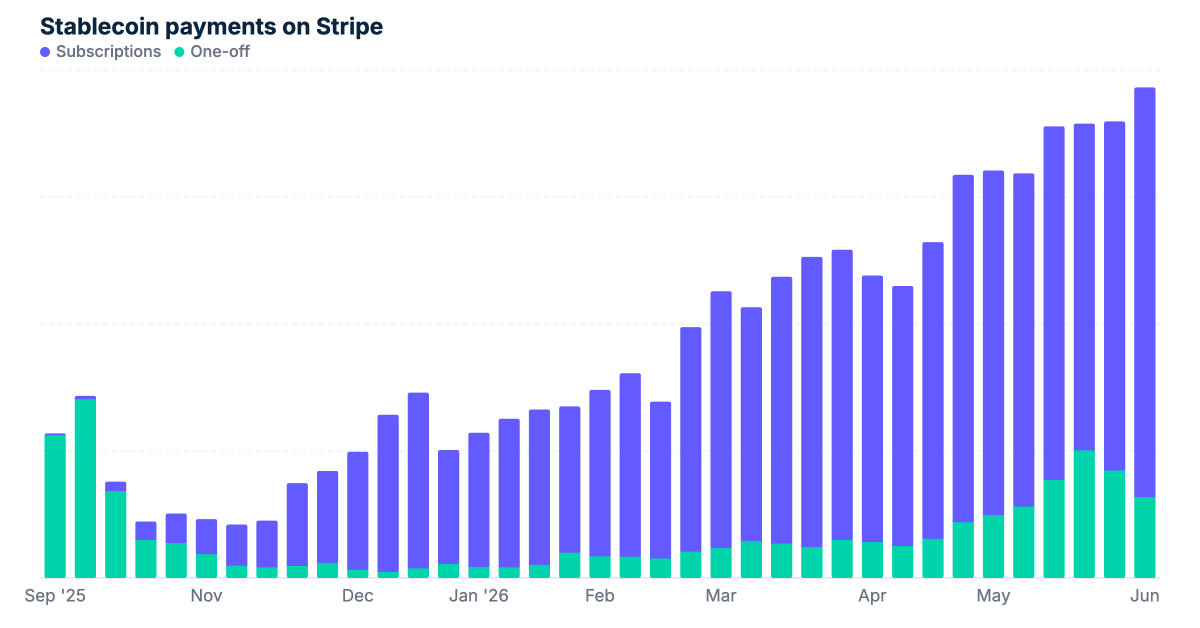
Been digging into stablecoin payments lately -- wild to see how much subscription models create lift for platforms. Powering robust subscriptions on stablecoin rails is obvious to anyone who knows payments at all but almost no one does this well. Nonetheless wild to see how much stablecoin subscriptions outpace one-off payments. Excited to see the likes of @emergentlabs, @veniceai, @Tatum and @Filebase use Stripe stablecoin rails to deliver their products to users all over the world (esp where card coverage is thin)!
Henri Stern Ꙫ tweet media
English
12
8
65
5.8K
Bam Azizi retweetledi
Mesh | We Are Hiring!
We're formalizing our partnership with @BitgetWallet. 🤝 The idea is simple: crypto you hold should be crypto you can use. Bitget Wallet users can link their wallet in a few taps to any Mesh-powered platform — then move funds or make a purchase. No copied addresses, no switching apps. → More to come. na2.hubs.ly/H06N4770
Mesh | We Are Hiring! tweet media
English
5
5
25
24.4K
Bam Azizi
Bam Azizi@bamazizimesh·
⚡ 🔐 We leverage military-grade security and bank-grade compliance to power our clients' digital asset infrastructure. AMINA Bank is the first FINMA-regulated bank to integrate Mesh, enabling its customers to make secure, seamless, and fully compliant digital asset deposits.
Mesh | We Are Hiring!@meshpay

@AMINABankGlobal is the first FINMA-regulated bank to integrate Mesh. Verified deposits across hundreds of wallet providers, embedded directly in AMINA's online banking platform — verify wallet ownership and deposit stablecoins and digital assets in a single flow. na2.hubs.ly/H06Jjmz0

English
1
4
18
1.8K
Bam Azizi
Bam Azizi@bamazizimesh·
Argentina 🇦🇷 ⚽️🚀
Español
1
0
2
149
Bam Azizi retweetledi
Cuy Sheffield
Cuy Sheffield@cuysheffield·
Learned a ton from this discussion on lessons from USDC and the future of agentic identity with the brilliant Sean Neville
Tokenized Podcast@TokenizedPod

🚨 Ep. 9 of Agentic Commerce: From Building USDC to Agentic Commerce: Sean Neville on Programmable Finance @cuysheffield & @bamazizimesh are joined by: 👉 @psneville, CEO & Co-Founder, @catena_labs To discuss: 👁️ Early vision for stablecoins and USDC creation ⛓️ Founding story of Catena and AI focus 🥊 Agentic treasury vs agentic commerce use cases 🫆 Role of identity and trust in agentic commerce 🤖 Internal agents vs cross enterprise agent interactions 🗣️ Need for protocols in agent to agent communication 📈 Token cost efficiency for agentic transactions 🔒 Cryptographic trust advantages of stablecoins for agents *** Timestamps: 00:00 Introduction 2:48 Early vision for stablecoins and USDC creation 5:37 Founding story of Catena and AI focus 8:33 Agentic treasury vs agentic commerce use cases 12:49 Role of identity and trust in agentic commerce 18:38 Internal agents vs cross enterprise agent interactions 24:41 Need for protocols in agent to agent communication 34:07 Token cost efficiency for agentic transactions 41:43 Cryptographic trust advantages of stablecoins for agents *** 👉 𝘚𝘦𝘢𝘳𝘤𝘩 '𝘛𝘰𝘬𝘦𝘯𝘪𝘻𝘦𝘥 𝘗𝘰𝘥𝘤𝘢𝘴𝘵' 𝘖𝘯 𝘠𝘰𝘶𝘛𝘶𝘣𝘦. 𝘈𝘱𝘱𝘭𝘦, 𝘚𝘱𝘰𝘵𝘪𝘧𝘺 𝘰𝘳 𝘢𝘯𝘺 𝘗𝘰𝘥𝘤𝘢𝘴𝘵 𝘗𝘭𝘢𝘺𝘦𝘳! 👈

English
9
2
38
5.8K
Bam Azizi retweetledi
Mesh | We Are Hiring!
Mesh | We Are Hiring!@meshpay·
The question isn't whether AI agents can move money. It's whether you can trust them to. "I'd like to see trust encoded in technology rather than be left to humans and the businesses that humans create." — @psneville, who wrote the first USDC smart contract, now Co-founder & CEO of @catena_labs. His case on @TokenizedPod Agentic Commerce, with @bamazizimesh and @cuysheffield: stablecoins clear that trust hurdle in a way fiat can't. 🎧 na2.hubs.ly/H06yWL_0
English
1
2
11
1.2K
Bam Azizi retweetledi
Mesh | We Are Hiring!
Mesh | We Are Hiring!@meshpay·
We talk a lot about stablecoin volume. But what if that's not the metric that matters? @Bastion's @nassyweazy proposes a different one on the latest CEO Beat with @bamazizimesh: "time to live" — the time between a stablecoin's minting and burning. The longer a dollar stays onchain, the more useful it's been. Every off-ramp sends value back to inefficient rails. Optimize for that, not volume. 🎙️ na2.hubs.ly/H06wL1-0
English
0
1
13
1.5K
Bam Azizi retweetledi
Mesh | We Are Hiring!
Mesh | We Are Hiring!@meshpay·
Prediction markets just had their biggest month ever. Kalshi did $31B in June. The category topped $50B. DraftKings, Meta & a new Robinhood-backed venture are all piling in. But the real race isn't odds — it's funding. Our take 👇 na2.hubs.ly/H06wwCg0
Mesh | We Are Hiring! tweet media
English
0
1
6
782
Bam Azizi retweetledi
Gap | Suby
Gap | Suby@gaspardlezin·
If you're still moving money globally on SWIFT, you're paying for infrastructure designed in 1973. Cross-border payments are one of the most broken parts of finance. The numbers say it all: - Over $150 trillion crosses borders every year - The average B2B cross-border payment takes 2–5 business days - Fees run 1.5%–6% for businesses, and 8%+ on average for remittances to Africa - A meaningful share of payments still fail or get stuck in transit The real problem is fragmentation. Every region runs on its own rails, its own regulations, its own licensed providers. Brazil moves on PIX. Nigeria on mobile money. India on UPI. Argentina lives with capital controls. And in each market, a different set of specialized players actually moves the money. Here's a quick overview of who's moving money across borders today, region by region (full, detailed mapping in the comments 👇): 🇺🇸 North America, the API-first layer Bridge · Brale · Modern Treasury · Bastion · Crossmint · Sphere Labs · Mesh 🇪🇺 Europe, MiCA-native, EU passporting Currencycloud · Wise · Merge · Fipto · Depa · Venly 🌎 Latin America: built around PIX, SPEI, local FX Bitso · Koywe · BlindPay · Cobre · CambioReal · Trace Finance · Infinia 🌍 Africa: mobile money meets stablecoins Yellow Card · Flutterwave · Kotani Pay · HoneyCoin · VALR · Paychant 🌏 Asia-Pacific: the fastest-growing corridor Triple-A · Tazapay · FOMO Pay · Coins ph · Walapay And these are just the regional anchors. Several of these players operate across multiple corridors, Bridge, Triple-A, and Walapay among them, so the real map is far more interconnected than any single region suggests. The full breakdown is in the comments. The catch? No single provider covers more than a fraction of it. To go truly global, you'd integrate 10, 15, 20 of them, each with its own API, its own compliance, its own pricing. Expensive. Slow. Brittle. And the shift underneath all this is real: in 2024, stablecoins processed $15.6 trillion in volume, on par with Visa (ARK Invest). They settle in minutes, move 24/7, and skip correspondent banks entirely. So if you want all of this in one place, a single API that plugs into the whole network instead of stitching it together yourself, that's exactly what Borderless does. One integration, 94+ countries, 63+ currencies, with smart routing, failover, and unified compliance built in. Mastercard just tapped them as a launch partner for its Crypto Partner Program, alongside Circle, PayPal, and Ripple. Cross-border payments don't need another bank. They need a new network. PS: I post every week about payments with Suby, stablecoins & the reality of cross-border infrastructure. Follow for more.
Gap | Suby tweet media
English
10
18
70
8.9K
Bam Azizi
Bam Azizi@bamazizimesh·
Great post 👀
Rob Hadick >|<@HadickM

I believe that the correct takeaway from OUSD is actually quite nuanced, both specifically to what it means for Circle / Tether / Paxos and more broadly about what it means for adoption and the likelihood of being successful (warning, very long post). First, on CRCL, I wonder if it was more than a coincidence that Jeremy was on stage at the largest (and most hyped) Goldman Digital Assets conference in history at the exact time that the announcement occurred. He, Goldman, and many in the audience knew it was coming pre market open and that it would have a negative impact on the stock - that’s neither here nor there but did find it interesting as people in the audience were talking about it as he was being interviewed and the stock opened down 6% in the midst of the talk. In terms of impact on business, it’s been clear for awhile that revenue share %s were going to continue to go up and that for payments use cases redemption fees would need to go away. Circle was already responding to those points by striking deals with payment companies on mint/redeem and with distribution partners on yield sharing. The potential impending breakup with COIN, which has been signaled for awhile, actually near doubles their net revenue immediately, which is incredibly positive for them. That said, within a reasonable period of time that yield will likely end up in the hands of new distribution partners as they compete - but CRCL will be unshackled to compete here aggressively in a way they have not been able to with the COIN deal, so I think this specifically may end up being a net positive, if the deal is restructured or cancelled, even with further downward pressure on how much net revenue they keep. They also have deep liquidity that is hard to replicate and integrate, and that shouldn’t be forgotten or pushed aside as trivial. But it’s clear that for many Stripe partners, customers and ecosystem participants specifically, OUSD will likely become default use instead of USDC, which was previously preferred, as long as OUSD can bootstrap deep enough liquidity. And it’s inarguably true that Stripe is simply a better engineering and product organization and will likely ship better ancillary products and tooling needed for easy stablecoin use and distribution. Then again, CRCL has a clear head start and existing integrations that shouldn’t be ignored. Switching costs might not be high, but if you’ve built your product on top of CRCL’s APIs, you will need to be incentivized to switch which is a harder prospect than people realize and won’t simply come down to yield sharing - but of course the greenfield opportunity set is much larger than the market that is already well served. That said, for non payments use cases or for payments companies that compete with or have different incentives than Stripe, it’s not clear that this will be in anyway preferred vs existing (or net new) options. Lastly, if this ends up being issued by a Bridge entity, it doesn’t solve one of the main problems USDC has had in deeply penetrating enterprises - and that’s the fact that these tokens are still, today, essentially credit to the issuing organization and CRCL (and Bridge) is not investment grade credit. Bridge is also not, today, ready to be genius compliant (though they are working on that). If there is a parental guarantee at Stripe or some of the other members, that changes the calculus, but both are at risk of having the large banks/AMs swoop in and take the most profitable and largest opportunity use cases. And there is still a lot of wood to chop in terms of global licensing. So I don’t see this announcement as changing that competitive risk that already existed. Overall, I told someone before the announcement yesterday I thought CRCL stock would be down 15-20% on the day and it landed right in the middle of that. I do think the market reaction is justified but I don’t see this as some type of death knell many commentators are framing it as. CRCL does need to accelerate their payment and fintech product development, however, and I believe they need to be acquisitive. That time may have passed, now with the stock trading down, but there are a number of interesting options that they could explore that would still be accretive. This isn’t the end of the new entrants, so some defensive posturing will be key. For Tether, this is not their core market anyways and they will continue to focus on distribution in channels that neither Stripe nor CRCL will prioritize - they will be fine, but as Paolo said on stage at Token 2049 a couple years ago, Tether’s market share is likely to keep declining over time (but in a market that should grow a lot). Paxos, OTOH, will lose the upper hand on their main selling point of USDG and will, at some point, lose their regulatory upper hand as well. I see this as far more existential for them than the others but that’s also why they’ve refocused on the brokerage as a service business this past year.


English
0
0
4
1.4K
Bam Azizi
Bam Azizi@bamazizimesh·
But other than USDG, none of them have the liquidity and distribution needed to be more effective than OUSD. Serious competition is always good for customers and partners. Eventually the good product will prevail and win. If USDC or OUSD are good, they will eventually show their true spirit. Let the market decide.
English
2
0
0
56
Ben Milne
Ben Milne@bpmilne·
@bamazizimesh No it isn’t. That already exists at plenty of issuers. At least that’s the case at brale.
English
1
0
1
170
Ben Milne
Ben Milne@bpmilne·
the most impressive thing about open USD is that everyone signed up for it and no one knows what they signed up for.
English
18
3
137
14.4K