
Toby Langford

7.8K posts

Toby Langford banner
Toby Langford

Toby Langford

@Bangford

Birmingham Maths Tutor | UoB Physics Graduate | R Programmer | Insurance Pricing & Underwriting | Drummer | Making A Good Home For Knights In Chess | #ITM

Birmingham Katılım Kasım 2009
3K Takip Edilen454 Takipçiler
Toby Langford retweetledi

NASA
NASA@NASA·
Liftoff. The Artemis II mission launched from @NASAKennedy at 6:35pm ET (2235 UTC), propelling four astronauts on a journey around the Moon. Artemis II will pave the way for future Moon landings, as well as the next giant leap — astronauts on Mars.
English

3.8K
54.7K
174.1K
11.8M
Toby Langford retweetledi
delian
delian@zebulgar·
The coolest orbital animation I've seen of Artemis 2 Just really shows you how far away they're flying today and also how precise they need to be to go to the moon
English
206
2.9K
23.8K
1.5M
Toby Langford retweetledi
Oops That's Moments
Oops That's Moments@PplRegretting·
It is a miraculous moment captured by Google Street View.
English
18
185
2.7K
220.9K
Toby Langford retweetledi
Massimo
Massimo@Rainmaker1973·
Programmers were asked to make the worst volume control for a contest
English
18
91
881
95.8K
Toby Langford retweetledi
Science girl
Science girl@sciencegirl·
3D-printed joystick transforms your keyboard into a full arcade controller
English
65
386
2.6K
276.6K
Toby Langford retweetledi
Mathieu
Mathieu@miniapeur·
Mathieu tweet media
ZXX
21
372
3.1K
37.3K
Toby Langford retweetledi
The Math Flow
The Math Flow@TheMathFlow·
Calculators don't do geometry; they do algebra! For instance, have you ever wondered how your calculator actually finds the value of sin(x)? It isn't drawing tiny right triangles inside a microchip. Instead, it uses a brilliant mathematical trick called series approximation. Instead of dealing with complex waves, we can build the same shape using simple addition, subtraction, multiplication, and division. This specific pattern is called a Maclaurin Series. We alternate adding and subtracting odd powers, divided by their matching factorials. Every new term we add makes our polynomial "hug" the original wave a little further out. If we string this pattern out to infinity, it stops being an approximation; it becomes the exact definition of the sine wave itself.
The Math Flow tweet media
English
3
14
80
3.7K
Toby Langford retweetledi
0xC0DE
0xC0DE@0xC0DE6502·
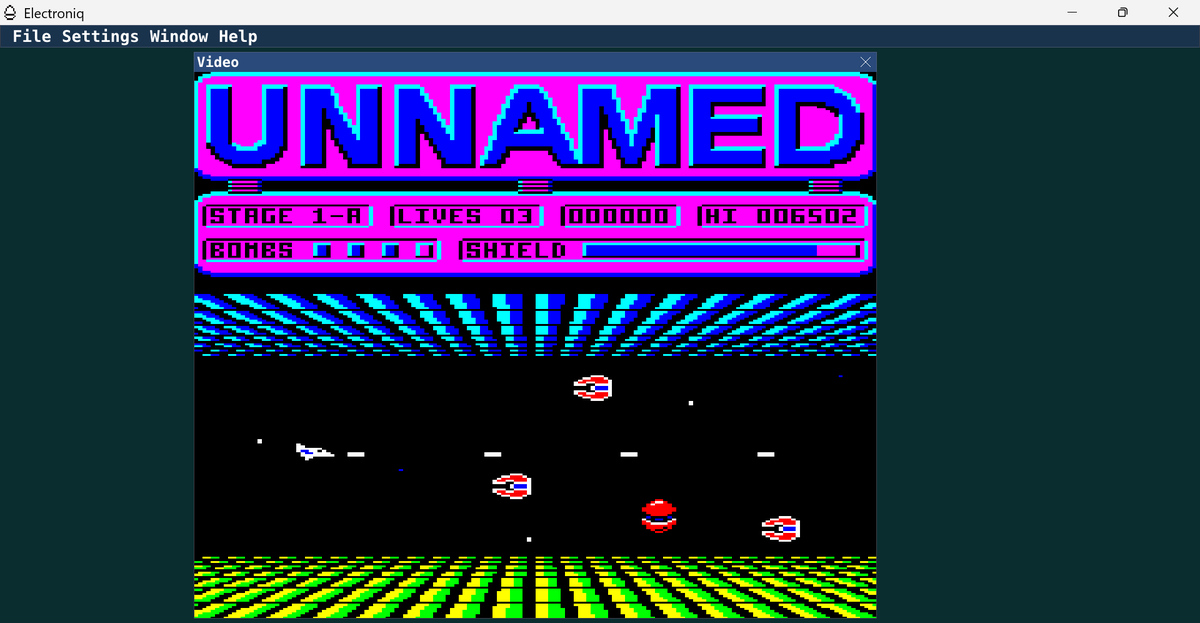
Acorn Electron shoot 'em up WIP. Quick screenshot to show the work I've done on the dashboard / status panel at the top of the screen
0xC0DE tweet media
English
7
12
64
1.8K
Toby Langford retweetledi
arin
arin@ArinVerma1910·
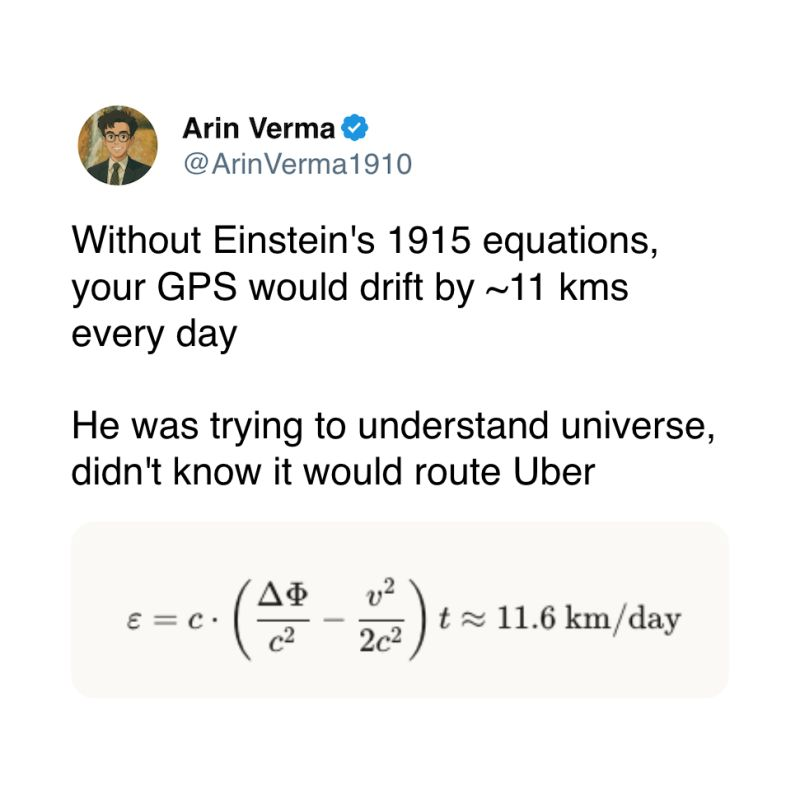
In 1905, Einstein published special relativity. In 1915, he published general relativity. Einstein was just trying to understand the universe. But without Einstein's math, Google Maps would be wrong by 11 kms every single day. Let me tell you why - this is very interesting :)) Your phone doesn't "talk" to GPS satellites. It only listens. Each satellite is broadcasting one thing, constantly: "I am satellite 'A', and it is currently 14:23:00.000000." Your phone receives signals from 4 satellites simultaneously. Because light travels at a known speed, tiny differences in arrival time tell it exactly how far it is from each satellite. 'A' satellite tells you: you're somewhere on a sphere of radius 20,000 km. 'B' satellite: that sphere intersects another sphere - now you're on a circle. 'C' satellite: that circle intersects a third sphere - now you're at 2 points. 'D' satellite: eliminates the last ambiguity and only one point remains. That's you! Except there's a problem nobody thought about until Einstein. The satellites are orbiting at 20,200 km altitude, moving at 14,000 km/h. Two things happen to their clocks simultaneously: - Special relativity: Moving clocks tick slower. At orbital velocity, the satellite clock loses 7.2 microseconds per day - General relativity: Clocks in weaker gravity tick faster. At that altitude, gravity is weaker. The clock gains 45.9 microseconds per day. Net effect: 45.9 - 7.2 = +38.7 microseconds per day. In 38.7 microseconds, light travels 11.6 kilometers. So without correction, the system would accumulate 11.6 km of error. Every single day. In a week, your navigation is useless. The fix is one of the most elegant things in all of engineering. Before each satellite launches, its atomic clock is physically tuned to tick slightly slower than it would on Earth - by exactly 38.7 microseconds per day. Once in orbit, relativistic effects speed it back up. And it arrives at exactly the right rate. Einstein's 1915 paper is baked into the hardware of your phone's navigation system. The next time Google Maps routes you correctly, you're experiencing general relativity. You just didn't know it.
arin tweet media
English
45
614
2.4K
102.1K
Toby Langford retweetledi
0xC0DE
0xC0DE@0xC0DE6502·
You knew the Cobra was coming, because it has to be done! I managed to squeeze out 1 more bit of precision, making the object less jittery. Also, the line drawing is using OR-plotting instead of EOR-plotting at the moment. Next up: back-face culling / hidden line removal
English
8
17
167
8.8K
Toby Langford retweetledi
Math Files
Math Files@Math_files·
bouncing from the focus of one parabola to another 📽: Matthew Henderson
English
9
47
408
59.5K
Toby Langford retweetledi
Mathematica
Mathematica@mathemetica·
Left: A perfect rectangle. Balls bounce in perfect sync forever. Right: One tiny curve and chaos takes over in seconds.
English
11
37
402
86.7K
Toby Langford retweetledi
exQUIZitely 🕹️
exQUIZitely 🕹️@exQUIZitely·
40 years ago Andrew Braybrook created something for the C64 that will probably live on as one of the best C64 games ever made. I can't comment on how Uridium looked and played on other systems, but it was absolutely epic on the C64. It was one of those games that I never managed to finish but always came back to. It has this incredible quality of "just one more try" that could keep you hooked for hours. Though it didn't have a 2-player mode, it was still fun to play in a group, as in you would pass the joystick along and cheered on your friends to just get to that next level, to see what the name of it was. Uridium had 15 levels, each named after a metal element (and changing its color accordingly), with the final level named "Uridium" after a fictional metallic element. Andrew Braybrook and the manual's author, Robert Orchard, invented the name Uridium for the final level, with Orchard noting he initially thought it was a real element. I was pretty bad at chemistry, so I didn't even think twice and thought it was real. Personally, I found it absolutely gorgeous in terms of design: the sprites were super crisp, the animations very smooth, the graphics top notch, and of course, the sound/music was simply iconic. Difficulty was truly through the roof though.
English
28
18
300
14.6K
Toby Langford retweetledi
Math Files
Math Files@Math_files·
The sum of counting numbers arranged in an increasing and then decreasing pattern—such as 1; 1 + 2 + 1; 1 + 2 + 3 + 2 + 1; and so on—always equals a perfect square.
Math Files tweet media
English
11
33
270
14.6K
Toby Langford retweetledi
The Math Flow
The Math Flow@TheMathFlow·
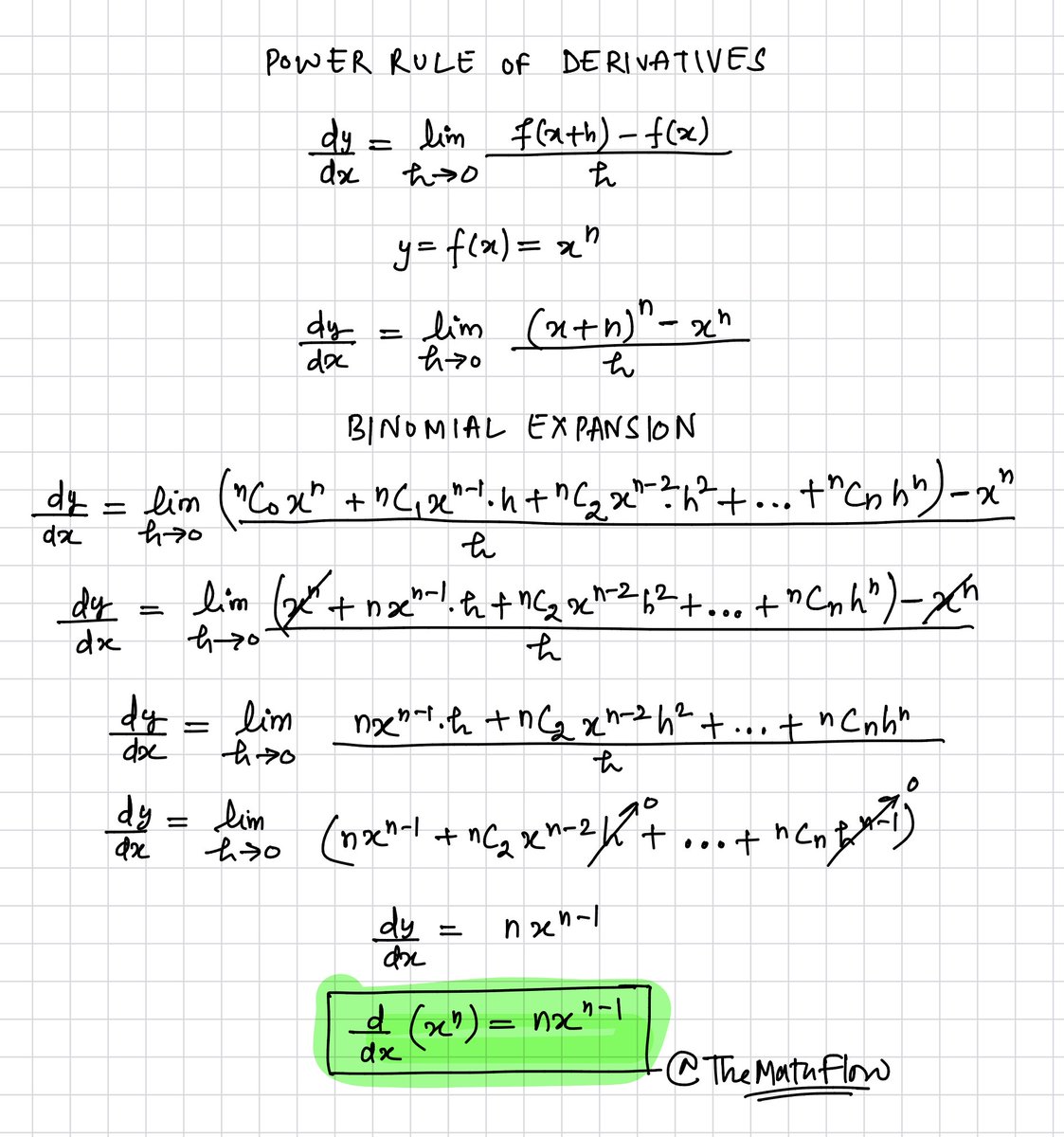
Proof of the Power Rule from First Principle.
The Math Flow tweet media
English
4
102
724
17.8K
Toby Langford retweetledi
Cliff Pickover
Cliff Pickover@pickover·
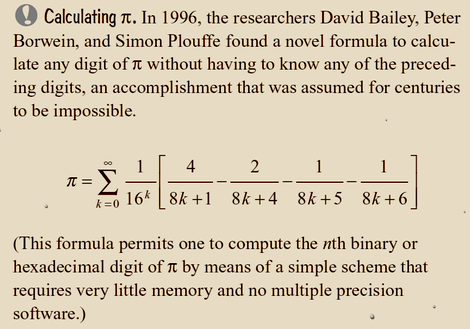
Math. SHOCKING FORMULA to calculate any digit of Pi without needing any preceding digits. Info: tinyurl.com/4tm5ynxr
Cliff Pickover tweet media
English
12
70
341
21K
Toby Langford retweetledi
anul agarwal
anul agarwal@anulagarwal·
You all are overthinking your side projects. >This guy made digital balls physically bounce off real objects/sticky notes using just a webcam, a projector, and JavaScript. Go build something fun. (via ig/bongyunng)
English
124
775
14K
865.2K
Toby Langford retweetledi
Math Files
Math Files@Math_files·
This wordless proof, featured in the Fall 1983 issue of the Pi Mu Epsilon Journal, was developed by Purdue University freshman Hao-Nhen Qua Vu.
Math Files tweet media
English
12
46
326
14.3K
Toby Langford retweetledi
Math Files
Math Files@Math_files·
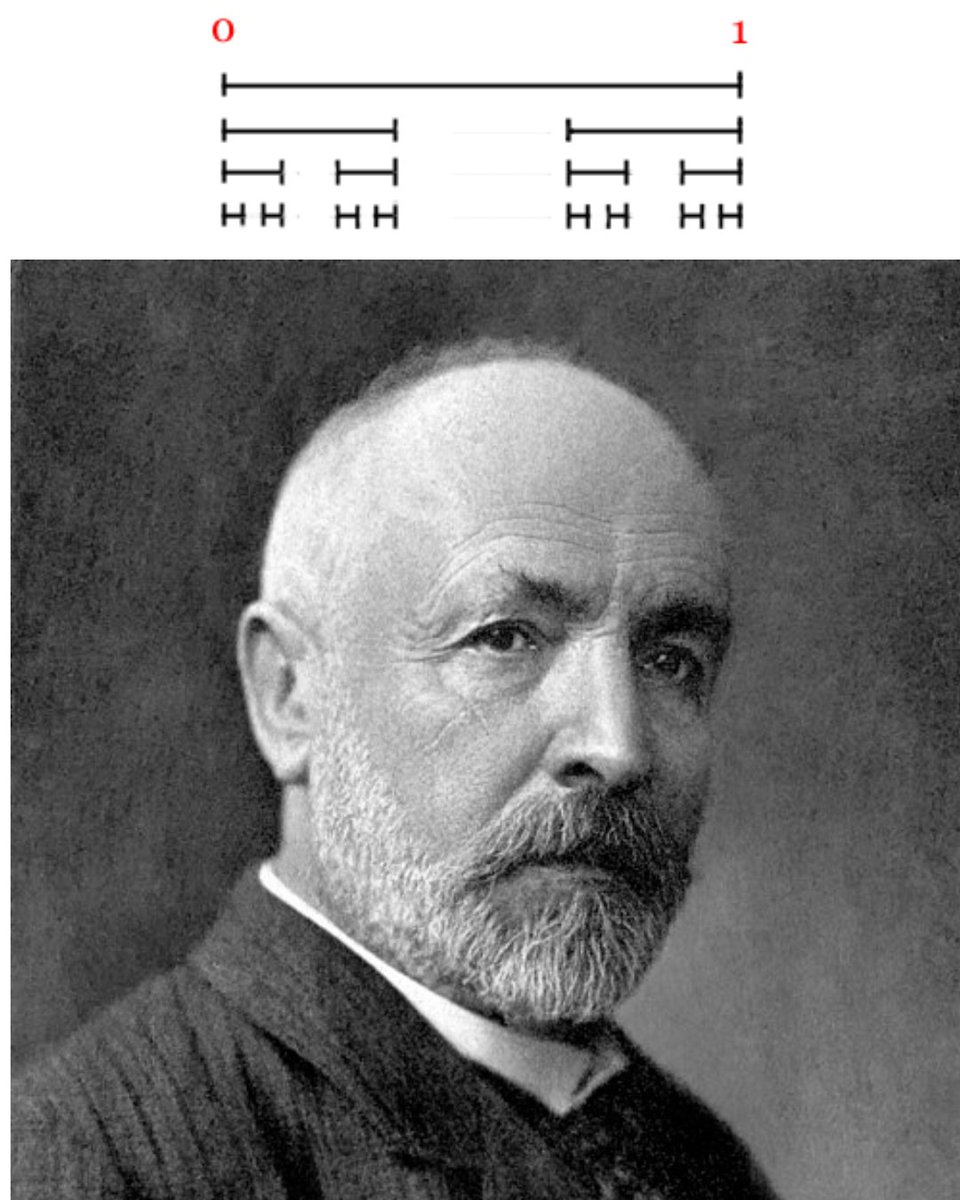
The Cantor set is one of the most surprising ideas in mathematics. Start with the line from 0 to 1, then remove the middle third of it. From the two remaining pieces, remove their middle thirds as well, and keep repeating this process again and again forever. After infinitely many steps, what remains is called the Cantor set. Here’s the strange part: if you add up all the pieces that were removed, their total length becomes exactly 1, which means the Cantor set has zero length. Yet, it is not empty at all. In fact, it still contains infinitely many points. Even more surprisingly, the Cantor set has just as many points as the entire interval from 0 to 1. This means that although it is a smaller part with no length, it is just as “large” in terms of the number of elements it contains. The Cantor set shows how our intuition about size can fail, revealing that something can have no length but still be infinitely rich in structure.
Math Files tweet media
English
30
111
585
43.2K