Barrett

9.9K posts

Barrett banner
Barrett

Barrett

@BarrettYouTube

Living in Shenzhen, China. Creating content about China & Geopolitics.

Shenzhen, China Katılım Haziran 2019
846 Takip Edilen43.5K Takipçiler
Barrett
Barrett@BarrettYouTube·
Every time Western politicians talk about “de-risking” or “reducing dependence on China,” it’s presented as if it’s simply a matter of political will. Build a few factories, move some production, and the problem is solved. Now someone has finally tried to put a price on it. According to new research cited by the Financial Times, the US, Europe and the UK would need to invest an astonishing $23.6 trillion over the next 25 years just to significantly reduce their reliance on China. That’s almost $1 trillion every year,and even then, the report says there is no guarantee they could actually achieve it. The reason is simple. China isn’t just a place that manufactures products cheaply anymore. Over decades it has built complete industrial ecosystems that combine raw materials, advanced manufacturing, engineering talent, logistics, research, software development and highly integrated supply chains. Recreating all of that isn’t something you can do simply by throwing money at the problem. The report also warns that moving production away from China would increase manufacturing costs, push up inflation and require huge additional investments in factories, infrastructure and skilled workers. In other words, consumers would end up paying the bill. Whether you agree with the politics or not, the economics are becoming much harder to ignore. The narrative has always been that decoupling would be difficult. This report suggests it could also be one of the most expensive industrial projects in modern history, and even after spending $23.6 trillion, there is still no certainty that China could be replaced.
Barrett tweet media
English
4
13
46
1.8K
Barrett
Barrett@BarrettYouTube·
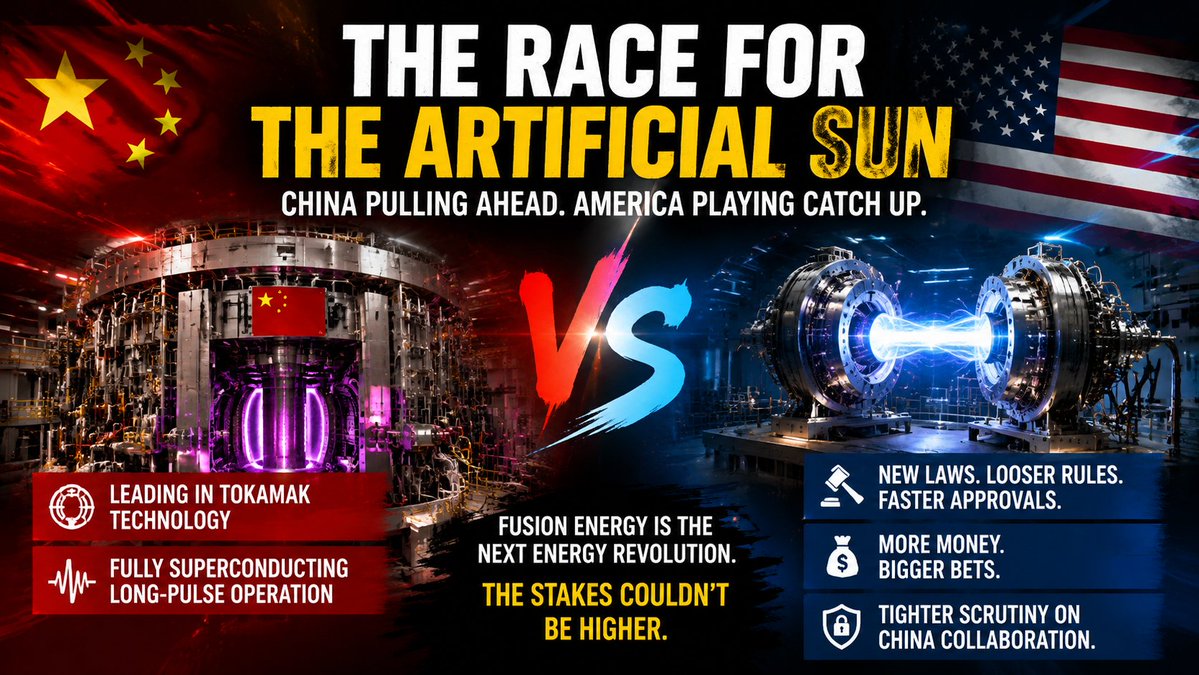
For years we were told China could never catch up with the West in advanced science. Now look at nuclear fusion. The US is openly rewriting regulations, increasing funding, and tightening scrutiny of research partnerships because it believes China is moving too fast. Think about that. If China wasn’t a serious competitor, none of this would be necessary. China is leading in long-pulse superconducting tokamak technology, while the US is racing to commercialise alternative approaches. This isn’t just about who builds the first “artificial sun.” It’s about who controls one of the most important energy technologies of the century. The conversation has shifted from “China can’t” to “How do we stop China pulling further ahead?” That’s a remarkable change in just a few years. And as I have said numerous times, don't underestimate China...
Barrett tweet media
English
3
30
97
6.5K
Barrett
Barrett@BarrettYouTube·
This is how the US and it’s media tries to frame competing companies over cyber security After reading CNBC’s article, many readers would come away believing Duke University’s LiDAR security research exposed a problem with Hesai. But that’s not what the research shows. The Duke demonstration wasn’t carried out on Hesai LiDAR at all. The research used hardware supplied by $OUST , and the paper acknowledges that $OUST provided both the LiDAR sensors and engineering support for the proof-of-concept. That’s an important piece of context missing from the article. The experiment also demonstrated something much narrower than many readers might assume. It showed that if malware is intentionally inserted into a device’s firmware in a controlled lab environment, the device can behave maliciously. The same principle could apply to almost any modern electronic component if its firmware were deliberately compromised. Cybersecurity research is valuable, and these kinds of studies help improve the resilience of connected systems. But accurate reporting matters too. If the research you’re using to support a wider narrative wasn’t even conducted on the company you’re placing in the spotlight, readers deserve to know that.
Serenity@aleabitoreddit

Hesai Technology, a Chinese lidar maker faces US national scrutiny over its expanded partnership with $NVDA and lidar sensors. For $OUST, $AEVA, and Western lidar bros, this is generally positive if competitors get regulated out. Since there were warnings that: Sensors could be disabled or exploited remotely, given Hesai firmware update disabled lidar units on February 29 (as evidence). By second order effect, this is also bullish for upstream laser suppliers too like $LITE and $SIVE that are used in western lidar players.

English
1
4
27
1.7K
Barrett
Barrett@BarrettYouTube·
@alvinfoo The thing about the US, they don't have allies, they only have interests...
English
0
0
11
790
Alvin Foo
Alvin Foo@alvinfoo·
Blindly following US and completely cutting Europe out of the world’s largest semiconductor market is short-sighted and self-harming. ASML and Dutch industry shouldn’t have to sacrifice billions in revenue and future growth just to play geopolitical games. China is too big, too dynamic, and too central to global supply chains to ignore. The current Dutch trade mission is a smart, pragmatic move. Targeted engagement beats blanket restrictions every time.
English
3
1
15
1.2K
Barrett
Barrett@BarrettYouTube·
The US chip war is starting to create problems that Washington probably never expected. The Netherlands is sending a senior trade mission to China, and one company sits right at the centre of it all: ASML. For years, the US has pushed its allies to restrict China’s access to advanced chip technology. But those restrictions don’t come without a cost. Every machine that isn’t sold is revenue lost. Every cancelled order is an opportunity for competitors to catch up. Now even America’s closest partners are starting to ask a difficult question. Why should European companies sacrifice billions of dollars to support American strategic goals? If Europe keeps losing business while China continues investing, innovating and building its own supply chain, who actually benefits in the long run? Sanctions can slow progress, but they rarely stop it. History shows that pressure often pushes countries to become more self-reliant. The more barriers Washington builds, the stronger China’s determination becomes to develop its own technology. The chip war was supposed to contain China. Instead, it may end up driving China towards complete semiconductor independence while leaving America’s allies wondering why they’re the ones paying the bill.
Barrett tweet media
English
38
89
273
15.1K
Barrett
Barrett@BarrettYouTube·
@CN_Americans It doesn't really take a genius to know that ASML will be on the Adgenda!!
English
1
0
3
433
Barrett
Barrett@BarrettYouTube·
@Proea_00 I could not have put it better. It's ridiculous how some people in the collective west seem to think it's beyond the capabilities of China.... I've said on many many occasions.... Do not underestimate China.
English
2
0
4
713
Ash
Ash@Proea_00·
@BarrettYouTube 中国人从不对西方抱有幻想,独立自主,自力更生一直是其发展理念。中国有14亿人,是欧美日韩的总和还多。它有先进的教育体系,充沛的人才供给,突破半导体封锁只是时间问题。
中文
1
0
9
786
YB
YB@YBLi56062416·
@BarrettYouTube Stop selling ASML to China but denied acess to top AI models, EU is really f ked.
English
1
0
2
608
Barrett
Barrett@BarrettYouTube·
@Estadodederech1 Indeed, even if it does get access to ASML machines now. China will still continue to develop its own..
English
0
0
9
492
Estadodederechas
Estadodederechas@Estadodederech1·
@BarrettYouTube Too little,too late, China will never trust western companies for critical technologies.
English
1
0
9
544
Barrett
Barrett@BarrettYouTube·
@alvinfoo great post Alvin, so so true...
English
0
0
2
246
Alvin Foo
Alvin Foo@alvinfoo·
The brutal truth about teams in one 7-second video: France: Full squad synchronized, pulling as one beast.
Argentina: A few grinding, one chilling on the sled.
Portugal: Tight coordination, moving forward.
Norway: One absolute unit dragging everyone while the rest sit like passengers. This is your company. Most “teams” are Norway mode, one or two founders/operators bleeding effort while everyone else consumes. Looks heroic until it collapses. Winners build France mode: zero passengers, ruthless alignment, collective force. Founders: Audit your sled. Cut the dead weight. Align the pullers. Your team right now, France, Portugal, Argentina or Norway? 😄
English
3
9
30
4.1K
Barrett
Barrett@BarrettYouTube·
@OopsGuess Excellent, and 100% correct. It's oh, so easy to blame others for your own policy mistakes...
English
0
1
29
968
𝘊𝘰𝘳𝘳𝘪𝘯𝘦
Ursula von der Leyen said she would explicitly raise the issue of “the massive influx of surplus Chinese products into Europe.” Meanwhile, Chinese air conditioners are seeing a frenzy of demand in the European market, with demand far exceeding supply. China’s response was simple: trade is voluntary exchange, and consumers are capable of making their own judgments. Europe should abandon its zero-sum mentality. At this point, Europe’s decline is not a mystery. It cut off cheap Russian energy in the name of ideology. It weakened its own energy autonomy. It watched Biden’s subsidies pull industry toward America. It got hit by Trump’s tariff war. It lived off old industrial prestige for decades while refusing to update, compete, or scale. And now it turns around and barks at China: Why are you producing so many affordable, high-quality goods? Why are Europeans buying them? Why are Chinese companies making money? Nobody forced European consumers to buy Chinese air conditioners, fans, EVs, solar panels, batteries, appliances, or electronics. They bought them because the goods are useful, affordable, and competitive. That is called a market. If Europe wants to win, it can produce better products at better prices and sell them to China. Europe tried before. Did China scream about European car overcapacity? Did China call Nokia’s dominance in China’s telecom market an existential threat? Did China consider Siemens a market monopoly? Did China accuse every successful Western brand of “flooding” the market? No. Because China competed. Europe does not want competition anymore. It wants moral protection for industrial failure. China did not force Europe to become expensive, slow, dependent, and complacent. Europe did that to itself. Now Chinese factories are making what Europeans need, and Brussels calls that a crisis. But China’s production capacity is not Europe’s problem. Europe’s problem is that it can no longer build what its own people need at prices they can afford.
English
80
610
1.9K
66.3K
Barrett
Barrett@BarrettYouTube·
I was there last week, in that same location, also didn't see many foreigners either, but plenty of Chinese tourists. I think one issue is that many foreigners seem to think they require some sort of special permit to Visit Xinjiang, which is absolutely NOT the case. anyone can just travel there,
English
1
4
17
485
Arnaud Bertrand
Arnaud Bertrand@RnaudBertrand·
I just arrived in Xinjiang for our family holiday and the one thing that immediately strikes me is that, so far, there seems to be virtually no foreign visitors (other than myself). We're in one of THE most touristic spot in the entire region, the central bazaar in Urumqi (which has great food, by the way, offering full refunds if the food doesn't taste good, see picture 👇), and it's fully packed but only with local Uyghurs and visiting Chinese tourists - not a single foreigner around! This is pretty crazy to me: there's so much being said about Xinjiang but obviously people don't bother coming here to check things with their own eyes. Despite there being absolutely zero restrictions to do so: as a French man I can even stay here 30 days visa-free, I just need to book a flight and show up, that's it 🤷‍♂️ I know I sound like a broken record on this but that's the biggest illness affecting commentary on China: people simply speak about it in the abstract without engaging with the reality of the place.
Arnaud Bertrand tweet mediaArnaud Bertrand tweet media
English
304
682
4.9K
328.3K
Barrett
Barrett@BarrettYouTube·
70% of China’s Gold Passes Through Here… And The Security Surprised Me. I honestly couldn’t believe this place. Around 70% of China’s retail gold passes through Shuibei in Shenzhen. Mountains of gold, thousands of traders, and billions worth of jewellery changing hands every year. What surprised me most wasn’t the amount of gold… it was how relaxed the security appeared compared to what I was expecting. Welcome to the beating heart of China’s gold industry.
English
19
104
501
33.7K
Barrett
Barrett@BarrettYouTube·
@RrRjrobinson9 It's Shuibei in Shenzhen, next to Hong Kong.
Deutsch
1
0
5
1.3K
Barrett
Barrett@BarrettYouTube·
Remember when they said America was “protecting” Taiwan? Take another look. Trump is celebrating TSMC doubling down in Arizona and talking about America taking 50% of the global chip market. Think about what that really means. For decades, Taiwan built the world’s most valuable semiconductor company. Now Washington wants more of that technology, more of those jobs, more of that investment, and more of that manufacturing on American soil. It’s no surprise that many people in Taiwan are asking whether TSMC is slowly becoming an American company in everything but name. This is how great powers operate. National interests come first. While China was hit with sanctions and forced to build its own semiconductor industry from scratch, the US is trying to strengthen its position by attracting the world’s leading chipmaker to expand inside America. The lesson? Sanctions don’t stop competition. They accelerate it. And every country ultimately looks after itself first.
Barrett tweet media
English
3
13
40
3.8K
Barrett
Barrett@BarrettYouTube·
@Rena_Angla Indeed it is, however there are still many in the collective west that hold this view. Many are in complete denial of the China of 2026.
English
1
1
6
196
meow
meow@bin58101069·
@BarrettYouTube 其实就是国家的力量和资本的力量的区别, 资本只是为了自己资产的提升进行投资,而国家需要为了国民资产的提升而投资
中文
2
1
10
483
Barrett
Barrett@BarrettYouTube·
For years the world thought China’s advantage was cheap labour. That era is over. I spent a week inside some of China’s most advanced factories in Ningbo, and what I saw was something very different: world-class automation, AI, 5G manufacturing, robotics, and companies building their own global brands instead of manufacturing for someone else’s. Countries hoping to compete with China won’t just need lower costs, they’ll need to match decades of investment in supply chains, infrastructure, engineering talent and manufacturing scale. The world is changing far faster than many people realise.
English
39
237
894
35.8K