Basedash

850 posts

Basedash banner
Basedash

Basedash

@Basedash

The AI-native business intelligence platform. Basedash makes everyone a data analyst.

💾 Katılım Ocak 2020
6 Takip Edilen4.2K Takipçiler
Sabitlenmiş Tweet
Basedash
Basedash@Basedash·
Basedash is live on Product Hunt today! The world's first AI-native Business Intelligence Platform. We loved building this product, and we hope you love it too. producthunt.com/posts/basedash…
English
18
8
89
19.4K
Basedash
Basedash@Basedash·
New in Basedash this week: 1/ Much deeper control over chart appearance 2/ Smarter chat responses with better memory 3/ More granular role-based access controls Quite a few additional small improvements as well. Over the next couple of weeks we'll be focusing on traceability for AI, a new category Basedash is helping to pioneer. To start, we're building one of the first ways to understand how your team is using you company data in MCPs, so you should see some big announcements around that. Hope everyone has a great weekend!
Basedash tweet media
English
0
1
3
118
Basedash retweetledi
Kris Lachance
Kris Lachance@KrisLachance·
We got a new shipment of @Basedash t-shirts! Made in a stealthy black-on-black. Who wants one?
Kris Lachance tweet media
English
6
2
6
496
Basedash retweetledi
Kris Lachance
Kris Lachance@KrisLachance·
Proud to announce that Poolhouse has selected @Basedash as their AI-native BI platform. Poolhouse is a tech-enabled pool entertainment company from the founders of Topgolf, reimagining a 500-year-old sport through interactive games set within hospitality-led venues designed for social experiences. Their team is using Basedash to explore data and ship dashboards with greater speed and self-serve. Welcome aboard!
Kris Lachance tweet media
English
0
2
5
352
Basedash retweetledi
Kris Lachance
Kris Lachance@KrisLachance·
We don't have a user-facing model picker in @Basedash. Tools that do (e.g. Cursor) are primarily optimized around a single persona: engineers. For that audience, model selection can make sense. But we have a product that spans sales, ops, marketing, finance and, yes, engineering. In a cross-functional environment, a model picker introduces friction and doubt, without any benefit to the end user. In the best cases, a model picker still has tradeoffs. One customer (a CTO) recently told us, half-jokingly, "I still have PTSD" from a specific model they were using in Cursor. Even AI-native users don't actually want to be the one accountable for picking the model behind every answer; they just want the answer to be right. Scenarios like this are exactly what we want to avoid. Selecting the right model for a workload is a design decision. You have to account for context windows. Reasoning quality. Speed. Latency. Cost. Failure modes. Plus a bunch of other stuff. In our view, design decisions should be made by us, not by the end user. That's what we get paid for. We want our customers to have fewer things to think about in their day. That's why we focus on routing to the best model per task: chart generation, chat response, and SQL writing each have different optimal models. We continuously benchmark against our own evals, and swap the moment something better ships. The routing is invisible, but it is governed. Our evals catch regressions and our workflows preserve consistency. Best of all? Customers get the benefit of model improvements, without having to manage the complexity themselves.
English
0
1
3
116
Basedash
Basedash@Basedash·
Introducing: Basedash for Slack. Your AI data analyst, now living in the place your team already talks. Now officially available on the Slack marketplace. Try it today.
English
3
2
6
650
Basedash
Basedash@Basedash·
AI is excellent at exploring data, but teams still need deterministic calculations for the metrics they run the business on. If “activation rate” means completed onboarding within seven days, every chart, dashboard, and report should use that same calculation. Before the Basedash semantic layer, the usual options were copy-pasting SQL, writing prose instructions for the AI, or relying on an external semantic layer that lived outside the product where the analysis happened. Those all work until the metric changes, the SQL drifts, or someone asks the AI a question from a different workflow. The Basedash semantic layer brings that modeling layer into the same product where your team asks questions, builds dashboards, and automates reports. Your warehouse, synced data, reusable SQL models, AI analyst, BI dashboards, reports, and automations can now live in one place. basedash.com/blog/introduci…
English
1
0
3
242
Basedash
Basedash@Basedash·
Introducing the Basedash semantic layer. Define your metrics once. Generate trusted dashboards and reports every time.
English
8
2
16
165.2K
Basedash
Basedash@Basedash·
Try these features in Basedash today. Lots more to come this summer.
Basedash tweet media
English
0
0
3
58
Basedash
Basedash@Basedash·
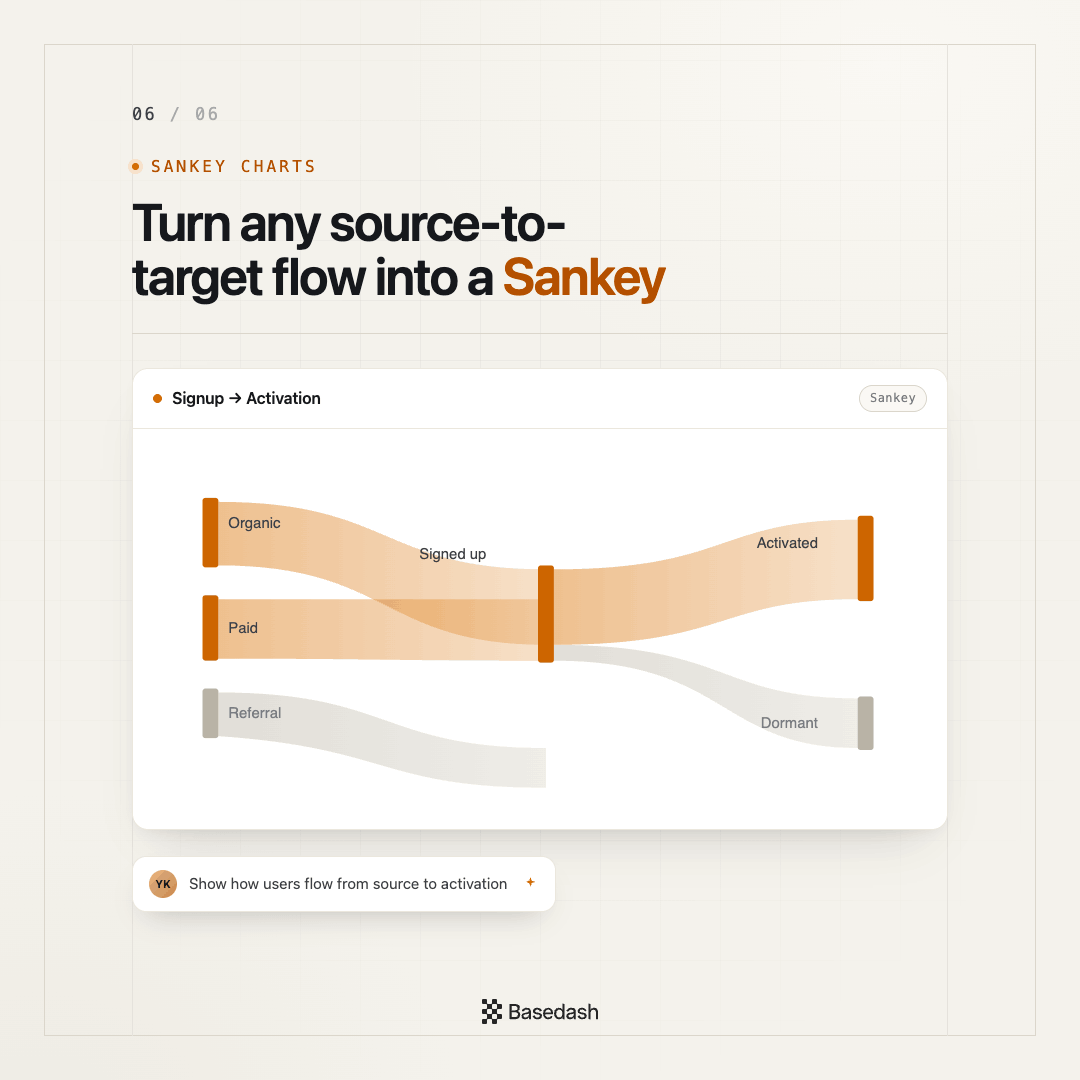
6/ Sankey charts: Funnels, transitions, attribution paths, anything with a source-to-target shape now renders as a proper Sankey diagram. Describe the flow in chat and the agent wires it up.
Basedash tweet media
English
1
0
3
76
Basedash
Basedash@Basedash·
The last month at Basedash was our busiest yet. Here's a small snapshot of what we've shipped over the past 30 days: 1/ Dashboard Agent: The first AI agent that builds entire dashboards end-to-end. Ask for what you want to see and it picks the charts, metrics, and time series for you.
Basedash tweet media
English
1
2
5
361
Basedash
Basedash@Basedash·
Basedash Embedding is now generally available. Embedding puts the full power of Basedash inside your own product. Drop a dashboard in with one iframe, or embed the entire platform so your customers can chat with the AI agent, build their own dashboards, and get automatic insights. All without ever leaving you.
English
4
2
6
306