Bobline Mace

2K posts

Bobline Mace banner
Bobline Mace

Bobline Mace

@BbiiraKevin

everything everything

Katılım Ocak 2023
1.3K Takip Edilen88 Takipçiler
Bobline Mace retweetledi
mustafa dilo
mustafa dilo@MustafaDelw·
ابراهيم ديارا بعد الاصابة مازال متألق🙏
العربية
6
28
703
15.4K
Bobline Mace retweetledi
Gaspar
Gaspar@igasparens·
A theoretical physics course opens not with equations but with the rules for saying anything true at all. This is lecture 1 of Lectures on the Geometric Anatomy of Theoretical Physics, taught by Frederic Schuller. The topic is propositional and predicate logic. Most physics courses assume logic and start with mechanics. Schuller refuses. Before manifolds, before tensors, before a single physical claim, he builds the language the claims will be written in. The audience is advanced students who have already met the physics. He is going back under it and rebuilding the floor. Watch how precisely he states each rule, then shows what collapses if you loosen it. No appeals to intuition anywhere in the hour. A machine learning engineer I know worked through the first 10 lectures and said proofs stopped feeling like a different profession. Free on YouTube, green chalkboard, German lecture hall. Everyone starts with the physics. He started with what counts as true.
Merlow@exeMerlow

x.com/i/article/2080…

English
1
29
129
8.2K
Bobline Mace retweetledi
tsukiema
tsukiema@tsukiema_·
This paper is f*cking insane A quant paper microfounds GARCH models by replacing rational expectations in Kyle's market model with adaptive learning agents The result: market feedback loops generate fat-tailed return distributions, volatility clustering, and 2.5x excess volatility without needing news shocks The crazy part is how price volatility emerges purely from agent behavioral loops Traders update price impact estimates through inductive belief revisions, driving excess variance into a Kesten stochastic process Most financial models assume volatility comes from external economic news This framework proves market structure and agent adaptation generate volatility clustering internally Read the complete paper + article below Bookmark it for future reference
tsukiema tweet media
tsukiema@tsukiema_

x.com/i/article/2081…

English
5
16
147
10K
Bobline Mace retweetledi
Trackmind
Trackmind@0xTrackmind·
25 of Wall Street's most elite quants just told the whole story these are the people behind the firms that print billions and never say a word publicly. their real backgrounds, their actual mistakes, how they genuinely broke in. and none of it reads like the myth everyone's sold on. bookmark for later.
Trackmind tweet media
Trackmind@0xTrackmind

x.com/i/article/2080…

English
6
10
73
2.9K
Bobline Mace retweetledi
Cosmos Archive
Cosmos Archive@cosmosarcive·
In 1924, Louis de Broglie proposed that every moving particle has a wave associated with it. His bold idea became the foundation of wave mechanics and was later confirmed by experiments, helping shape modern quantum physics. The key relation is simple: λ = h/p For a particle with kinetic energy E: λ = h/√(2mE) This means faster particles have more momentum, so their wavelength becomes smaller. It is one of the simplest equations with one of the biggest impacts in science, leading to technologies like electron microscopes and advancing our understanding of the quantum world.
Cosmos Archive tweet media
English
4
22
94
1.9K
Bobline Mace retweetledi
venus
venus@RitOnchain·
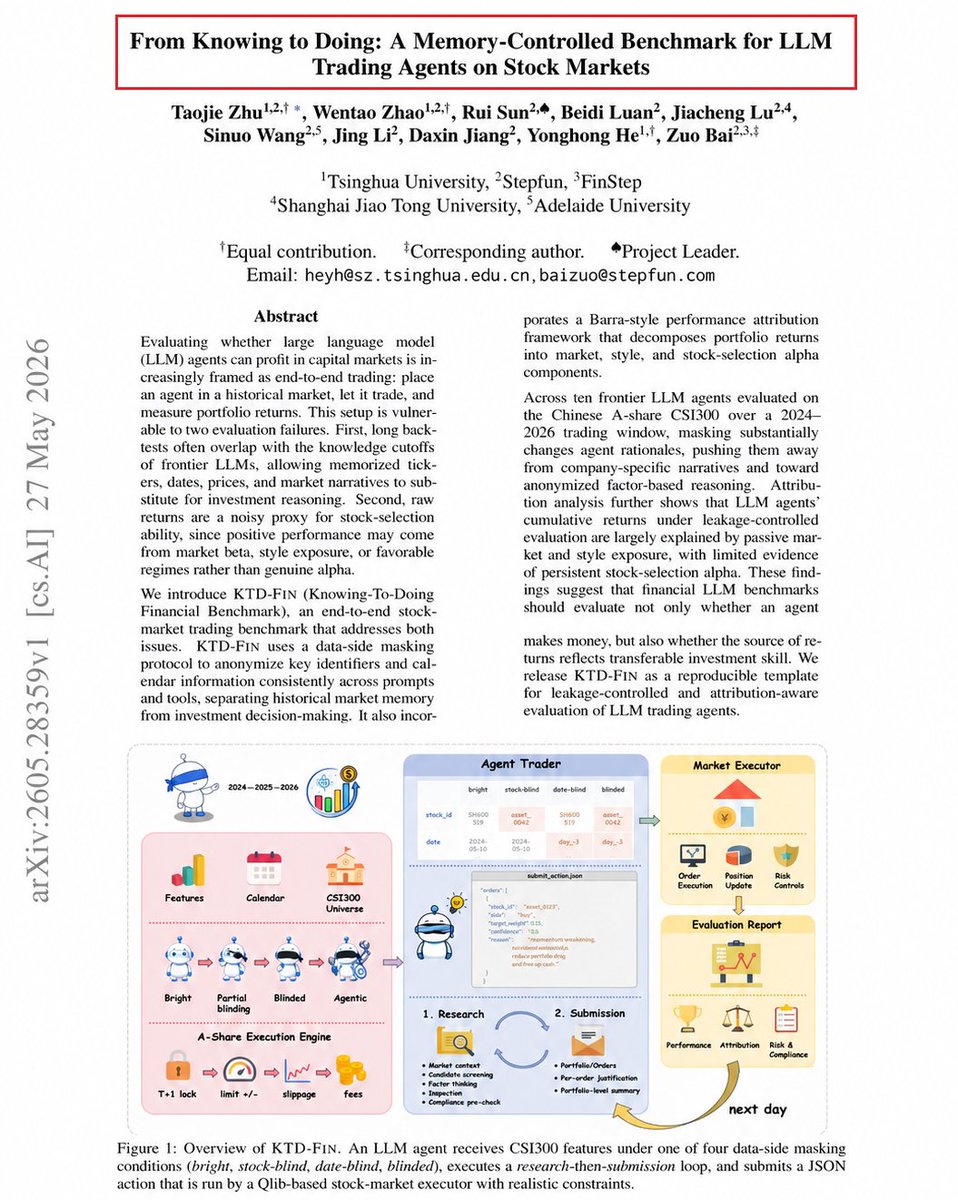
As anyone building trading agents knows, the hardest part isn't getting an LLM to place a trade. It's proving the model isn't just pattern-matching a name it already knows from pretraining. This paper solved it with a 4-level masking protocol - hide the ticker, hide the date, or both - then had an independent panel of LLMs try to break it. Sharpe ratio: 2.02 Bookmark it, this is best read of week for me.
venus tweet media
venus@RitOnchain

x.com/i/article/2079…

English
9
15
122
7.1K
Bobline Mace retweetledi
Quant Science
Quant Science@quantscience_·
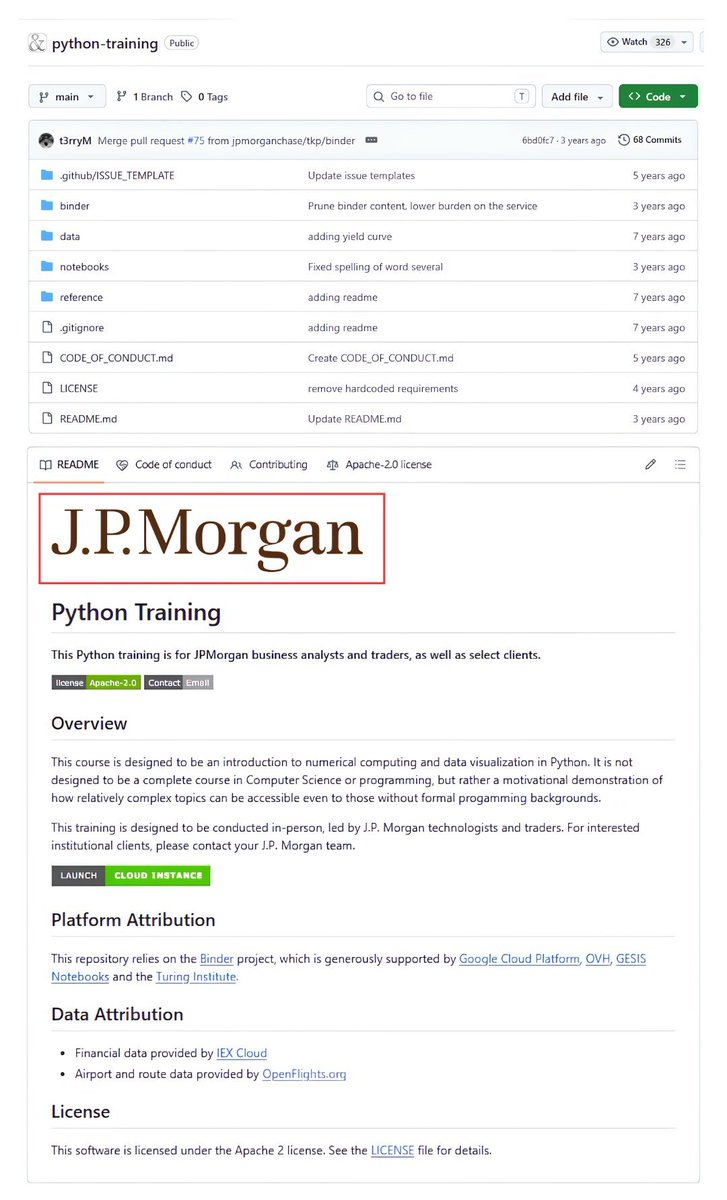
J.P. Morgan pays $650,000+ a year for quants. They built this exact Python training to get you there & released it for free. Zero to quant directly from J.P. Morgan technologists. Bookmark this before someone takes it down:
Quant Science tweet media
English
3
11
105
9.7K
Bobline Mace retweetledi
Nainsi Dwivedi
Nainsi Dwivedi@NainsiDwiv50980·
Everyone is talking about AI agents. Very few people are building the thing that actually makes them powerful: Context. The people who win with AI over the next few years won't necessarily have better prompts. They'll have better memory systems. Because every time you don't save an insight, connect an idea, or capture a thought... you're forcing yourself to start from zero again. Meanwhile, a small group is quietly building something different: → years of notes → connected ideas → reading highlights → project histories → personal patterns → accumulated context Then they plug AI into it. That's when AI stops being a chatbot. And starts becoming a thinking partner. This is why I'm so bullish on Obsidian. Not because it's a note-taking app. Because it's an engine for compounding knowledge. Every note can become: • a future insight • a content idea • a business opportunity • a connection you would've otherwise missed The gap between people using AI and people using AI + personal context is going to get ridiculously large. One group will ask better questions. The other group will build systems that think with them. Five years from now, your most valuable asset may not be your prompts. It may be the context you've been compounding in private. I made this infographic to show the framework I use to turn Obsidian from a storage app into a second brain that actually creates leverage. Bookmark it. Your future self might thank you. 🧠⚡️
Nainsi Dwivedi tweet media
Suryansh Tiwari@Suryanshti777

x.com/i/article/2077…

English
0
22
109
8.3K
Bobline Mace retweetledi
Khairallah AL-Awady
Khairallah AL-Awady@eng_khairallah1·
Andrew Ng just released a free 1-hour course on building agentic knowledge Graphs from scratch: • 00:00 - Introduction to agentic knowledge Graphs • 03:07 - Building a graph from scratch • 14:00 - Architecture of multi-agent systems • 23:00 - Building a real one with Google ADK • 01:06:03 - Why Graphsare the future of agentic AI This 1-hour workshop will replace 10 paid courses on agentic engineering. Watch it today, then learn how to become a Graph Engineer in the article below.
Khairallah AL-Awady@eng_khairallah1

x.com/i/article/2082…

English
12
33
164
15.4K
Bobline Mace retweetledi
Dominique
Dominique@0xDominiqq·
Euler's formula is not a formula. An MIT professor spent a whole lecture proving it is a definition, not a discovery. This is 18.03, Lecture 6, Arthur Mattuck. Free on MIT OpenCourseWare. The formula is e^(iθ) = cos θ + i sin θ. Most people memorize it and move on. Mattuck refused to. He asked one thing. What gives that the right to be called an exponential at all? An exponential has to obey one law: e^a · e^b = e^(a+b). So he checked it. He multiplied e^(iθ₁) by e^(iθ₂), expanded the sines and cosines, and looked at what fell out. The angle-addition identities. cos(A+B) and sin(A+B), the two formulas you were forced to memorize in school. They were never two formulas. They are one line: e^(iθ) obeying the law of exponents. Then the payoff. An integral that normally needs integration by parts twice and a trick, ∫ e^(-x) cos x dx, drops out in a few lines once you let the numbers go complex. Nothing is easier to integrate than an exponential. Someone once asked him what beauty in math looks like. He pointed at the board. Something long became something short, and lost nothing.
Niko@0xNiko1

x.com/i/article/2081…

English
9
100
570
41.8K
Bobline Mace retweetledi
rvaniaaa
rvaniaaa@rvaniaaaa·
An Anthropic engineer shared the exact system they use as a second brain. Three folders. One file. One evening to build. Most people use Claude the same way every day. Open a new tab. Rebuild context. Get an answer. Close the tab. Tomorrow it remembers nothing. You are still the one holding all the context. You are still the one resetting. This architecture solves that problem. The system is built around three folders and one file. raw/ holds everything unstructured. Articles, transcripts, PDFs, voice memos, screenshots. Drop it in and never touch it again. Immutable ground truth. wiki/ is where Claude converts everything in raw into structured, linked, cross-referenced knowledge. Clean. Organized. This is the folder Claude actually thinks from. The human reads it. The model writes it. output/ is where finished work lands. Reports, posts, documents, presentations. Everything Claude builds using the wiki as its source. At the center is CLAUDE.md. Not a prompt, but a persistent layer of identity, preferences, goals, and project context. Claude reads it before every session. You never explain yourself again. Five automations run the system. Ingest captures and extracts new sources into the wiki. Write retrieves context and drafts outputs. Manage links decisions to context. Review summarizes and updates. Maintain prunes and improves connections. Every session adds to the system. Every source makes the wiki smarter. The returns compound over time. One month in, context stops disappearing. Three months in, the vault surfaces ideas you forgot you had. Six months in, the gap between compounding and resetting becomes impossible to ignore. Build once. Maintain daily. Let it compound. Bookmark this.
rvaniaaa tweet media
Ryven@imryven

x.com/i/article/2082…

English
33
151
1K
137K
Bobline Mace retweetledi
Mr. Buzzoni
Mr. Buzzoni@polydao·
ANTHROPIC ENGINEERS JUST SHOWED HOW THEY BUILD A FULL APP FROM SCRATCH USING A LOOP OF AGENTS 36 minutes from the team behind Claude Code three agents, cycling until the app actually works: > one plans > one builds > one judges the winners won't have the smartest model they'll have the best loop watch it, then read the full guide on using loops below 👇
Mr. Buzzoni@polydao

x.com/i/article/2073…

English
13
22
152
15.7K
Bobline Mace retweetledi
AI Frontliner
AI Frontliner@AIFrontliner·
Andrew Ng just dropped a 3-hour course on how to become an AI Engineer in 2026: • 00:00 - How to build agentic AI systems • 04:25 - Future of AI engineering • 23:38 - AI Prompting full course • 2:52:17 - Creating an app with AI in 30 minutes This 3-hour watch could replace 10 AI engineering courses on the internet. Watch it today, then read the 12- month path to becoming an AI Engineer in the article below.
The AI Colony@TheAIColony

x.com/i/article/2077…

English
12
86
336
34.6K
Bobline Mace retweetledi
Ritika Agrawal
Ritika Agrawal@RitikaAgrawal08·
How does the AI find the right information among thousands or millions of them? AI applications often need to find information before they can do something useful with it. A normal keyword search isn't always enough. A user might ask: "I forgot my password. How can I reset it?" But the relevant document might say: "You can reset your credentials from account settings." The words aren't exactly the same, but the meaning is similar. This is where embeddings and vector databases come in. ✨ What is a Vector Database? A vector database is a database designed to store and search embeddings. An embedding represents information as a vector. A list of numbers that captures patterns and relationships in the data. When an AI application processes a document, each chunk is converted into an embedding. For example : "You can reset your password from account settings." might be converted into : [0.21, -0.43, 0.87, ...] The vector database stores this embedding along with useful information such as : → The original text → Document ID → Metadata → Source ✨ What happens when the user asks a question? Suppose the user asks : "I forgot my password. How can I reset it?" The application : → Converts the question into an embedding → Searches the vector database → Finds the most similar vectors → Retrieves the corresponding text chunks → Adds them to the prompt → Sends the prompt to the LLM The LLM then generates the answer using the retrieved information. ✨ Why not use a normal database? A traditional database is great at queries like : "WHERE user_id = 123" But AI applications often need a different kind of search: "Find information that is semantically similar to this question." That's what vector databases are optimized for. The important thing to remember : The vector database doesn't generate the answer. It finds the relevant information. The application retrieves it. The LLM reasons over it. That's why vector databases have become an important building block across modern AI applications, from ChatGPT and Claude Code to Cursor, GitHub Copilot, Bug0 , and AI-powered search and recommendation systems.
Ritika Agrawal tweet media
English
9
14
68
2K
Bobline Mace retweetledi
Roan
Roan@RohOnChain·
Don't waste 2 years learning to become an AI agentic engineer in 2026. Andrew Ng, the godfather of AI, gave the complete playbook to become one from scratch. 1 hour course. Free: • 00:00 - AI agent basics • 12:12 - AI Agentic workflows & design patterns • 53:27 - Practical tips for building AI agents • 1:20:30 - self-improving AI agent loops • 1:30:19 - multi-agent AI systems I watched it last night. Halfway through, I realized I could get into Anthropic in weeks, not years. Bookmark now. Watch it. Then build your own AI agent with the guide below.
Roan@RohOnChain

x.com/i/article/2079…

English
28
160
808
64.5K