
Sabitlenmiş Tweet
Belette
34.9K posts

Belette
@BcBelette
Immobilier, automobile, politique, et bien évidement : les aventures de la Belette !
Tournus, France Katılım Kasım 2013
1.3K Takip Edilen1.5K Takipçiler


@BcBelette Je suis d’accord avec ça, ce n’est pas le problème. C’est la façon de dire qui n’a pas été bonne.
Elle lui avoue qu’elle est amoureuse. La moindre des choses de dire que ça ne se fera pas mais avec gentillesse tu vois ? Comme quand tu apprécies un minimum la personne
Français
J’ai missionné mini moi pour faire un dessin à une copine pour ce soir.
Encore une que je ramasse à la petite cuillère parce que devinez quoi?
Elle est tombée amoureuse de son plan Q qui lui a lâchement balancé « ah mais t’as vraiment cru que ça se ferait toi et moi? »
0 tact
Français
@SpookyScaryAnna Je ne sais plus 🤷♂️
On connaît les propriétaires, mais elle est surtout trop vieille et trop caractérielle pour que la Belette la monte 😥
Français


@SpookyScaryAnna Vi 😊
Ça faisait un moment que nous n’étions pas passé à voir !
Français
Belette retweetledi

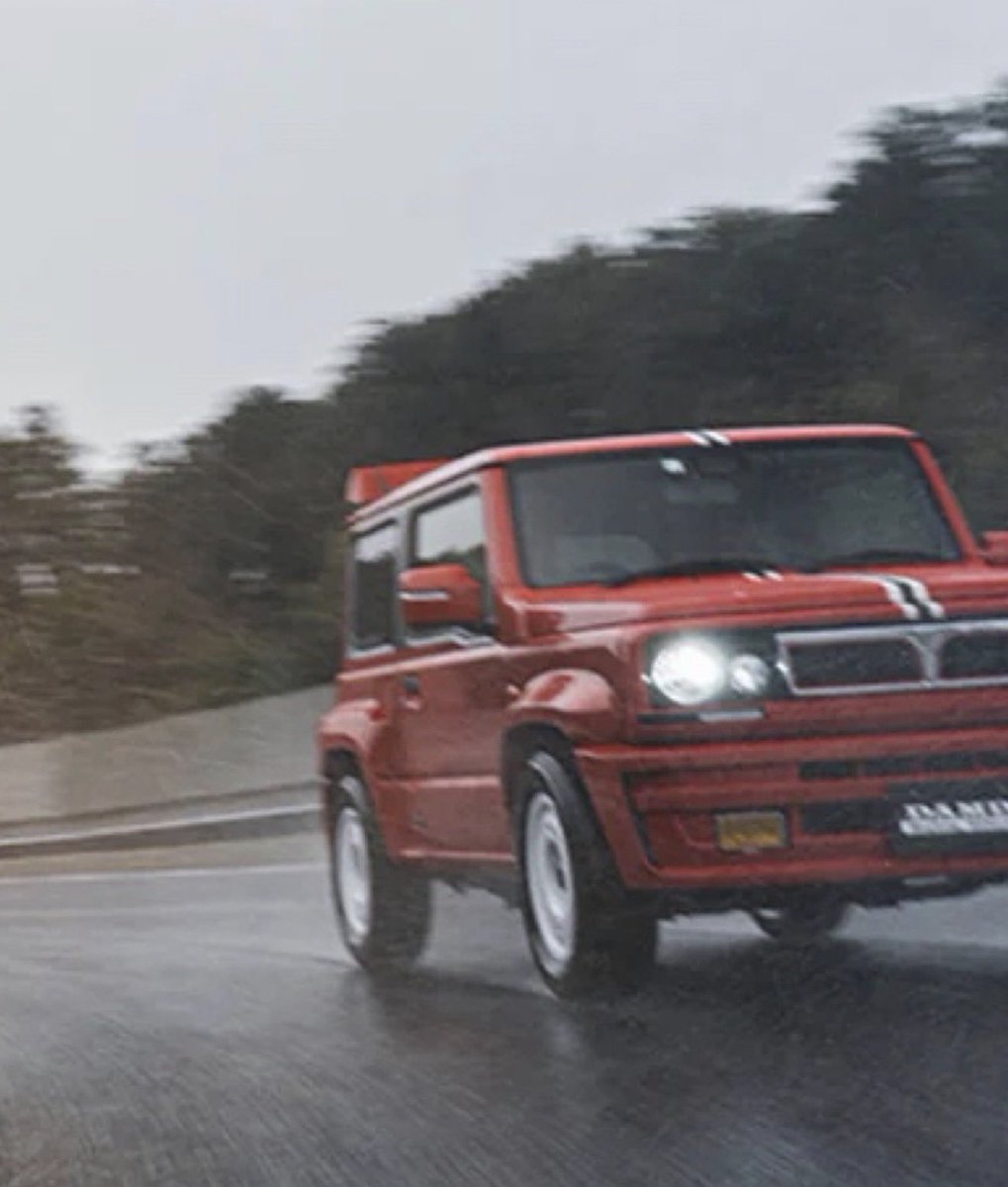
There is a company called DAMD who for £4000 will supply you with a kit to turn your Suzuki Jimny into a Lancia Delta Integrale! I love car people!



English
@little_dory95 Grand corps malade a écrit une très belle chanson sur ce principe.
Français

@minihibou007 J’avais acheté la même boite 😁
Des heures et des heures et des heures de coloriages 🥰
Profitez bien !
Français


Belette retweetledi


Le problème c'est pas la sexualité du candidat. C'est sa compétence et ses valeurs. Et éventuellement un bout de programme
Impact@ImpactMediaFR
🇫🇷🏳️🌈 FLASH Les Français sont prêts à élire un président ouvertement homosexuel, affirme Gabriel Attal. (Brut)
Français
Parce que la courbe de Laffer s’applique à d’autres domaines…
Tu augmentes les prix, tu emmerdes les gens, au final… les gens font ce qu’ils veulent ;-)
On est passé d’un Pays avec 6 ramassages par semaine à 0, en explosant la facture 🤷♂️
ICI Occitanie@icioccitanie
🗑️ À Saint-Jean par exemple, la municipalité est contrainte de ramasser elle-même les dépôts sauvages de plus en plus nombreux ➡️ l.ici.fr/TTLY
Français
Belette retweetledi

Murph is in her nineties when she sees her dad for the last time at the end of Interstellar. He is 47. Christopher Nolan had a Nobel Prize-winning physicist work out exactly how old everyone should be before he started filming.
The physicist was Kip Thorne. He won the 2017 Nobel Prize in Physics for helping detect gravitational waves, which are tiny ripples in spacetime caused by huge events like two black holes crashing into each other. On Interstellar, he was the science advisor and an executive producer.
Cooper barely ages while his daughter gets old enough to be his grandmother because of one decision early in the film: landing on Miller's planet. Miller orbits a black hole called Gargantua, with the mass of 100 million suns and spinning almost as fast as physics allows. That close to it, one hour on the planet's surface equals seven years back on Earth. The crew spends about three hours and seventeen minutes on the surface. By the time they get back to orbit, 23 years, four months and eight days have passed at home. Cooper's son is now older than him.
When Cooper finally wakes up in a hospital bed in orbit around Saturn, the doctor tells him that by Earth's calendar he is 124 years old. His body has aged about twelve years over the whole mission. On Earth, eighty-nine years have passed. The numbers come straight out of Einstein's general relativity, the same theory that makes the GPS in your phone work. GPS satellites have to correct their clocks every day, because gravity actually changes how fast time passes.
Gargantua itself was built using a custom piece of software called the Double Negative Gravitational Renderer. The visual effects team wrote new code to trace each beam of light as it bent through the warped space around a spinning black hole. The work turned into two peer-reviewed physics papers in 2015, in Classical and Quantum Gravity and the American Journal of Physics. The film won that year's Academy Award for Best Visual Effects. The rendering was so accurate that the team's calculations revealed details about how light bends near spinning black holes that physicists hadn't seen visualized before.
All those numbers add up to the hospital scene. Murph tells Cooper that a parent should not have to watch their own child die, and sends him back out to find Brand. The screenplay describes him "watching them, their love, as if from another dimension. A man out of time. A ghost." Nolan never explains the scene further. In April 2019, five years after Interstellar came out, a network of radio telescopes around the world called the Event Horizon Telescope released the first real photograph of a black hole. The orange ring around its dark center looked like a fuzzier version of what Christopher Nolan and Kip Thorne had already put on screen in 2014.
Best Movie Moments 🍿@BestMovieMom
Christopher Nolan never explained the ending of Interstellar (2014). When asked if Cooper’s reunion with his daughter was real or symbolic, he said, “It’s not about what you see, it’s about what you feel.” The emotion mattered more than the answer.
English
Belette retweetledi

That water clarity is an engineering decision, and the math behind it is wilder than the video.
Roman aqueducts ran on gravity alone. No pumps, no pressure systems. Engineers carved channels with a gradient so shallow it borders on absurd. The Pont du Gard in southern France drops 2.5 centimeters over 275 meters. That's roughly the thickness of a coin over the length of three football fields. They surveyed that accuracy with plumb lines and wooden leveling instruments.
The clarity you're seeing is a direct product of flow velocity. Too steep and the water erodes the channel walls, picks up sediment, turns brown. Too flat and it stagnates. Roman engineers targeted a slope of about 20 centimeters per kilometer, which kept the water moving fast enough to stay fresh but slow enough to stay clear. Before the water reached the city, it passed through multi-chamber settling tanks where velocity dropped near zero. Suspended particles sank. Clean water flowed out the top into the next chamber. Repeat three or four times.
Pliny specified the minimum slope in writing. Vitruvius published the exact mortar ratio for hydraulic cement: one part lime to two parts volcanic ash for underwater work. The pozzolana from Pozzuoli reacted with water to form a calcium-aluminum-silicate compound that actually gets stronger the longer it sits submerged. Modern concrete degrades in water. Roman concrete bonds with it.
Scale the whole system and it gets harder to process. Eleven aqueducts fed Rome at its peak. Combined output: roughly 1 million cubic meters of water per day. That works out to about 250 gallons per person for a city of one million. Modern New York delivers about 125 gallons per person per day. Ancient Rome had access to double the per capita water supply of the largest city in the United States, running entirely on slope and stone.
The Trevi Fountain in Rome is still fed by one of them. Two thousand years, same source, same gravity, same water.
Ulises@UlisesDavid__
🚨| La claridad de un acueducto del imperio Romano, de hace 2000 años
English
@Jean_Ninetutor Je l’ai utilisé sur la Lancia d’un pote !
Mais apparemment, réservée aux modèles sportifs.
Français

Je me demande si c'est une image IA ou s'ils ont vraiment dégoté une boîte avec 1e en bas à gauche ?
Y'avait ça sur les Ferrari, certaines Mercedes, peut-être Porsche, mais y a-t-il eu des voitures "roturieres" avec cette grille ?
Les 2CV et je crois 404 mais pas au plancher.
20 Minutes@20Minutes
« On a de moins en moins de demande » ➡️ 20min.fr/Aep
Français
Belette retweetledi
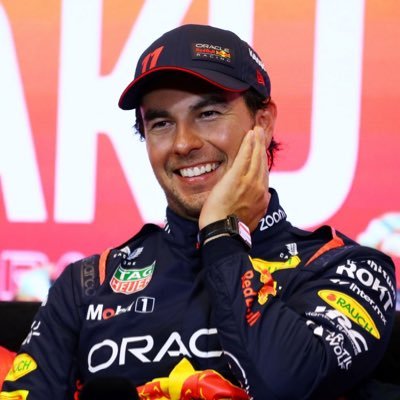
Max: “He estado conduciendo distintos tipos de autos, y el fin de semana pasado (Nürburgring) me recordó lo puro y grandioso que el automovilismo puede ser, y luego regresas a F1… Incluso si nos dieras un auto rentado les daríamos un gran show, no es eso. Para mí es confuso, no es lo que F1 debería ser, es muy complicado, que está permitido, cuando estás adelante o atrás, en la vuelta de formación… todo eso es una pena que tengamos que lidiar con eso. F1 debería ser más pura. Y espero que los cambios que hagan el año siguiente sean lo mínimo necesario para volverlo más natural.”
GRÍTALO MAX
#CanadaGP
Español
Belette retweetledi


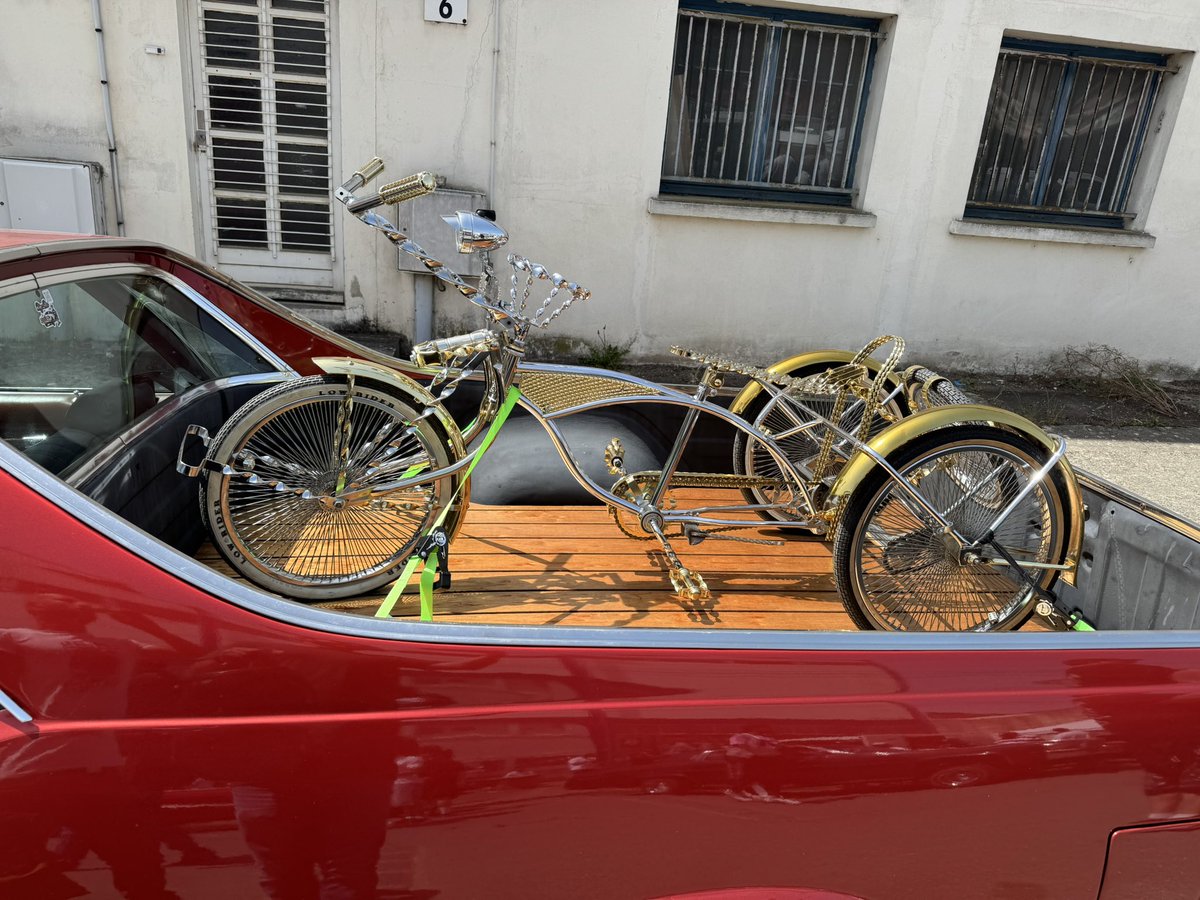
@JeNeToucheARien Oh la El Camino (sauf erreur) et le « vélo ». À mourir ça !
Français
Belette retweetledi


Belette retweetledi
