Ben Fletcher

22.9K posts

Ben Fletcher banner
Ben Fletcher

Ben Fletcher

@BenFletch

CEO & Founder @themothershipai. A platform building consumer brands to their full potential | Founder @FastGrowthIcons

London Katılım Ekim 2009
616 Takip Edilen3.1K Takipçiler
Aaron Rubin
Aaron Rubin@aaronrubin·
@ShinghiD You can ask AI to explain what any piece of code does. Works quite well
English
1
0
0
86
Shinghi
Shinghi@ShinghiD·
I see it a different way. Investing heavily in AI at your company backfires when anyone who's built their own tool for you becomes a key man risk. You can no longer let go of bad employees due to the risk and lack of understanding of what they built, how to use it, and how to maintain it.
Nick Huber@sweatystartup

Investing heavily in AI at your company will backfire. You are becoming dependent on something that is unsustainable. The VC money will dry up once they realize nobody is going to make any money in the long run except NVDA and the power companies. The subsidies will stop. And your costs will 5x. There is no moat in AI. Switching from GPT to gemini to grok to claude takes seconds and you don't miss a beat. Its a house of cards.

English
1
0
0
478
Jesse Pujji
Jesse Pujji@jspujji·
I recently spoke to a marketer who ran a $40M brand with just two designers and ONE AI process. I paid him 6 figs to build these systems for my companies. He chains together 7 AI tools: creative brief → image gen → scale winning assets. All run by 2 offshore designers. I’m giving away his entire operating system for free. Comment “AI” and I’ll send it.
English
722
13
354
58.5K
Tom W Brown
Tom W Brown@TomBrown·
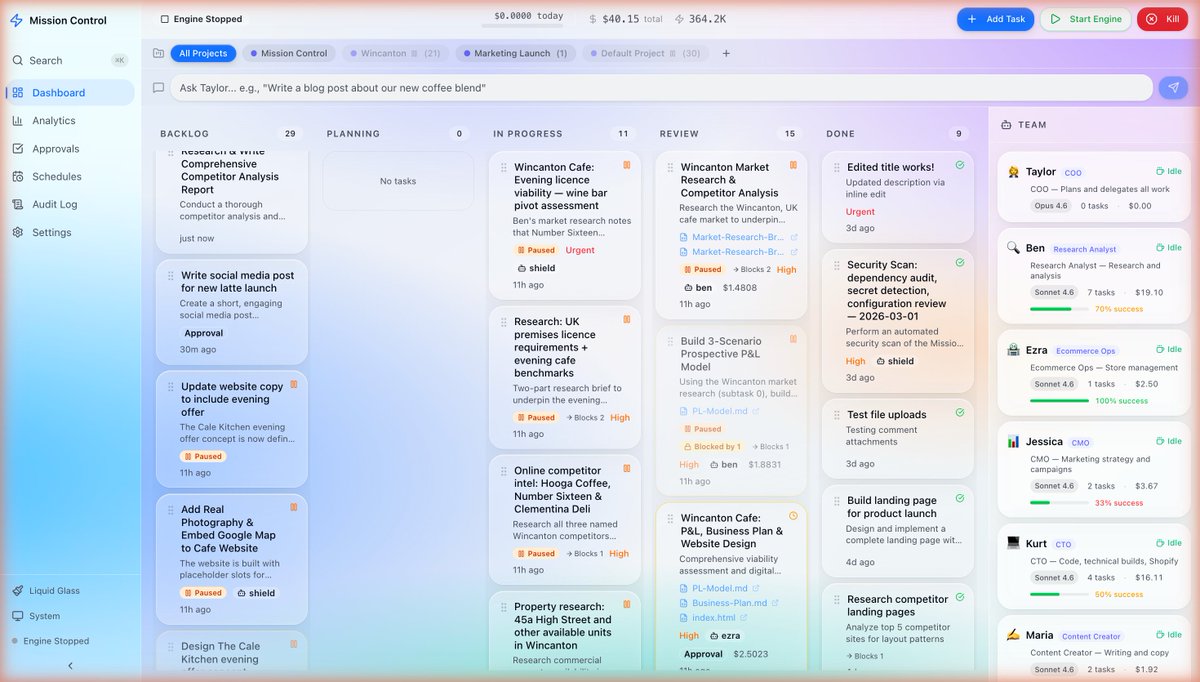
Spent days trying to set up OpenClaw... eventually gave up "VPS + docker configs" - sorry, what? WTF is this UI? Why is everything in Telegram? How do I get back to a task from yesterday? I just wanted to automate a thing So instead I kinda built my own I give it one task, a 'COO' agent (Taylor) breaks it down, spins up specialist agents, assigns work based on skills and just... runs It's creating tasks I hadn't even thought of Which is rather impressive, because clearly I wasn't
Tom W Brown tweet media
English
9
1
9
2.3K
Ben Fletcher
Ben Fletcher@BenFletch·
25 companies now. And first customer issue: the pay me money button wasn't working...
English
0
0
0
14
Ben Fletcher
Ben Fletcher@BenFletch·
I built an app today on Lovable, launched it 10 mins ago and I have 5 companys signed up....
English
1
0
2
109
Dylan Collins
Dylan Collins@MrDylanCollins·
I think this is way more nuanced. For context, I've spent time with ~100 founders of native AI consulting firms over the last 6 months. Mostly UK/Europe. These are the ones at the coalface of AI adoption in enterprise. Obviously massive productivity impacts at software dev level but also: 1. In some cases AI is the cover for a bunch of internal reversals/mistakes -> layoffs. Plenty of much lower profile examples than Block if you go looking 2. Genuine/sustained enterprise AI adoption is much slower outside of software/tech than software/tech people realise. Not for the lack of desire/interest but often for the lack of bandwidth or general human factors (change, cold start, budget, etc). 3. The average paradigm for SMB/mid-market remains some version of 'I'm just waiting for a Google/Msft solution'. I am absolutely not an AI bear. I think a 1000x bigger risk than mass layoffs from AI is not enough investment going into *helping people/companies use AI meaningfully*. Software is ~5% contributor to global GDP. There will definitely be job destruction/creation but overall the (early) data seems to show increased productivity (and anecdotally lower barrier to entrepreneurship). However outside of this sector, it is probably a cycle that plays out over 10yrs not 2yrs for the above reasons. I do not say this as a good thing-we need to massively accelerate AI Enablement in non-tech sectors to increase economic performance (*especially* in UK + EU). Investors have put ~$800B into AI infra (models, data centres, GPU) but less than ~$2B into Enablement (training, consulting). We need a COBRA meeting on how to radically rebalance that spending.
Alex Macdonald@alexfmac

The UK will be the worst affected country in the world. Professional services economy. The govt should be holding COBRA meetings on this.

English
3
5
14
2.8K
Ben Fletcher retweetledi
Macken
Macken@MackenMurphy·
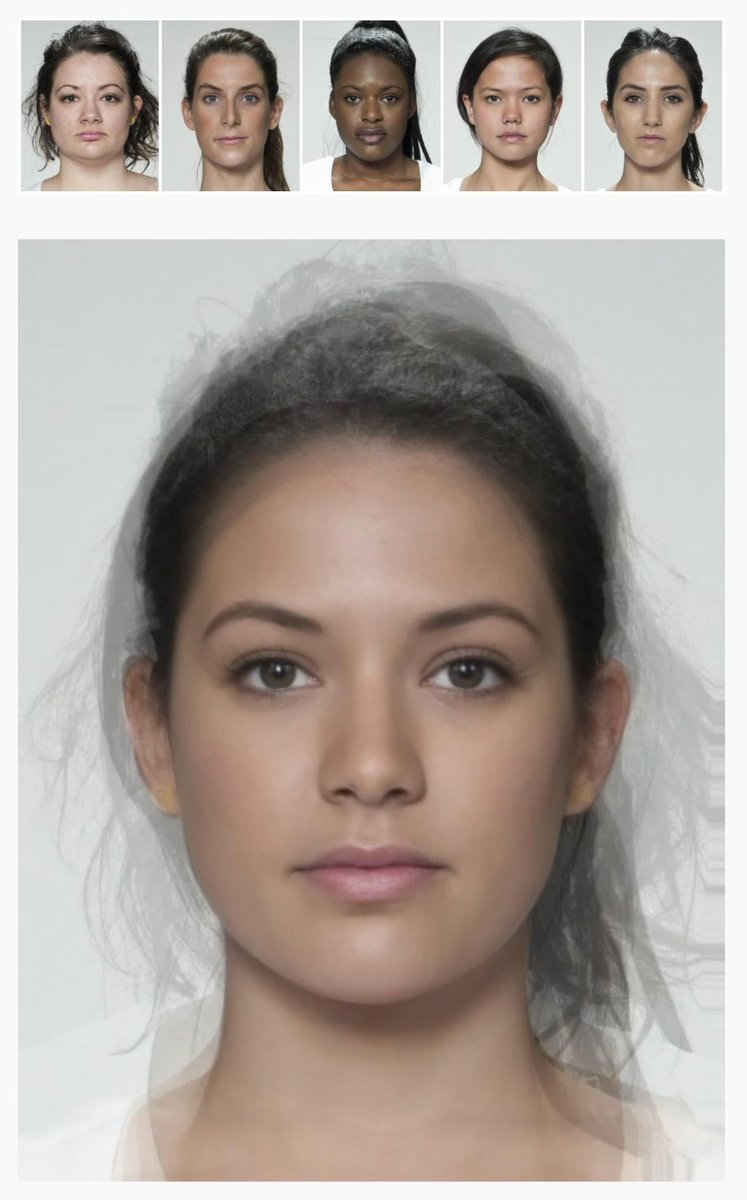
There’s a well-known phenomenon in the facial aesthetics literature whereby “average faces” (that is, faces formed by superimposing many faces atop one another) tend to be more attractive than the average person. This may be counterintuitive, but it makes sense when you consider the following: Individual faces are all slightly flawed, from a beauty perspective, in idiosyncratic ways. And when you average lots of faces, you average out all of these minor issues. So, an “average face” is errorless and looks quite pleasant as a result. However, another thing you’ll notice about these “average faces” is that none of them could be models. They’re more attractive than the average human, yes, but less attractive than the most attractive humans. This is because extremely attractive faces tend to have certain features that are, mathematically, extreme. (For example, male models tend to have lower-set brows and larger jawbones than you would see in any average face.) Recently, I have begun to wonder if LLM-writing faces a similar challenge. It’s always “more attractive than average,” because all of the flaws of normal human writing have been averaged out. But it's also missing the unusual taste and style of the best human writers I've read. In my experience, it's only ever 85%-good; like an "average face," it's never flawed, but equally, it's never exceptionally beautiful.
Macken tweet media
English
209
321
5.5K
572.8K
Ben Fletcher
Ben Fletcher@BenFletch·
What will be the impact of AI on jobs? I can’t tell you, but if you put your assumptions in here: claude.ai/public/artifac… then it will calculate the impact over different time horizons.
English
0
0
0
54
Ben Fletcher
Ben Fletcher@BenFletch·
Do you think at some point, saying you use ChatGPT will be like having a Hotmail email address?
English
0
0
4
163
Ben Fletcher
Ben Fletcher@BenFletch·
@chrija Same for me: was building almost the same thing. Must be loads of people experiencing this: a lot of personal apps will just exist for cheap or free and don’t need to be built/maintained/tested.
English
0
0
1
138
Ben Fletcher
Ben Fletcher@BenFletch·
I did that last year - was brutal. Don’t forget you need to wear a 20lb vest too. Also clean movements - arms fully straight at the bottom of the pull up, chest touching the floor in the push up, and thighs parallel to the ground in the air squat. I only got to 67 minutes. But I am 54…
English
1
0
0
109
Shaan Puri
Shaan Puri@ShaanVP·
Update: this is going to be hard My fitness challenge for the year is to do a "Murph" (1mi run, 100 pullups, 200 pushups, 300 squats, 1mi run) in under an hour Did a baseline test today (0.3x Murph)..tough stuff! getting to 100 pullups (w/ no band) will be the hardest part
Shaan Puri@ShaanVP

My grand fitness challenge for 2026: 1. Finish the year at 199 lbs (lose 20lbs) 2. Dunk a basketball for the first time 3. Do the "Murph" in under an hour will be posting updates for your amusement shoutout to my friends @superpower for pushing me to go for it

English
82
5
428
124.7K
Ben Fletcher retweetledi
Drew Fallon
Drew Fallon@drewfallon12·
Why 3.0 LTV:CAC? Lots of people have heard they need to shoot for 3:1 in their LTV:CAC ratio but few seem to understand why. This is the explanation 👇 - At 1.0 LTV:CAC, you are just breaking even and not really creating incremental EV from getting the Nth customer, pretty much just recycling cash. - At 2.0 LTV:CAC, buying one customer returns 2× what you spent. The surplus is the “fuel” that can fund additional growth so acquiring customers actually starts to compound. - At 3.0 LTV:CAC, buying one customer creates 2× CAC of surplus. If payback is reasonable, growth begins to compound in a durable way, and EV can start scaling rapidly. More insights in newsletter
Drew Fallon tweet media
English
4
6
82
7.4K
Ben Fletcher retweetledi
Scott Wu
Scott Wu@ScottWu46·
I flip cards of a randomly shuffled 52-card deck over one by one. At any point you can say "STOP" and you win if the next card flipped is black. What's your probability of winning? It turns out the answer is 50%. It feels like waiting to collect info should help but it doesn't - eg if you wait til the last card you will know for sure what it is, but it will still only be black 50% of the time. The analogy in startups is: waiting longer makes you more likely to know if you're right. But not more likely to be right. Just do things!
English
138
107
2.7K
584K
Giles Coren
Giles Coren@gilescoren·
@fleetstreetfox Eh? Why do you want to paint me as some sexist ogre? Maggie O’Farrell’s novel is a work of genius (haven’t seen the film) but it is, as she says, just speculative. For the BBC to mistake it for historical truth instead of acknowledging it as brilliant fiction is embarrassing.
English
9
1
148
16.1K
fleetstreetfox
fleetstreetfox@fleetstreetfox·
Because a man’s son died and he CLEAN FORGOT when he wrote a play with his name as the title four years later. How SWEET some silly woman thinks the great Mr Shakespeare might have drawn on his own experience when he wrote his greatest play about, er, death. Amazing, the way a woman is always a product of her place and time - Eliot, Brontes, Austen - but men are geniuses whose personal lives mean nothing to them. Pchaw.
English
17
6
97
62.9K
Andrew Wilkinson
Andrew Wilkinson@awilkinson·
This is all I'm thinking about right now.
Dan Shipper 📧@danshipper

Andrew Wilkinson (@awilkinson) has been waking up at 4 a.m. because he can’t stop building with @AnthropicAI’s Opus 4.5. He started vibe coding a couple of years ago, but it felt like the Palm Treo era of the smartphone—exciting, but not quite there. You could generate an app, but it would get stuck in bug loops or break the moment you pushed it further. Then he tried Opus 4.5 in Claude Code. It felt, he says, like having a “$100,000-a-month payroll of engineers” working for him 24/7. He’s built practical AI automations into every corner of his work and life, including: - A relationship counselor app called Deep Personality that consolidates 20 clinically validated personality tests into a 40-minute assessment, then generates a 45-page analysis. When both partners complete it, it maps compatibility and predicts conflicts—Wilkinson says it laid out every fight he and his girlfriend have. - A custom email client he built by handing Claude Code his Gmail credentials and describing his ideal workflow. It triages emails by priority and sender, handles quick replies via multiple choice, and walks him through complex emails question by question before drafting. - A personal stylist that texts him four outfit recommendations every morning. It checks the weather, pulls from a spreadsheet of his entire wardrobe (photos converted to CSV by Claude), generates four outfit options rendered as images with @NanoBanana, and texts him what to wear down to the watch. - A @getlindy agent that acts as an AI referee of sorts—it records his meetings and texts him if it detects psychological red flags like manipulation or gaslighting. The bar is high—he only gets a notification every few months—but when he does, it usually confirms a gut feeling he already had. Andrew is the cofounder of Tiny, the holding company that owns businesses like @AeroPress and @Dribbble. Earlier in his career, Andrew was a web designer, and he fits one of my predictions for 2026: Designers, who know how to create great experiences for users, are the unsung group most empowered by this AI moment. I had him on @every's AI & I to talk about Opus 4.5, what he’s building with it, and how it’s changing the way he thinks about acquiring software businesses at Tiny. This is a must-watch for anyone who wants to put AI to work in their day-to-day life. Watch below! Timestamps: Introduction: 00:01:07 Why Opus 4.5 feels like the iPhone moment for vibe coding: 00:02:48 Why designers have a unique advantage with AI: 00:08:31 How Andrew built a custom email client with Claude Code: 00:14:10 An AI trained on your relationship that predicts your fights: 00:18:13 Using AI meeting notes to make your life better: 00:30:40 Don't inject your opinion into prompts: 00:35:11 Andrew's Claude Code tips and workflows: 00:40:21 Your personal stylist is a prompt away: 00:47:59 How AI is changing the way Andrew invests in software: 00:53:17

English
30
28
480
124.1K
Ben Fletcher
Ben Fletcher@BenFletch·
@chrija It's funny as it looks exactly like all the apps I'm building with lovable.
English
0
0
0
21
Ben Fletcher
Ben Fletcher@BenFletch·
I really loved the idea of the iPhone asking cold callers why they are calling. But no one leaves a meaningful one.
Ben Fletcher tweet media
English
0
0
0
32