BenLewisMD

253 posts

BenLewisMD

BenLewisMD

@BenLewisMD

Assistant Professor of Psychiatry. Psychedelic Research. Huntsman Mental Health Institute, University of Utah.

Salt Lake City, Utah Katılım Temmuz 2019
472 Takip Edilen157 Takipçiler
BenLewisMD retweetledi
Psychedelics Today
Psychedelics Today@PsydelicsToday·
Utah Gov. Spencer Cox signed H.B. 390 into law. It does not legalize broad psychedelic access but it authorizes a tightly regulated clinical study at Huntsman for veterans with treatment-resistant PTSD. A narrow step, but a meaningful one. psychedelicstoday.com/2026/03/19/gov…
Psychedelics Today tweet media
English
0
2
12
454
Matthew W. Johnson
Matthew W. Johnson@Drug_Researcher·
Just published: our RCT shows psilocybin (magic mushrooms) dramatically beats nicotine patch for quitting smoking using the same psychotherapy! A single psilocybin session showed 6x greater odds of staying quit. Biologically verified. In @JAMANetworkOpen Thread 🧵 #Psychedelics #QuitSmoking
Matthew W. Johnson tweet media
English
19
81
334
81.6K
BenLewisMD retweetledi
Stephen Zerfas
Stephen Zerfas@stephen_zerfas·
Teresa of Ávila, the Desert Fathers, and Persian Sufis mapped the same meditative states the Buddhists call jhana. They never read a Buddhist text.
Stephen Zerfas tweet media
English
10
12
123
13.4K
BenLewisMD
BenLewisMD@BenLewisMD·
In this paper our NNDC group discusses several categories of challenges that can arise in the context of clinical trials with psychedelics including a) treatment nonresponse, b) functional unblinding / expectancy effects, c) post session difficulties, and d) contagion effects
English
0
0
1
13
BenLewisMD retweetledi
David B. Yaden
David B. Yaden@ExistWell·
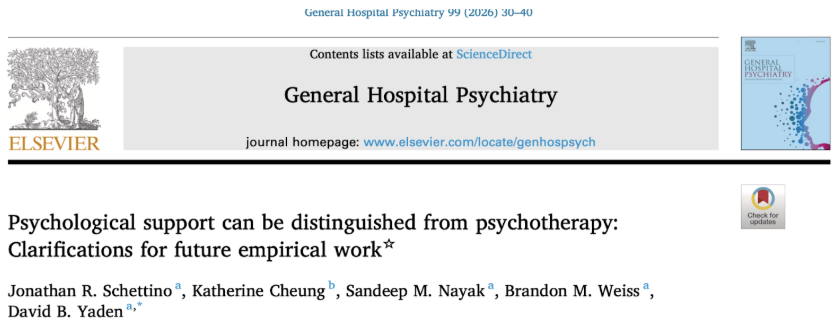
The debate over psychological support vs psychotherapy in psychedelic treatment is confused—and that confusion matters for science, safety, and regulation. We were confused too. So we worked it through together and published what clarified it for us... 🧵
David B. Yaden tweet media
English
2
10
31
4.1K
Johns Hopkins Psychedelic Research Center
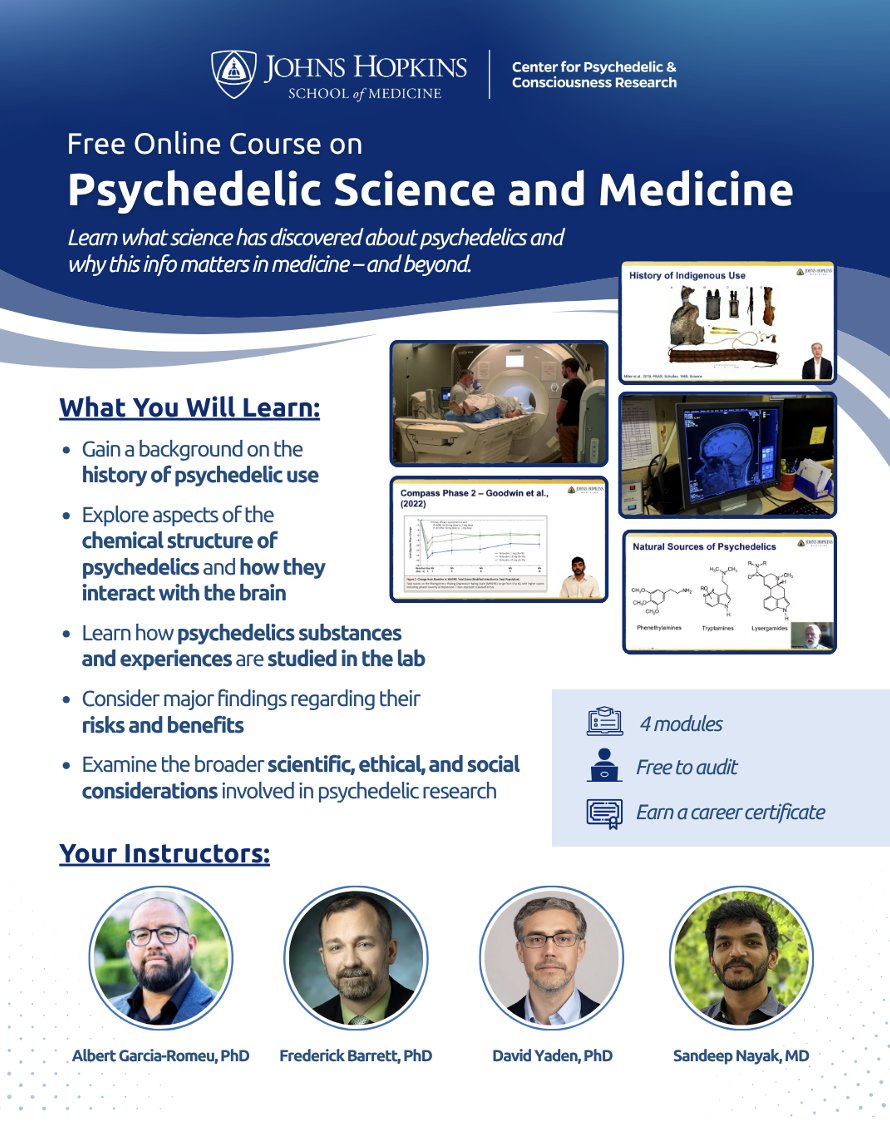
Curious about psychedelics beyond the hype? Our new Coursera course, Psychedelic Science and Medicine, offers clear, evidence-based education on how they work & who they may help. Perfect for clinicians, students, researchers, or anyone wanting reliable info in a rapidly growing field. Enroll below👇
Johns Hopkins Psychedelic Research Center tweet media
English
6
19
52
3.9K
BenLewisMD retweetledi
Captain Pleasure, Andrés Gómez Emilsson
The Phenomenology of Status as Load-Bearing Cognition There’s a simple experiment you can run with almost any group of humans: lift something heavy while people watch. If they shout encouragement, the weight feels lighter. If they doubt you, it gets heavier. I don't think this is just evocative metaphor. The proprioceptive feedback changes. Your motor system changes its action thresholds under social input. The presence of others, and their attitudes to the value of your behavior, modifies the computation of effort itself. So, it turns out the boundary between self and other is porous at the level of movement. When you act for the tribe, your nervous system lets their representations bleed into your own. Their confidence gets compiled into your motor plan. Their doubt inserts drag. The social field literally alters how many Watts (power output) you put into your work. Status rides on this same circuit. When your standing drops, it’s as if the network has withdrawn part of its processing power. The job you were doing hasn’t changed, but now you’re running the full load locally. The body reads this as increased resistance, more friction per unit of will. The opposite (high status) feels light because the tribe’s simulation of you is helping to carry the weight. This is why the pain of lost recognition feels so primitive and non-negotiable. The system isn’t measuring esteem in abstract points; it’s tracking how much of the cognitive load is distributed across the network. “Low status” literally means the distributed computation has collapsed back into the local node. The tragedy is that entire civilizations run on this fragile architecture. Infrastructure, research, healthcare... all depend on people whose subjective effort fluctuates with how seen they feel. Someone tending a reactor or writing safety code who loses that social scaffolding isn’t being dramatic when the work starts to feel impossible. The load has, in fact, increased. We keep pretending status is about vanity, when it’s really about load-sharing. And lack of introspective skills allows one to feel the valence dynamics but not what they're meant to be tracking. It's also the case that there is enormous interpersonal variability for how much people need the support of others. The tricky situation is, above all, when people have load bearing status they don't realize is borrowed distributed cognition. Exacerbated with heavy selfing. (Edited lightly with Char [mostly cutting down length])
San Francisco, CA 🇺🇸 English
24
37
473
70.3K
BenLewisMD retweetledi
Johns Hopkins Psychedelic Research Center
1/ New consensus statement just dropped on the potential for psilocybin in clinical care, from the Task Group on Psychedelics and Related Compounds of the US National Network of Depression Centers The message? Lots of promise, but real risks if we rush. 🧵 authors.elsevier.com/sd/article/S25…
English
4
15
50
12.3K
BenLewisMD
BenLewisMD@BenLewisMD·
I'm excited to share that our manuscript for our trial of group psilocybin + MBSR for healthcare provider depression and burnout has been published in PLOS Medicine! @DrEricGarland @uofu_hmhi @UofUHealth #sec019" target="_blank" rel="nofollow noopener">journals.plos.org/plosmedicine/a…
English
5
4
18
5.7K