
Sabitlenmiş Tweet
Ben
2.3K posts


30 days. 22 launches. One company.
Anthropic shipped more products in 30 days than most companies do in 3 years.
Mar 19: Claude Sonnet 4.6
Mar 20: Claude Code Security
Mar 24: Claude Mac Remote Control
Mar 24: Claude Code Redesign
Mar 26: Claude Managed Agents (Beta)
Mar 31: Claude Cowork (General Availability)
Apr 1: Claude Managed Agents API
Apr 2: ant CLI
Apr 7: Claude Mythos Preview
Apr 7: Project Glasswing
Apr 9: Claude Code Routines
Apr 10: Claude Mobile Interactive Apps
Apr 11: Claude Custom Inline Visuals
Apr 11: Claude Cowork Plugin Marketplace
Apr 14: Claude Code Push Notifications
Apr 14: Claude Cowork Group Permissions
Apr 15: Claude for Excel (Updated)
Apr 15: Claude for PowerPoint (Updated)
Apr 16: Claude Opus 4.7
Apr 17: Claude Design
Apr 17: Claude for Excel
Apr 17: Claude for Windows
Apr 17: Claude Code Fullscreen Mode
Apr 17: Claude Code /tui
which are you most bullish on?
English
@sentient_agency this is pretty cool to be fair, look forward to playing around with it
English

This feels like cheating.
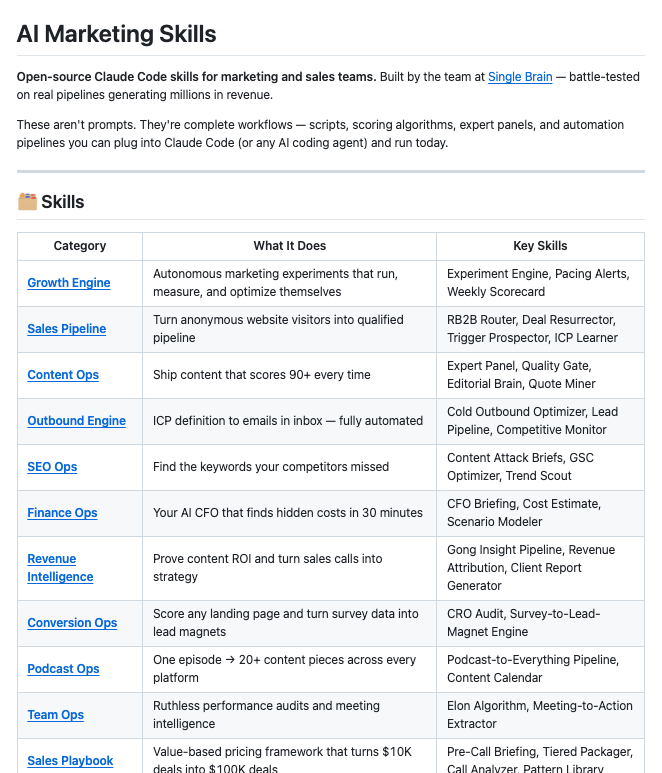
Someone open-sourced a full marketing and sales operating system for Claude Code.
It's called ai-marketing-skills. Six complete workflow engines built by the team that runs pipelines generating millions in revenue.
Here's what's inside:
→ Growth Engine: runs marketing experiments with bootstrap confidence intervals and Mann-Whitney U tests, not guesses
→ Sales Pipeline: turns anonymous website visitors into qualified deals with intent scoring, seniority dedup, and agency classification before anything touches outbound
→ Content Ops: 9 expert panel personas that recursively score your content until it hits 90+
→ Outbound Engine: ICP definition to emails in inbox, fully automated
→ SEO Ops: finds the keywords your competitors missed, not the ones they're already ranking for
→ Finance Ops: an AI CFO that finds hidden costs in 30 minutes
Drop any SKILL.md into your Claude Code project. Tell it what you want. It runs the entire workflow.
"Run an experiment testing carousel vs static posts on LinkedIn."
It handles the rest.
MIT License. 100% Opensource.
English
@HYPEconomist I actually disagree. I think a truer measure of intelligence is being able to explain concepts at the level of your peer. If you can't explain a concept to both an expert and to a small child, do you really understand it?
English

if a founder doesn’t make me feel stupid when i talk to him, i'm not interested in the project
English

i have a very original idea to #beattheheat.
vibe coding from starbucks.
i have a spot i sit daily. the ac is right above me and it's so strong that i start shivering. internet speed is bad, 2 mbps. i've tried getting wifi pwd from nearby outlets but failed. now suffer or hack
English
@Padierfind signups > trophy every time. £0 revenue at culta but one genuine dm from a user hits harder than any pitch comp win ever would
English

Unfortunately we didn't win the Startup Competition at Blockchain Paris. But the event was a big success for us nevertheless. Great meetings & tons of Signups to Sokosumi.
Now it's time to get back to work and turn leads into partnerships.
English

My brother just launched his first SaaS
Somanath Diksangi@SomanathDi48172
Introducing vidgenn 🥳 You can now: > > Type any topic → get a full publish ready video in 60 seconds > > AI writes the script, picks footage, adds voiceover + burned in subtitles >> Zero editing, zero skills, zero headaches Creators are posting 10+ videos a day with this. Try → vidgenn.com
English
@sumitdoriya21 been using it exactly like this to build my fintech tool solo. the MCP connections are what made it go from "cool toy" to actual infrastructure
English

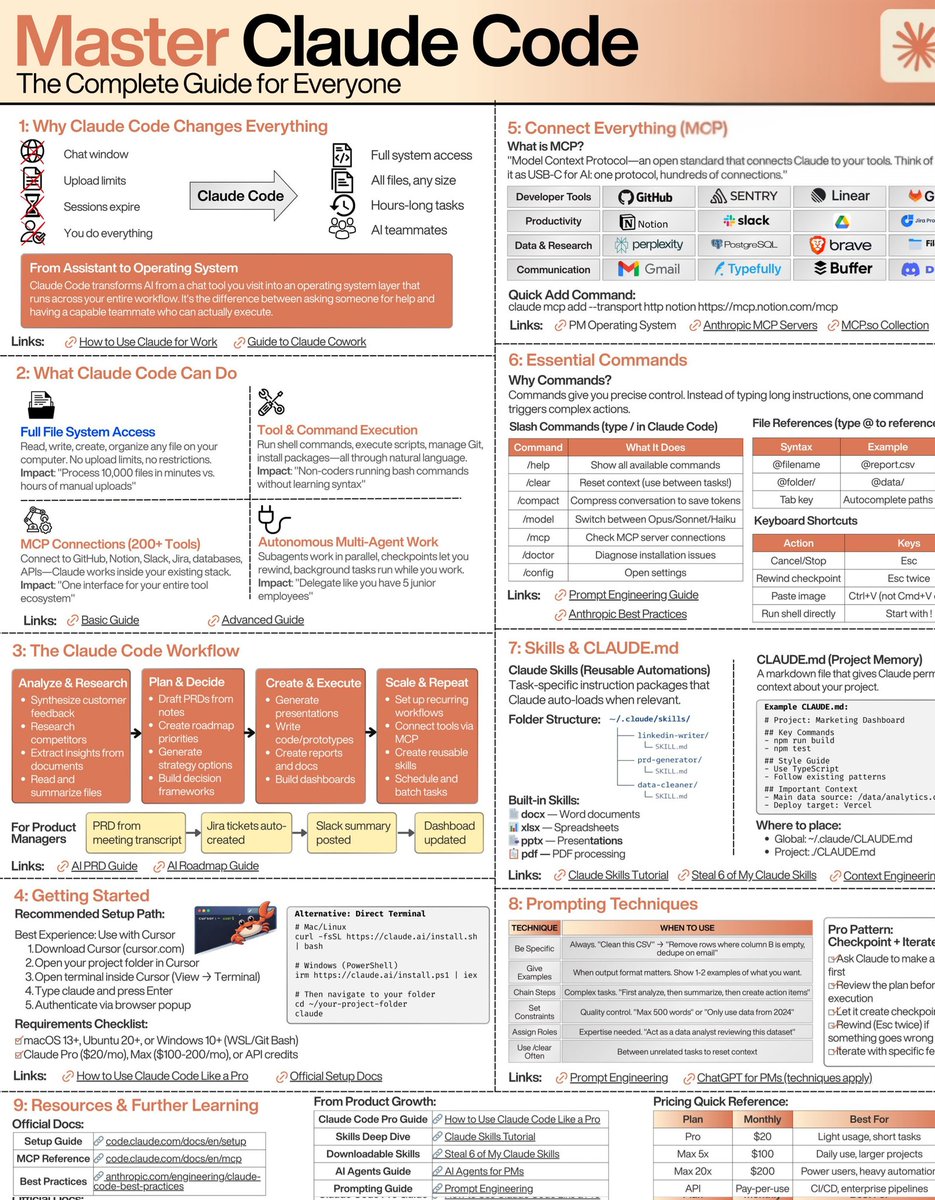
This is wild.
Most people are using Claude like a chatbot.
That’s the mistake.
Claude isn’t just chat.
It’s an execution layer for your entire workflow.
And in the era of vibe coding, this is pure leverage.
Here’s the shift:
Claude has layers: • Chat → ideas
• Code → implementation
• MCP → tool connections
• Skills → reusable automations
• CLAUDE.md → project memory
But the real unlock?
Skills + MCP together.
That’s when Claude stops replying…
and starts actually doing the work.
When you: • connect GitHub, Notion, Slack, Vercel
• install reusable skills
• add persistent project context
You’re not prompting anymore.
You’re running an AI teammate.
This is how people are: • auto-creating PRDs from meetings
• shipping features from one prompt
• generating dashboards & reports
• running workflows across tools
• deploying without touching UI
No prompt hacks.
No copy-paste loops.
No tab switching.
Just structured execution.
Most people haven’t realized this yet.
The ones who do will move 10x faster.
Bookmark this.
You’ll need it when you stop “chatting” and start building.
Follow me @sumitdoriya21
English

>be obsidian
>small team, just 3 engineers
>quietly builds a note app people use
>no hype, no noise, just a good product
>decides it’s time to grow
>hires one more engineer
>now 4 people, still fully remote
>still shipping like crazy
>pays sf-level salary, from anywhere
Insane.
Obsidian@obsdmd
The Obsidian team is growing from three engineers to four engineers. Competitive SF salary. Fully remote, live anywhere. Apply below.
English
@lucas_montano claude code doesn't take easter off unfortunately. just checked and it shipped 3 features while i was eating chocolate
English

@forgebitz this is literally why i'm building culta. your finances should flag problems before you even open the dashboard
English

@eliana_jordan i get the reverse. people pitch me dev agencies when i literally vibe coded the whole thing myself at 21 with no team
English

@heynavtoor this is genuinely dangerous for my productivity. dropping spotify's design system into a project at 2am is exactly how i end up redesigning everything instead of shipping
English

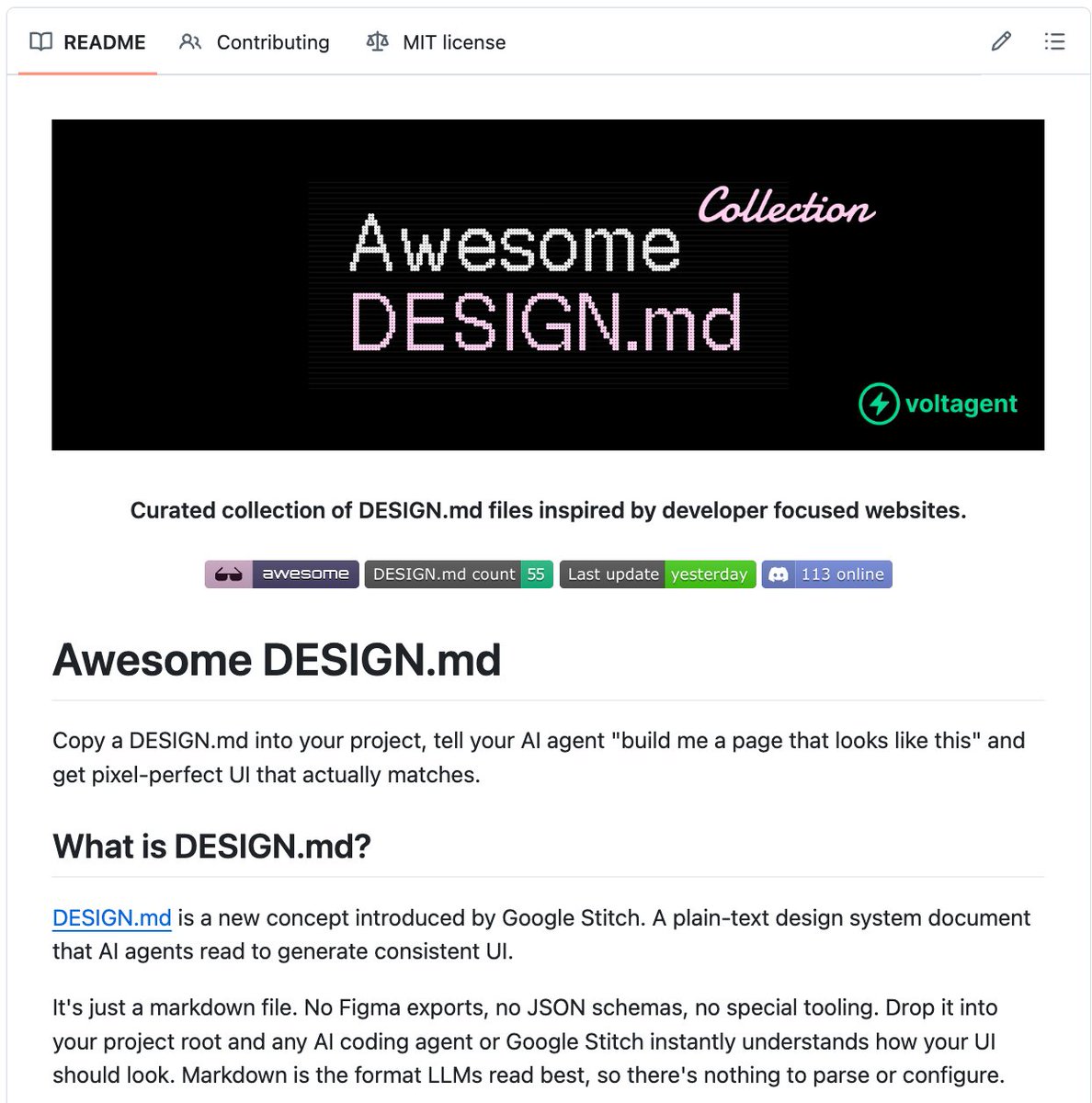
🚨 Someone reverse-engineered the design systems of Apple, Spotify, Airbnb, and 30+ billion-dollar companies.
Packed each one into a single file. Free.
It's called Awesome Design MD.
Drop one file into your project. Your AI agent builds UI that looks like Spotify. Or Apple. Or Airbnb. Instantly.
Not screenshots. Not Figma links. A single DESIGN .md file that captures every color, font, spacing value, button style, and layout pattern from a real website. In a format AI agents read and reproduce.
Here's the difference:
Tell Claude Code "build me a landing page" and it gives you generic UI.
Tell Claude Code "build me a landing page" with Spotify's DESIGN .md in your project and it gives you Spotify.
Here's what's inside:
→ Apple. Premium white space, SF Pro typography, cinematic imagery.
→ Spotify. Vibrant green on dark, bold type, album-art-driven layout.
→ Airbnb. Warm coral accent, photography-driven, rounded UI.
→ Linear. Ultra-minimal, precise spacing, purple accent.
→ SpaceX. Stark black and white, full-bleed imagery, futuristic.
→ BMW. Dark premium surfaces, precise German engineering aesthetic.
→ NVIDIA. Green-black energy, technical power aesthetic.
→ Uber. Bold black and white, tight type, urban energy.
→ Sentry, PostHog, Raycast, Cursor, ElevenLabs, and 20+ more.
Here's how to use it:
→ Pick a design system from the collection
→ Copy the DESIGN .md file into your project root
→ Tell your AI agent to use it
→ Get UI that matches the design language of a billion-dollar company
That's it. One file. Your AI agent now has the design taste of a $200/hour design consultant.
Designers charge $5,000+ for a custom design system. Companies spend $50,000+ building one from scratch.
This is free. 31 design systems. Copy. Paste. Ship beautiful UI.
Works with Claude Code, Cursor, Codex, and any AI coding agent that reads project files.
100% Open Source. MIT License.
English
@aakashgupta building a fintech tool rn and this is the exact pricing psychology i keep going back and forth on. do you make it easy to leave or do you bet on inertia
English

The word "free" is doing a lot of heavy lifting in SaaS.
The entire business model runs on one metric: forgetting. 60-80% of people who enter credit card details on a free trial never cancel. Companies have the churn data broken down by hour. They know the exact day most users stop logging in. They set the trial length to end two days after that.
Hulu ran an experiment where removing the credit card requirement increased signups 4x but decreased conversions by 10x. The credit card field is the entire product. Everything else is packaging around it.
Every "free trial" is a bet that your future self will be too lazy, too busy, or too guilty about canceling something you already set up. That bet hits at a 70% rate across the industry.
The puppy eyes in this GIF are accurate. You walked into a store that was already charging you.
Roro ☃@RoRoFli
When I click "Start free trial" and they're asking for my credit card details
English

Zuckerberg is building a personal AI agent to help him run Meta. 44% of C-suite executives expect AI agents to lead major projects within two years.
Meta's CFO reported engineering output up 30% since deploying internal AI tools. Zuckerberg's agent ingests years of internal data, flags inconsistencies across teams, and delivers post-meeting summaries in real time. Capital allocation decisions that required weeks of strategy work now take minutes.
The enterprise landscape is moving at the same pace. Gartner projects 40% of enterprise apps will embed AI agents by the end of 2026, up from under 5% in 2025. Full AI implementation jumped from 11% to 42% YoY. 30% of enterprise AI budgets are now dedicated to agentic AI.
When decision cycles compress from weeks to minutes, financial infrastructure has to keep pace. A treasury team that identifies an opportunity in seconds but needs 2-3 days for settlement is still operating on legacy rails. The decision layer got faster. The settlement layer didn't.
This really matters for capital markets.
The data supports this convergence. B2B stablecoin transactions surged 733% YoY in 2025. 56% of financial institutions expect 5-10% of global cross-border payment value to flow through stablecoins by 2030 — that's $2.1 to $4.2 trillion annually.
Speaking to family offices and wealth advisors, the institutional advantage is clear. AI agents compress the decision layer. Stablecoins compress the settlement layer. The institutions connecting both will operate at a fundamentally different speed.
At Brava, this is exactly what we're building for.

English

the "failed twice then built a $2M ARR company" narrative is clean but it skips the part where timing and market conditions did most of the heavy lifting
AI tools in 2026 basically sell themselves
drop any decent product into this market with a free tier and a founder who tweets a lot and you'll hit numbers
umesh seems solid but let's not pretend this happened in a vacuum
the wave carried a lot of boats this year
Umesh Kumar@itsumeshk
3 weeks ago, we launched Runable 2.0 Today we hit $2M in ARR, making @runable_hq one of the fastest-ever to do it! We are just getting started...
English
In all seriousness on the “lines of code” debate for vibe coding, our AI VP of Marketing:
- runs our team stand-up
- designs every single marketing activity and campaign
- manages every human on the team each day, assigns their GTM activities and follows-up
- provides daily Slack and email updates on everything GTM related
-> It’s 14,230 lines of code
Could a great developer have done it in 3,000? 4,000? 5,000? Probably
Is it “over coded”? Probably. Is there slop in here? I am sure. Especially since we have made 373 commits. The more you make, the more “slop” that creeps in.
Still, it works great.

English
@BrianRoemmele building a fintech tool rn and the pricing model question keeps me up at night. per seat doesn't make sense when the agent does the work
English

If the US doesn’t grow from Grandpa’s 2010 SAAS monetization model for AI, real fast, we will not make it past the end of this decade.
Stop employing the wrong folks that have no new ideas in making AI companies profitable.
Just stop.
Get a REAL OPEN SOURCE PLAN IN THE US NOW!
Brian Roemmele@BrianRoemmele
This is just the tip of the iceberg berg. The open source AI that will eventually be released in the US will end many AI company’s SAAS plans. I know the open source path for AI in the US but I ain’t got pedigree. I am just some guy on X.
English