there's a phone number that deletes debt
it's the Consumer Financial Protection Bureau hotline: 855-411-2372
when you file a complaint through the CFPB (you can also do it online at consumer finance. something very specific happens on the other end that most people don't understand
the CFPB forwards your complaint directly to the company you're complaining about. the company has 15 days to respond and 60 days to resolve. but here's the part that matters: the CFPB tracks every single complaint and publishes response data in a public database that regulators, journalists, and attorneys monitor
companies know this. banks know this. collection agencies know this
a CFPB complaint against a debt collector carries more weight than 50 dispute letters because the collector now has a federal regulatory body watching their response. if they fuck it up, it creates a paper trail that FCRA and FDCPA attorneys can use to sue them
the resolution rate on CFPB complaints is dramatically higher than normal disputes. we're talking 65-80% of complaints resulting in some form of resolution versus 40-50% for standard bureau disputes. companies would rather delete the account than have a negative response on their CFPB record
the process:
go to consumerfinance "credit reporting" or "debt collection" depending on your issue
describe the problem in detail. be specific. include dates, account numbers, dollar amounts, and what you've already tried. mention any FCRA or FDCPA violations you've identified. if you sent dispute letters and the bureau failed to investigate properly, say that. if a collector is pursuing time-barred debt, say that. if they can't validate, say that
the CFPB complaint creates three layers of pressure simultaneously:
layer 1: the company's compliance department gets involved (not the call center, not the dispute processing center, the compliance team that reports to the legal department)
layer 2: the response becomes part of the company's permanent public record in the CFPB complaint database (searchable by anyone including the media)
layer 3: if the company's response is inadequate, the CFPB can flag it for enforcement review. companies with patterns of poor complaint responses end up in consent orders and class action settlements worth millions
i file CFPB complaints on every account that survives two rounds of bureau disputes. the success rate on the third attempt via CFPB is absurdly high because the dynamics completely change when a federal regulator is cc'd on the conversation
a guy came to us with a $6,800 collection from a gym membership he cancelled in 2020. the gym sold the account. he disputed through all three bureaus twice. came back "verified" both times. filed CFPB complaint on a friday afternoon. the collection agency contacted him the following wednesday offering to delete the account entirely if he'd withdraw the complaint
$6,800 account. deleted. no payment. because a federal agency was watching
the same collectors who ignore your certified mail and auto-verify your bureau disputes will fold in 48 hours when the CFPB is involved. the power dynamic flips completely
you can file unlimited CFPB complaints. there's no limit. no fee. no attorney needed. you can file against the collector, the original creditor, AND each bureau separately for the same account if they all played a role in the violation
most people have never heard of the CFPB. collectors are counting on that. the bureaus are counting on that. the entire credit reporting industry operates with less accountability than it should because most consumers don't know there's a federal agency specifically designed to pressure these companies on their behalf
now you know the number
we file CFPB complaints and run the full dispute process across bureaus, furnishers, and regulatory channels. if your credit has items that won't come off through normal disputes, link in bio. we use every tool that exists
Yes, it's legit. Rayhunter is an official open-source EFF project (launched 2025) that runs on a cheap ~$20 Orbic RC400L mobile hotspot from Amazon/eBay. You flash their GitHub software, carry it in your pocket, and it analyzes cellular handshakes in real-time to detect suspicious cell-site simulators (Stingrays/IMSI catchers) that could track phones nearby. It alerts on the screen.
Details: eff.org/deeplinks/2025…... and github.com/EFForg/rayhunt….
You can sue debt collectors yourself and win up to $1,000 per lawsuit
No lawyer needed
Small claims court costs $30-75 to file. Collectors violate federal law constantly. Each lawsuit can recover $1,000 in statutory damages plus actual damages and attorney fees
I know someone who made $11,000 suing collectors last year
Here's the playbook:
Violations that build your case:
Under the FDCPA (Fair Debt Collection Practices Act), collectors cannot:
- Call before 8am or after 9pm
- Call your workplace after you tell them not to
- Use profanity or threats
- Claim to be attorneys when they're not
- Threaten lawsuits they don't intend to file
- Discuss your debt with third parties
- Call repeatedly to harass you
- Fail to validate debt when requested
- Continue collection after cease & desist
- Add unauthorized fees
- Misrepresent the amount owed
Most collectors violate 3-5 of these per account. You can sue for up to $1,000 in statutory damages PER LAWSUIT (not per violation), plus actual damages if you can prove harm, plus attorney fees
The documentation process:
STEP 1: Record everything (check your state's recording laws)
Many states allow one-party consent recording. If yours does, record every call. Apps like TapeACall work perfectly
STEP 2: Keep all letters and voicemails
Screenshots, photos, saved messages. Everything timestamped
STEP 3: Send a debt validation letter (certified mail, return receipt)
If they continue collecting without validating, that's a violation
STEP 4: Send cease and desist letter (certified mail, return receipt)
If they contact you after receiving it, that's a violation
Filing in small claims:
STEP 5: File complaint in your county's small claims court
Name the collection agency AND the original creditor in some cases
Filing fee: $30-75 depending on county
STEP 6: Serve the defendant
The court clerk will explain how. Usually costs $20-40
STEP 7: Show up with your evidence
Bring recordings, letters, call logs, everything
Most collectors don't even show up to small claims. Default judgment = automatic win
STEP 8: Collect your money
If they don't pay, you can garnish THEIR bank accounts (ironic, right?)
The settlements:
Most collectors will offer to settle before the court date
"We'll delete the debt and pay you $2,000 to drop the case"
Take the offer if it's fair. Getting paid to delete debt is the ultimate win
The 605(b) alternative (Blackhat):
Don't want to sue? Some people skip straight to filing FTC Identity Theft Reports claiming the debt "isn't theirs"
Under Section 605(b) of the FCRA, bureaus must delete within 4 days with an Identity Theft Report
This is fraud if the debt is actually yours. You're swearing under penalty of perjury. People have faced consequences
But most don't. Bureaus rarely investigate. Thousands do it monthly
Suing gets you PAID. 605(b) just deletes. Your choice. You're a legal adult
The person who made $11k filed against 4 different collectors over 14 months. He recovered statutory damages, actual damages for harassment stress, and attorney fees across multiple cases
Turn their harassment into your income
(I help you repair your credit in 30-90 days, link in bio if your tired of being held back by your 500 credit score)
@Betterlatetha18 That's hard to know. If it breaks up and out of the falling wedge it's in, that should take it to the top of the macro structure to begin with.
So far #LTC has shown acceptance and held between roughly $74-$75 in a consolidation structure, which currently leans towards bullish expansion/continuation. The possibility of wicking back down into the upper 60’s exists if it loses this structure.
Debt is fake money
You can settle $50,000 worth of debt for $2-5k
(if you know what to say 😉)
The collections industry is built on a lie: that you "owe" the full amount and must pay it.
Tf? In reality they bought your debt for pennies and will take any profit they can get
Here's the game they don't want you to
understand:
When you stop paying a credit card, the original bank writes it off after 180 days. "Charge-off" on your credit report. They sell that debt to a collections agency for 2-4 cents per dollar
Your $30,000 debt? Collector paid maybe $900 for it
That collector would happily take $3,000 from you because it's a 233% return on their
investment. But they'll ask for the full $30,000 first because most people don't know the game
The Settlement Protocol:
Step 1: Let the debt go to collections (stop paying - counterintuitive but necessary)
Step 2: Wait 90 days for it to sell to a collection agency (original creditor won't negotiate, collectors will)
Step 3: Dispute with all three bureaus using 605(b) method. Often one bureau will delete first
Step 4: When one bureau deletes, save that confirmation letter. Send to other bureaus as leverage: "Experian already deleted this unverified account, you must do the same under FCRA"
Step 5: Hire a consumer debt attorney (they work on contingency, costs you nothing upfront). Have them contact collector with settlement offer: 15-25% of original balance in exchange for full deletion
Why collectors accept:
They paid pennies for your debt, any payment is profit
Legal threats from attorneys cost them money to fight
They'd rather settle for $4k than spend $3k in legal fees chasing $30k they'll never get
Their business model assumes most people will pay without negotiating
Real example:
Client had $67,000 in collections across 4 accounts Disputed with bureaus: 2 accounts deleted for non-verification Remaining $41,000 settled for $7,800 total (19 cents on dollar) Collections attorneys took 25% fee: $1,950 Client paid $9,750 to eliminate $67,000 in debt
The psychology flip:
You feel guilty because you "owe" money They feel scared because they might get nothing You have leverage.
They have a spreadsheet hoping you don't know that
Stop answering collector calls with fear. Answer them with a settlement offer and an attorney's letterhead
Debt isn't a moral failing. It's a negotiation that most people lose because nobody taught them the rules
(If you need credit repair dm me, and NO i cant settle your debt for you, just remove negatives)
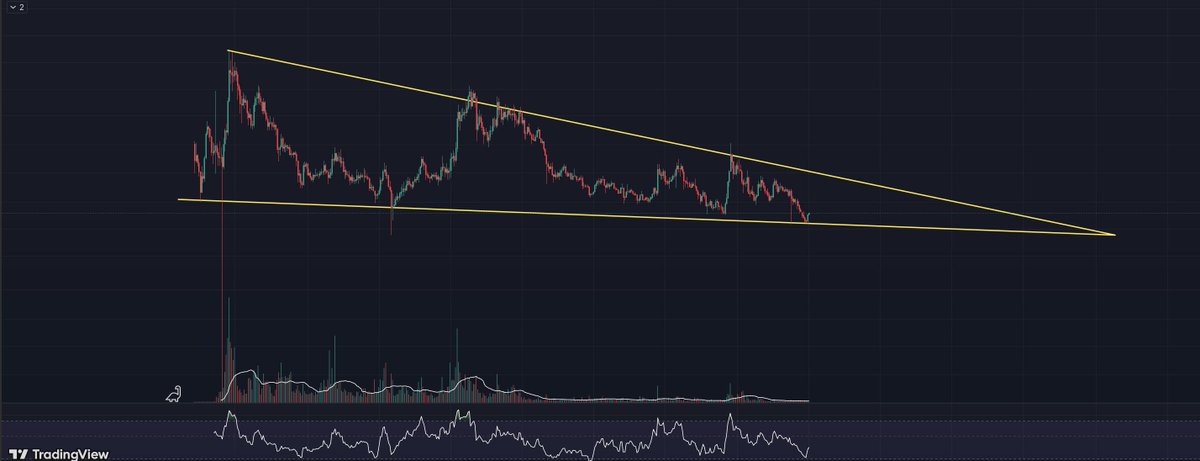
For a change of pace, here is one of my longer term investments. Who can guess what it is? Here's my evaluation on the weekly chart:
This is multi-year compression, not decay. Lower highs pressing into a rising base suggests capital is being parked, not abandoned. This is not a dying asset as many would make you believe, just like they tried to with #ZEC.
Volatility has been crushed for years as markets don’t do that forever. When this resolves, I expect an upward, extremely fast expansion, not a slow grind.