BeursTalk
622 posts

BeursTalk
@BeursTalk
BeursTalk is DE podcast over beurs & beleggen! Te vinden op https://t.co/56HFLNC1mI, Spotify en Apple Podcasts


🇦🇷 Argentina: Phasing Down Under Milei Argentina’s wealth tax, the Impuesto sobre los Bienes Personales (Personal Assets Tax), applies to resident individuals on their worldwide net assets and to non-residents on their Argentine-situated assets. The current regime is being significantly reduced under President Javier Milei’s 2024 reform package (Ley Bases). The highest bracket of the rate table is removed each fiscal year. Rates for 2025 range from 0.5% to 1.1%, down from a top rate of 1.5% in 2023. By 2027, the only rate will be 0.25%. Milei’s administration also introduced a voluntary prepayment scheme (REIBP) allowing taxpayers to pay a reduced rate of 0.75% on their 2023 asset base to cover wealth tax obligations for the entire 2023-2027 period. The broader objective is a phased elimination of the tax, consistent with the administration’s libertarian economic agenda. For foreign assets held by residents, a higher rate schedule has historically applied (up to 2.25%), though the 2024 reforms equalized the treatment of domestic and foreign assets. Argentina’s approach represents the clearest current example of a country actively dismantling its wealth tax. Whether the trajectory holds through future administrations remains an open question.


NEW: Dutch Parliament Member Michel Hoogeveen explains how the 36% unrealized capital gains tax, just passed by the House of Representatives, will work. Here is a more detailed example: Step 1. Starting position You own 500 shares. Value on Jan 1, 2028: €50,000 Value on Jan 1, 2029: €100,000 So the paper gain is: €100,000 − €50,000 = €50,000 unrealized profit You did not sell. But for tax purposes, that €50,000 is treated as income. Step 2. Apply exemption You are married, so you get a €3,600 exemption. €50,000 − €3,600 = €46,400 taxable amount Tax rate: 36% €46,400 × 36% = €16,704 tax bill That bill is due in May, even though you never sold anything. Step 3. Market falls before you pay Now suppose by May the shares drop in value. New total value: €60,000 So your portfolio is no longer worth €100,000. It’s worth €60,000. But the tax bill is still €16,704, because it was calculated based on the January 1 valuation. Step 4. You must sell shares to pay tax To raise €16,704, you sell part of your shares. After paying the tax, you’re left with: €60,000 − €16,704 = €43,296 Originally you had 500 shares. Now you have 360 shares left. You were forced to sell 140 shares. 140 ÷ 500 = 28% of your shares gone. Step 5. What happened economically? Before the correction: Paper gain was €50,000. After the correction: Portfolio is worth €60,000. Original cost basis was €50,000. Real gain is only €10,000. But you paid €16,704 in tax. So instead of being up €10,000, you are now: €43,296 − €50,000 = €6,704 below your original starting value. You turned a €10,000 real gain into a €6,704 net loss. And you lost 28% of your shares permanently.


Don’t thank us, thank that big “IDIOT” @elonmusk 👀 Sale now on👇 ryanair.com/ie/en/lp/promo…


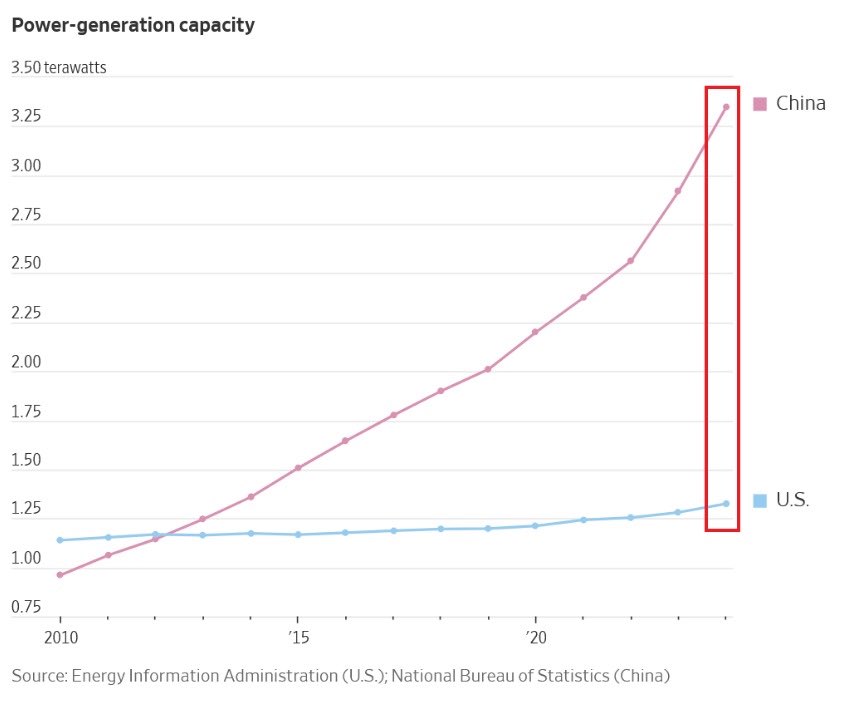
China is dominating the worldwide race for power: China now has a record 3.75 terawatts of power generation capacity. That capacity has doubled over the last 8 years. This is nearly 3 TIMES more than the US, which has ~1.30 terawatts of capacity. Furthermore, China has 34 nuclear reactors under construction, more than the next 9 countries combined. Nearly 200 other reactors are planned or proposed. At the same time, there are currently no large commercial nuclear reactors under construction in the US. The US must act now to keep up with China.


*LBMA SAYS IT'S 'ACTIVELY MONITORING' TIGHTNESS IN SILVER MARKET