Blockchain Hive

285 posts

Blockchain Hive banner
Blockchain Hive

Blockchain Hive

@BlockchainHiive

Curating Latest High Level Thoughts from High Level CT Industry Think-Tanks Only High Thoughts

Ground Zero Katılım Temmuz 2023
11 Takip Edilen3.5K Takipçiler
Blockchain Hive retweetledi
CalmLedger
CalmLedger@CalmLedger·
Spent months building something for web3 enthusiasts. It reads your wallet history, not your balance, your behavior. When and how often you trade. Then it scores you and gives you an AI coach that remembers everything it learns about you. Apply here → tally.so/r/44k19Y
English
0
2
4
70
𝕋𝕖𝕞𝕞𝕪🦇🔊
𝕋𝕖𝕞𝕞𝕪🦇🔊@Only1temmy·
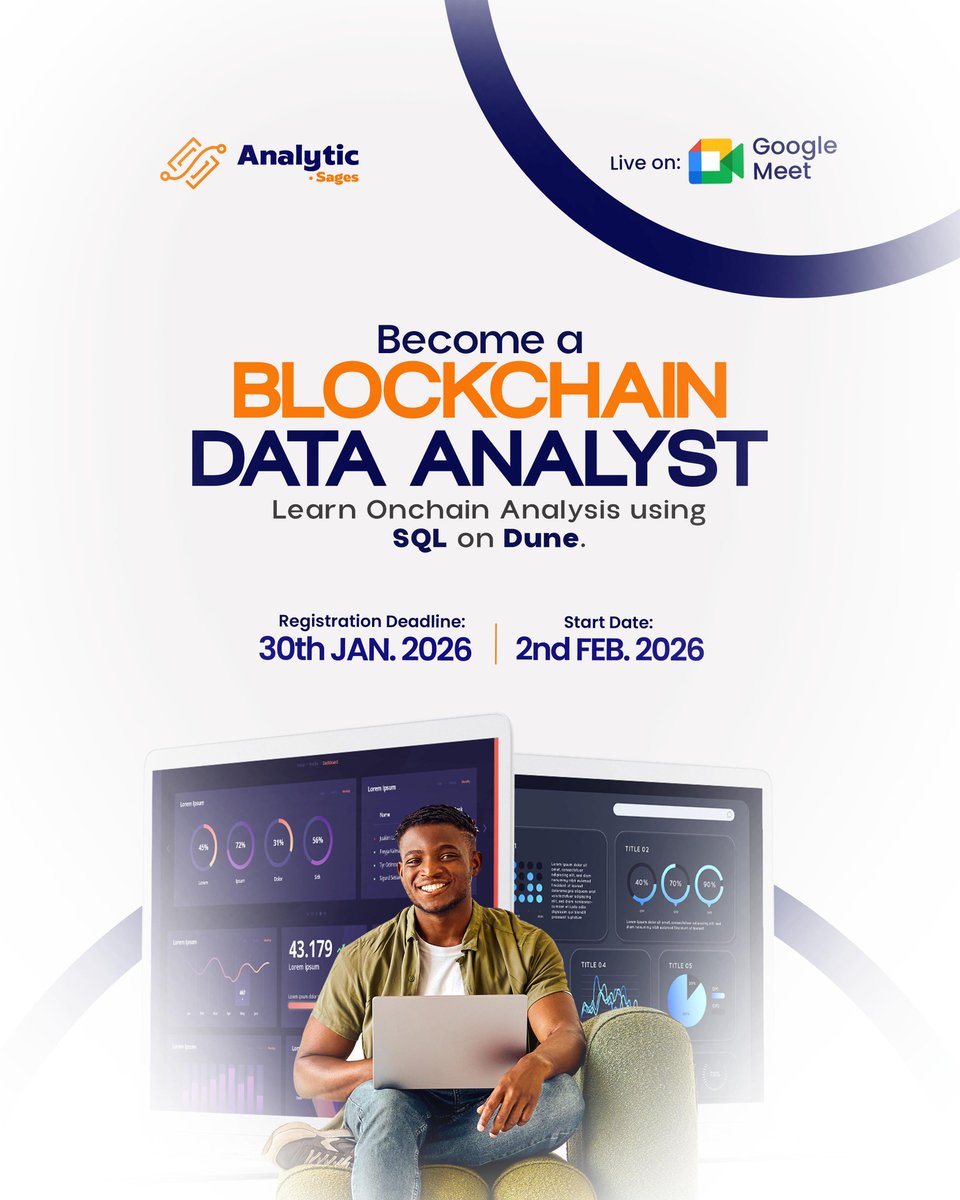
I curated the best crypto reads this week on staying ahead and positioning early (15 posts)🧵👇
𝕋𝕖𝕞𝕞𝕪🦇🔊 tweet media
English
14
27
40
2.1K
Might & Magic Fates TCG
Might & Magic Fates TCG@MightMagicFates·
🔥 Discover the next big battle card game with Might & Magic Fates TCG! Earn cards, build your perfect deck & dominate the PvP! Wishlist now on Steam👉 bit.ly/fates-steam
Might & Magic Fates TCG tweet media
English
26
804
967
59.1K
Blockchain Hive retweetledi
𝕋𝕖𝕞𝕞𝕪🦇🔊
𝕋𝕖𝕞𝕞𝕪🦇🔊@Only1temmy·
my 2025 wrap. > got the jupiter airdrop > made real friends on ct like @thesaint_, @ViktorDefi, @andrewsaunders and many others > influenced for several of my dream crypto brands > started getting noticed by founders, including the team behind one of the best l2s out there @megaeth > received merch packages from @okx, @magpiexyz_io and others > traveled to one of my dream countries > took advice from @DefiIgnas, @CryptoGirlNova and @patfscott seriously and it’s been paying off > tested fredware wallets from @KeystoneWallet and @CardwareWallet and they’re genuinely solid > got free subscriptions to @Delphi_Digital, @_dexuai, @getmoni_io and more > vibecoded my first app with help from @swishi_eth yes it was just a calculator lol > got a free mint into a strong socialfi community thanks to an old friend @ripchillpill > secured @KaitoAI NFT and the s1 drop > made a lot of cool friends on crypto twitter > received a few retroactive and social capital airdrops thanks to x > stayed away from leverage trading. what i regret this year > not taking profit early enough > being too loyal to ct and getting rugged > investing in a bad irl business > not doing enough due diligence before investing > missing my financial targets this year it hurts > not stress testing my systems properly > not farming enough airdrops > caring too much about people’s opinions 2026 goals: > tweet more lol > hit my financial goals > relocate > stay consistent > build better systems > keep learning and compounding far from giving up. still in the game. still building.
𝕋𝕖𝕞𝕞𝕪🦇🔊 tweet media
Ignas | DeFi@DefiIgnas

Things I got wrong this cycle: - restaking - Runes/Ordinals - Friend tech - Stacks ecosystem - Sonic - Arweave/AO Weirdly, a few good decisions fixed the above mistakes: - Not fading Sol - Buying Hype - Selling airdrops - No leverage. Not many lessons to take from these mistakes: I believed and still believe in clicking buttons. But the amount of clicking has decreased significantly since late 2025. The R/R for alts seems bad and great airdrops are few and rare.

English
49
7
117
12K
Xeusthegreat (♟,♟)
Xeusthegreat (♟,♟)@SamuelXeus·
If you're in Africa and want to get into Web3, make the most of the opportunities there in and join communit(ies) that is suited for you, drop a comment. I'm tryna see something.🥲
English
2.1K
168
3.9K
197K
ℝ𝕦𝕓𝕚𝕜𝕤
ℝ𝕦𝕓𝕚𝕜𝕤@RubiksWeb3·
𝐙𝐊-𝐏𝐫𝐢𝐯𝐚𝐜𝐲 𝐄𝐜𝐨𝐧𝐨𝐦𝐢𝐜𝐬: 𝐁𝐮𝐢𝐥𝐝𝐢𝐧𝐠 𝐓𝐫𝐮𝐬𝐭 𝐖𝐢𝐭𝐡𝐨𝐮𝐭 𝐓𝐫𝐮𝐬𝐭𝐢𝐧𝐠 𝐀𝐧𝐲𝐨𝐧𝐞 Today, no matter what you do, your digital action leaves a footprint. Each search, message, and payment is stored somewhere. The existing systems were built on undeserving trust because, at the end of the day, there is no privacy. Privacy has always been treated like a favor, not a right. Yet technology has reached a point where it can now be proven instead of promised. That is the power of Zero Knowledge. ------ 📌 Breaking Privacy The old web was built on confidence in companies, without user control. Every data server was policy-secured, not proof-secured. That was the 19th-century DeFi until we realized that every policy could be changed and every server could be hacked. Interestingly, Web3 replaced trust with transparency. And this transparency solved one problem by creating another, proving trust but compromising privacy, as all transactions, positions, and trades would be made public forever. But what we need is not blind transparency or blind trust, but rather a system where truth can be verified without exposing the data that proves it. Hence, ZK technology. ------ 📌 The Core of ZK A zero-knowledge proof allows you to prove that a statement is true without revealing the underlying information, by turning computation into proof. In simple terms, you can prove that you paid your tax without showing your income. You can also prove that you have enough collateral without showing your wallet. This concept turns privacy into infrastructure. Instead of depending on laws or terms of service, privacy is baked into the system itself. Ethereum’s shift toward RISC-V is part of this vision. It will make privacy computation faster and cheaper by design. Ethereum’s upcoming shift to RISC-V is making private computation faster and cheaper by design. ------ 📌 The Four Pillars of Real Privacy → Confidentiality: Hiding amounts or values from public view. → Unlinkability: Preventing others from connecting your actions to your identity. → Selective Disclosure: letting you reveal data only when needed. → Verifiable Compute: Proving that a result is correct without revealing inputs. When ZK technology covers all four pillars, which it does, it turns the system into a complete architecture for privacy. ------ 📌 The Builders of Private Compute → @Zcash pioneered shielded transactions using zk-SNARKs. It connects privacy and regulation by introducing viewing keys for optional auditability. → @SuccinctLabs runs a universal prover network that allows developers to outsource heavy cryptographic computation. → @cysic_xyz builds hardware acceleration for ZK proofs using GPUs and ASICs, converting compute power into yield assets and lowering proof cost to real-time levels. → @brevis_zk is a zk coprocessor that lets developers compute on historical data privately, allowing DeFi apps like @uniswap or @Frax to run data analytics without revealing the underlying transactions. → @arcium focuses on confidential computing on Solana. It uses Multi-Party eXecution Environments where encrypted data is processed in parallel across node clusters. → @encifherio offers private token transfers and swaps on Solana using ZK proofs, making it the closest thing to a private Venmo for blockchain. Together, they point toward one direction: privacy is becoming modular. It will plug into any chain or app like liquidity or gas today. ------ 📌 Privacy Economics Privacy benefits markets by reducing adverse selection, protecting user autonomy, and curbing data monopolies. But in a free market, users seldom pay for it, making it underprovided. ZK gives a mechanism to enable privacy to be economically sustainable, thus internalizing the externality. Supply and Demand of Proofs → Demand side: Protocols, dApps, institutions will want privacy, compliance, auditability, and proof-based trust. → Supply side: Prover networks (like Succinct), hardware accelerators (Cysic), zkVMs, and specialized services will deliver proofs. Tokens, economic mechanism design, plus governance, must align supply with demand. @SuccinctLabs, for example, raised $55M led by Paradigm to enable developer access to ZK proofs. Their SP1 zkVM is an infrastructure, used by protocols like @Mantle_Official. ☑️ Game Theory and Equilibrium: Users weigh cost vs privacy utility. Provers weigh cost, rewards, and staking risk. As proofs become cheaper and ubiquitous, a stable equilibrium will only form where privacy is the default, not the premium. ☑️ Correcting Information Asymmetry: ZK levels the playing field because no one can hide falsity behind opacity. In DEXs, private intent layers reduce front-running and insider advantage. ------ 📌 Privacy Economic Architecture 1. Private Intent Layer If you want to prove, you prove privately. The Private Intent Layer allows users to submit encrypted orders or transfers. The system processes them privately and posts only a verifiable receipt to the blockchain, removing transaction exposure while keeping execution transparent. It reduces the risk of MEV and protects users from front-running. Here's how it works: → Users submit encrypted intents (e.g., trade, transfer). → Proof networks or encrypted compute match or execute. → A succinct receipt posts on-chain that proves correctness. This hides volumes, counterparty, and timing. Then curtails MEV while preserving correctness. 2. ZK Data Permits The ZK Data Permit extends the logic of Zcash’s viewing keys by making the user define who can access their data, for how long, and for what reason. 3. Private Historical Compute This is the real meeting point between data utility and confidentiality. Here, protocols prove aggregate facts about history (90-day profit, risk ratios) without raw data. @brevis_zk and other zk coprocessors make this possible. ------ 📌 How Can Non-Private Systems Become Private Like I said earlier, privacy can be added where it was never designed to exist. → DEXs can route orders through the Private Intent Layer, providing best execution without exposing sizes or prices. → Lending protocols can accept ZK proofs of collateral health instead of public wallet balances. → Wallets can use ZK Data Permits to give auditors or partners temporary access. → Oracles can publish ZK-verified summaries instead of raw feeds. → Bridges can verify KYC status without receiving identity data. These examples prove that privacy can scale horizontally across every layer of blockchain. ------ 📌 The Privacy Movement Privacy applications have already processed over $10B in 2024. It is showing strength again, meaning that the figure could reach over $50B to $100B. Transaction fees on these networks are already below a cent, showing that privacy no longer costs performance. Therefore, when Ethereum completely shifts to RISC-V and hardware acceleration is fully added, private computation will become as fast as public execution. ------ 📌 The End of Blind Trust ZK turns trust into math. It removes the need to hope that systems do the right thing and lets you verify it directly. This implies that the future of digital privacy will rely solely on default cryptography that enforces confidentiality. The next evolution of Web3 will not ask for trust. It will prove it. Thanks for reading!
ℝ𝕦𝕓𝕚𝕜𝕤 tweet media
English
45
16
99
4.9K
Vlad 👾
Vlad 👾@vladsvitanko·
I just finished my first book “$100M+ Blueprint in Web3”. It cost me $1,000,000+ to buy this knowledge. Now you can "copy" my best strategies with this book. Cool? This unique $100M+ Blueprint is your A to Z playbook to hit the top: - Raise $$ quick and easy - Scale past 9-figures - $0 marketing tactics to build a HUGE community - 10+ Hyperscaling funnels that brought me MILLIONS - Successful token launch & TGE tactics - Brand building & storytelling & content templates ... and 5 FREE Gifts valued at $5,000+ I wish i had this book at the beginning of my journey.. Whether you build, invest, or just live in web3 — this book is a MUST. (by the way, it isn't a boring 1,000-page PDF.. it's a fun 3-hour read) I would trade it for $10,000... $30,000.. $100,000.. Because it printed MILLIONS for me. Look, i could've sold this book for $99 and made >$100k.. I felt nahhh. I want this book to be in hands of EVERY web3 builder. This is how i can give back. So, here's the deal.. i'm giving it away FOR FREE. 💬 Comment "BLUEPRINT" and follow @vladsvitanko I also prepared a secret gift for the first 100 🎁 🔁 Repost to get the book FIRST among the many & spread the word.
Vlad 👾 tweet media
English
1.2K
287
2K
139.3K
𝕋𝕖𝕞𝕞𝕪🦇🔊
𝕋𝕖𝕞𝕞𝕪🦇🔊@Only1temmy·
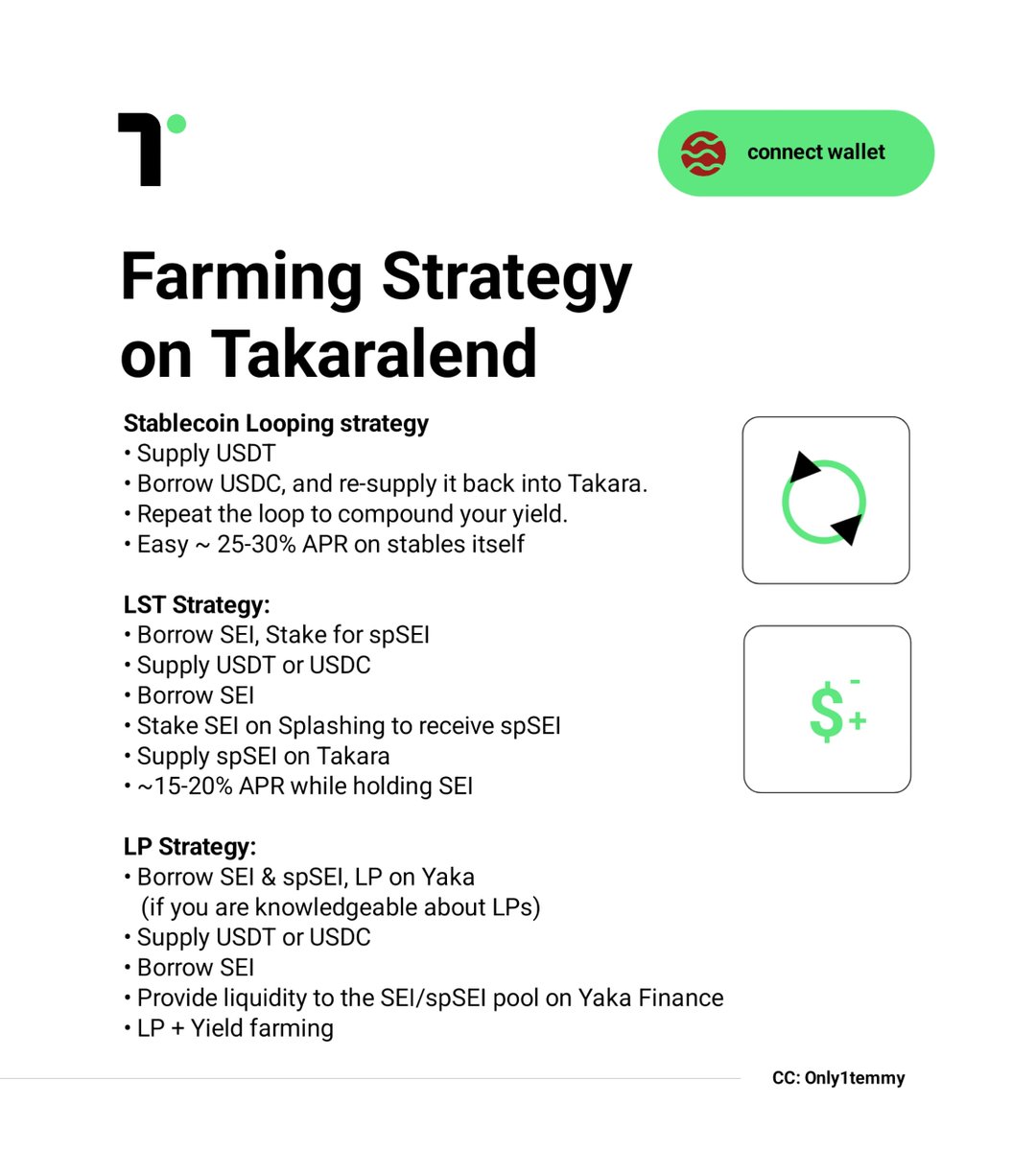
3. Underfarmed Despite Strong Farming Strategies @TakaraLend doesn't only have sticky stablecoin yields but it also have jaw dropping farming strategies that cut across LST and LP will allowing you to discover new platforms like @splashing_xyz and @YakaFinance. Here's the guide:
𝕋𝕖𝕞𝕞𝕪🦇🔊 tweet media
English
2
0
4
1.2K
𝕋𝕖𝕞𝕞𝕪🦇🔊
𝕋𝕖𝕞𝕞𝕪🦇🔊@Only1temmy·
Sei remains one of the most bullish L1s. While most eyes are on Yei Finance, the real overlooked gem is @TakaraLend. It gained over $120M in TVL within 5 months and is evolving into the Visa of Crypto Payments. Here are 6 reasons why it deserves your attention 🧵👇
𝕋𝕖𝕞𝕞𝕪🦇🔊 tweet media
English
42
1
51
40.1K
AO Captain🛩️
AO Captain🛩️@NigIsland·
Oga Peter, every time you jet off for another “global engagement,” it feels less like nation-building and more like academic tourism. Nigerians don’t need travelogues of you eating lunch with professors; they need light in their homes, jobs for their children, and roads that don’t kill them. You’ve turned policy into a TED Talk tour. You love quoting books like Why Nations Fail, but the irony is you’ve built a brand on diagnosing Nigeria’s sickness without ever stepping into the theatre to do the surgery. Nigeria doesn’t fail because we lack intellectual seminars it fails because politicians like you romanticize theory while dodging the grit of execution. And this habit of sprinkling every statement with “I met this professor, I dined with that economist”? It makes you look less like a leader and more like a LinkedIn influencer farming clout off elite names. The hard truth is no foreign academic will fix Anambra’s erosion, or stop bandits on Kaduna roads. That takes real governance, not endless study abroad programs. “A new Nigeria is POssible”? At this rate, the only thing that’s certain is another Obi photo-op in a Western university while Nigerians at home are still stuck in darkness.
English
13
1
11
3K
Peter Obi
Peter Obi@PeterObi·
Turning Nigeria Around: Insights from Global Engagements My last engagement of 3-day trip to the USA was defining and enriching, including over two hours of lunch and a walk meeting with the distinguished Professor James Robinson, alongside Professors Korieh and Utomi. Professor James Robinson was co-author of “Why Nations Fail” and a Nobel Laureate in Economics on “Prosperity of Nations”. My interest in meeting him was stirred by one of his penetrating observations, that there are nations in the world which clearly know the path to prosperity, yet consistently fail to take it. Among his examples was Nigeria. That remark struck me profoundly. It was not merely an academic statement but as a mirror held up to our nation. In our conversation, Professor Robinson reminded me that nations must possess the humility to remain learners if they are to advance. For me, the dialogue was both challenging and inspiring. It strengthened my conviction that Nigeria’s renewal requires difficult choices. With committed reforming and prioritising critical sectors of development, we can leapfrog our turnaround. Earlier this year, in pursuit of similar insights, I visited Johns Hopkins University to meet Professor Peter M. Lewis, the author of “Growing Apart: Oil, Politics, and Economic Change in Indonesia and Nigeria.” His comparative study of Indonesia and Nigeria - two nations that began with similar trajectories but diverged so starkly - posed an unavoidable question: why did one move in the right direction while the other faltered? To seek answers, I travelled to Indonesia itself, where I held constructive engagements with six ministers, a former Vice President, and Indonesia's most Popular President Joko Widodo. These encounters, across continents and with some of the finest minds and most experienced leaders, continue to deepen my conviction: Nigeria’s story is not a closed chapter of decline but an unfinished narrative with the potential for redemption. With competent and visionary leadership - rooted in capacity, character, commitment, and compassion - Nigeria can still be transformed into a nation of pride, dignity, and prosperity. A new Nigeria is POssible. -PO
Peter Obi tweet mediaPeter Obi tweet mediaPeter Obi tweet mediaPeter Obi tweet media
English
482
3.1K
9K
230.1K
Blockchain Hive retweetledi
ℝ𝕦𝕓𝕚𝕜𝕤
ℝ𝕦𝕓𝕚𝕜𝕤@RubiksWeb3·
Back in 2022, DeFi ran on metas like: • GMX & GNS perps • The “real yield” model • Curve & Solidly’s ve(3,3) wars All made noise. Few made liquidity stick. The problem? Capital rotated. Liquidity was mercenary. Protocols bled emissions, and users moved on. This cycle broke more than a few DeFi dreams and pushed many into pure degen trading. That’s why I’m now joining @HookedExchange as an advisor. I’ve been watching closely - and this is one of the few projects that seems to have actually learned from the past. Launch is coming soon. But even now, Hooked is building a DEX that: → Learns from past models → Fixes the real points of pain → Prioritizes transparency, utility & long-term alignment They’re shipping: → Dynamic fees that scale with volatility → Smart routing for better trades + LP yield → Filters to kill spam pools & wash trading → LPs that adapt, not drain → Incentives aligned with LPs and traders → Cleaner, less grindy governance → A design for *sticky* liquidity I’ll be working with the team to help shape all this - and I truly think Hooked is worth your attention. Follow @HookedExchange - you’ll want to be early here. Now, it's time to tell me. What’s the biggest dealbreaker you still see in today’s DeFi models? From what I've listed or something I missed?
ℝ𝕦𝕓𝕚𝕜𝕤 tweet media
English
36
13
66
2.8K