mawarire mbizvo jealousy@mawarirej
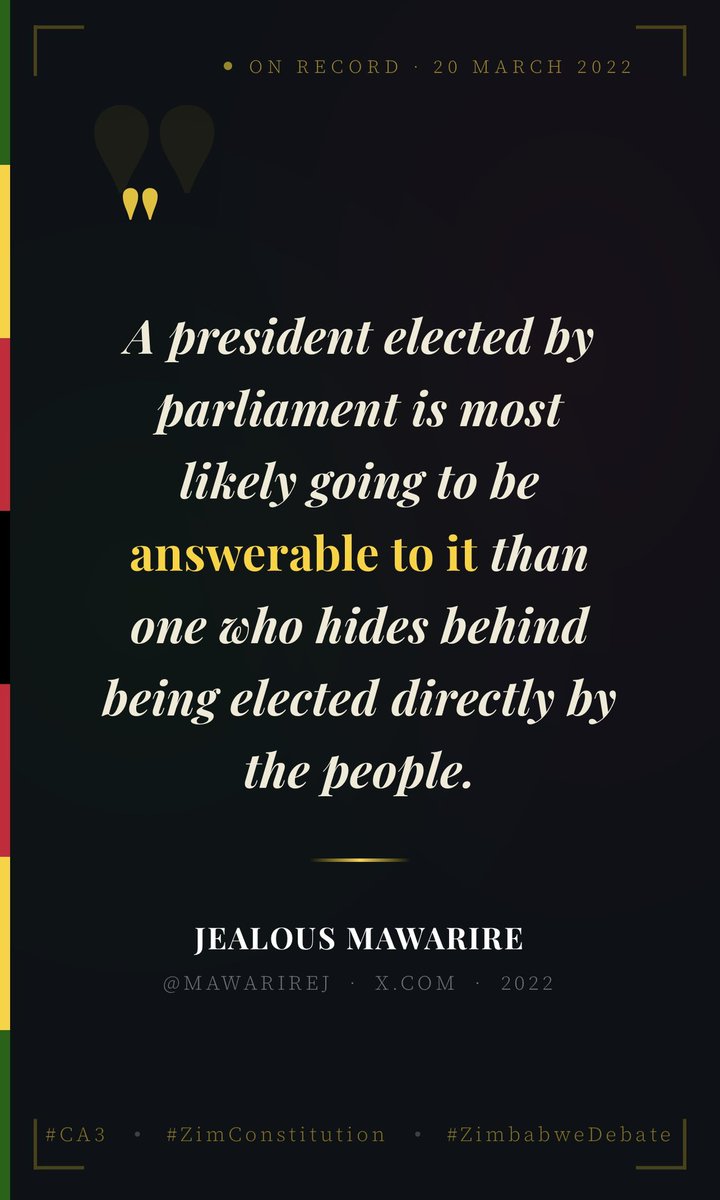
Your #CAB3 doesn't propose Proportional Representation in parliamentary elections. Those that elect presidents through parliament also elect parliamentarians through PR.
Zimbabwe uses a different system. We use First Past The Post (FPTP) to elect MPs, which is completely different from what I proposed in my tweets.
For me, electoral violence occurs in parliamentary elections where warlords employ massive violence in their electoral districts to force people to vote for them.
Our elections are violent because they're winner-takes-all. That situation cannot be cured by parliament electing a president because the parliament itself is a result of a very violent electoral process. Change the system on how MPs are elected if the amendments envisage ending political violence. You don't fix an engine malfunction by changing a car's exhaust pipe.
Go full-time PR, elect political parties, not individuals, in parliamentary elections in order to cure the violence that FPTP brings in parliamentary elections.
Legitimize parliament by ensuring the process of electing parliamentarians isn't violent if you want to use parliament to elect a president. It's that simple.
That was the argument I made then, it is an argument I still make today.
Show me where, in your CAB3, there is a proposal to elect MPs through PR.
Also show me where in my tweets I advocated for extending presidential term from 5 to 7 years?
Where did I suggest to mutilate the constitution by ignoring the disability clause in section 328 (7) inorder to extend ED's term unconstitutionally?
If you don't understand electoral systems don't argue on things you are not well versed in.
Zimbabwe doesn't use the system South Africa uses to elect a parliament which then chooses, from within itself, a president.
Don't be desperate to the extent of confusing your desire to shield ED from elections and the illegality of extending his term with calls for electoral reform.
I advocated for Zimbabwe to go full-time Proportional Representation, which I still do, but I don't agree with the illegality of extending the President's term from 5 to 7 years. I also don't agree ED should violate s328(7) by presiding over his term extension.
In any case, my proposal for full-time PR is a personal view, if it has to be adopted, put it to the people. Surely, you can't hold the whole of Zimbabwe at ransom because Mbizvo Jealousy Mawarire made a proposal that Zimbabwe should go PR.
Mawarire is just but one exiled soul out of 17 million people. His views cannot be generalized on 17 million people without their involvement.
Any proposal on changing the electoral system has to be subjected to a referendum. Don't be afraid of the people you want to govern. Go to them with CAB3, let them pass their verdict through a REFERENDUM.