
Bete 𝕏 retweetledi
Bete 𝕏
16.9K posts


Bete 𝕏
@Bete263
Bete and the gang
Harare, Zimbabwe Katılım Nisan 2017
1.7K Takip Edilen1.6K Takipçiler

Bete 𝕏 @Bete263
“In Accordance With” Means Exactly What It Says. Brian Mari has now built 19 numbered points on a distinction between “in accordance with” and “in terms of” in s117(2)(a). This is the new foundation of his argument. “In accordance with” in constitutional language means: follow the procedure prescribed. Nothing more. Nothing less. It does not convert Parliament from the body that amends the Constitution into a passive fiduciary waiting for someone else to bring it a proposal. That reading finds no support in the text of s117, s328, or any judgment of the Constitutional Court of Zimbabwe. s117(2)(a) says the legislative authority confers on the Legislature the power to amend the Constitution in accordance with s328. Read plainly: Parliament has the power. s328 tells Parliament how to use it. Constitution of Zimbabwe (Amendment No. 3) Bill, 2026 follows s328. That is the end of the argument. His s328(2) point collapses the same way. He argues that “precise terms” means a separate prior document must exist, initiated by someone outside Parliament, before the Bill can be introduced. s328(2) says no such thing. “Precise terms” means the Bill must clearly state what it is amending and how. Read CA3’s memorandum and its 22 clauses. Every amendment is stated with precision. The requirement is met. @brianmari3’s marriage analogy in point 18 destroys his own argument. Under Zimbabwe’s Marriages Act, the parties themselves initiate the notice of intention to marry. No external authority dictates the terms to them first. The notice period exists so the public can raise objections. That is precisely how s328 works: Cabinet brought the Bill, the Speaker published its precise terms in the Gazette, Parliament invited public submissions for 90 days. The initiating party brings the terms. A third party does not prescribe them from outside. Brian Mari’s own analogy confirms CA3 followed the correct procedure. And point 19 reveals everything. After 18 numbered points of linguistic architecture, he lands in exactly the same place he started: Cabinet through the Minister of Justice should not have initiated this. That is the s110 argument he had @matinyarare push all of last week. The same argument that has been answered. Repeatedly. What we are watching is not constitutional analysis. It is a man who started with a conclusion, CA3 is invalid, and is working backwards through definitions, conjunctions, and analogies to find a path to that conclusion. Each time the path is closed, he finds a new door. “In accordance with” is the door i’m now closing. Section 328 is the amendment framework the people of Zimbabwe wrote for themselves. CA3 walks through it, step by step. No creative reading of a conjunction changes that. I’m up until 2am Brian. Hit me again.
QME

Ok. I do not know if I must also be dump like you and fail the basics in that-
1. s117(2)(a) refers Legislature to amend constitution "in accordance with s328" and not "in terms of" . This should be a loud and clear first step. Do not make "in accordance with" to mean "in terms of", two different things.
2. Once a provision says "in accordance with "it does not make you the originator of the action to be done but puts you in a fiduciary position which require you to ensure others bring legislative claims that comply with s328 a provision in constitution . Your mistake is to convert "in accordance with" to mean "in terms of".
3. In that regard, right from source of authority conferred to legislator, it is not the one to initiate amendments.
4. If the said s117(2)(a) had said "in terms of" then one would look at s328 and follow a step by step to complete the whole s328.
5. In that regard, it is the duty of the one who want the constitution to be amended that look at s328(2) first and must take note its wording which reads "An Act of Parliament that amends this constitution must do so in precise terms". Then look at his or her claim if the claim require some authorities vested somewhere was acquired first before approaching Parliament for enactment.
6. Now the said s117(2)(a) which said legislator amends constitution has now been broken down into Act of Parliament- it's no longer "legislator" amending but "Act of Parliament"- I think we can all read this and follow.
7. The Act of Parliament is the one amending constitution not ZANU MPs, so there is an Act of Parliament which you must visualise and put it to your right hand and make it raise its right hand to amend the constitution. Does that make this visually imaginable event suggest that the said animal "Act of Parliament" that has capacity to act on another animal called "this constitution" is part of the amended item?
8. Let me bring to you to the next step in text, "must do so in precise terms" who is giving terms here? Is it the constitution giving terms to amend or Act of Parliament givings terms?
9. Of course, the Act of Parliament is the one giving terms on which the amendments are being done and those terms must be precise. Does that make the terms of amending constitution referred here the actual proposed amendments?
10. If the amendments were part of the Act of Parliament then who is being given the terms of amendments by the same Act of Parliament to then amend constitution? That must show you from s328(2), the legislator (Parliament and President acting in accordance with chapter 6) has a role of looking at proposed amendments and see if the proposal deserve amendment, then draft a Bill (a draft judgement why Parliament think the proposal deserve approval for amendment) stating the precise terms and conditions the amendment are enacted.
11. Let's do it closer. Section 328(3) breaks down the task little bit further, s117(2)(a) was referring to Legislator which we later found out in s328(2) that Legislator is actually Act of Parliament doing it, but an Act of Parliament in terms of s131(2) is a Bill that was presented to Senate and National Assembly and acquired majority vote and Assented to and signed by President. So the precise terms referred to in s328(2) first have to be on a Bill that will be presented to public first and then to Parliament and then signed by President.
12. In that regard, what is referred in s328(3) as "Constitutional Bill" also defined by s328(1) is that which will be come Act of Parliament in s328(2) and Speaker before presenting it to be passed by Senate and National Assembly he must give 90 days notice to public.
13. Notice of what? Does s328(3) refer to notice of amendments to constitution? No. It is clear of what the Notice contains.
14. Clearly we can read and follow and see that the notice is of the Precise terms of the Constitutional Bill to be presented as the grounds upon which parliament feel they can amend the constitution.
15. Does that make the amendment themselves the terms? Of course not. Terms are separate thing that if enacted becomes an Act of Parliament but the proposed amendments, which must be an attachment or schedule to the Constitutional Bill, are separate thing brought by someone for reasons that will be in the terms of the Constitutional Bill.
16. In that regard a constitutional Bill is like a proposed judgement by Parliament on why they feel the proposed amendments must be enacted and it must justify the reasons the enactment must be granted.
17. This is the judgement we have 90 days of assessing and giving the parliament our views in order to help the parliament to be guided on their terms on the Bill in order for it to see if the terms meet the constitutional requirements first before we look at the proposal meeting the constitutional requirements.
18. It's like notices given by people wanting to marry who put public notice requiring any person to show cause why the two must not marry. The notice must attach what the two intend to marry say, are you a devorcee, Bachelor ,Spinster, widow, widower. These are terms upon which the two are getting married but once married your other reference vanish and marriage officer does not become part of marriage
19. Now, what is failing here is that, Cabinet through Minister of Justice, is the one seeking the amendment and the Bill itself is the amendment not the terms of amendment
Bete 𝕏 @Bete263
The Constitution Is Not a Riddle. Stop Pretending It Is. Some people have taken to social media with long, numbered posts full of legal-sounding definitions, hoping that complexity alone will pass for argument. It will not. Let us make this simple. The 2013 Constitution of Zimbabwe was written by Zimbabweans, for Zimbabweans. It was not written to confuse people, it was written to govern them. And one of the things it does very clearly is explain how it can be changed. That provision is Section 328. It does not hide. It does not require a PhD to find. It is there, in plain language, telling Parliament exactly how to amend the Constitution, which clauses require a two-thirds majority, which require a referendum, and which do not. Constitution of Zimbabwe (Amendment No. 3) Bill, 2026 follows that process. Exactly. Now, some will build elaborate arguments using the word “this” in Section 2(1), or parse definitions in Section 332 across seventeen numbered points, to arrive at the conclusion that Parliament cannot amend existing constitutional provisions, only add new ones. Read that again slowly. They are arguing that every constitutional amendment in Zimbabwe’s history, including Amendment No. 1 and Amendment No. 2, was invalid. They are arguing that the word “amend” in Section 117(2)(a) does not mean what “amend” has always meant in every constitution in the world. That is not legal analysis. That is wordplay designed to confuse, not to illuminate. Section 117(2)(a) is unambiguous. It gives the Legislature, Parliament, the power to amend the Constitution in accordance with Section 328. Not to add to it only. Not to correct inconsistencies only. To amend it. And Section 328 provides the graduated framework for doing exactly that: some provisions require a referendum, others require enhanced majorities. The drafters of the 2013 Constitution were not careless people. They built a living document, not a frozen one. A constitution that cannot be amended by the people’s representatives, following the people’s own prescribed process, is not supreme law. It is a trap. Zimbabwe’s Constitution is not a trap. It is a framework. And CA3 operates squarely within that framework, initiated by Cabinet under Section 110(3)(c), proceeding through Parliament under Section 117(2)(a), following the amendment procedure under Section 328. The people who wrote Section 328 knew exactly what they were doing. The people trying to argue it away know exactly what they are doing too.
English
“In Accordance With” Means Exactly What It Says.
Brian Mari has now built 19 numbered points on a distinction between “in accordance with” and “in terms of” in s117(2)(a). This is the new foundation of his argument.
“In accordance with” in constitutional language means: follow the procedure prescribed. Nothing more. Nothing less. It does not convert Parliament from the body that amends the Constitution into a passive fiduciary waiting for someone else to bring it a proposal. That reading finds no support in the text of s117, s328, or any judgment of the Constitutional Court of Zimbabwe.
s117(2)(a) says the legislative authority confers on the Legislature the power to amend the Constitution in accordance with s328. Read plainly: Parliament has the power. s328 tells Parliament how to use it. Constitution of Zimbabwe (Amendment No. 3) Bill, 2026 follows s328. That is the end of the argument.
His s328(2) point collapses the same way. He argues that “precise terms” means a separate prior document must exist, initiated by someone outside Parliament, before the Bill can be introduced. s328(2) says no such thing. “Precise terms” means the Bill must clearly state what it is amending and how. Read CA3’s memorandum and its 22 clauses. Every amendment is stated with precision. The requirement is met.
@brianmari3’s marriage analogy in point 18 destroys his own argument. Under Zimbabwe’s Marriages Act, the parties themselves initiate the notice of intention to marry. No external authority dictates the terms to them first. The notice period exists so the public can raise objections. That is precisely how s328 works: Cabinet brought the Bill, the Speaker published its precise terms in the Gazette, Parliament invited public submissions for 90 days. The initiating party brings the terms. A third party does not prescribe them from outside. Brian Mari’s own analogy confirms CA3 followed the correct procedure.
And point 19 reveals everything. After 18 numbered points of linguistic architecture, he lands in exactly the same place he started: Cabinet through the Minister of Justice should not have initiated this. That is the s110 argument he had @matinyarare push all of last week. The same argument that has been answered. Repeatedly.
What we are watching is not constitutional analysis. It is a man who started with a conclusion, CA3 is invalid, and is working backwards through definitions, conjunctions, and analogies to find a path to that conclusion. Each time the path is closed, he finds a new door. “In accordance with” is the door i’m now closing.
Section 328 is the amendment framework the people of Zimbabwe wrote for themselves. CA3 walks through it, step by step. No creative reading of a conjunction changes that.
I’m up until 2am Brian. Hit me again.
brian mari@brianmari3
Ok. I do not know if I must also be dump like you and fail the basics in that- 1. s117(2)(a) refers Legislature to amend constitution "in accordance with s328" and not "in terms of" . This should be a loud and clear first step. Do not make "in accordance with" to mean "in terms of", two different things. 2. Once a provision says "in accordance with "it does not make you the originator of the action to be done but puts you in a fiduciary position which require you to ensure others bring legislative claims that comply with s328 a provision in constitution . Your mistake is to convert "in accordance with" to mean "in terms of". 3. In that regard, right from source of authority conferred to legislator, it is not the one to initiate amendments. 4. If the said s117(2)(a) had said "in terms of" then one would look at s328 and follow a step by step to complete the whole s328. 5. In that regard, it is the duty of the one who want the constitution to be amended that look at s328(2) first and must take note its wording which reads "An Act of Parliament that amends this constitution must do so in precise terms". Then look at his or her claim if the claim require some authorities vested somewhere was acquired first before approaching Parliament for enactment. 6. Now the said s117(2)(a) which said legislator amends constitution has now been broken down into Act of Parliament- it's no longer "legislator" amending but "Act of Parliament"- I think we can all read this and follow. 7. The Act of Parliament is the one amending constitution not ZANU MPs, so there is an Act of Parliament which you must visualise and put it to your right hand and make it raise its right hand to amend the constitution. Does that make this visually imaginable event suggest that the said animal "Act of Parliament" that has capacity to act on another animal called "this constitution" is part of the amended item? 8. Let me bring to you to the next step in text, "must do so in precise terms" who is giving terms here? Is it the constitution giving terms to amend or Act of Parliament givings terms? 9. Of course, the Act of Parliament is the one giving terms on which the amendments are being done and those terms must be precise. Does that make the terms of amending constitution referred here the actual proposed amendments? 10. If the amendments were part of the Act of Parliament then who is being given the terms of amendments by the same Act of Parliament to then amend constitution? That must show you from s328(2), the legislator (Parliament and President acting in accordance with chapter 6) has a role of looking at proposed amendments and see if the proposal deserve amendment, then draft a Bill (a draft judgement why Parliament think the proposal deserve approval for amendment) stating the precise terms and conditions the amendment are enacted. 11. Let's do it closer. Section 328(3) breaks down the task little bit further, s117(2)(a) was referring to Legislator which we later found out in s328(2) that Legislator is actually Act of Parliament doing it, but an Act of Parliament in terms of s131(2) is a Bill that was presented to Senate and National Assembly and acquired majority vote and Assented to and signed by President. So the precise terms referred to in s328(2) first have to be on a Bill that will be presented to public first and then to Parliament and then signed by President. 12. In that regard, what is referred in s328(3) as "Constitutional Bill" also defined by s328(1) is that which will be come Act of Parliament in s328(2) and Speaker before presenting it to be passed by Senate and National Assembly he must give 90 days notice to public. 13. Notice of what? Does s328(3) refer to notice of amendments to constitution? No. It is clear of what the Notice contains. 14. Clearly we can read and follow and see that the notice is of the Precise terms of the Constitutional Bill to be presented as the grounds upon which parliament feel they can amend the constitution. 15. Does that make the amendment themselves the terms? Of course not. Terms are separate thing that if enacted becomes an Act of Parliament but the proposed amendments, which must be an attachment or schedule to the Constitutional Bill, are separate thing brought by someone for reasons that will be in the terms of the Constitutional Bill. 16. In that regard a constitutional Bill is like a proposed judgement by Parliament on why they feel the proposed amendments must be enacted and it must justify the reasons the enactment must be granted. 17. This is the judgement we have 90 days of assessing and giving the parliament our views in order to help the parliament to be guided on their terms on the Bill in order for it to see if the terms meet the constitutional requirements first before we look at the proposal meeting the constitutional requirements. 18. It's like notices given by people wanting to marry who put public notice requiring any person to show cause why the two must not marry. The notice must attach what the two intend to marry say, are you a devorcee, Bachelor ,Spinster, widow, widower. These are terms upon which the two are getting married but once married your other reference vanish and marriage officer does not become part of marriage 19. Now, what is failing here is that, Cabinet through Minister of Justice, is the one seeking the amendment and the Bill itself is the amendment not the terms of amendment
English
Bete 𝕏 retweetledi

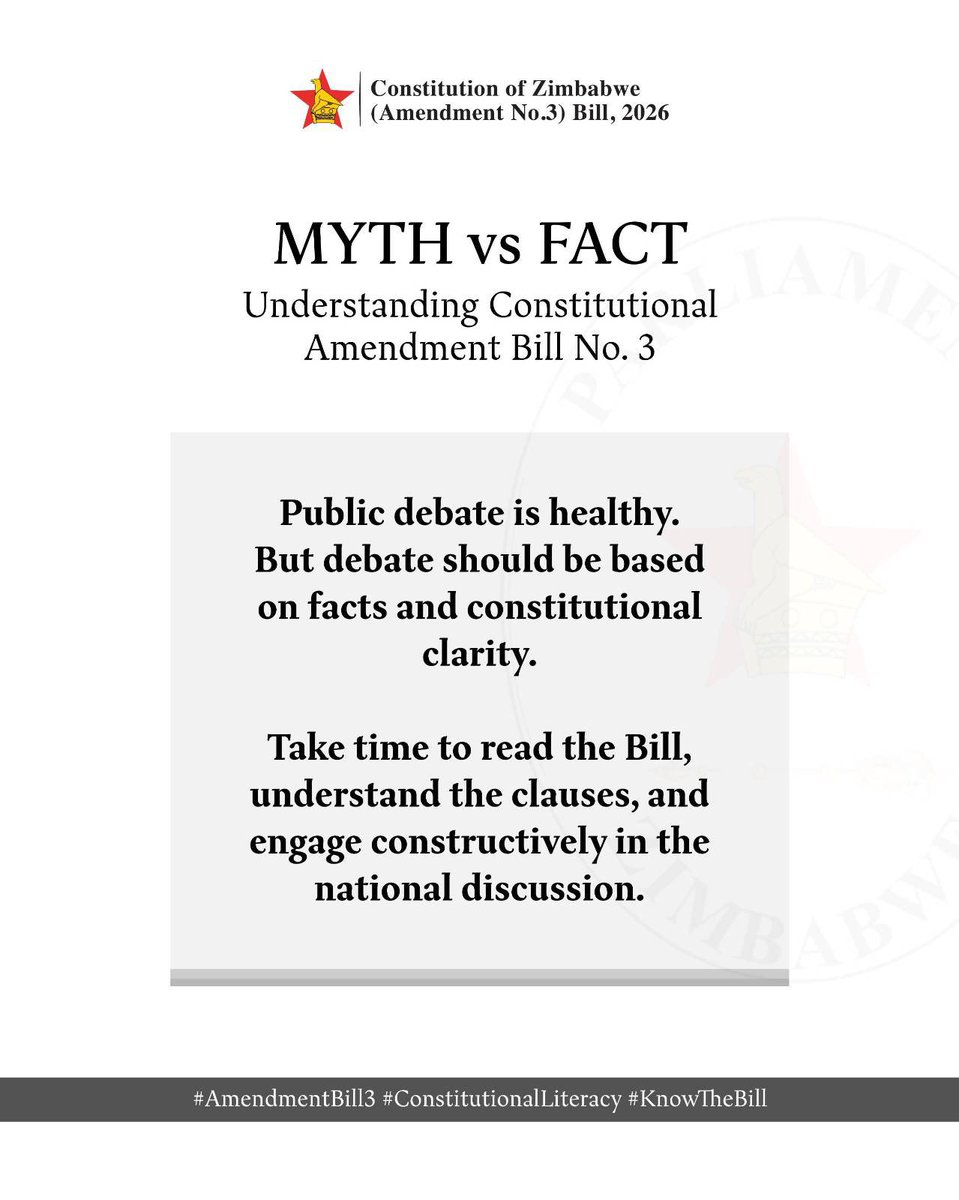
Having public debates on X is very good and healthy. It’s encouraging to see so many voices now engaging on #CA3 - it reflects a level of political maturity.
BUT,
Many of those voices, especially the ones opposing the bill, seem to be driven more by spite than by facts. Every day, we see unfounded claims and arguments from people who haven’t even taken a minute to read what the bill actually says, yet are quick to say NO.
At the very least, read and understand the bill first; then post whatever position you want.
@bbmhlanga
English


Bete 𝕏 retweetledi

@Bete263 @PopoMas12 @MkonoPride I love me some @Bete263. I stand with Bete where #CA3 is concerned. So far, it's Bete 30 vs. 0 ALL Opposition put together. #CA3Success #CA3Zimbabwe #CA3WINS
English
Bete 𝕏 retweetledi

#Zimbabwe
#HappySunday
Fear thou not; for l am with thee: be not dismayed; for l am thy God: I will strengthen thee; yea, I will help thee; yea, I will uphold thee with the right hand of my righteousness. Isaiah 41 v 10
English
@Chaguta7610 @Potifahzvombo1 @brianmari3 @matinyarare @KMutisi @Gatsheniadv @MoJLPA @AGZim_Official Don’t over estimate yourself
👇🏾
x.com/bete263/status…
Bete 𝕏 @Bete263
The Constitution Is Not Frozen in the People’s Hands You are conflating constituent power with constitutional amendment procedure, two distinct legal concepts. Yes, the 2013 Constitution originated with the people through COPAC and referendum. But the people, in exercising that very constituent power, also wrote s328, which explicitly delegates amendment authority to Parliament. The people did not reserve all future changes to themselves. They created a graduated amendment procedure: some provisions require a referendum, others require enhanced parliamentary majorities. That is the people’s will, expressed in their own document. Your Lancaster House analogy works against you. Zimbabwean parties negotiated the constitutional content at Lancaster House, but it was British Parliament that enacted it. Nobody who voted in Westminster wrote that constitution. Enactment and authorship have always been distinct exercises. Your claim that a Bill cannot “become part of” the constitution misreads how constitutional amendment works in every jurisdiction. The Amendment Act is the instrument; the amended constitution is the result. Nobody argues the instrument is the constitution. S95(2)(b) is not a term-limit provision under s328(1), it is coterminous with Parliament, not a fixed personal cap. S328(7)’s incumbent-protection rule is therefore never triggered. The two-thirds majority required under s328 was met and the procedure prescribed was followed. You want to invoke the people’s voice, but the people already spoke in 2013, when they wrote s328 themselves.
English

@Bete263 @Potifahzvombo1 @brianmari3 @matinyarare @KMutisi @Gatsheniadv @MoJLPA @AGZim_Official Ana Bete mashaya mhinduro ka. This is the one thing that will taint ED's legacy. Whoever is pushing it wants ED to fail. Sorry maningi
English
@matinyarare @KMutisi @Gatsheniadv
Pamwe pacho unoseka wega hako.
1. A whole minister of Justice @MoJLPA and a whole Attorney General of state @AGZim_Official cannot tell the difference between constitution of Zimbabwe and Constitution of Zimbabwe amendment (No.20) Act of 2013.
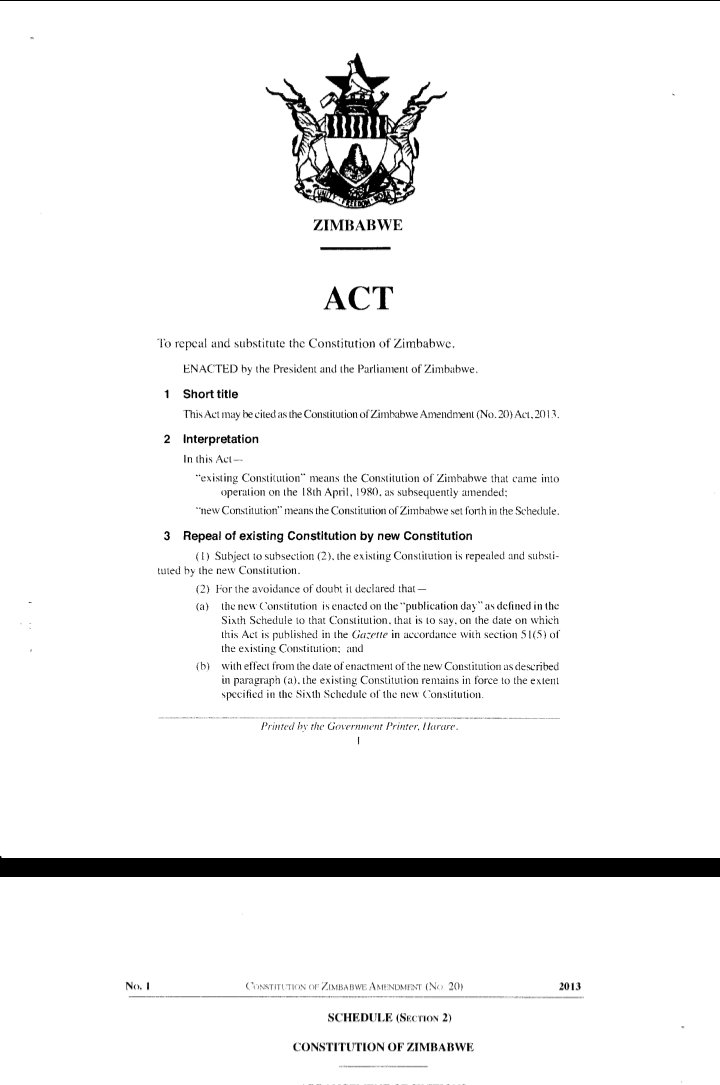
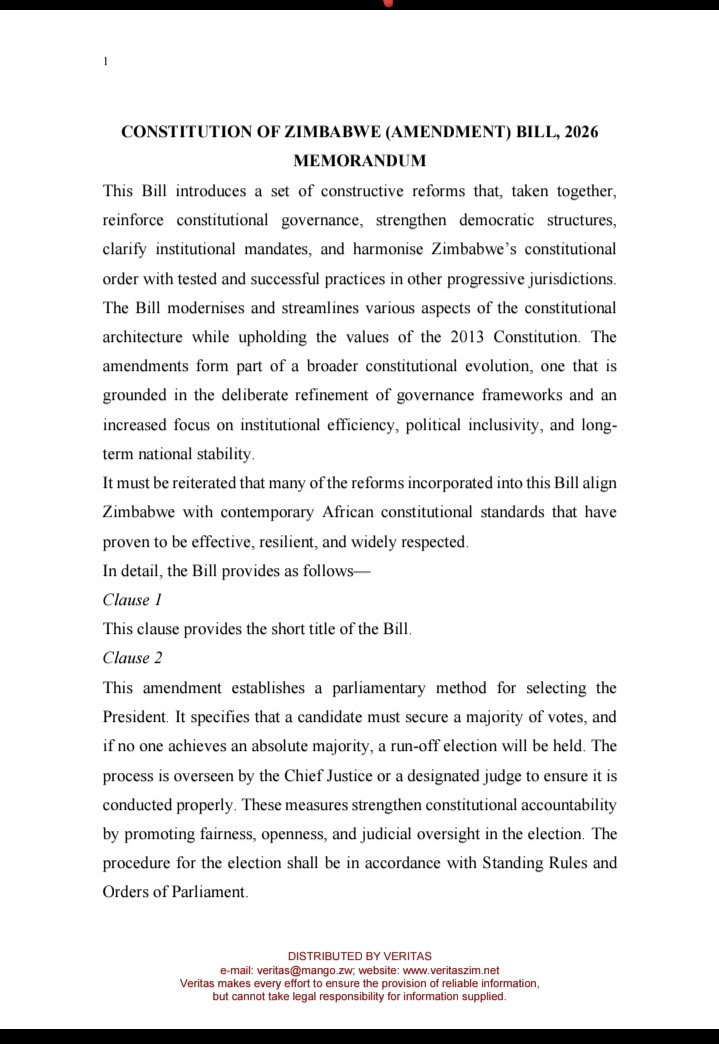
2. They cannot read from original Constitution of Zimbabwe Amendment (No.20) Act of 2013, which has only 3 (three section) 3 only (I put screen shot of it here-
a. Section 1, to give title to the Act,
b. Section 2, to interpret the Act and introduce constitution of Zimbabwe as set in schedule 2 of itself
c. Section 3, to repeal former constitution and substitute it with new and
d. In s3(2) an avoidance of doubt was made to help the lost, and it clearly states that, "new constitution" which is a separate document to "Constitution of Zimbabwe amendment (No.20) Act, was to be enacted on the publication "publication day" as defined by Sixth Schedule to that constitution, which was the publication day of "constitution of Zimbabwe amendment (No.20) Act of 2013" as separate law to the Act and
e. A transition from the then existing constitution to new constitution was published.
3. If you are to hold the Constitution of Zimbabwe today, would you say it is an Act of Parliament or it must be defined as "constitution of Zimbabwe as defined by s2 of constitution of Zimbabwe amendment (No.20) Act of 2013 and set in Second Schedule to the Act"?
4. Would you say, by repealing and substituting former constitution of Zimbabwe and enact new constitution as Second Schedule to the Act, "Parliament authored second schedule to Constitution of Zimbabwe amendment (No.20) Act of 2013"?
5. Can we then say, repeal, substitute or amendment of constitution means the physical and direct drafting and enactment of the actual text of constitution by Parliament and President or the power to political exercise on the actual text is separate exercise from Parliament day to day duties where in some jurisdictions like South Africa it is done through freely chosen representatives in a forum specifically meant for that and in case our jurisdiction the exercise done by the people of Zimbabwe directly on their document, whereby
6. After exercising of right to participate, there must be an amendment to the Preamble of the actual constitution, stating that, the same people who made the constitution in 2013, now, at a referendum or by petition from Citizens which received a majority vote on such such a date, we have amended section so and so and submitted this to parliament for enactment, effective dates and other modalities stated
7. Where therefore, the Act of Parliament seeking to amend the constitution contemplated by section 328(2) is just like "Constitution of Zimbabwe amendment (No.20) Act 2013" which I have put a screen shot of here. An Act seeking to amend constitution is not part of constitution, it only spells the terms that brought in the amendment and how the Parliament was engaged to enact and reference to any petition or schedule describing anything that made the process of amendment go through. Period.
8. The 2/3 majority vote to a Constitutional Bill is not to vote for contents of provisions that are for amendment, those are in the terms of the Bill, theirs is to vote for the enactment of the Bill that will make the contents of terms law and not its terms.
9. Just as part 1 of Sixth Schedule explain in the definition of "publication date" that "a statutory instrument from s51(5) of former constitution shall be used to enact the constitution and publication date of that instrument shall be publication date of constitution". The parliament that sat to vote for the enactment of constitution did not write the constitution or draft the COPAC constitution as a bill, but it was a proposal that was put to people and it got the majority vote.
10. Even the Lancaster House Constitution that came as a result of Lancaster House agreement, it was an attachment to an agreement- Annexure C and in Annexure D of agreement paragraphs 22 and 23, it states that Legislative authority of British Parliament was to be sought to enact the Independence Constitution of Zimbabwe and a Bill was to be introduced to provide for establishment of Zimbabwe.
11. To date under British Statutes, there is a Zimbabwe Act 1979 chapter 60, no one from Zimbabwe ever voted in that parliament and the decision to enact this Act was made by thresholds laid up in British Parliament, not because any of the people voting in the parliament had a party they want to win elections of Zimbabwe or they were interested in the contents of annexure C of agreement.
12. Zimbabwe Act never became part of Zimbabwe constitution and in its 7 sections and the schedules it does not refer to the good or bad of contents of annexure C of agreement. They referred to paragraphs 22 and 23 and deliberate on the question to do with enactment and how the transition was going to be dealt with.
13. When @ProfJNMoyo quotes the Former constitution he does not cite Zimbabwe Act 60 of 1979 in British Parliament, he refers to the "we", forgetting that the parties that were involved in that agreement were not freely chosen delegates of any single process, save to say s1 of Zimbabwe Act 1979 gave us "independence" as a people to then self determine our own political destiny directly or through a freely chosen representative.
14. This is the fight we fought until 2013 when we finally decided our own political destiny directly. If this is to be changed, we change it ourselves directly again.
15. In the two constitutions births 1980 and 2013 in our history, at no time legislative authority to enact a constitution been construed to mean writing a constitution for people nor the Act of Parliament enacting a constitution or constitution amendment been regarded as part of constitution. Constitution is not an Act of Parliament or work of parliament.
16. Rather from agreement that brought Lancaster House constitution, they made a constitution that had a provision giving a single citizen, right that was above the rest and others came after him. By this status we were all second class citizens in our land for 33 years and all the said amendments in their constitution of agreement of political parties, they were never people's decisions, neither were these decisions made without political opinion as the right to participate in your country affairs is protected and guaranteed.
17. Funny enough to see, a whole minister of Justice and a whole Attorney General of State writing a memorandum, possibly a copy and paste exercise from templates of Act of Parliament, then state that it seek to "introduce" reforms. ..
18. Parliament only has power to amend constitution in terms of s328. Period. "Introduce" is making law and that is exercised under s117(2)(b). Period.
19. A Bill seeking to amend constitution must only state the precise terms of amendments and not the amendments. The amendments must be attachment to the Bill. This is what s328(4) refers to as terms.Just like in court's notices of motion which attach affidavit of the applicant. The terms of application are on notice of motion but the whole story is in the sworn affidavit.
20. Now we have a Bill that has no reference to people Zimbabwe involvement and no single person whose citizenship is positively identified, purporting to amend that which people of Zimbabwe made on their own and in their reasoning after publication, the Act becomes part of constitution or the provisions become part of constitution without people.
21. How? How does a Bill become part of constitution? How nhaimi madofo imo.
22. From 2009 to 2013, the constitution of Zimbabwe never ever became a Bill, it was never a Bill then and no Bill can physically change constitution.
23. A Bill may only enact what people of Zimbabwe agreed on, it does not make itself part of constitution or decide for the people. All Parliament does is enact. Period.
24. Go to the COPAC draft that went for referendum. It has three signatures on each page of draft. The names are of citizens of Zimbabwe. While they were members of Parliament for purpose of other functions but for this exercise there was another free choice made to pick the three to act in place of parties- the word party strictly meaning a group of people making up a side in a dispute or engagement or motion and not political opinion as the basis of participation and the draft was never ever called Bill and after enactment it never became a Act of Parliament.
Musatamba nevanhu mhani imi

English
Bete 𝕏 retweetledi

Don't lie to the public Brother, You've been lying for too long. One thing we should now tell you is you're not a politician. You know nothing about politics. You're busy manufacturing your fake statements. Mukoma, Munonyepera vanhu imi, miswai.. You can not politicize everything you see around Cde Emmerson Dambudzo Mnangagwa @edmnangagwa No, No.. President vakenda ku Farm kwavo, matove busy with your keyboard CAB3 What not, What not. President vakashanyirwa nemashamwari avo, keyboard renyu typing CAB3..
This visit has nothing to do with whats on your keyboard. We've seen Cde Cyril Ramaphosa touring the farm, taking photos & video clips, previously it was Botswana President, Cde Duma Boko.. was it still CAB3? Miswai Mukoma. The place is an inspiration, everyone wants to visit Precabe Farm to take notes, hear from the horses mouth how they are doing it. The place is open for everyone especially Citizens & Young men & women, His Excellency Cde @edmnangagwa wants others to replicate this to other places across the Nation & beyond. #VisitPricabe #Inspirational @wicknellchivayo
@CMukungunugwa @fansokT @ShamaseI80733
ED4TheNation 🇿🇼 🇿🇼 🇿🇼
English
@JonesMusara @matinyarare @brianmari3 Cde responding is not for them, they are already lost. It is for the people watching.
Every unanswered wrong claim becomes accepted truth to someone who doesn’t know better
English

@Bete263 @matinyarare @brianmari3 Kusimbisana pahuwrong hwavo, im beginning to think its a waste of time responding to them!
English
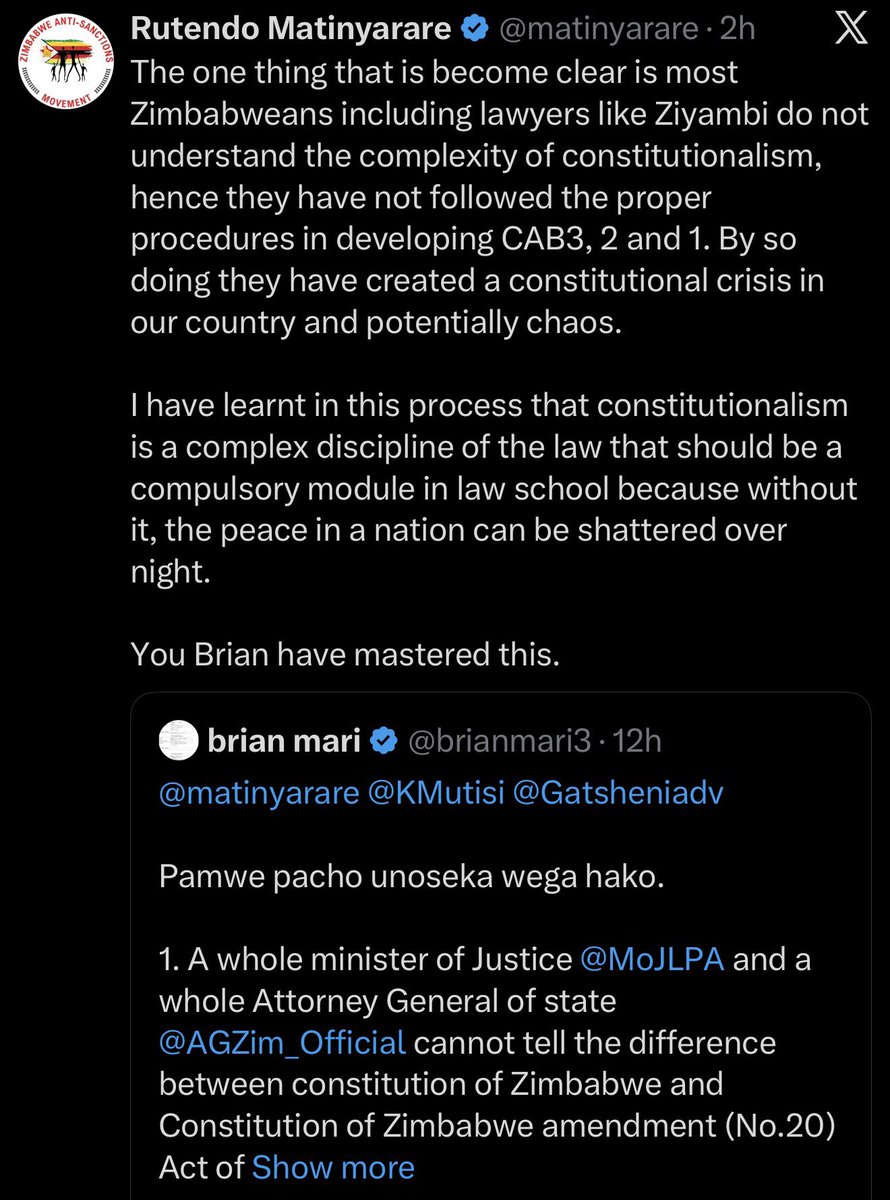
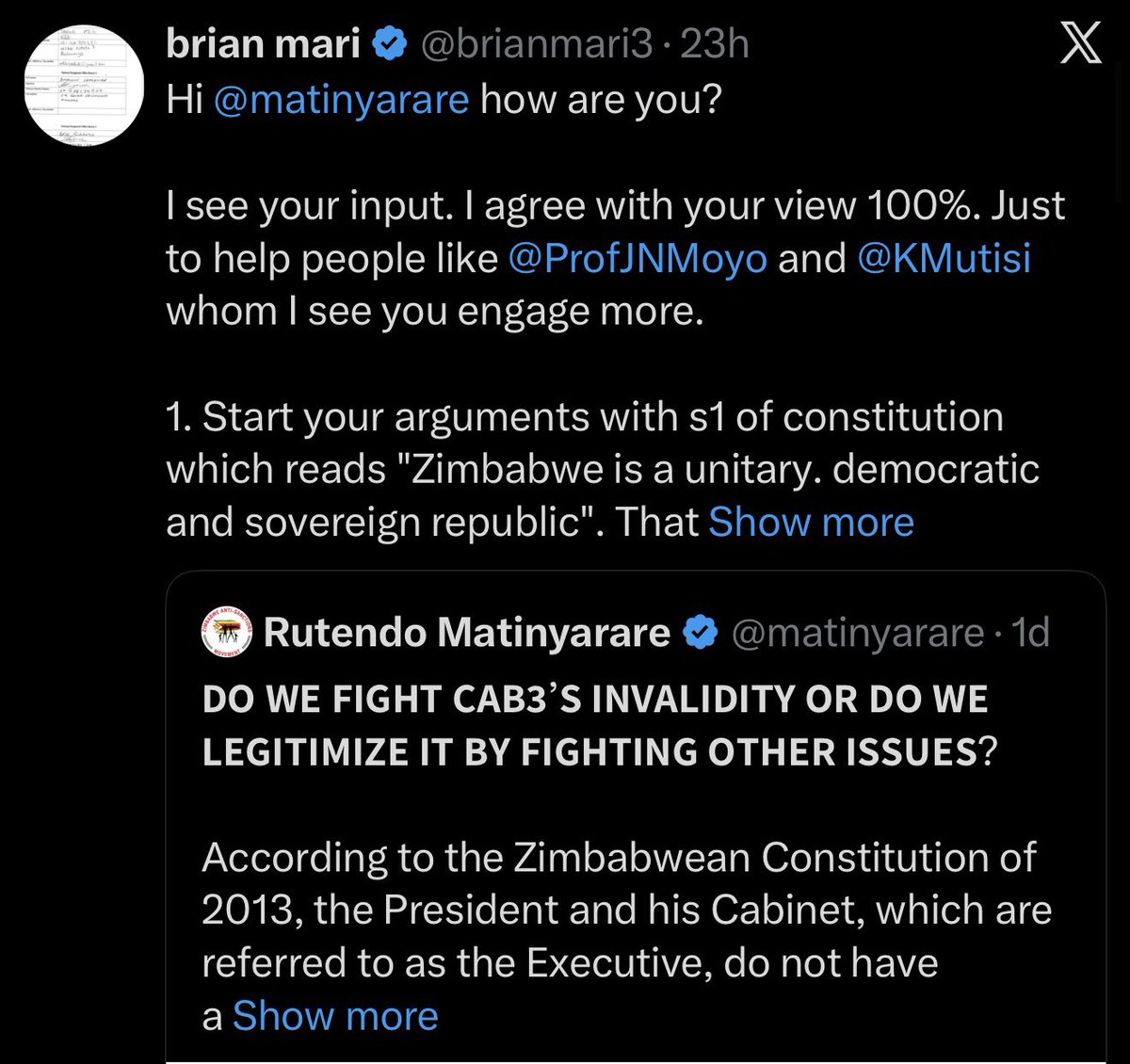
This is what happens when two people who have been wrong all week find each other.
@matinyarare spent 7 days getting fed constitutional arguments by @brianmari3.
@brianmari3 spent 7 days watching Matinyarare lose every exchange.
Now they are publicly declaring each other geniuses.
The student says the coach has “mastered” constitutionalism.
The coach says the student is asking all the right questions.
27 numbered points. Zero correct conclusions. Two very satisfied men.
😂😂😂😂😂
I’m never leaving this app.
English
GIF
QME

@Bete263 @matinyarare @brianmari3 😂😂 The echo chamber effect in full display.
When weak arguments meet mutual validation, suddenly everyone is a “constitutional expert.” One feeds the other, the other applauds back yet the substance stays the same. It's been hilarious tbh
English
Bete 𝕏 retweetledi
Nhai va Dhagi @DMwonzora, what exactly did you mean by this? By your own words it is wrong for ZEC to continue the dual responsibility of delimitations and supervising elections in the country. Why then are you now opposed to the idea of removing such powers from ZEC? If not creating an independent Delimitation Commission, who then should assume that position?
I am starting to think these guys are used to being opposed to anything. They actually want #CA3 to pass but just can't admit it in public.
English
The Constitution Is Not a Riddle. Stop Pretending It Is.
Some people have taken to social media with long, numbered posts full of legal-sounding definitions, hoping that complexity alone will pass for argument. It will not.
Let us make this simple.
The 2013 Constitution of Zimbabwe was written by Zimbabweans, for Zimbabweans. It was not written to confuse people, it was written to govern them. And one of the things it does very clearly is explain how it can be changed. That provision is Section 328. It does not hide. It does not require a PhD to find. It is there, in plain language, telling Parliament exactly how to amend the Constitution, which clauses require a two-thirds majority, which require a referendum, and which do not.
Constitution of Zimbabwe (Amendment No. 3) Bill, 2026 follows that process. Exactly.
Now, some will build elaborate arguments using the word “this” in Section 2(1), or parse definitions in Section 332 across seventeen numbered points, to arrive at the conclusion that Parliament cannot amend existing constitutional provisions, only add new ones. Read that again slowly. They are arguing that every constitutional amendment in Zimbabwe’s history, including Amendment No. 1 and Amendment No. 2, was invalid. They are arguing that the word “amend” in Section 117(2)(a) does not mean what “amend” has always meant in every constitution in the world.
That is not legal analysis. That is wordplay designed to confuse, not to illuminate.
Section 117(2)(a) is unambiguous. It gives the Legislature, Parliament, the power to amend the Constitution in accordance with Section 328. Not to add to it only. Not to correct inconsistencies only. To amend it. And Section 328 provides the graduated framework for doing exactly that: some provisions require a referendum, others require enhanced majorities. The drafters of the 2013 Constitution were not careless people. They built a living document, not a frozen one.
A constitution that cannot be amended by the people’s representatives, following the people’s own prescribed process, is not supreme law. It is a trap.
Zimbabwe’s Constitution is not a trap. It is a framework. And CA3 operates squarely within that framework, initiated by Cabinet under Section 110(3)(c), proceeding through Parliament under Section 117(2)(a), following the amendment procedure under Section 328.
The people who wrote Section 328 knew exactly what they were doing.
The people trying to argue it away know exactly what they are doing too.
brian mari@brianmari3
Hi @matinyarare how are you? I see your input. I agree with your view 100%. Just to help people like @ProfJNMoyo and @KMutisi whom I see you engage more. 1. Start your arguments with s1 of constitution which reads "Zimbabwe is a unitary. democratic and sovereign republic". That is a constitutive statement describing the "entity". This means one must not conflate his feeling or option to be that of Zimbabwe. 2. Zimbabwe speak for herself and she does so through her constitution. 3. Next go to s2(1) which reads and I quote "This Constitution is the supreme law of Zimbabwe and any law, practice, custom or conduct inconsistent with it is invalid to the extent of the inconsistency". 4. section 2(1) identify the constitution by the word "this" which means you cannot add or subtract contents of the constitution and leave the word "this" still remaining with same meaning. 5. It goes on to say "is the Supreme law of Zimbabwe". It does not say "is Supreme legislation of Zimbabwe" but "law of Zimbabwe". Then it says "any law" inconsistent with it is invalid. 6. What is the difference? "Law" is defined by s332 as and I quote "law" means- "(a) any provision of this Constitution or of an Act of Parliament: (b) any provision of a statutory instrument; or (c) any unwritten law in force in Zimbabwe. including customary law; and "lawful". ''lawfully". "legal and "legally" are to be construed accordingly; 7. The definition introduce "Act of Parliament" as separate and distinct law from "provision of constitution" and it then it lists other laws to include statutory law and unwritten laws including customary law. 9. A further definition of "Act of Parliament'' given by s332 says "Act of Parliament means- (a) an enactment that has been passed by Parliament and then assented to and signed by the President in accordance with this Constitution: or (b) an enactment that was in force in Zimbabwe as an Act of Parliament immediately before the effective date. including- (i) any enactment included in the revised edition of the statute law of Zimbabwe prepared in 1996 under the authority of the Statute Law Compilation and Revision Act [Chapter 1:03]: and (ii) any enactment which, though omitted from the revised edition referred to in subparagraph (i), continued in force notwithstanding that omission: and (iii) any enactment enacted by the Parliament of Zimbabwe after the revised edition referred to in subparagraph (i) but before the effective date". 10. From definition of "law" we also pick "statutory instrument" and s332 define this separately and say "statutory instrument· means any instrument that has the force of law and that is made by the President, a Vice-President, a Minister or any other person or authority under this Constitution or an Act of Parliament". 11. Furthermore from definition of "law" we also pick "customary law" again s332 define "customary law"' and it say it "means the customary law of any section or community of Zimbabwe's people;". 12. Now we have s110(3)(c) which refer to something in current debate, clearly stated as "National Legislation". Section 332 defines this animal too as "national legislation means an Act of Parliament or a statutory instrument made under an Act of Parliament". 13. While "Act of Parliament" is stated as is from its own definition in s332 into definition of "National Legislation" also in s332, from definition of Statutory instrument given by s332, we can all see that there are statutory instruments made by President, vice President, minister or any other person or authority under the Constitution" but by definition of "National Legislation", only statutory instruments made under an Act of Parliament are part of National Legislation. Statutory instruments made under constitution are not National Legislation. 14. Why will instruments made by President, vice President, minister or any other person or authority under the Constitution not be part of "National Legislation"? What separates them is being made either under constitution or under Act of Parliament. 15. In that regard, Legislation means a "law made under authority of Parliament". 16. In that regard National Legislation does not include anything made directly under constitution but include everything made under. 17. So we go back to s2(2) which talk of any law that is inconsistent with it is invalid to the extent of the inconsistency. What is the inconsistency? 18. Constitution is not made under authority of Parliament and not legislation. 19. Definition of "law" does not identify the "document" constitution or "document" Act of Parliament or Statutory Instrument. 20. Rather it defines "law" by "provisions" of "this constitution" or "provisions of an Act of Parliament", or "Provisions of statutory instrument". 21. In that regard, when s2(1) says "any law inconsistent with it is invalid" it is also referring to provisions of constitution itself that are inconsistent with it as laws that are invalid to the extend of their inconsistency because s332 "provision of the constitution" as "law" and 22. This leaves the constitution itself as Supreme law again separate separate to "law". Why? Because s2(1) separates Supreme law and "any law" . 23. In that regard a provision of constitution can only be amended or repealed for being inconsistent with constitution. Why? Because a "Provision of constitution" on its own is a law, separately defined by constitution. 24. In that regard one cannot bring a Bill to amend constitution without raising inconsistency of the provision to constitution. 25. Therefore "amending this constitution" constitution in s117(2)(b) does not refer to amending a provision already existing in the constitution but adding what is not in the constitution. Why ? 26. Because s2(1) introduced us to a "This constitution" and called it "Supreme law" then further introduced us to "any law" and in 332 " any provision of "this constitution" was defined as law separately from Supreme law. 27. Therefore s117(2)(a) does not refer to amending "any provision of this constitution" but the "this constitution". Saka vaudze Kuti vari kukama yakarumura
English
Hi @matinyarare how are you?
I see your input. I agree with your view 100%. Just to help people like @ProfJNMoyo and @KMutisi whom I see you engage more.
1. Start your arguments with s1 of constitution which reads "Zimbabwe is a unitary. democratic and sovereign republic". That is a constitutive statement describing the "entity". This means one must not conflate his feeling or option to be that of Zimbabwe.
2. Zimbabwe speak for herself and she does so through her constitution.
3. Next go to s2(1) which reads and I quote "This Constitution is the supreme law of Zimbabwe and any law, practice, custom or conduct inconsistent with it is invalid to the extent of the inconsistency".
4. section 2(1) identify the constitution by the word "this" which means you cannot add or subtract contents of the constitution and leave the word "this" still remaining with same meaning.
5. It goes on to say "is the Supreme law of Zimbabwe". It does not say "is Supreme legislation of Zimbabwe" but "law of Zimbabwe". Then it says "any law" inconsistent with it is invalid.
6. What is the difference? "Law" is defined by s332 as and I quote "law" means- "(a) any provision of this Constitution or of an Act of Parliament: (b) any provision of a statutory instrument; or (c) any unwritten law in force in Zimbabwe. including customary law; and "lawful". ''lawfully". "legal and "legally" are to be construed accordingly;
7. The definition introduce "Act of Parliament" as separate and distinct law from "provision of constitution" and it then it lists other laws to include statutory law and unwritten laws including customary law.
9. A further definition of "Act of Parliament'' given by s332 says "Act of Parliament means- (a) an enactment that has been passed by Parliament and then assented to and signed by the President in accordance with this Constitution: or (b) an enactment that was in force in Zimbabwe as an Act of Parliament immediately before the effective date. including- (i) any enactment included in the revised edition of the statute law of Zimbabwe prepared in 1996 under the authority of the Statute Law Compilation and Revision Act [Chapter 1:03]: and (ii) any enactment which, though omitted from the revised edition referred to in subparagraph (i), continued in force notwithstanding that omission: and (iii) any enactment enacted by the Parliament of Zimbabwe after the revised edition referred to in subparagraph (i) but before the effective date".
10. From definition of "law" we also pick "statutory instrument" and s332 define this separately and say "statutory instrument· means any instrument that has the force of law and that is made by the President, a Vice-President, a Minister or any other person or authority under this Constitution or an Act of Parliament".
11. Furthermore from definition of "law" we also pick "customary law" again s332 define "customary law"' and it say it "means the customary law of any section or community of Zimbabwe's people;".
12. Now we have s110(3)(c) which refer to something in current debate, clearly stated as "National Legislation". Section 332 defines this animal too as "national legislation means an Act of Parliament or a statutory instrument made under an Act of Parliament".
13. While "Act of Parliament" is stated as is from its own definition in s332 into definition of "National Legislation" also in s332, from definition of Statutory instrument given by s332, we can all see that there are statutory instruments made by President, vice President, minister
or any other person or authority under the Constitution" but by definition of "National Legislation", only statutory instruments made under an Act of Parliament are part of National Legislation. Statutory instruments made under constitution are not National Legislation.
14. Why will instruments made by President, vice President,
minister
or any other person or authority under the Constitution not be part of "National Legislation"? What separates them is being made either under constitution or under Act of Parliament.
15. In that regard, Legislation means a "law made under authority of Parliament".
16. In that regard National Legislation does not include anything made directly under constitution but include everything made under.
17. So we go back to s2(2) which talk of any law that is inconsistent with it is invalid to the extent of the inconsistency. What is the inconsistency?
18. Constitution is not made under authority of Parliament and not legislation.
19. Definition of "law" does not identify the "document" constitution or "document" Act of Parliament or Statutory Instrument.
20. Rather it defines "law" by "provisions" of "this constitution" or "provisions of an Act of Parliament", or "Provisions of statutory instrument".
21. In that regard, when s2(1) says "any law inconsistent with it is invalid" it is also referring to provisions of constitution itself that are inconsistent with it as laws that are invalid to the extend of their inconsistency because s332 "provision of the constitution" as "law" and
22. This leaves the constitution itself as Supreme law again separate separate to "law". Why? Because s2(1) separates Supreme law and "any law" .
23. In that regard a provision of constitution can only be amended or repealed for being inconsistent with constitution. Why? Because a "Provision of constitution" on its own is a law, separately defined by constitution.
24. In that regard one cannot bring a Bill to amend constitution without raising inconsistency of the provision to constitution.
25. Therefore "amending this constitution" constitution in s117(2)(b) does not refer to amending a provision already existing in the constitution but adding what is not in the constitution. Why ?
26. Because s2(1) introduced us to a "This constitution" and called it "Supreme law" then further introduced us to "any law" and in 332 " any provision of "this constitution" was defined as law separately from Supreme law.
27. Therefore s117(2)(a) does not refer to amending "any provision of this constitution" but the "this constitution".
Saka vaudze Kuti vari kukama yakarumura
Rutendo Matinyarare@matinyarare
𝗗𝗢 𝗪𝗘 𝗙𝗜𝗚𝗛𝗧 𝗖𝗔𝗕𝟯’𝗦 𝗜𝗡𝗩𝗔𝗟𝗜𝗗𝗜𝗧𝗬 𝗢𝗥 𝗗𝗢 𝗪𝗘 𝗟𝗘𝗚𝗜𝗧𝗜𝗠𝗜𝗭𝗘 𝗜𝗧 𝗕𝗬 𝗙𝗜𝗚𝗛𝗧𝗜𝗡𝗚 𝗢𝗧𝗛𝗘𝗥 𝗜𝗦𝗦𝗨𝗘𝗦? According to the Zimbabwean Constitution of 2013, the President and his Cabinet, which are referred to as the Executive, do not have a right to change the existing Constitution according to the functions given to the Executive in section 110 of the Constitution. 1. According to s110(3)(c), the Executive can initiate, facilitate, and implement LEGISLATION. In other words they can make NEW legislation. 𝗡𝗼𝘁𝗲: making NEW legislation is not the right to create a new Constitution and it is not a right to amend existing legislation or to amend the existing Constitution. So this right is only to create new legislation ONLY. 2. 110(1)(a) the Executive can assent to and sign Bills. 3. 110(1)(b) the Executive can send a Bill to the Constitutional Court to check constitutionality. 4. 110(2)(f) the Executive can call for a referendum. FULL STOP. Do we agree that nowhere in the 22-23 points of section 110 are the executive given the power to write a Bill to amend or change the Constitution? Why? Because the Executive must uphold the Constitution. You can’t uphold a constitution or supreme law that you can change whenever you want, hence they were not given the power to change the Constitution. So this means the Executive had/has no power or right to create a Constitutional Amendment Bill (CAB3, CAB2, or CAB1), hence CAB3 and the others are invalid. As a nation, we must now decide what about CAB3 we are challenging in court. Are we challenging the attempt by the Bill to take away the constitutional rights and power of the people and to give them to a few? Or are we challenging CAB3 as being invalid from the start? We must decide because we can’t have both.
English
@mimmitwit @ProfJNMoyo @mfanaBambo @bbmhlanga @ProfMadhuku Problem yakatanga pakudhira @LynneStactia @mawarirej na @matinyarare, vanhu vane self-importance bigger than the actual job. Zvino zvava pachena.

@ProfJNMoyo @mfanaBambo @bbmhlanga @ProfMadhuku The propensity bit on point🤣
Like I tell people
CAB3 is a bad bill but those arguing for it are doing a better job than those arguing against it.
So basically chinhu che zanu chinowina because vacho vanoti hachisi bho havasi kuisa ma resources avo together let alone minds🤣
English

Education is overrated- this has nothing to do with CAB3 @ProfMadhuku was clear here on what he was talking about, your meaning making formula Prof is way off the mark.
Prof Jonathan Moyo@ProfJNMoyo
Professor Lovemore Madhuku in his Own Words Making the Case for Parliament to Indirectly Elect the President as an Electoral College: “We must not put in the Constitution of the country a provision that is dependant on what happens in a political party. That’s the point I’m making. We must never say in our Constitution of Zimbabwe that if a sitting President dies or resigns, we will wait to hear what the political party of that President is saying. No. That is not the best way of running a country. Political parties remain the preserve of those people who are in those political parties. But the country is run on the basis of either an election by the people—direct election—or you have Parliament as an institution sitting as an electoral college. Where parties have influence, they must do the influence within Parliament, but never to allow the political party to sit there to say I’m giving you this President, and so forth. That’s the point I’m making. And on that point, I’m making it right across the world; that’s what they do.” - Professor Madhuku, addressing a “Heal Zimbabwe Trust” public meeting in Harare on 22 February 2020. COMMENT: Professor Lovemore Madhuku’s 2020 remarks make a clear, powerful and enduring case for Clause 3 of the Constitution of Zimbabwe (Amendment No. 3) H.B.I. Bill, 2026. This clause replaces the direct election of the President with an indirect election by Parliament sitting jointly as an electoral college; both after every general election and, when necessary, to fill any vacancy in the office of President. The current direct election of the President was first introduced in anticipation of a legislated one-party-one-man rule through Constitution Amendment No. 7, Act 1987 in the old Lancaster Constitution repealed in 2013. Professor Madhuku put it plainly: The Constitution should not—as it currently does— depend on the internal decisions of a political party to select a successor to the President of the country. When a sitting President dies, resigns or is removed, the nation should not have to wait and hear what that President’s political party “is saying.” That is not a constitutionally proper way to run a country. Political parties exist for their own members. The country, however, belongs to all Zimbabweans. The proper solution is straightforward: Parliament—the institution chosen by the people—should act as the electoral college. Inside that open forum, parties may exercise their influence transparently and accountably. No party should ever stand outside the Constitution and simply “give” the nation its next leader. This principle is not abstract. Worldwide, presidential by-elections to fill mid-term vacancies are extremely rare. Most stable presidential systems instead use automatic succession by a deputy or, increasingly, allow the legislature to elect a successor who serves out the remainder of the term. These arrangements place national continuity and stability above partisan interests. Clause 3 of the Bill follows exactly this proven path. By giving Parliament the clear duty to elect the President—whether at the start of a new term or in an unforeseen vacancy—Zimbabwe will secure stronger democratic stability, and keep the highest office firmly within the people’s constitutional framework rather than the private control of any single party. In short, Clause 3 is a mature, practical and principled reform that directly honours Professor Madhuku’s wise 2020 counsel. As such, it deserves the full support of every well-meaning Zimbabwean who values good governance, democratic constitutionalism, institutional integrity and the long-term strength of the country’s democracy in the national interest!
English
Bete 𝕏 retweetledi
#Zimbabwe
The Art Of War🐊🐊🐊
Farming Is A Business✅
During a visit to Precab Farm in Kwekwe, South African President Cyril Ramaphosa received key insights from Dr. Kudakwashe Tagwirei, Chairman of the Land Tenure Implementation Committee, on the title deeds program, a transformative initiative designed to bolster land ownership security and drive economic empowerment✅
#ZimReform @Zim_Vision2030 #EDWORKS #CAB3
Protecting the values of #Chimurenga✊🏿
#AmendmentBill3🇿🇼 is unstoppable🐊🐊🐊


LynneM 💕💝💎@LynneStactia
Meeting that involves Zvigananda and no VPs? 🚮🚮🚮
English