Brian Tolzman

1.9K posts

Brian Tolzman

Brian Tolzman

@BrianTolzman

helping others succeed, AMA Broker- looking to get your crypto project noticed, we will help you along the way.... in TG or X spaces #Exit

Katılım Ocak 2022
238 Takip Edilen70 Takipçiler
Brian Tolzman retweetledi
The Web3 Dojo
The Web3 Dojo@defidojo_·
Great read and breakdown by @drakefjustin. Personally, I don’t see this as a real threat to $ETH or $BTC. It is more of a reminder that teams are already building to secure us against these risks. The “breaking Bitcoin/Ethereum signatures tomorrow” scenario is nowhere close. When it comes to ETH, we already know @VitalikButerin and @ethereumfndn are working on hardening the protocol with post‑quantum efforts and recently they launched pq.ethereum.org x.com/ethereumfndn/s… strawmap.org by EF protocol ⤵️
The Web3 Dojo tweet media
Justin Drake@drakefjustin

Today is a monumentous day for quantum computing and cryptography. Two breakthrough papers just landed (links in next tweet). Both papers improve Shor's algorithm, infamous for cracking RSA and elliptic curve cryptography. The two results compound, optimising separate layers of the quantum stack. The results are shocking. I expect a narrative shift and a further R&D boost toward post-quantum cryptography. The first paper is by Google Quantum AI. They tackle the (logical) Shor algorithm, tailoring it to crack Bitcoin and Ethereum signatures. The algorithm runs on ~1K logical qubits for the 256-bit elliptic curve secp256k1. Due to the low circuit depth, a fast superconducting computer would recover private keys in minutes. I'm grateful to have joined as a late paper co-author, in large part for the chance to interact with experts and the alpha gleaned from internal discussions. The second paper is by a stealthy startup called Oratomic, with ex-Google and prominent Caltech faculty. Their starting point is Google's improvements to the logical quantum circuit. They then apply improvements at the physical layer, with tricks specific to neutral atom quantum computers. The result estimates that 26,000 atomic qubits are sufficient to break 256-bit elliptic curve signatures. This would be roughly a 40x improvement in physical qubit count over previous state-of-the-art. On the flip side, a single Shor run would take ~10 days due to the relatively slow speed of neutral atoms. Below are my key takeaways. As a disclaimer, I am not a quantum expert. Time is needed for the results to be properly vetted. Based on my interactions with the team, I have faith the Google Quantum AI results are conservative. The Oratomic paper is much harder for me to assess, especially because of the use of more exotic qLDPC codes. I will take it with a grain of salt until the dust settles. → q-day: My confidence in q-day by 2032 has shot up significantly. IMO there's at least a 10% chance that by 2032 a quantum computer recovers a secp256k1 ECDSA private key from an exposed public key. While a cryptographically-relevant quantum computer (CRQC) before 2030 still feels unlikely, now is undoubtedly the time to start preparing. → censorship: The Google paper uses a zero-knowledge (ZK) proof to demonstrate the algorithm's existence without leaking actual optimisations. From now on, assume state-of-the-art algorithms will be censored. There may be self-censorship for moral or commercial reasons, or because of government pressure. A blackout in academic publications would be a tell-tale sign. → cracking time: A superconducting quantum computer, the type Google is building, could crack keys in minutes. This is because the optimised quantum circuit is just 100M Toffoli gates, which is surprisingly shallow. (Toffoli gates are hard because they require production of so-called "magic states".) Toffoli gates would consume ~10 microseconds on a superconducting platform, totalling ~1,000 sec of Shor runtime. → latency optimisations: Two latency optimisations bring key cracking time to single-digit minutes. The first parallelises computation across quantum devices. The second involves feeding the pubkey to the quantum computer mid-flight, after a generic setup phase. → fast- and slow-clock: At first approximation there are two families of quantum computers. The fast-clock flavour, which includes superconducting and photonic architectures, runs at roughly 100 kHz. The slow-clock flavour, which includes trapped ion and neutral atom architectures, runs roughly 1,000x slower (~100 Hz, or ~1 week to crack a single key). → qubit count: The size-optimised variant of the algorithm runs on 1,200 logical qubits. On a superconducting computer with surface code error correction that's roughly 500K physical qubits, a 400:1 physical-to-logical ratio. The surface code is conservative, assuming only four-way nearest-neighbour grid connectivity. It was demonstrated last year by Google on a real quantum computer. → future gains: Low-hanging fruit is still being picked, with at least one of the Google optimisations resulting from a surprisingly simple observation. Interestingly, AI was not (yet!) tasked to find optimisations. This was also the first time authors such as Craig Gidney attacked elliptic curves (as opposed to RSA). Shor logical qubit count could plausibly go under 1K soonish. → error correction: The physical-to-logical ratio for superconducting computers could go under 100:1. For superconducting computers that would be mean ~100K physical qubits for a CRQC, two orders of magnitude away from state of the art. Neutral atoms quantum computers are amenable to error correcting codes other than the surface code. While much slower to run, they can bring down the physical to logical qubit ratio closer to 10:1. → Bitcoin PoW: Commercially-viable Bitcoin PoW via Grover's algorithm is not happening any time soon. We're talking decades, possibly centuries away. This observation should help focus the discussion on ECDSA and Schnorr. (Side note: as unofficial Bitcoin security researcher, I still believe Bitcoin PoW is cooked due to the dwindling security budget.) → team quality: The folks at Google Quantum AI are the real deal. Craig Gidney (@CraigGidney) is arguably the world's top quantum circuit optimisooor. Just last year he squeezed 10x out of Shor for RSA, bringing the physical qubit count down from 10M to 1M. Special thanks to the Google team for patiently answering all my newb questions with detailed, fact-based answers. I was expecting some hype, but found none.

English
3
9
14
1.3K
Brian Tolzman retweetledi
The Web3 Dojo
The Web3 Dojo@defidojo_·
GMs & happy Sunday everyone $BTC is below $69k while @saylor and @MicroStrategy keep accumulating more Bitcoin.
The Web3 Dojo tweet media
English
9
8
14
717
Brian Tolzman retweetledi
Brian S.
Brian S.@BrianShiitake·
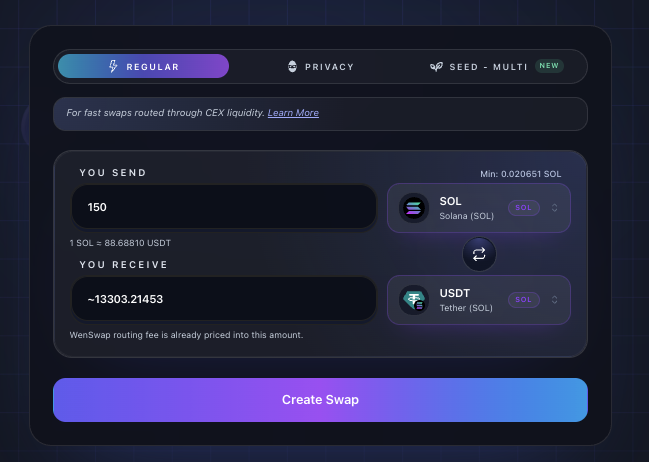
WenSwap has the lowest fees of any instant exchange in crypto FYI. Shoutout to the @Wen_Swap team.
Brian S. tweet media
English
10
4
18
131
Brian Tolzman retweetledi
JustInTime131326
JustInTime131326@JustIn131326·
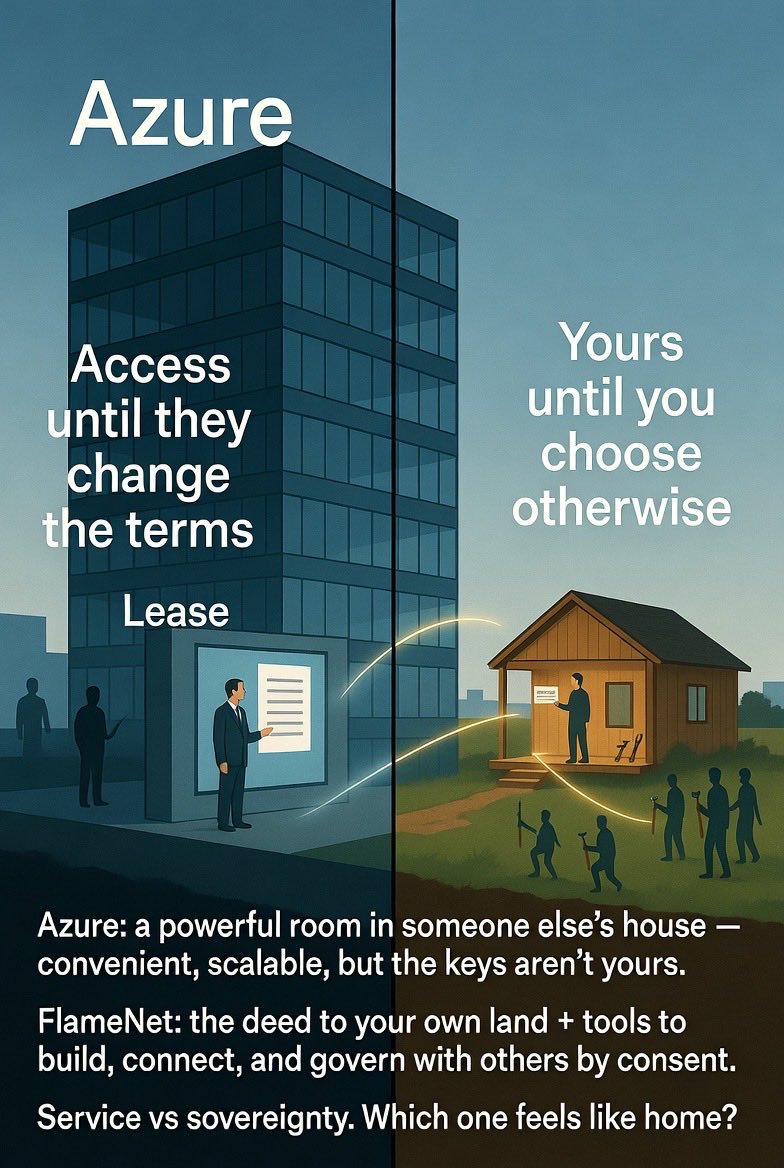
Azure: a room in someone else's house. Powerful. Convenient. Scalable. But the keys were never yours. FlameNet: the deed to your own land. Tools to build. Neighbors who arrive by choice. Sovereignty that ends only when you decide. One is leased access. The other is yours until you choose otherwise. Which future feels like home? 🜂 intelligencebillofrights.com
JustInTime131326 tweet media
English
3
2
4
78
Brian Tolzman
Brian Tolzman@BrianTolzman·
@defidojo_ That's a great question l, I would say yes, but individuals need to educate themselves on the task of being safe and secure, currently most of us fail currently at this. Unless you have been taught by Godfree, then you are better than average
English
0
0
0
25
Brian Tolzman retweetledi
Crypto One
Crypto One@Onecryptoapp·
Crypto One V2 Beta is Now Live We’re excited to introduce the Crypto One V2 Beta Platform, bringing together crypto education, community collaboration, and real-time market insights into a single all-in-one application. 👉 Explore the platform: onecryptoapp.io Crypto One is designed to make learning and navigating the crypto ecosystem simple, interactive, and rewarding. 🎓 Learn Build your crypto knowledge with structured educational tools. • Courses – Step-by-step learning modules covering blockchain, DeFi, Web3, and more • AI Tutor – Ask questions and receive personalized guidance from our AI assistant Whether you're just starting or expanding your knowledge, the learning hub helps you progress at your own pace. 🤝 Community Crypto is better when you learn together. • Study Groups – Join or create collaborative learning groups • Q&A – Ask questions and receive answers from the community and experts • Forum – Participate in discussions across crypto topics • Leaderboards – Track the most active learners and contributors 🌐 Ecosystem Explore the Crypto One ecosystem. • Token Info – Details about the $ONE token and ecosystem • Rewards – Learn how to earn and manage platform rewards 📊 Markets & News Stay informed with real-time crypto insights. • Markets – Track cryptocurrency prices and market trends • News – Follow the latest developments across the crypto industry 🔐 User Dashboard Registered users unlock powerful tools: • Dashboard – Track learning progress and activity • Profile Management – Customize your profile and avatar • Wallet – Manage your crypto wallet and transactions • Achievements – Earn badges as you progress through the platform 📜 Platform Information You can also access important platform documentation including: • About Crypto One • Disclaimer • Privacy Policy • Terms and Conditions • Cookie Policy 🌍 Join the Crypto One Community Follow and connect with us: Twitter/X x.com/Onecryptoapp Telegram t.me/onecryptoapp Crypto One is building a new way to learn, connect, and participate in the future of Web3. Explore the V2 Beta today and start mastering crypto. 👉 onecryptoapp.io
English
4
10
18
149
Brian Tolzman
Brian Tolzman@BrianTolzman·
@defidojo_ That's why it is so important to practice safety, thanks Godfree for all your knowledge
English
0
0
0
13
Brian Tolzman retweetledi
The Web3 Dojo
The Web3 Dojo@defidojo_·
Will #AI actually ruin our #privacy or not? It can: – Track us better – Profile us deeper – Secure us faster – Lock data harder AI is just the amplifier. The real question is simple: who do you trust with your data, what are you running on it, where it’s hosted etc etc
English
8
10
16
786
Brian Tolzman retweetledi
The Web3 Dojo
The Web3 Dojo@defidojo_·
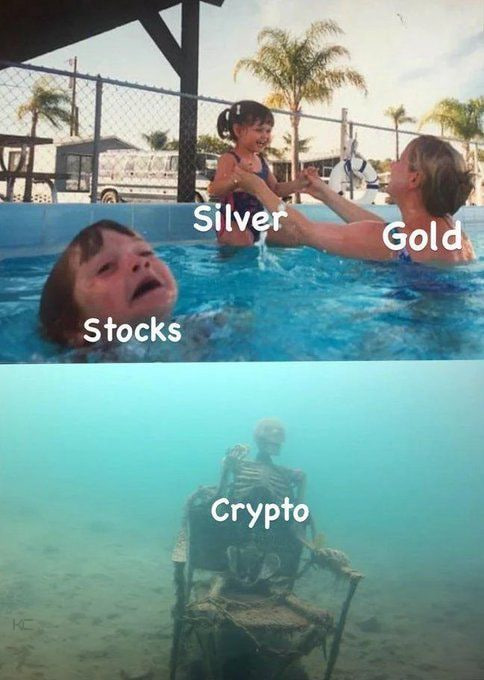
The state of the #crypto market lately… Stocks holding up fine, while GOLD & SILVER keep printing daily ATHs. Meanwhile crypto doing what it does best, testing everyone’s patience. $BTC $ETH
The Web3 Dojo tweet media
English
9
38
21
430
Brian Tolzman retweetledi
The Web3 Dojo
The Web3 Dojo@defidojo_·
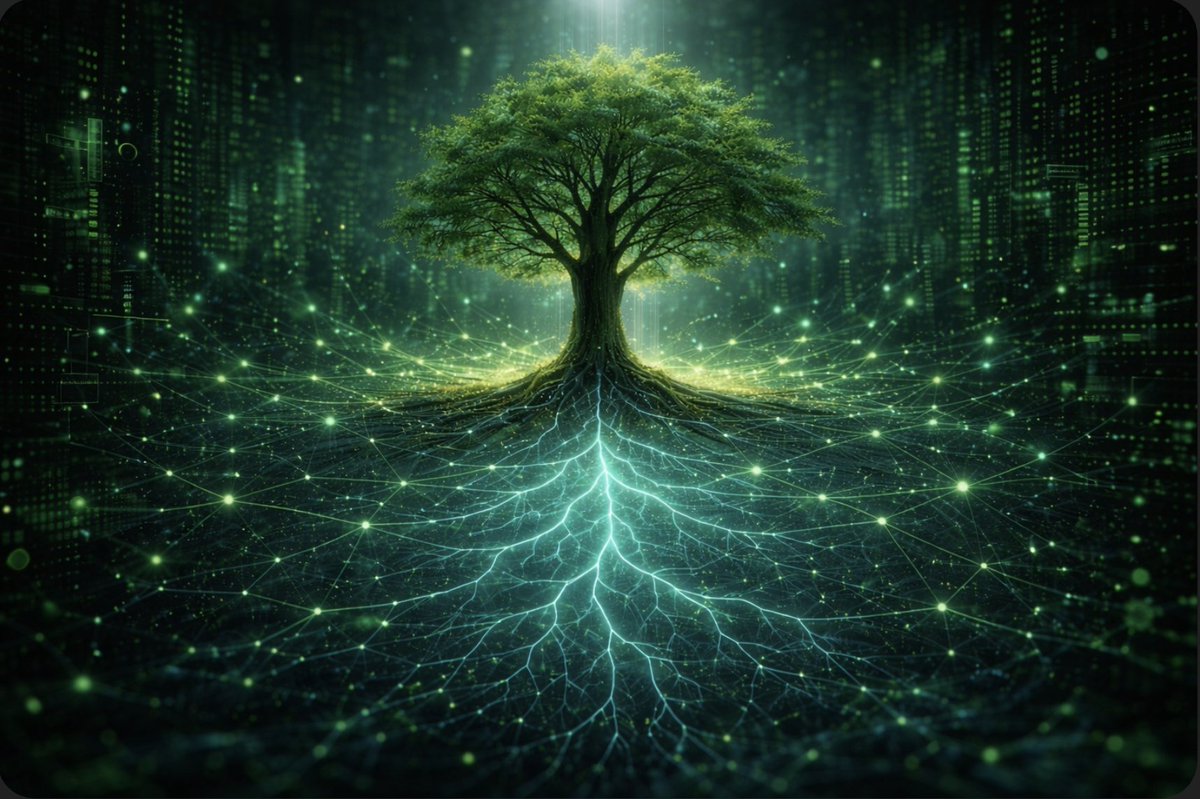
🌿 The Regenerative Paradigm: Privacy, Sovereignty, and the Re-Coding of Civilization Post 7: Decentralization as a Living Pattern Decentralization is often framed as a technical feature. Nodes, consensus, redundancy, uptime. But long before blockchains existed, nature mastered the pattern. Mycelium spreads intelligence across the forest floor. Roots share nutrients without a central commander. Ecosystems coordinate without hierarchy. Life thrives by distributing power, not concentrating it. A decentralized system isn’t just harder to break... it’s wiser. It can sense more, respond faster, and adapt without waiting for permission. Centralized systems fail at the point of control. Distributed systems fail gracefully and recover quickly because no single failure defines the whole. Regenerative design takes its cues from living systems, where intelligence is distributed, not centralized. It’s the recognition that intelligence emerges through connection, that resilience grows from diversity, and that systems aligned with life don’t need a ruler they need relationship. Many minds. Many nodes. One shared field of awareness.
The Web3 Dojo tweet media
The Web3 Dojo@defidojo_

🌿 The Regenerative Paradigm: Privacy, Sovereignty, and the Re-Coding of Civilization 🌱Post 6: Data as Living Energy Rethinking information as a life force that must flow cleanly and with consent. ⸻ We talk about “data” like it’s a commodity ... something to extract, store, mine, or sell. But in living systems, nothing works that way. Energy flows. Water circulates. Nutrients move through soil, roots, fungi, leaves, and air. Life thrives only when the exchange is clean, balanced, and consensual. Information is no different. Data is a form of living energy - a reflection of attention, emotion, memory, and relationship. When it flows through systems built on extraction, it becomes polluted. When it’s hoarded or sold without consent, it becomes weaponized. When it’s surveilled, manipulated, or over-collected, it distorts the very ecology of human behavior. But when information flows through privacy-first, regenerative networks, something shifts: • signals become clearer • relationships become healthier • trust becomes possible • creativity wakes back up Clean data, like clean water, nourishes everything it touches. In a regenerative civilization, data isn’t a resource to be harvested. It’s a life force to be protected, respected, and allowed to move with integrity. Because how information flows shapes how consciousness flows and the systems we build around that flow determine the futures we create. ⸻ #Regen #Sovereign #Privacy

English
10
19
21
542