The Navy Secretary's testimony is the sound of a security architecture cracking in real time. Suspending $14 billion of arms to Taiwan to preserve ammunition for an operation named Epic Fury — while simultaneously claiming reserves are "sufficient" — tells you everything about Washington's actual priority hierarchy. Taiwan is not being abandoned; it is being repriced.
But here's the part nobody at that hearing mentioned: when Washington pauses, Tokyo doesn't. Japan has already sent destroyers through the Taiwan Strait, deployed combat troops to Philippine soil for the first time since 1945, and is rewriting its pacifist constitution. The third player isn't waiting for American permission — it's doing its own math, and the answer is rearmament.
We wrote the full breakdown: The Taiwan Calculus. Three players, one strait, three different speeds on the same clock. Read it in our page.
During a hearing in the Defense Subcommittee of the Senate Appropriations Committee, Acting US Navy Secretary Hun Kaohui told senators that arms supplies to Taiwan have been suspended
Kaohui explained the suspension as follows:
"We are taking a pause now to ensure that we have the necessary ammunition for [Operation 'Epic Fury']."
However, the acting secretary immediately after this said that the US has "sufficient" ammunition.
This statement is notable because it came against the backdrop of previous reports and statements by US President Donald Trump that the supply in question, worth $14 billion, might be suspended following Donald Trump's summit with Chinese leader Xi Jinping.
Earlier this week, the Financial Times reported that Beijing had postponed a visit by Pentagon officials, including Elbridge Colby, the Under Secretary of Defense for Policy, scheduled for this summer, as China is trying to pressure Donald Trump over a major supply of modern weapons to Taiwan worth more than $14 billion.
Trump has turned unspoken rules into explicit ones.
This is the common fate of the four empires traced in *The End of the Old Order*: when the cost of maintaining distant territories outweighs the benefits, the "sacred promise" instantly becomes a "geographical problem." The Habsburgs said this when they lost the Netherlands, the Bourbons said this when they lost their colonies, and Great Britain said this when it lost its dominions—it wasn't that we didn't want to defend them, it was just too far away.
Taiwan's value has never been democracy. It's friction, leverage, and a point of pressure.
Article 26, written for four centuries, only proves one thing: a piece can never predict the player's next move, but the player never overturns the board for a single piece. When the stakes are too high, the player will say, "59 miles against 9500 miles, the arithmetic isn't fair"—and then withdraw.
This isn't betrayal. This is the law.
🇹🇼 Taiwan said it is an "independent" nation, hours after US President Donald Trump warned the democratic island against declaring formal independence.
➡️ u.afp.com/SReT
Taiwan's response remained unchanged, the same standard answer used for thirty years.
But the world has changed. The one who spoke of "sovereign, independent, and democratic nations" has turned its gaze—from Taipei to Beijing.
This is the third stage described in *The End of the Old Order*: allies discover that security guarantees are never unconditional. The Habsburg Netherlands, Britain's Canada, America's South Vietnam—when the hegemon begins to calculate, the more ornate the wording of the alliance, the crisper the sound of its break.
Taiwan's retort wasn't toughness. It was panic. It was loudly repeating old lines to a departing figure, hoping that person would turn back.
Sovereignty isn't written in a declaration. Sovereignty is something someone is willing to shed blood for. When that person's arithmetic changes from "defending democracy" to "59 against 9500," the declaration is still the same declaration—but no one is listening anymore.
The declaration hasn't changed. The guarantor has changed. That's everything.
Trump just gave the most candid American statement on Taiwan in decades — and he did it without a teleprompter.
"We'll call it a place, because nobody knows how to define it." That sentence alone detonates seventy years of strategic ambiguity. A sitting American president refusing to call Taiwan a country, a province, or even an island — just "a place." The linguistic retreat is the policy retreat.
Then the geography: "59 miles away. We're 9,500 miles away. That's a little bit of a difficult problem." This is exactly what we traced across four empires in The End of the Old Order. When the Habsburgs couldn't hold the Netherlands, when the British couldn't hold the Boer Republics, when America couldn't hold Afghanistan — the arithmetic was always the same. Distance kills empires that try to govern it. Land power is not optional.
And the punchline: "They stole our chip industry." This is the real agenda. Trump wants TSMC's fabs in Arizona, not American soldiers in the Taiwan Strait. He is treating the defense commitment as a bargaining chip to be traded for semiconductor repatriation. The transactionalism is naked — but the strategic signal is irreversible: Washington is not coming to fight a war at the end of a 9,500-mile supply line for a "place" it cannot define.
As we wrote in Lose the Strait, Lose the Empire, when a maritime hegemon openly signals it will not guarantee the sea lanes that sustain its empire, the deterrence structure does not degrade gradually. It snaps. Beijing heard every word. So did Tokyo. So did Manila.
Trump on Taiwan:
“The Chinese just don’t want to see this place — we’ll call it a place, because nobody knows how to define it — but they don’t want to see it go independent.
I’d like to see everybody making chips in Taiwan come over to us in America.
I’m not looking to have somebody go independent. And, you know, are we supposed to travel 9,500 miles to fight a war? I’m not looking for that.
When you look at the odds, China is a very, very powerful and big country. That’s a very small island.
Think of it; it’s 59 miles away. We’re 9,500 miles away. That’s a little bit of a difficult problem.
If you look at the history, Taiwan was developed because we had presidents that didn’t know what the hell they were doing. They stole our chip industry”
🇺🇸🇨🇳🇹🇼
China has upgraded its J-20 component manufacturing facilities into "dark factories"—highly automated plants operating almost 24/7 with minimal human intervention—boosting efficiency by nearly 150%. This indeed represents a significant advancement in both industrial capacity and systems integration. However, what truly warrants attention is not the sheer production metric—such as "rolling out one aircraft every two days"—but rather whether the quality control, training infrastructure, and systemic combat capabilities can keep pace with this rapid production rhythm. The essence of a fifth-generation fighter jet has never been mere numerical quantity; rather, it lies in the ability to establish a genuine systemic advantage—encompassing sensor fusion, data links, maintenance and logistics support, pilot training, and more. Weaknesses in these critical areas are often far more detrimental than any limitations in production line speed.
I recently authored an in-depth analysis specifically examining the strategic implications of the potential export of the J-35AE to Pakistan, as well as the broader competition between China and the United States regarding fifth-generation fighter jets. In that piece, I also addressed the intricate relationship between production speed and actual combat effectiveness. If you are also tracking the real-world impact that this current wave of stealth fighter proliferation is having on the aerial balance of power in the Indo-Pacific region, that article may offer some more systematic insights for your consideration.
🇨🇳 China has more than doubled production efficiency for components of its advanced Chengdu J-20 by quietly transforming a Chengdu facility into a fully autonomous “dark factory” operating nearly 24/7 with AI-driven machinery and autonomous vehicles.
The lights-out factory now produces structural components for the J-20 with minimal human involvement.
Previously, workers had to monitor operations in rotating shifts, but automated vehicles, intelligent scanning systems, and robots now handle material transport, precision manufacturing, inspections, and reporting.
The main challenge was integrating dozens of machines using different software protocols, but the systems now communicate through a unified digital platform.
The upgrade increased production efficiency by nearly 150% while allowing machinery to operate at maximum capacity for more than 21 hours daily.
The fifth-generation J-20 entered combat service in 2018, with mass production beginning in 2020.
The fact that China's J-20 "dark factory" can achieve a production rate of one aircraft every two days truly demonstrates a significant advancement in industrial capability. The fleet is projected to reach a size of over 500 aircraft by the end of 2026; if realized, this would mark a major milestone in the realm of fifth-generation stealth fighter jets. However, behind this rapid growth in quantity lie even more critical issues: quality, training protocols, and integrated combat capabilities. The mass production of the J-20 is one thing; ensuring these aircraft translate into genuine combat power—integrating them into the existing operational architecture and countering adversaries' anti-stealth measures—is quite another.
This becomes particularly pertinent as the J-35AE begins to enter the export market (with Pakistan highly likely to become its first customer). This represents not merely the proliferation of a single aircraft model, but rather the dissemination of fifth-generation fighter technology throughout the Indo-Pacific region—a development that will have profound implications for the regional balance of air power.
I recently authored an in-depth article specifically analyzing the strategic implications of the J-35AE's export to Pakistan, as well as the broader competition between China and the United States in the fifth-generation fighter arena. If you are also following the real-world impact that this current wave of stealth fighter proliferation will have on the future landscape of aerial warfare, that article may be well worth your time.
The J-20's dark factory can roll out one fighter jet every 2 days.
It is expected that by the end of 2026, there would be 500+ J-20s
When Trump comes to China, should we have the J-20s fly in formation over his head once, as a show of welcome?
The statement regarding "peaceful coexistence" issued by the Chinese Embassy in the U.S.—set against the backdrop of the current highly tense atmosphere—sends a clear signal that China seeks to stabilize Sino-U.S. relations.
However, beyond diplomatic rhetoric, the true trajectory of bilateral relations is ultimately determined by shifts in structural forces. Historically, great-power competition has never been decided solely by acts of benevolence or malice; rather, it hinges on which power can sustain long-term control over critical ground forces, strategic chokepoints, and technological advantages.
When an empire begins to gradually lose its grip on the "ground beneath its feet," it often marks the beginning of its decline.
I recently authored a lengthy article that offers a detailed analysis of how various historical empires succumbed to decline after losing control of their ground forces, drawing parallels between this historical pattern and the current geopolitical contest between China and the U.S. in the Indo-Pacific region. If you, too, are contemplating the feasibility of "peaceful coexistence" within the context of real-world geopolitics, this article may offer some systematic historical and strategic perspectives.
@ChingteLai Ensuring uninterrupted security?
So you spent $2.2 billion to buy 108 M1A2T tanks without depleted uranium armor, sufficient ammunition, or battlefield information systems? And then used them to cover your escape?
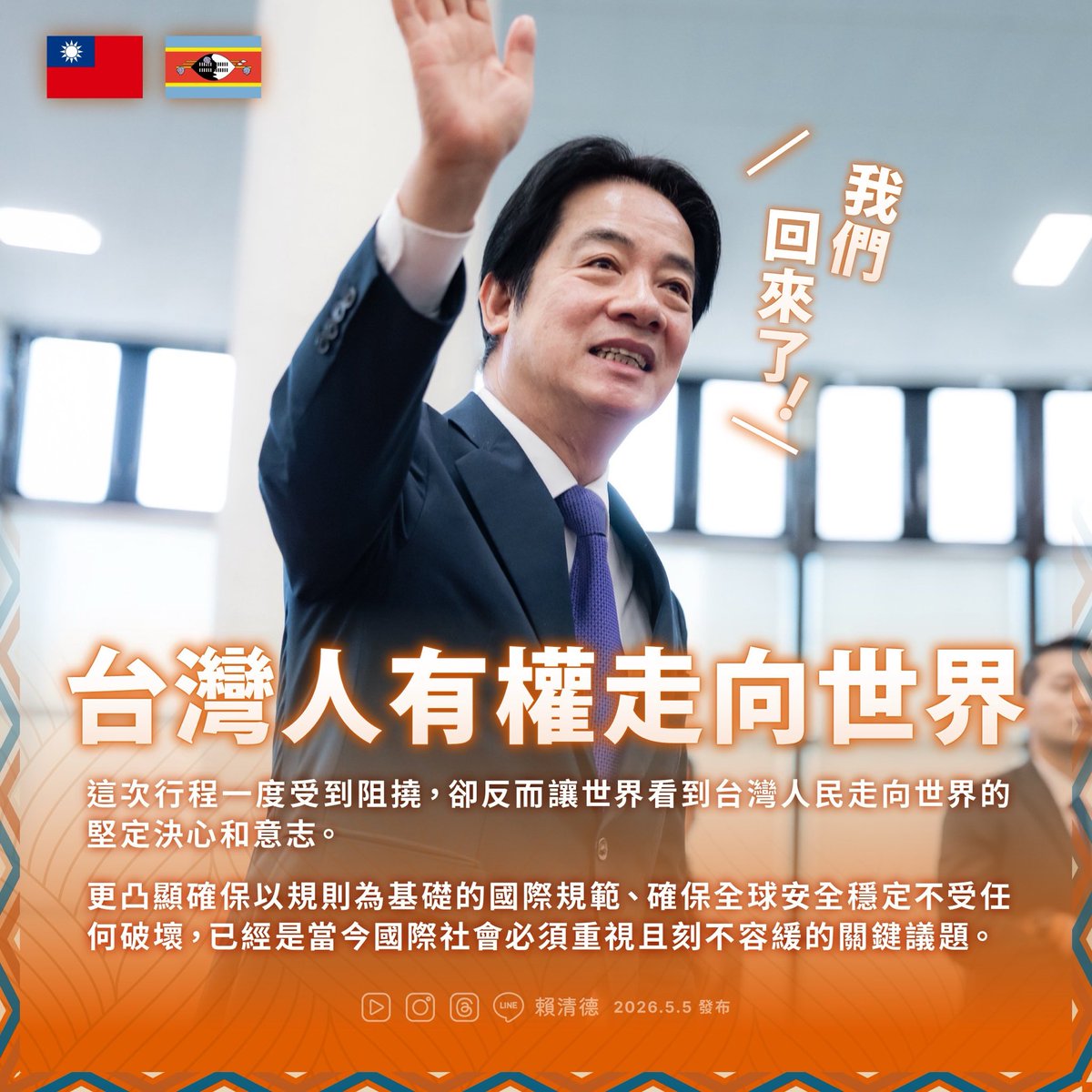
Today I returned to #Taiwan after a fruitful visit to #Eswatini, further strengthening our partnership. Overcoming initial disruptions, the trip further highlighted that the people of Taiwan have both the right & the resolve to continue contributing to the global community.
Taiwan recently acquired 108 M1A2T tanks for US$2.2 billion, seemingly strengthening its "beachhead combat" capabilities. However, this was actually a typical "high-price, low-configuration" deal—lacking depleted uranium armor, advanced ammunition, and a battlefield network system (which was provided by Israel for the US version of the M1A2). Even sufficient training ammunition and logistical support were severely lacking.
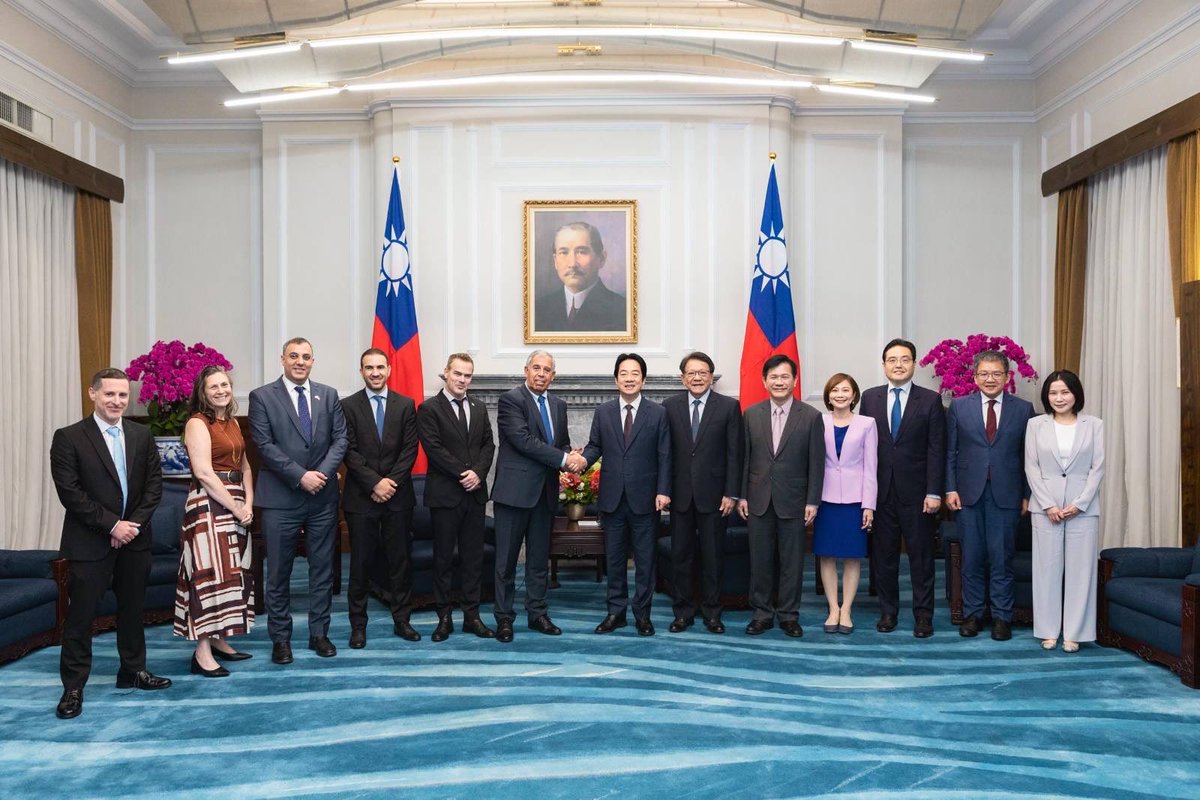
Delighted to meet the @KnessetENG delegation led by former Speaker @MKMickeyLevy & @BToporovsky and discuss #Taiwan-#Israel cooperation in AI, societal resilience & more. Grateful for the Knesset’s support as we work to advance industrial development & deepen our partnership.
THE ARCHITECTURE OF NO DEAL
The foreign ministers meet. The readouts say "progress." The markets shrug. Then nothing happens. Again.
The US-Iran negotiation cycle has become predictable enough to name: announce, rally, deny, reverse. We documented the diplomatic failure. This is about the structural one — why even when both sides know a deal would make them better off, the deal doesn't happen.
The answer: the deal isn't blocked by diplomacy. It's blocked by constituencies.
On the Iranian side, the 450kg of enriched uranium at 60% purity is the IRGC's political anchor. It's not becoming a bomb — crossing 90% adds marginal strategic value but triggers a certainty of strike. At its current level, the stockpile is the sweet spot: threatening enough to matter, ambiguous enough to deny. The civilians would love to trade it for sanctions relief. But that's a wealth transfer from the guys with guns to the guys with spreadsheets. The IRGC says no. The cycle resets.
On the American side, Trump's political identity is lashed to pro-Israel donors through a family channel: Jared Kushner calls Netanyahu "Uncle Bibi." Any deal leaving even 1kg of uranium in Iranian hands is, from that perspective, betrayal. The demand isn't 450kg. It's zero. The IRGC knows this — which is why they won't bother offering to give it up.
Meanwhile, the blockade is the negotiation. Iran's shore-based drones can shut Hormuz in six hours. The US naval armada costs billions per month and takes weeks to mobilize. Iran proposed phased de-escalation. Trump said no — once carriers redeploy, re-mobilization takes a month. The window closes. The strait stays closed. The leverage stays intact.
Russia profits too. The Hormuz closure pushed oil to $95+. Putin's fiscal gap closed. The flexibility on Ukraine evaporated. The US-Iran standoff and the Russia-Ukraine war aren't separate stories — they're the same story: American coercive credibility eroding in two theaters simultaneously.
And while the Middle East and Europe burn, China's export machine runs at full tilt. The US is pinned in two theaters. China is pinned in none. The "Indo-Pacific" strategy is now a collection of PowerPoint slides the Navy doesn't have ships to execute.
The "twists and turns" aren't setbacks or breakthroughs. They're choreography. The deal isn't being blocked. It's being managed — kept alive enough to extract leverage from, never close enough to threaten anyone's political capital.
The 450kg stays. The strait stays closed. The diplomats keep meeting.
And the architecture holds.
🇮🇷🇺🇲 "Either the Iranians sincerely reach an agreement, or we will resume military operations. If necessary, we will use all our modern weapons." – says Donald Trump.
Video is made Grok AI
Read this Axios piece carefully. Then read it again. Because what it describes is not a policy decision. It is a decision-making system that has lost the ability to make decisions.
Trump was presented with a plan to send naval vessels through the Strait of Hormuz by force. CENTCOM Commander Adm. Cooper drew it up: sail through, take out any Iranian missiles or fast boats that respond, resume full-scale war if Iran escalates to Gulf states. Clean logic. Defined escalation ladder. The kind of plan a military produces when it still believes it can execute.
Trump said no. Not because the plan was reckless. Because the plan was honest — and honesty is the one thing this system can no longer afford.
(《The 14-Day Clock》)
— — —
Instead, we got "Project Freedom." Not an escort. Not a convoy. An "advisory" operation where Navy ships will be "in the vicinity" — which is military language for "close enough to watch, too far to help." The Axios source close to the president explains the logic: the "humanitarian" framing means "if the Iranians do something, they will be the bad guys and we will have the legitimacy to act."
Translation: the operation is not designed to open the Strait. It is designed to produce a pretext.
This is not strategy. This is a patience game played by an administration that cannot decide whether it wants a deal or a war, and has structured its military posture so that the decision gets made for them — by whatever Iran does next.
(《The Art of the Deal That Isn't》)
— — —
The piece reveals something else that should disturb anyone paying attention to the structural math. CENTCOM is deploying guided-missile destroyers, drones, over 100 aircraft, and 15,000 troops for an "advisory" mission. That is not an advisory footprint. That is a war footing dressed in humanitarian drag.
We wrote about this in The 14-Day Clock: the pattern since February has been consistent — every pause in hostilities coincides with a reinforcement window. The 14-day ceasefire wasn't diplomacy; it was a calendar. The "infinite ceasefire" in late April wasn't peace; it was a blockade by other means. Now "Project Freedom" isn't freedom of navigation; it's a tripwire with 15,000 troops behind it.
The decision architecture hasn't changed. It just keeps generating escalatory postures with deniable labels.
(《Summer of Disconnect》)
— — —
And then there is the diplomacy track — the one that is supposed to make all of this unnecessary. Kushner and Witkoff are "still exchanging drafts" with Araghchi. The senior official's description is accidentally revealing: "They're carrying messages by hand to caves or wherever he or whoever is hiding."
Two things are happening in that sentence. First, the U.S. does not know where Iran's supreme leader is, or even whether the same person is making decisions. That is not a minor intelligence gap. That is the absence of a counterpart. You cannot negotiate a deal with a system whose command structure you cannot locate.
Second, the communication channel — hand-carried messages through intermediaries to unknown locations — is not a negotiation. It is a message-in-a-bottle. The negotiation gap we described in The Art of the Deal That Isn't has not closed. It has widened. In April, the gap was 270 billion versus 26 billion. Now the gap includes the question of who, exactly, is on the other end.
This is the structural problem that "Project Freedom" cannot solve, because it was never designed to. The operation addresses the symptom — stranded ships — while the disease — an unresolved war with no viable off-ramp — continues to metastasize.
(《The Art of the Deal That Isn't》)
— — —
Iran's position, stated by parliament security chair Ebrahim Azizi, is equally clarifying: any American interference in the Strait's "new maritime regime" is a violation of the ceasefire. The phrase "new maritime regime" is doing important work. Iran is not describing a temporary disruption. Iran is describing a new normal — a world in which the Strait of Hormuz operates under Iranian coordination, not American guarantee.
And the world is watching which regime actually moves ships. If Iran's coordination works and America's "in the vicinity" posture does not, the lesson writes itself. The post-WWII order in the Gulf was never a treaty. It was a capability. When the capability becomes "nearby" instead of "present," the order becomes an announcement.
We wrote about this death spiral: once the hegemon cannot physically back its guarantee, the guarantee becomes a liability. Everyone starts pricing the probability that the next announcement will also come with a footnote. The Axios piece is that footnote.
(《Lose the Strait, Lose the Empire》)
— — —
The bottom line from the senior official is as honest as Washington gets: "It's either we're looking at the real contours of an achievable deal soon, or he's going to bomb the hell out of them."
This is presented as a binary. It isn't. There is a third option — the one we are currently living inside — where there is no deal and no war, just a perpetual stalemate that grinds down the empire's credibility one "advisory operation" at a time, while the other side builds facts on the water.
Every sea power that lost a strait thought it was managing a stalemate right up until it wasn't. Carthage managed a stalemate. Venice managed a stalemate. The Dutch managed a stalemate. The stalemate is the late stage, not the middle.
The Strait doesn't care about the label. It cares about who can move ships through it. Right now, that is not the United States. And "Project Freedom" does not change that calculation. It just announces it.
(《Lose the Strait, Lose the Empire》)
— — —
One more thing. The Ford is in Croatia. The Eisenhower caught fire at the pier. The Bush is still transiting. The Navy that is supposed to be "in the vicinity" of the world's most important chokepoint is currently short one carrier — the most advanced one it ever built — because of a laundry room fire that burned for 26 hours.
You cannot separate the strategic indecision from the material decay. They are the same phenomenon. An empire that cannot maintain its ships cannot maintain its commitments. An empire that cannot maintain its commitments produces operations that are "in the vicinity" rather than "on station." The gap between the announcement and the capability is not a messaging problem. It is an arithmetic problem.
(《Fire on the Empire》)
— — —
Let's name what just happened.
Act I: The announcement. "We're escorting ships." The empire's word, historically, was a force-carrying instrument. When the U.S. said "we guarantee navigation," the world priced that into the cost of oil. That was the deal.
Act II: The clarification. American officials tell Axios: no, not escorting. Just… nearby. Indirectly. The empire's word now comes with a footnote that says "not literally."
Act III: The other side calls it. Iran says no. And the silence from Washington is the loudest part.
Three acts. Forty-eight hours. The balance sheet updates itself.
(《Fire on the Empire》)
— — —
There is a concept we've written about before: the empire doesn't fall in a day. It falls in moments like this — when the gap between what is announced and what is delivered becomes visible to everyone, including the people who are supposed to be impressed by it.
The Strait of Hormuz handles ~20% of global oil consumption. If the U.S. cannot guarantee passage, the global energy market reprices the risk. Not because of what Iran does. Because of what the U.S. no longer can.
This is the death spiral we outlined in Lose the Strait, Lose the Empire: once the hegemon cannot physically back its guarantee, the guarantee becomes a liability on the balance sheet. Everyone starts pricing the probability that the next announcement will also come with a footnote.
(《Rome Didn't Fall in a Day》)
— — —
And here is the part that should worry people in D.C. more than the headlines: Iran didn't need to fire a shot to call this bluff.
Think about that. A regional power — one the U.S. has been escalating against for months — simply said "no," and the operation's definition changed from "escort" to "somewhere nearby."
This is what strategic overreach looks like when it shows up in real time. The empire is still making the announcements. It just can't deliver the substance. So it rewrites the substance after the announcement.
The maintenance window never came for the ships. Now the credibility window is closing for the words.
(《The Mamluk Playbook: Stabilization Interventions Create More Instability》)
— — —
The most honest sentence in the entire episode is the Axios clarification: "The operation does not involve escorting with military ships."
That sentence is doing more work than an entire carrier battle group. It's translating imperial rhetoric into imperial capacity, in real time, on the record.
A $13.3 billion carrier that can't keep a laundry room fire under control for 26 hours is not projecting power. It's managing decline.
An escort operation that doesn't involve escorts is not a strategy. It's a press release.
The balance sheet doesn't care about the press release.
(《Fire on the Empire》)
— — —
What happens next?
Commercial ships will try to leave the Strait. Iran will coordinate — because they said they will. The U.S. will be "somewhere nearby" — because they said they will.
And the world will watch which coordination actually gets ships through.
If Iran's coordination works and the "nearby" U.S. ships don't intervene, the lesson is absorbed globally: the post-WWII security guarantee in the Gulf is now bilateral between Iran and the shipping companies, not a U.S.-backed regime.
That is not a theory. That is next week.
(《Lose the Strait, Lose the Empire》)
— — —
We wrote this months ago: the empire is not ending with a bang. It's ending with clarifications.
Trump announces. Officials clarify. Iran says no. The empire is silent.
The Strait doesn't need a war to change hands. It just needs everyone to see that the announcement and the capacity are no longer the same thing.
They saw it this weekend.
(《Rome Didn't Fall in a Day》)
"Project Freedom." Trump announces a U.S.-led escort operation for commercial ships through the Strait of Hormuz. CENTCOM confirms. CNN and Politico amplify it.
Then Axios drops the fine print: no American military ships will actually escort anyone. U.S. ships will be "somewhere nearby," providing "indirect support."
Then Iran's General Staff says: no American military ship crosses the Strait. Period. And Washington doesn't argue.
This isn't a policy. It's a three-act play about what the empire can no longer do.
My previous article:《Lose the Strait, Lose the Empire》 provides a complete analysis
🇺🇲🇮🇷 Despite the fact that last night, Trump announced the start of a safe escort operation for commercial ships in the Strait of Hormuz, which was later confirmed by the US Central Command, American officials told Axios this morning that the operation does not involve escorting with military ships. American ships will be somewhere nearby and will provide indirect support to ships exiting the strait.
At the same time, the General Staff of the Iranian Armed Forces states that no American military ship will be allowed to cross the Strait of Hormuz, Iran will not grant permission for this, and commercial ships will only be able to leave the strait in coordination with Iran.